Art in The Burg: “Picasso: A Life in Print” at Susquehanna Art Museum

Summer steams ahead.

One month into the season and July is almost over. The bulls have run in Pamplona and the Bastille has been stormed…and this past Friday night, 3rd in the Burg took place. Hope you were there. After all, Picasso is in town.

There is plenty of great art in the world. Major cities that house grand museums vie for blockbuster exhibitions all the time. So, not only is it noteworthy but truly impressive when a museum in a city the size of Harrisburg shows an A-list artist—and has an entire summer for the public to view it.

“Picasso: A Life in Print” (45 years of collecting from the John Szoke Gallery) runs through Sept. 22 at the Susquehanna Art Museum.

There is a bit of kismet as to how it came to be.

The John Szoke Gallery in New York City has made its reputation since 1974 as being a collector/purveyor of works on paper featuring prominent artists like Pablo Picasso and Edvard Munch. The SAM director of exhibitions, Lauren Nye, happened to return materials to the gallery on an unrelated matter when she struck up a conversation with the gallery owner. When Nye inquired about featuring Picasso prints at SAM, her request was met by his emphatic response that the only museum/gallery in Pennsylvania that could show the exhibit would be that of his “artistic adviser,” Alice Anne Schwab, executive director of SAM. And that is the genesis of the exhibit coming to Harrisburg.

In a time when the world shrinks more by the day, it is refreshing to learn that personal ties trump technology.

Ross Tyger, SAM’s special events manager, was the gatekeeper on Friday night, greeting us in the grand lobby. Moments later, Schwab graciously gave her time to share the wonderful backstory to the exhibit. Pianist Ralph Diekemper accompanied the exhibit in the upstairs, main gallery, adding to its dazzling brilliance.

This exhibit eschews excess by focusing on a specific portfolio of Picasso prints. With no formal training in the medium, Picasso became proficient in printmaking through years of practice and perseverance. While working in only black and white through etchings and drawings, he later incorporated color and expanded to lithography, using his paintings to reach a greater audience. His thirst for knowledge placed him at the press learning from master printmakers, Eugene Delatre and Louis Fort.

Highlights in the collection of etchings and drypoints, all vital works indeed, feature 15 from “Suite des Saltimbanques,” which capture a certain earthiness put forth by the young Picasso, who was 24 at the time. He depicted the group of friends that he knew as circus performers for this study. Understated in a spare yet true to Picasso style, the etchings are remarkable for their realism. They capture a certain freedom of spirit in spite of the subject’s poverty.

The other two groupings are from “Suite Vollard,” which encapsulates 100 prints commissioned by renowned art dealer, Ambroise Vollard. These represent Picasso’s first major venture in printmaking. The “Caisse a’ Remards” prints demonstrate Picasso pushing at the parameters of art and exploding them as he saw fit, creating his own personal vision. Picasso produced more than 2,000 prints in his lifetime, and this capsule collection centers on his initial pursuit of printmaking, revealing an artist finding his calling and embracing art for the entire span of his life.

Creativity lies at the very heart of genius. Genius is a label attributed to many but deserved by few. Pablo Picasso qualifies as an artist of true genius who created his own sphere of influence across many art forms.

The artist said it best.

“I am always doing that which I cannot do, in order that I may learn how to do it,” he said.

Picasso today is as legendary for his ever-changing mistresses, muses and marriages as being the father of modern art. In helping to advance cubism, Picasso changed the canvas of art forever. Drawing from real-life relationships, both collegial and romantic, he made the most of all human involvement, seizing the essence of others, pouring them onto his palette, mixing personality with potency in producing a provenance precisely his own.

Picasso revolutionized art, and the way the world views it, thinks about it and appreciates it. His fundamental understanding of art provides a universal commentary in that, “The purpose of art is washing the dust of daily life off our souls.” So, take a moment and escape from the summer heat for a cool dip into the pool of “Picasso: A Life in Print” before it evaporates right before your eyes.

“Picasso: A Life in Print” runs through Sept. 22 at the Susquehanna Art Museum, 1401 N. 3rd St., Harrisburg. Visit https://www.susquehannaartmuseum.org/.
Continue Reading

The Week that Was: News and features around Harrisburg

Dueling designs for N. 2nd Street

The news week around Harrisburg began slowly but then picked up steam as the city unveiled its redesigns for N. 2nd Street. Take a few minutes to catch up on news you may have missed this past week.

2-Way 2nd Street got closer to reality this week as the city unveiled its final two designs for the project. We published a summary of the designs, covered the public meeting then wrapped up our coverage with a blog post.

Capital Region Water will hold three community meetings to present information and get feedback on its proposed stormwater fee. Click here to find out where they’ll be.

Jambo Fashion is a new African-style boutique in downtown Harrisburg. Read how the owners made it to Harrisburg and why they decided to open up their store.

Market Square Concerts features several can’t-miss performances this month, which is just a taste of what’s to come for the 2019-20 season. Click here for the details.

Methodist churches in the Harrisburg area have hit the market in bulk, with six currently for sale. According to the realtor, interest in the buildings has been strong.

Salvation Army Harrisburg took up residence last week in the Strawberry Square atrium, as it accepted donations for its “Christmas in July” fill-a-backpack initiative. Find out how you can help.

Sara Bozich has dozens of fun things to do this weekend, both inside and out. Beat the heat with music, festivals, art and more.

Susquehanna Art Museum will host a screening of “Las Madres de Berks,” a documentary about four women detained at the Berks County Residential Center. Click here for details of the Sunday screening.

Urban Churn received some high-profile visitors this week, as the governor and lieutenant governor stopped in for a cone and to promote the state’s ice cream trail. Click here for the details.

Valley Youth House in Harrisburg is dedicated to helping children in foster care. Check out our feature from this month’s magazine.

Do you receive TheBurg Daily, our daily digest of news and events? If not, subscribe here!

Continue Reading

Burg Blog: Street Wise

Residents crowded around tables to write down comments and offer suggestions on large maps of 2nd Street during last night’s meeting.

“This is democracy.”

And then, with a big smile on his face, he repeated, “This is democracy.”

Such was the response of one long-time Harrisburg resident last night to my casual question: “So, what do you think?”

In the question, I was actually referring to what the meeting was about—the two competing designs for converting much of N. 2nd Street to two-way traffic. I wanted to know what he thought of the proposals. However, this Uptown resident, with a sweep of his hand, meant something else.

He was amazed at the size of the crowd—and he was beaming.

I estimated that 200 people packed into the former library on the second floor of HACC Midtown 2, but I heard others guessing anywhere from 150 to 300. In any case, it was a substantial showing, the largest gathering that I can recall for any city meeting—and people remarked on it repeatedly throughout the evening.

Over the past decade, Harrisburg has been through a lot, arguably more than most cities, yet this is what brought out the masses—a street redesign. Since last night, I’ve wondered why.

There are multiple reasons, I’m sure.

You could say that this is a big change that affects a lot of people—and you’d be right. And you could say it’s controversial, and the loud, mid-presentation interruption by one resident angry over the expected loss of a few dozen parking spaces emphasized that point.

However, in the end, the far majority of attendees seemed not only supportive of the change but profoundly so. As I interviewed residents, numerous people said something to the effect of, “I prefer this design, but really I’m happy with either one.”

They attended the meeting because, yes, they wanted information, and they wanted to share comments and offer suggestions. But they also wanted to engage as a community as this transformation takes place.

People lingered well after the presentation, digesting the maps, pointing out their houses, discussing what it will mean to have a neighborhood street, not an asphalt wasteland/raceway outside their front doors. In this way, the evening served as a civic engagement opportunity, and the project, many people hoped, would make their city more livable, more attractive and more whole, restoring Harrisburg as place to be, not just to speed through.

Sure, this may have been a self-selecting group, but it was a large self-selecting group, made up of people invested in their city and who wanted to share their feelings, their hopes and even their excitement with their neighbors.

After the meeting, Mayor Eric Papenfuse said to me, “You had a lot of positive energy in that room.”

Harrisburg, as I’ve written often before, can be a divisive place, often unnecessarily so, in my opinion. But, on this night, the mayor had it right.

Continue Reading

Hundreds pack Harrisburg meeting to discuss, debate 2-way 2nd Street

Attendees look over street plans during the meeting on Thursday night.

Some 200 people packed into a room in Midtown Harrisburg on Thursday night to hear the city present two designs for converting much of N. 2nd Street to two-way traffic.

Mayor Eric Papenfuse led off the discussion at HACC Midtown 2, explaining to attendees that the two concepts were similar with one fundamental difference.

Each design has one lane northbound and one lane southbound along the two-mile stretch of N. 2nd from Forster to Division streets. However, one has a protected bike lane, while the other has left-turn lanes with medians to assist pedestrian crossings.

“We hope to emerge from this meeting with a consensus,” he said. “I don’t know if there will or won’t be.”

Much of 2nd Street became a three-lane, mini-highway in the 1950s to accommodate commuter traffic. With the two-way redesign, the city hopes to slow traffic, improve safety and return the road back to neighborhood use.

This was the second public meeting for the project, attracting about double the attendance from the first one last year. This was the final meeting before the city decides on a design. The $5.7 million project is expected to begin next year and be completed in 2021.

Andy Hughes was one 2nd Street resident who said that he preferred the concept that included the left-turn lanes with the medians, but added that he regarded “both concepts as a positive step.”

Dick Norford, a founding member of Bike Harrisburg, advocated for the second option, which includes a bike lane sheltered from the parking area. He said that a bike lane going northbound on 2nd Street would complement the southbound bike lane on neighboring Front Street.

“It makes sense if we have a lane going inbound and one going outbound,” he said.

Besides debate over the two competing concepts, residents had much to say about two other issues: a loss of street parking and the inclusion of roundabouts.

In his presentation, city Engineer Wayne Martin explained that the city would lose several dozen parking spaces because of the project. Those losses, though, mostly are not attributable to the designs but because the city needs to rebuild intersections to be compliant with the federal Americans with Disabilities Act.

In all, the project will result in a loss of 11 to 13 percent of spaces along the street.

Following the presentation, attendees examined large-scale renderings of the street and left numerous comments—some that complained about the loss of parking spots but many more  that supported the plan.

“I don’t know if the arguments about losing parking are legitimate,” said Midtown resident Steve Cline. “You’re losing about one spot per block. It’s nothing.”

The city is also proposing replacing traffic lights with roundabouts at several intersections, including at Verbeke and Reily streets.

Comments seemed mixed on the roundabouts, with competing comments both for and against the traffic circles. Papenfuse added that the city had not yet made a decision on how many will be built to replace traffic lights.

All in all, the crowd seemed to strongly favor the changeover.

“I’m for anything that will slow down the traffic and create a more walkable city,” said Green Street resident Tom Robel.

Ross Willard, founder of Recycle Bicycle, concurred.

“I like both concepts,” he said. “I originally wanted a two-way bike lane, but it’s all good.”

Following the meeting, Papenfuse said that he was “impressed” by the turnout, saying the event had the largest attendance of any city meeting in memory.

“From a public meeting standpoint, I think it was successful and that the community really came together,” he said. “You had lots of positive energy.”

For more information about the project, visit the city’s Vision Zero website.

Continue Reading

Sweet Dreams: Wolf, Fetterman drop in for a scoop, promote ice cream trail

Urban Churn owner Adam Brackbill (center) shares a word and a scoop of his craft ice cream with PA Lt. Gov. John Fetterman and Gov. Tom Wolf.

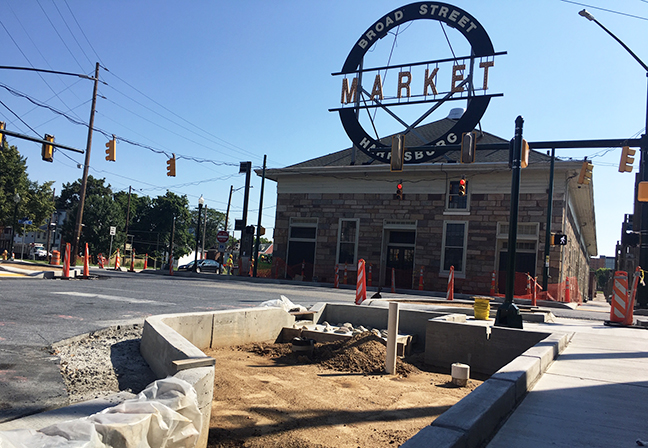
There are certain things you expect to see on a Thursday afternoon in Midtown Harrisburg: customers at Midtown Scholar, state workers eating lunch at the Broad Street Market.

Our state’s two top elected officials chomping down on ice cream cones might not be one of them. Yet that’s exactly what surprised customers saw today at Urban Churn’s new ice cream shop on N. 3rd Street.

Gov. Tom Wolf and Lt. Gov. John Fetterman joined Urban Churn owner Adam Brackbill in grabbing some cones to help bring awareness to Pennsylvania’s “Pursue Your Scoops” ice cream trail. Sponsored by the PA departments of Agriculture and Community and Economic Development, the trail offers participants prizes for visiting select creameries.

“[The trail] has brought in a lot of folks from out of town. We have people from Reading, from Lancaster, people who otherwise wouldn’t have heard about us,” Brackbill said. “Especially since we’re new, it’s helped our new retail shop to grow because of it.”

From now until Sept. 2, if you visit five creameries on any of the three trails, you’ll win a “Pursue Your Scoops” T-shirt. If you visit all of the shops on the list, you’ll receive a T-shirt and a “Pursue Your Scoops” ice cream bowl.

This is the second year that the departments are hosting the trail. According to VisitPA, the trail offers a variety of ice cream experiences, from “an urban to true cow-to-cone farm experience.” The trail is broken down into three regions: western, eastern and south central. This is the first year the trail will include creameries located off of a farm.

“We found that the way to impact our farmers isn’t just having someone visit the farm,” said Ashlee Dugan, coordinator of PA Preferred. “It’s also through companies like Urban Churn and Betsy’s Ice Cream in Pittsburgh that are still working really closely with farmers.”

Not only does the trail bring people a fun treat, but it helps promote small businesses in Pennsylvania and economic growth in those areas.

“Urban Churn buys locally so that helps create a demand for the dairy products,” Wolf said. “It’s just one small part of what the commonwealth is trying to do to really support, by some accounts, our biggest industry in Pennsylvania. Part of this is really serious [as far as] strong economic implications. Part of it is that it’s really fun to just eat good ice cream.”

For more information on the Pursue Your Scoops ice cream trail, visit visitpa.com/scoops.

Continue Reading

Bike lane or median? Harrisburg seeks input on 2-way 2nd Street concepts.

Harrisburg Mayor Eric Papenfuse looks over a rendering of a proposed roundabout at 2nd and Verbeke streets under a plan to convert much of N. 2nd Street to two-way traffic.

Do you prefer a bike lane or a center lane?

That will be the big decision tonight for Harrisburg residents attending the final community meeting for the planned conversion of N. 2nd Street to two-way traffic.

The city will unveil its two final design concepts at the meeting at HACC Midtown 2, which starts at 6 p.m.

The first design features a left-hand-turn lane, along with partial median strips, along the two-mile stretch of N. 2nd from Forster to Division streets. The second includes a dedicated, “parking protected” bike lane, meaning it would be protected from the parked cars.

“That’s the main difference,” said Mayor Eric Papenfuse this morning. “Do you want a center lane with medians, or do you want a bike lane? We can’t accommodate both.”

A 40-minute presentation will kick off tonight’s meeting, Papenfuse said. Afterwards, attendees will be able to break off into groups to study the concepts in detail, block by block, and offer input.

The two concepts are not mutually exclusive, Papenfuse said. Some features are interchangeable between the two designs.

Both designs include roundabouts at certain busy intersections, such as at N. 2nd and Verbeke streets and N. 2nd and Reily streets.

Notably, most traffic signals would be removed under both concepts and, like with the current construction along the 3rd Street corridor, intersections would be improved to make them compliant with the Americans with Disabilities Act (ADA) requirements. Signals would remain at the busy intersections at Forster, Maclay and Division streets.

“We are genuinely interested in feedback as to what the public thinks about each option,” Papenfuse said. “If there is an overwhelming consensus for one of the two options, we’re going to go with that. If it’s divided, then we’re going to choose.”

Papenfuse expects construction to begin next year, wrapping up at the end of 2021. The cost of the $6 million project is being split between the city, the state Department of Transportation and Impact Harrisburg, a nonprofit set up in the wake of the city’s financial crisis.

Residents will evaluate these two design concepts tonight. The left concept shows the turning lane/median and the right concept shows the protected bike lane.

The city converted 2nd Street from a neighborhood street to a three-lane, mini-highway in the 1950s to accommodate commuter traffic. Proposals to return the road to two-way traffic have been floated for decades, but gained steam a few years ago as the city made it a priority and pressed the issue with PennDOT.

Last year, the city held its initial community meeting on the project, which attracted more than 100 residents. That meeting gathered information on what residents, especially those who live on 2nd Street, would like to see, and some of that input has been incorporated into the final designs, Papenfuse said.

Neither design includes angled parking, which was discussed at length during the first public meeting. That concept took up too much road space, while adding no additional parking, said city Engineer Wayne Martin.

Both final concepts will reduce the total amount of parking along 2nd Street, mostly because of the ADA-mandated intersection improvements, Martin said.

Currently, there are 620 street parking spaces on N. 2nd from Forster to Division streets. Concept 1, which includes the turning lanes, would reduce parking to 550 spaces, while concept 2, which includes the bike lane, would reduce street parking to 537 spaces, Martin said.

“It is genuine to say that I see the benefits of both,” Papenfuse said. “We could go with either and be very pleased as a city. They’re both transformative and safer and better for the neighborhood.”

The two-way 2nd Street community meeting begins at 6 p.m. at HACC Midtown 2, 1500 N. 3rd St., Harrisburg.

Continue Reading

Weekend Roundup with Sara Bozich

Happy Weekend!

Please don’t mind this abbreviated WR, written from the beach.


What are you doing this weekend?

(more…)

Continue Reading

CRW plans meetings to offer information, answer questions about proposed stormwater fee

The new bumpouts along 3rd Street are designed to reduce stormwater runoff.

Capital Region Water will hold three community events to offer information on its proposed stormwater fee and to answer residents’ questions.

Last month, CRW unveiled a plan to impose a stormwater fee starting next year that would impact its Harrisburg customers.

Under the proposal, most residential customers would pay a new stormwater fee of $72 a year, or $6.15 a month. Commercial customers could potentially pay much more, depending upon the amount of impervious surface area on their properties.

CRW is under a “partial consent decree” with the federal Environmental Protection Agency to slash the amount of untreated pollutants flowing into the area’s streams and the Susquehanna River.

As a result, CRW expects to spend some $315 million over 20-plus years to come into compliance. Planned improvements include everything from facility and infrastructure upgrades to installing porous pavement and greening 177 additional acres of land.

CRW has said that residential customers’ wastewater fees would rise less slowly with the new stormwater fee, as the stormwater improvements have been accounted for as part of the wastewater portion of the monthly CRW bill.

“The meeting format allows residents to move through educational stations to learn more about the challenges of stormwater pollution, regulatory obligations, and solutions, including a new rate structure to fairly fund stormwater expenses,” according to a statement from CRW. “The final station will allow participants to comment on the proposal and plan.”

The meetings are:

  • Tuesday, July 30, 6 p.m. to 7:30 pm
    Lincoln Administration Building, 1601 State St.
  • Tuesday, Aug. 6, 5 p.m. to 9 p.m.
    National Night Out at Camp Curtin Academy, 2900 N. 6th St.
  • Thursday, Sept. 12, 6 p.m. to 7:30 p.m.
    Cloverly Heights Park, 18th and Pemberton streets

For more information about Capital Region Water, visit their website.

Continue Reading

SAM to screen, “Las Madres de Berks,” the story of 4 women held at Berks detention center

The Susquehanna Art Museum will host a screening of “Las Madres de Berks.”

It’s been less than a year since artist Michelle Angela Ortiz installed her compelling mural, featuring the eyes of four mothers detained in Berks County Residential Center, on the state Capitol steps and in Allison Hill.

Through her art, Ortiz brought attention to the stories of these mothers and their families who were held at the immigrant detention facility for almost two years. This Sunday, Harrisburg residents will get the chance to hear from the mothers themselves.

As part of her “Las Familias Separadas” public art project, Ortiz will present her 30-minute documentary “Las Madres de Berks.” The film, which translates to “The Mothers of Berks,” features interviews with four mothers speaking about their families and about being detained in Berks.

“It’s important to me, especially as an artist, to create a platform for these mothers to share their own experiences,” Ortiz said. “In most cases, families that are detained, they always have someone speaking on their behalf, whether it’s a lawyer or an organizer. I thought it was really important to hear their voices and to see them.”

The documentary is a product of 2½ years of work. Ortiz began interviewing the mothers five months before their release in August 2017. The film shares just some of the conditions they had to endure while at Berks. Many of the mothers were denied proper hygiene products, were told to wear “loose clothing” because of institutional rape, and earned less than $1 day, if they could work at all.

However, what hurt the mothers and Ortiz most was how the center affected their children. The ages of the kids held at Berks ranged from 16 years down to 2 weeks old. According to Ortiz, some children fell ill while living in the facility. When the mothers complained too much or did not abide by the staff’s rules, they were threatened with separation from their children.

“It’s as if they didn’t have kids,” one mother said in the “Las Madres de Berks” trailer. “As if we are nothing to them.”

Since being released, two of the mothers were sent to different cities in the United States, another was deported back to El Salvador, and another, unfortunately, died.

“We are still incarcerating children. We are incarcerating mothers and fathers with their children,” Ortiz said. “What does that mean when we live in a state that is incarcerating families and children and stripping them of their humanity?”

After the screening, Ortiz, along with Anna Drallios and Maria Hernandez of the Shut Down Berks Coalition, will conduct a talk back and share how members of the audience can help immigrant families and shut down Berks.

“We want people to feel for these mothers,” Ortiz said. “We want people to feel anger and all these emotions, but, most importantly, we want people to take action. So, now that we’re presenting this information, what can you do?”

See the screening of “Las Madres de Berks” this Sunday at 5:30 p.m. at the Susquehanna Art Museum, 1401 N. 3rd St., Harrisburg. For more information on Michelle Angela Ortiz and the Familias Separadas public art project, visit www.michelleangela.com. For more information on Shut Down Berks, visit www.facebook.com/ShutDownBerksCoalition.

Continue Reading

Methodist churches hit the market as congregations close, consolidate

The historic First United Methodist Church in Harrisburg

If you’ve ever been in the market for an old, stately church in the Harrisburg area, your time has arrived.

Recently, the Susquehanna United Methodist Conference listed six of its churches for sale, part of a plan to cut costs and consolidate congregations. The churches cover numerous neighborhoods around Harrisburg and range in price from $169,000 to $325,000.

“I’ve shown all of these churches a number of times already,” said realtor Bill Gladstone of the Bill Gladstone Group, part of Wormleysburg-based NAI CIR, which is listing the properties. “The demand for these churches has been very high.”

Late last year, the conference, facing dwindling membership in the immediate Harrisburg area, decided to dispose of 10 of its buildings, several dating back a century or more.

Since then, one of the churches, historic Grace United Methodist Church on State Street, voted to maintain its congregation, said Shawn Gilgore, the conference’s director of communications. Another church, Rockville UMC, has become affiliated with Linglestown UMC, with both buildings in use, he said.

Six of the remaining churches currently are for sale:

  • Camp Curtin Memorial Mitchell UMC, 2221 N. 6th St.: $195,000
  • First United Methodist, 269 Boas St.: $169,000
  • Riverside Methodist Church, 3200 N. 3rd St.: $325,000
  • St. Mark’s UMC, 3985 N. 2nd St (Susquehanna Township): $325,000
  • Trinity Penbrook Church, 5 N. 25th St.: $255,000
  • Grace Penbrook Church, 25 S. 28th St.: $265,000

Another church, Derry Street UMC on Allison Hill in Harrisburg, soon will be listed for sale, Gladstone said.

The final church in the group, Twenty Ninth Street UMC in Harrisburg, is the new home of The Journey Church, a combined congregation of Twenty Ninth Street UMC and the former Riverside Methodist Church.

Gladstone said that most potential buyers have been interested in continuing to use the buildings as churches. They often are leaders of emerging congregations that have been using temporary spaces for worship.

“Everybody wants one,” he said. “Even if they can’t afford it, they want one.”

Two of the churches date from the 19th century. First United was built in 1881 and Camp Curtin, which is on the U.S. National Register of Historic Places, was constructed in 1896.

These large, aging buildings, which feature stained glass and other impressive architectural details, are very costly to maintain. As a result, banks can be skittish about lending to aspiring churches without a very solid financial plan, Gladstone said.

“The last thing a bank wants to do is foreclose on a church,” he said.

Some of the properties lend themselves to non-church uses, but also may be constrained by parking and zoning issues. For example, First United in Midtown is located in a desirable area, but is tucked on a residential block with no off-street parking.

“It could have a residential use for apartments,” Gladstone said. “If you’re a smart developer, you can figure out how to do that.”

Continue Reading