Weekend Roundup with Sara Bozich

Happy Weekend!

I’m back! Come see us in SoMa tonight for our SoMa Block Party! FREE to attend; pay-as-you-go! Friday is chill but Saturday we’re working then have a sitter and are heading to Lancaster for a date afternoon/night. Sunday is the Serb Picnic at Jimi’s church, and Bo and I need our çevapes!

What are you doing this weekend?

(more…)
Continue Reading

Vegan meal, with a side of personal triumph, on the menu at Bethesda Mission

The serving line at Bethesda Mission during a vegan meal prepared by Animal Advocates of South Central PA last winter.

Seth Dellinger remembers the day he was dropped off at Bethesda Mission.

He was a recovering alcoholic, fresh out of rehab. He didn’t stay long, but his experience stayed with him. Now, he’s going back.

“Being able to go back there and help people in the same psychological place as me is important to me,” said Dellinger, director of community engagement at Animal Advocates of South Central PA.

Dellinger and a small group of five from Animal Advocates (pictured) will be serving a completely vegan meal to around 200 residents of the mission. It will include vegan chili, vegetables and other side dishes. They first served at Bethesda in January and decided to return on Aug. 10.

Animal Advocates is a York-based group with a mission to spread the practice of veganism in the area, Dellinger explained. They do this through outreach at fairs, vegan challenges, coaching and volunteer days at animal shelters and rescue missions.

Dellinger explained that one of the main criticisms vegans face is the allegation that they don’t care enough about people. The meal at Bethesda is one way to show that, while they do focus their attention on animals, they care a great deal about people, as well.

Bethesda Mission communications specialist Jessica Henry was grateful to hear the group was returning, especially during a time of year when volunteer participation can decrease.

“To have them in the summer when people aren’t necessarily thinking about shelters is really helpful,” she said. “We are happy to have them again.”

Although Animal Advocates is serving a vegan meal, the goal is not necessarily to persuade any Bethesda residents to become vegan, Dellinger said.

“It’s more about something we are able to do to help them that is in our own ethics,” he said. “No animals are being killed in that meal.”

He noted that, in January, almost all residents said that they enjoyed the meal.

Dellinger also pointed out that veganism doesn’t mean you have to purchase expensive specialty foods from vegan retailers–that it can be affordable.

“Rice is vegan, apples are vegan, you can eat healthy very inexpensively,” he said. “In a way, [the meal] is to demonstrate that vegan food is for everyone.”

Bethesda Mission is located at 611 Reily St., Harrisburg. For more information, visit https://www.animaladvocatesscpa.com/ or https://www.bethesdamission.org/.

Continue Reading

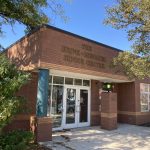
Harris Tower Museum is a tribute to local rail history — and to the men who helped preserve it.

John Smith and Dan Rapak stand in front of the large interlocking machine inside Harris Tower.

Rounding the corner onto Walnut Street in Harrisburg, I could see the Harris Tower out of the corner of my eye. It’s one of those places I’d seen before in passing and recognized, but never really gave a second glance.

The tour began as soon as I walked up to the building. John Smith welcomed me and assured me he had turned the AC on over the weekend so it would be cool enough on this day that was already pushing 90 degrees.

As Harrisburg Chapter president of the National Railway Historical Society (NRHS), Smith knows his stuff, and he wasted no time taking me inside to show off the 90-year-old building.

“Railroads built this country,” Smith said. “Towers like these at one time dotted the landscape.”

Harris Tower once functioned as a command center of sorts for railways in Harrisburg, controlling how track connections moved, allowing trains to pass through safely. During the height of rail travel, more than 120 trains passed through the Harrisburg station each day, Smith explained.

In 1991, the tower shut down, but, a few years later, the Harrisburg Chapter of the NRHS began restoration of the building, with hopes to showcase the heyday of Harris Tower circa the 1940s.

“There were literally foot-long strips of paint hanging from the ceiling when we started,” said Dan Rapak, a long-time member of the NRHS.

The exterior of Harris Tower in Harrisburg.

The main attraction at the small museum is a large interlocking machine, which takes up most of the upstairs space. Rapak was instrumental in getting the machine functioning again as it did years ago—this time as a simulation.

When Rapak and his buddy Jeff Vinton began work on the machine, they had no previous experience. Both were engineers working at a television station in New Jersey at the time, but never touched a piece of equipment like this. All they had was a love of trains and the determination to get the machine up and running.

Smith remembered seeing parts—panels and levers—lying all over the floor. “Guys from the chapter thought, ‘Do these guys know what they’re doing?’” he said.

The interlocking machine has come a long way from a mess of scattered parts on a grease-stained floor. Visitors to the museum can now interact with the machine by guiding simulated trains through a course on the same schedule they would’ve run in years past.

Now it was my turn. With more than 470 indicator lights on the board, Rapak graciously pointed out the ones I needed to pay attention to as I turned the levers, switching imaginary tracks and guiding my train on its way.

To get the Harris Tower back to a functioning state, where visitors could be part of the railway action, it’s taken Smith and Rapak thousands of hours. Not to mention all the time other volunteers have given.

“Anything you see in here that’s brass, I’ve polished it,” Smith said.

A quick scan of the room, and I could see that was no small feat as there were brass knobs, hinges and detail everywhere.

I wondered—why would these guys put in so many hours to this tiny brick building that was just a small part of railroad history? But then Rapak told me the story of Don Rittler, a former train director in Harris Tower who has since passed away.

He painted a picture of Rittler, who was 82 at the time and going in for a double-knee replacement in a couple of weeks. Rapak remembers him hobbling up the staircase to the upstairs room as he started up the interlocking machine. Rittler directed trains just as he had done during his years working at the tower.

“I remember he hung his head and said, ‘I keep looking back [out the window] for the trains,’” Rapak said. “If you can fool someone that’s worked there for 40 years, we’ve got it pretty spot on.”

Seeing visitors, young and old, interact with the tower is exactly why Smith and Rapak are so invested.

“It’s not only about preserving it, but experiencing it,” Rapak said.

The Harris Tower Railway Museum is located at 637 Walnut St., Harrisburg. It is open Saturdays, 9 a.m. to 4 p.m., through the end of October. Admission is free. For more information, see visit https://www.harristower.org/or https://www.harrisburgnrhs.org/.

Continue Reading

Music in the park, on the stage during two Harrisburg Opera performances

For a second year, the Harrisburg Opera Association will feature a free concert in Italian Lake Park.

When most people think of the opera, they probably picture elderly, wealthy folk in floor-length ball gowns and tuxedos, not picnickers lounging in Hawaiian-print shirts. The Harrisburg Opera Association is out to change that.

The Opera Association is returning for a second straight year of free opera in Italian Lake Park and its first full season after a 10-year hiatus. The association will put on two shows in August: “Opera in the Park” and its mainstage production, “An Artists’ Journey.”

“[These events] bring world-class music to Harrisburg,” said Tami Swartz, executive and artistic director of the association. “People who perform with us have major national and international careers.”

In early August, “Opera in the Park,” an educational show for all ages, will take audience members to exotic places, with opera pieces from around the world. Guests are encouraged to dress in Hawaiian-themed dress and bring picnic blankets and chairs for a casual night at Italian Lake, rain or shine.

Two weeks later, a mainstage production, “An Artists’ Journey,” depicts Swartz’s experiences of feeling different while growing up in Harrisburg as a mixed-race person. The 15-song piece, written by Swartz, actually boasts a variety of music ranging from rock to classical. Short acting vignettes supplement songs to move the piece forward.

“I said [to the cast], ‘I want you all to bring your own personal experiences into these songs because I think every single one of us in this cast has felt that we’re different,’” Swartz said. “Whether it’s cultural, racial, or sexual orientation, we all feel different. The composition is actually dedicated to everyone who is different.”

When casting her shows, Swartz tries to hire a diverse cast of local professional artists, hoping to distinguish herself from former artistic directors.

“We’re every color of the rainbow, and I’m hoping to make every production look like the cast of Hamilton,” Swartz said. “We want to share the love.”

Swartz, who works part time in New York City, said that, through opera, she wants to give back to the community that raised her.

“You get to the point where you’ve amassed all this knowledge that it’s time to apply it and give it back in a leadership position,” Swartz said. “You come back to your hometown and you give back what you’ve learned to enrich your home community.”

Opera in the Park is a free event held on Sunday, Aug. 11 at 4 p.m. at Italian Lake, Harrisburg. “An Artists’ Journey” is held on Aug. 24 at 7:30 p.m. in Messiah College’s Miller Theatre. Ticket are $25 for adults and can be purchased at www.messiah.edu/tickets. Visit the Harrisburg Opera Association’s website for more information: https://harrisburg-opera.org/season.html.

Continue Reading

VeggieFest returns to Strawberry Square, dishing up vegetarian, vegan cuisine

A tray of samples from last year’s VeggieFest.

Strawberry Square may be named after a fruit, but it surely won’t be left out at this year’s VeggieFest, which showcases plant-based cuisine.

For the third year in a row, event coordinator Sara Bozich, in conjunction with Strawberry Square, will welcome local vendors to downtown Harrisburg next month to share their take on vegetarian and vegan lifestyles and diets.

“It is intended to be a very inclusive event that is vegan- and vegetarian-friendly,” Bozich explained.

While not exclusively a vegan event, vendors will distinguish whether their products are vegetarian or vegan.

Vendors will include restaurants like Arooga’s Sports Bar & Grillhouse, giving a taste of its meatless menu, and Harvest Seasonal Grill & Wine Bar with its vegan menu options. There will also be plenty of beverages to sample from breweries such as Crook & Marker Spiked & Sparkling, HOLLA Spirits, Ploughman Cider and Tröegs Independent Brewing.

“We are really about showcasing the offerings our area has,” Bozich said.

Vendors will offer samples, and items will be available for purchase. Bozich pointed out that VeggieFest isn’t only for the herbivores, but those who are “veg curious” are welcome as well.

Plant-based skincare retailers and health practitioners will be in attendance along with treats from Cocoa Creek Chocolates, Boom! Crafted Pickles and Sarah’s Sweet & Savory Snacks, among others.

“A lot of times, people stay away from vegan or gluten-free products because they think the flavor experience won’t be the same, but it is,” said Diane Krulac, founder of Mechanicsburg-based Cocoa Creek Chocolates.

At this year’s VeggieFest, these chocolatiers will hand out samples from their all-natural “Luther’s Trek Bars.” The bars are made with vegan dark chocolate and sprinkled with various fruit and nut combinations.

They will also share products from their upcoming veggie collection, which is all plant-based and vegan. The dark chocolate truffles are made with cashew cream, oat milk or almond milk, and some include raspberry, beet, cinnamon or orange flavors.

“You don’t have to be vegan to want to eat them,” Krulac said. “Flavor won’t be compromised.”

The crowd from last year’s event.

A faux burger challenge, sponsored by the Hilton Harrisburg, will give attendees a chance for local grills to serve up their best meatless burger to a panel of judges, letting the audience have a bite, as well.

While perusing the vendors, attendees will hear from His and Hers Vinyl, a duo of DJs.

Tickets are required for VeggieFest and are $20 for an adult, $10 for an adult or minor not including alcohol, and free for children under 12.

Proceeds this year will benefit the Central Pennsylvania Food Bank. According to Bozich, the partnership is a perfect fit.

“Our event is about food, and clearly we want to help feed people in the area,” she said.

Harrisburg VeggieFest takes place on Saturday, Aug. 17, 1 to 4 p.m., at Strawberry Square in downtown Harrisburg. For more information, visit www.hbgveggiefest.com.

Continue Reading

Unitarian Church of Harrisburg finds new life, new purpose as Shalom House community center

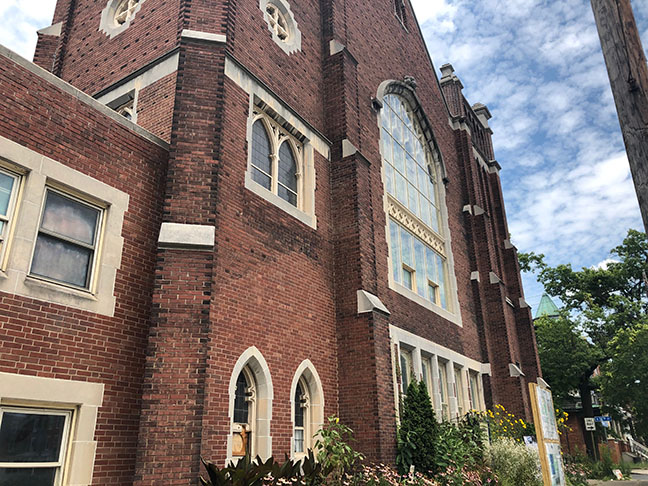
The former Unitarian Church of Harrisburg, which is being repurposed by Shalom House.

Recently, there’s been much discussion over what to do with the numerous Methodist churches that are for sale in the Harrisburg area.

Some say they should be used for their intended purpose—as churches. Others hope to repurpose the buildings for other uses. But what would that look like?

Shalom House in Allison Hill is currently embarking on a project to create a community center from the former Unitarian Church of Harrisburg on Market Street to further its goal of serving single women, mothers and their children.

The nonprofit currently provides a 21-bed emergency shelter, as well as programs to meet the needs of those who are “chronically homeless.” Now, the organization would like to expand its mission by tackling the root causes of homelessness.

“Instead of just trying to address homelessness, let’s try to create a healthy community as a whole,” said Denise Britton, executive director of Shalom House.

On May 1, Shalom House purchased the church, which is located just around the corner from its facility on S. 15th Street.

Capital Area Head Start (CAHS), part of Keystone Human Services, will serve as Shalom’s main partner through this process, bringing its experience with children and families in the Dauphin, Cumberland and Perry County area. The group signed a seven-year lease with Shalom, and construction began in early May.

“Now, being so close, Shalom can provide services to the adults—and we can provide educational programming to the children,” said Jo Pepper, consulting director for CAHS. “It’s a more efficient use of community resources.”

The new space also satisfies the need that CAHS was facing due to the loss of classroom space for more than 300 kids last year.

Construction workers stand in the former church sanctuary, which is being converted to community space.

The main issues Britton saw that needed to be addressed were the barriers that women with small children have to early childhood education, transportation and childcare.

The building will house both Shalom and CAHS offices and the programs they will work together to operate. In addition to the offices, the multi-phase project will include office space for mothers and single women in the community to use, as well as early learning classrooms for their children. While CAHS professionals meet the needs of the kids, mothers can receive workforce development training in various fields.

In addition, HACC will partner with Shalom to offer an onsite version of its job readiness curriculum. Other colleges and universities, such as Elizabethtown College, Misericordia University and Alvernia University, will bring in occupational therapy interns to provide mental health services.

Centurion Construction Group LLC is the general contractor for the project. First-floor offices and classrooms should be completed in September.

Britton explained that Shalom House currently serves more than 200 mothers and single women every year. With the new facility and partnership with CAHS, they expect to offer services to around 500 families yearly.

The total cost of the purchase and renovation of the building is around $2.2 million, and Britton said that they’re about halfway to meeting their fundraising goal.

But the project doesn’t stop at the building’s walls.

Shalom House has purchased four lots behind the church building for the construction of a playground for the CAHS children. They also would like to purchase more lots in the coming years to add transitional (six-month) living for women and children coming out of emergency shelters, as well as affordable apartments for those who need a permanent place to stay.

With the new housing facilities, Britton would like to cater to women coming out of prison who not only need housing, but support services.

“We know that, as folks are transitioning out of emergency housing, there’s not an appropriate amount of housing for them,” Britton explained.

According to Britton, the total for the entire project, including the community center, playground and housing, is projected at $5 million.

Along with the construction, Shalom is preparing its staff through team-building. The organization uses a mentorship model that provides one-on-one life coaching for those who are part of their program. Some of the rooms in the new building will be used for training these coaches.

“We weren’t interested in a big project that launches and then collapses from the inside,” said Chris Green, a life coach.

Elizabethtown College has been helping Shalom begin working as a social enterprise instead of a nonprofit. According to the College’s Social Enterprise Institute, this is “an organization that applies commercial strategies to maximize improvements in human and environmental well-being, rather than maximizing profits for external shareholders.”

A large-scale project with many different parts, Britton summed up the goal.

“We want people to be able to dream again.”

Shalom House is located at 9 S. 15th St., Harrisburg. For more information, visit https://shalomhouse.net/.


Continue Reading

Art in The Burg: “Picasso: A Life in Print” at Susquehanna Art Museum

Summer steams ahead.

One month into the season and July is almost over. The bulls have run in Pamplona and the Bastille has been stormed…and this past Friday night, 3rd in the Burg took place. Hope you were there. After all, Picasso is in town.

There is plenty of great art in the world. Major cities that house grand museums vie for blockbuster exhibitions all the time. So, not only is it noteworthy but truly impressive when a museum in a city the size of Harrisburg shows an A-list artist—and has an entire summer for the public to view it.

“Picasso: A Life in Print” (45 years of collecting from the John Szoke Gallery) runs through Sept. 22 at the Susquehanna Art Museum.

There is a bit of kismet as to how it came to be.

The John Szoke Gallery in New York City has made its reputation since 1974 as being a collector/purveyor of works on paper featuring prominent artists like Pablo Picasso and Edvard Munch. The SAM director of exhibitions, Lauren Nye, happened to return materials to the gallery on an unrelated matter when she struck up a conversation with the gallery owner. When Nye inquired about featuring Picasso prints at SAM, her request was met by his emphatic response that the only museum/gallery in Pennsylvania that could show the exhibit would be that of his “artistic adviser,” Alice Anne Schwab, executive director of SAM. And that is the genesis of the exhibit coming to Harrisburg.

In a time when the world shrinks more by the day, it is refreshing to learn that personal ties trump technology.

Ross Tyger, SAM’s special events manager, was the gatekeeper on Friday night, greeting us in the grand lobby. Moments later, Schwab graciously gave her time to share the wonderful backstory to the exhibit. Pianist Ralph Diekemper accompanied the exhibit in the upstairs, main gallery, adding to its dazzling brilliance.

This exhibit eschews excess by focusing on a specific portfolio of Picasso prints. With no formal training in the medium, Picasso became proficient in printmaking through years of practice and perseverance. While working in only black and white through etchings and drawings, he later incorporated color and expanded to lithography, using his paintings to reach a greater audience. His thirst for knowledge placed him at the press learning from master printmakers, Eugene Delatre and Louis Fort.

Highlights in the collection of etchings and drypoints, all vital works indeed, feature 15 from “Suite des Saltimbanques,” which capture a certain earthiness put forth by the young Picasso, who was 24 at the time. He depicted the group of friends that he knew as circus performers for this study. Understated in a spare yet true to Picasso style, the etchings are remarkable for their realism. They capture a certain freedom of spirit in spite of the subject’s poverty.

The other two groupings are from “Suite Vollard,” which encapsulates 100 prints commissioned by renowned art dealer, Ambroise Vollard. These represent Picasso’s first major venture in printmaking. The “Caisse a’ Remards” prints demonstrate Picasso pushing at the parameters of art and exploding them as he saw fit, creating his own personal vision. Picasso produced more than 2,000 prints in his lifetime, and this capsule collection centers on his initial pursuit of printmaking, revealing an artist finding his calling and embracing art for the entire span of his life.

Creativity lies at the very heart of genius. Genius is a label attributed to many but deserved by few. Pablo Picasso qualifies as an artist of true genius who created his own sphere of influence across many art forms.

The artist said it best.

“I am always doing that which I cannot do, in order that I may learn how to do it,” he said.

Picasso today is as legendary for his ever-changing mistresses, muses and marriages as being the father of modern art. In helping to advance cubism, Picasso changed the canvas of art forever. Drawing from real-life relationships, both collegial and romantic, he made the most of all human involvement, seizing the essence of others, pouring them onto his palette, mixing personality with potency in producing a provenance precisely his own.

Picasso revolutionized art, and the way the world views it, thinks about it and appreciates it. His fundamental understanding of art provides a universal commentary in that, “The purpose of art is washing the dust of daily life off our souls.” So, take a moment and escape from the summer heat for a cool dip into the pool of “Picasso: A Life in Print” before it evaporates right before your eyes.

“Picasso: A Life in Print” runs through Sept. 22 at the Susquehanna Art Museum, 1401 N. 3rd St., Harrisburg. Visit https://www.susquehannaartmuseum.org/.

Continue Reading

The Week that Was: News and features around Harrisburg

Dueling designs for N. 2nd Street

The news week around Harrisburg began slowly but then picked up steam as the city unveiled its redesigns for N. 2nd Street. Take a few minutes to catch up on news you may have missed this past week.

2-Way 2nd Street got closer to reality this week as the city unveiled its final two designs for the project. We published a summary of the designs, covered the public meeting then wrapped up our coverage with a blog post.

Capital Region Water will hold three community meetings to present information and get feedback on its proposed stormwater fee. Click here to find out where they’ll be.

Jambo Fashion is a new African-style boutique in downtown Harrisburg. Read how the owners made it to Harrisburg and why they decided to open up their store.

Market Square Concerts features several can’t-miss performances this month, which is just a taste of what’s to come for the 2019-20 season. Click here for the details.

Methodist churches in the Harrisburg area have hit the market in bulk, with six currently for sale. According to the realtor, interest in the buildings has been strong.

Salvation Army Harrisburg took up residence last week in the Strawberry Square atrium, as it accepted donations for its “Christmas in July” fill-a-backpack initiative. Find out how you can help.

Sara Bozich has dozens of fun things to do this weekend, both inside and out. Beat the heat with music, festivals, art and more.

Susquehanna Art Museum will host a screening of “Las Madres de Berks,” a documentary about four women detained at the Berks County Residential Center. Click here for details of the Sunday screening.

Urban Churn received some high-profile visitors this week, as the governor and lieutenant governor stopped in for a cone and to promote the state’s ice cream trail. Click here for the details.

Valley Youth House in Harrisburg is dedicated to helping children in foster care. Check out our feature from this month’s magazine.

Do you receive TheBurg Daily, our daily digest of news and events? If not, subscribe here!

Continue Reading

Burg Blog: Street Wise

Residents crowded around tables to write down comments and offer suggestions on large maps of 2nd Street during last night’s meeting.

“This is democracy.”

And then, with a big smile on his face, he repeated, “This is democracy.”

Such was the response of one long-time Harrisburg resident last night to my casual question: “So, what do you think?”

In the question, I was actually referring to what the meeting was about—the two competing designs for converting much of N. 2nd Street to two-way traffic. I wanted to know what he thought of the proposals. However, this Uptown resident, with a sweep of his hand, meant something else.

He was amazed at the size of the crowd—and he was beaming.

I estimated that 200 people packed into the former library on the second floor of HACC Midtown 2, but I heard others guessing anywhere from 150 to 300. In any case, it was a substantial showing, the largest gathering that I can recall for any city meeting—and people remarked on it repeatedly throughout the evening.

Over the past decade, Harrisburg has been through a lot, arguably more than most cities, yet this is what brought out the masses—a street redesign. Since last night, I’ve wondered why.

There are multiple reasons, I’m sure.

You could say that this is a big change that affects a lot of people—and you’d be right. And you could say it’s controversial, and the loud, mid-presentation interruption by one resident angry over the expected loss of a few dozen parking spaces emphasized that point.

However, in the end, the far majority of attendees seemed not only supportive of the change but profoundly so. As I interviewed residents, numerous people said something to the effect of, “I prefer this design, but really I’m happy with either one.”

They attended the meeting because, yes, they wanted information, and they wanted to share comments and offer suggestions. But they also wanted to engage as a community as this transformation takes place.

People lingered well after the presentation, digesting the maps, pointing out their houses, discussing what it will mean to have a neighborhood street, not an asphalt wasteland/raceway outside their front doors. In this way, the evening served as a civic engagement opportunity, and the project, many people hoped, would make their city more livable, more attractive and more whole, restoring Harrisburg as place to be, not just to speed through.

Sure, this may have been a self-selecting group, but it was a large self-selecting group, made up of people invested in their city and who wanted to share their feelings, their hopes and even their excitement with their neighbors.

After the meeting, Mayor Eric Papenfuse said to me, “You had a lot of positive energy in that room.”

Harrisburg, as I’ve written often before, can be a divisive place, often unnecessarily so, in my opinion. But, on this night, the mayor had it right.

Continue Reading

Hundreds pack Harrisburg meeting to discuss, debate 2-way 2nd Street

Attendees look over street plans during the meeting on Thursday night.

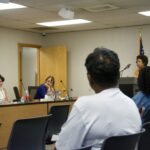
Some 200 people packed into a room in Midtown Harrisburg on Thursday night to hear the city present two designs for converting much of N. 2nd Street to two-way traffic.

Mayor Eric Papenfuse led off the discussion at HACC Midtown 2, explaining to attendees that the two concepts were similar with one fundamental difference.

Each design has one lane northbound and one lane southbound along the two-mile stretch of N. 2nd from Forster to Division streets. However, one has a protected bike lane, while the other has left-turn lanes with medians to assist pedestrian crossings.

“We hope to emerge from this meeting with a consensus,” he said. “I don’t know if there will or won’t be.”

Much of 2nd Street became a three-lane, mini-highway in the 1950s to accommodate commuter traffic. With the two-way redesign, the city hopes to slow traffic, improve safety and return the road back to neighborhood use.

This was the second public meeting for the project, attracting about double the attendance from the first one last year. This was the final meeting before the city decides on a design. The $5.7 million project is expected to begin next year and be completed in 2021.

Andy Hughes was one 2nd Street resident who said that he preferred the concept that included the left-turn lanes with the medians, but added that he regarded “both concepts as a positive step.”

Dick Norford, a founding member of Bike Harrisburg, advocated for the second option, which includes a bike lane sheltered from the parking area. He said that a bike lane going northbound on 2nd Street would complement the southbound bike lane on neighboring Front Street.

“It makes sense if we have a lane going inbound and one going outbound,” he said.

Besides debate over the two competing concepts, residents had much to say about two other issues: a loss of street parking and the inclusion of roundabouts.

In his presentation, city Engineer Wayne Martin explained that the city would lose several dozen parking spaces because of the project. Those losses, though, mostly are not attributable to the designs but because the city needs to rebuild intersections to be compliant with the federal Americans with Disabilities Act.

In all, the project will result in a loss of 11 to 13 percent of spaces along the street.

Following the presentation, attendees examined large-scale renderings of the street and left numerous comments—some that complained about the loss of parking spots but many more  that supported the plan.

“I don’t know if the arguments about losing parking are legitimate,” said Midtown resident Steve Cline. “You’re losing about one spot per block. It’s nothing.”

The city is also proposing replacing traffic lights with roundabouts at several intersections, including at Verbeke and Reily streets.

Comments seemed mixed on the roundabouts, with competing comments both for and against the traffic circles. Papenfuse added that the city had not yet made a decision on how many will be built to replace traffic lights.

All in all, the crowd seemed to strongly favor the changeover.

“I’m for anything that will slow down the traffic and create a more walkable city,” said Green Street resident Tom Robel.

Ross Willard, founder of Recycle Bicycle, concurred.

“I like both concepts,” he said. “I originally wanted a two-way bike lane, but it’s all good.”

Following the meeting, Papenfuse said that he was “impressed” by the turnout, saying the event had the largest attendance of any city meeting in memory.

“From a public meeting standpoint, I think it was successful and that the community really came together,” he said. “You had lots of positive energy.”

For more information about the project, visit the city’s Vision Zero website.

Continue Reading