Harrisburg’s state-appointed ICA down to four members, as chair submits resignation

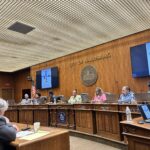
The Intergovernmental Cooperation Authority met on Wednesday. From left: Kathy Speaker MacNett, David Schankweiler, Ralph Vartan, Audry Carter and Jeffrey Stonehill (authority manager).

Harrisburg’s Intergovernmental Cooperation Authority is down to four voting members, as the chairman today announced his resignation from the state-appointed board.

At the end of the ICA’s monthly meeting, Chair David Schankweiler announced his departure, saying that another “opportunity,” which he declined to specify, prevented him from continuing to serve on the body.

“I need to, as of today, resign as an authority member,” he said. “I’m disappointed having to do this because I’ve enjoyed serving with the authority and for the city.”

Gov. Tom Wolf and state legislative leaders appointed the ICA’s five voting members. Schankweiler, the former publisher of the Central Penn Business Journal, was appointed in January by state Senate Pro Tempore Joe Scarnati, who presumably would have the authority to appoint a replacement.

The remaining board members then voted to appoint Audry Carter, the ICA’s vice chair, as the new chair. ICA member Ralph Vartan was appointed as the new vice chair.

“It will be an honor to try and follow in your footsteps,” Carter said, following her appointment. “You helped us get through that incredibly steep learning curve.”

In addition to Carter and Vartan, the board’s voting members are UPMC Pinnacle executive Tina Nixon and attorney Kathy Speaker MacNett.

The ICA and the city are in the midst of finalizing a five-year financial recovery plan for the city. Mayor Eric Papenfuse, who attended the ICA meeting, said that City Council will meet in executive session next week to review changes to the draft Intergovernmental Cooperation Agreement.

Once that agreement is finalized and approved, Harrisburg will have the ability to exit Act 47, the state’s program for financially distressed municipalities.

Otherwise, the board heard a presentation Wednesday on the city’s finances by Bruce Weber, Harrisburg’s budget and finance director.

Weber said that 2019 revenues are coming in as expected. Property tax receipts are about flat compared to last year, he said. However, both earned income tax and local services tax revenues are higher than anticipated, indicating a relatively strong city economy. Judging by these receipts, Weber estimated that the city created some 1,500 jobs through the second quarter.

“I think it’s important to note that, while we have some long-term fiscal challenges, I think we’re in a period of stability now, and that’s important to note, broadly speaking,” Weber said.

Continue Reading

Letter to the Editor: Environmental group responds to Capital Region Water letter

A sign along Harrisburg’s lower river walk warns of the combined sewer overflow.


A September 19, 2019, letter to the editor published in TheBurg by Charlotte Katzenmoyer, executive director of Capital Region Water (CRW), titled “Capital Region Water is Committed to Addressing Environmental Threats, Concerns,” makes two factually incorrect statements about an August 22 report by the Environmental Integrity Project, titled “Sewage Overflows in Pennsylvania’s Capital.”

The letter incorrectly asserts that our report claims that: “Capital Region Water has avoided paying penalties or fines for CSO or other violations.” In fact, we make it clear on page 8 of our report that Pennsylvania fined the water and sewer authority 29 times for sewage violations from 2015 through 2018. However, the state failed to fine the authority for an additional 102 self-reported sewage violations over this time period (out of a total of 131 violations), meaning that only 20 percent of the violations resulted in penalties.

The letter from Capital Region Water also wrongly claims that our report says: “Capital Region Water’s plan targets 60 percent capture.”  Our report does not say that. On pages 5, 9, 11, 14, and 21 our report states that the water authority’s proposal would allegedly “reduce” the current volume of sewage and stormwater flowing on an annual basis into the Susquehanna River, from an annual average of 800 million gallons to about 300 million gallons annually. That 60 percent estimate is correct, based on numbers in Capital Region Water’s written plan, “City Beautiful H20,” and CRW did not dispute those numbers we discussed the figures with CRW in a meeting at their offices on June 6 or in subsequent emails.

However, it should be noted that it is very different to say that the authority’s plan would “reduce” the volume of sewage and stormwater pouring into the river by approximately 60 percent (which is true, according to CRW’s figures), and to say that the plan would “capture” 60 percent of the total volume in the system (which would include both the liquid being piped to treatment at the wastewater treatment plant and the liquid being discharged to the river.)  Our report only focused on the percentage of reduction in pollution flowing directly into the river, which produces a different number than what CRW is highlighting (the percentage of capture.)  

We think it’s more important to focus on reducing the pollution into the river, which is why we chose the language we selected.  The figure and language that CRW is highlighting makes their plan appear to be more effective, so I understand why the authority would want that framework and emphasis.  But as a kayaker on the Susquehanna River, what I am more concerned about (and what I suspect many people are concerned about) is reducing the amount of raw human waste that we actually encounter in the river. Thank you for the opportunity to set the record straight on those factual issues.

Tom Pelton is the director of communications for the Environmental Integrity Project.

Continue Reading

Harrisburg council, administration spar over water system future, meetings

Harrisburg City Council chambers on Tuesday

Two branches of the Harrisburg city government sparred on Tuesday night over an administration plan to interview private companies that have expressed initial interest in taking over the city’s water/sewer system.

At a work session, several City Council members questioned a plan by Mayor Eric Papenfuse to interview four companies that responded to a “request for information” (RFI) issued two months ago by the city.

“You put the cart before the horse,” said council President Wanda Williams. “You should have had a public meeting to explain what you’re considering. In actuality, you’re continuing this process without informing the council.”

Earlier on Tuesday, Papenfuse issued a statement saying that six entities had responded to the city-issued RFI, and the administration determined that four of those companies were qualified and experienced enough to warrant an informational interview. Those companies are:

  • Bryn Mawr-based Aqua America
  • Hershey-based PA American Water
  • Paramus, N.J.-based Suez North America
  • Boston-based Veolia American Water

The first interview is slated to take place on Wednesday, with the last on Oct. 8.

As he has previously, Papenfuse stressed to council that the interviews are for informational purposes only–that there is no formal bidding or sales process underway.

“All we’re doing is gathering information,” he said. “We’re trying to gather information in a clear and transparent way. If we go down that path, we’ll need to have a greater conversation.”

Nonetheless, council members said that they felt left out of the process and said that the public felt the same way.

“I’m receiving five and six emails a day saying that you’re not being transparent about the process,” Williams said.

Papenfuse said that he felt it was necessary to perform this “due diligence” before potentially going through a more public bidding process.

He cited two principal reasons for taking this first step.

First of all, he said that he wants to better understand the city’s options in light of continuing negotiations with the state-appointed Intergovernmental Cooperation Authority over a five-year financial plan for the city. Secondly, he wants to explore options for sewer system improvements other than those undertaken by the city’s municipal utility authority, Capital Region Water (CRW), which plans to impose a user stormwater fee starting Jan. 1.

“We have a comment period closing tomorrow for CRW for a major rate increase that will impact our residents,” Papenfuse said. “Council has not had a hearing despite CRW’s request to do so, despite my request to do so.”

Williams said that council has been attempting to set up a public meeting with CRW to discuss the proposed stormwater fee. That meeting is now scheduled for Oct. 15.

Papenfuse added that he hopes for concrete options from companies that will lead to less pollution flowing into the Susquehanna River and, ultimately, the Chesapeake Bay, at a cost that city customers can afford to pay.

CRW plans to spend some $315 million over the next 20 years to stem the flow of wastewater into area waterways. But Papenfuse has criticized that plan as incomplete and said that it doesn’t have  final approval from the federal Environmental Protection Agency.

In the end, council members seemed resigned that the interviews with the private companies would proceed, with Papenfuse pledging greater council and public involvement if the administration decides to take a next step.

“If recommendations come from those meetings, I will share them with council, as well as the underlying reasoning behind them,” Papenfuse said.

This story has been updated to include information about the upcoming CRW meeting with City Council.

Continue Reading

Harrisburg to interview 4 companies as it ponders selling water/sewer system

Capital Region Water at work on Allison Hill in Harrisburg

Harrisburg has received six responses to a request for information as it considers privatizing its water/sewer system.

Of those six, the city administration plans to interview four respondents due to their “experience operating comparable systems,” according to a statement from the city administration. They are all significant municipal water system companies with existing operations in the commonwealth:

  • Bryn Mawr-based Aqua America
  • Hershey-based PA American Water
  • Paramus, N.J.-based Suez North America
  • Boston-based Veolia American Water

The city will interview representatives from these four companies starting tomorrow and concluding on Oct. 8, according to Mayor Eric Papenfuse’s office.

In July, the administration released a “request for information” to gauge preliminary interest from companies in acquiring the city’s water/sewer system, setting a response deadline of Sept. 16.

Papenfuse has repeatedly said that the request for information was just a first step and that no decision has been made on whether to pursue privatization.

“We’re just in the information-gathering, due diligence mode,” he told Harrisburg City Council last week.

Papenfuse has also pledged public meetings in case the city does decide to proceed with selling the system. Currently, municipal utility authority Capital Region Water serves 20,300 water customers and 17,000 wastewater connections.

During a council meeting in August, numerous city residents spoke out against privatizing the system, and the administration has also received pushback from city council members.

Continue Reading

Developer seeks zoning change before launching projects in Midtown Harrisburg neighborhood

These empty lots at N. 6th and Reily streets, part of the MarketPlace neighborhood, look out over the 1500 Condominiums (left), the new federal courthouse under construction (center) and Bethesda Mission (right).

A Harrisburg developer has ambitious plans to build out a centrally located Midtown neighborhood, but first is seeking a zoning change that would permit greater density and more building options.

Seven Bridges Development hopes to acquire numerous parcels from the Harrisburg Redevelopment Authority to construct a variety of residential and commercial buildings in the MarketPlace neighborhood, a large swath of land that includes about 15 city blocks just north of the Broad Street Market.

First, however, the company wants to change the zoning for the area as the current zoning code does not permit much of the anticipated construction.

“Single-family houses are all you can build there [currently],” said Ian Wewer, director of development and operations for Seven Bridges. “It’s evident that no one is interested in building in the area. If you change the zoning, you might be able to change the area.”

The outlined area would be rezoned under the proposal.

Wewer spoke on Monday night at a community meeting that his company held at HACC’s Midtown 2 building, which attracted about 20 people.

He explained that the area currently is zoned “residential medium density,” in accordance with a prior plan exclusively for single-family townhomes.

The city—and then State College-based S&A Homes—built several clusters of townhouses to try to revive the once-blighted area. However, no houses have been built for more than a decade and, in June, the Harrisburg Redevelopment Authority bought back the remaining 58 empty lots from S&A.

Wewer said that his company believes that the area has tremendous potential, especially with the nearby construction of the new federal courthouse. However, Seven Bridges, he said, would only consider building if both more density and a greater mix of uses were allowed in order to make their projects economically viable.

Therefore, the company is proposing to change the neighborhood’s zoning to “commercial neighborhood.” According to the city’s zoning code, this zoning designation allows a mix of medium- and high-density residential and neighborhood retail activities and encourages “pedestrian-oriented uses, while avoiding auto-related uses.”

One of many empty lots sprinkled throughout the MarketPlace neighborhood.

Wewer declined to say specifically what Seven Bridges intends to build, stating that the zoning change must come before the company fleshes out and publicizes its plans.

However, he said that proposals likely would include a mix of apartments, houses, retail and office uses.

“We’re proposing mixed use,” he said. “We want to provide more opportunity for bringing in business and providing housing for people.”

Wewer also said that he would seek community input before making final design plans.

“I want to come in front of the community,” he said. “I want to come before the stakeholders and say—what do you want this to look like?”

The city Planning Commission is slated to hear the issue at its Oct. 2 meeting. If the commission approves the change, the proposal would go before City Council for a final decision.

Residents who attended Monday night’s meeting seemed generally to support Seven Bridges’ position.

“It’s creating opportunity for projects to happen, and I’m in favor of creating opportunities,” said Julia James, who owns a house within the MarketPlace footprint.

What will Seven Bridges do if the zoning code fails to change?

“If it doesn’t pass, we’ll walk away,” Wewer said. “That’s the bottom line. Capital Heights [another stalled development project] is next door, and there lots of opportunities to do single-family there—and they’re sitting vacant.”

Continue Reading

Bob’s Art Blog: “Icons” during 3rd in the Burg

What do you get when you combine an “Iconic” art exhibit on a grand scale?

In bygone days, pilgrimages were made as a way of life, generally of a religious nature in their origin and purpose. Two landmark exhibits, mere miles apart, share that commonality.

One exhibit, “Icons in Transformation” currently resides at St. Stephen’s Episcopal Cathedral as part of an ongoing world tour, while the other, “Mamacha Carmen: The Festival of the Lady of Mount Carmel,” is opening for its first public exhibition at the Paper Lion Gallery in Lemoyne.

Both are blockbusters in the sense of the power of art. “Icons” was the focus of Fridays’ 3rd in the Burg, and that exhibit continues through Nov. 3. “Mamacha Carmen” opens at the Paper Gallery in Lemoyne this Saturday, Sept. 28.

There is no more powerful emotion than grief. Love may come close, and there will be those who argue that love is the most all-encompassing emotion. Grief often consumes love in its wake. As it is because of love, grief is so overwhelmingly powerful.

Ludmila Pawlowska worked through her grief after the untimely loss of her mother. She embraced painting contemporary icons, which became a cathartic experience, lifting her out of loss and filling her with a purpose for the rest of her life. Pawlowska, through that grief, found a clarity of vision. The passion for her art transcended her grief, and this passion is her gift to the people far and wide who have experienced “Icons.”

For now, the collection at the Riverfront Gallery (St. Stephen’s) completely envelops the sanctuary as paintings permeate the cathedral’s walls, are prayerfully placed on pedestals, and hang suspended in silence from the ceiling. Surrounded in serenity, the exhibit’s icons inhabit a realm somewhere between Earth and heaven, both of this world and the next.

There is something ever so humbling about entering a place of worship. The experience puts one in touch with the spirituality of life and its greater meeting. Perhaps it’s that presence of place and how we fit into the meaning of the cosmos. It is in realizing that what we do that connects us as vital to the world around us. The sheer size and scope of the works are breathtaking, and the subject matter is inspiring.

Pawlowska’s works of contemporary religious icons focus on the eyes, riveting and revealing both at the same time.

William Shakespeare wrote, “The eyes are the windows of the soul.” The paintings are radiantly revelatory in their range as timeless questions take on a deeper meaning and, within the context of the setting, posit life as a theme of transformation. Born in Russia and a child of the gulag, she was discovered in her youth as a prodigy in art. She advanced through the art schools and ended her studies with advanced classes in Moscow. As an adult today, she lives in Sweden, albeit when she is able to stay in one place as her exhibit travels the world.

The collection has been viewed across European museums as well as cathedrals in the United States. It has played to over 100,000 visitors in Brussels and 70,000 in Dublin, Ireland.

Pawlowska’s style is sweeping at times in its bold use of color incorporating vibrant blue and gilt resplendent in producing pronounced poetry with paint. Her art is a love letter to the past and tradition rendered in a modern 21st century take on 16th century Old World style. Her exhibit entails 136 works, 17 of which cling to the traditional representation of egg tempera technique. Pawlowska’s works use disproportionate measures in their focus as, time and again, the eyes are accentuated, becoming the main focal point. Her interpretations incorporate varied materials (burlap, metal, stone, copper and granite on wood panels). Her color palette reveals that “blue is the color of the sky, red is the symbol of life, gold is the divine light…the light eternal. No matter what technique and colors I use, I still want to go after the eternal, meaningful aspects of painting.”

If paintings could talk, hers would be listening instead to the world around them. The artist stated, “The people do not choose the icons, the icons choose them.”

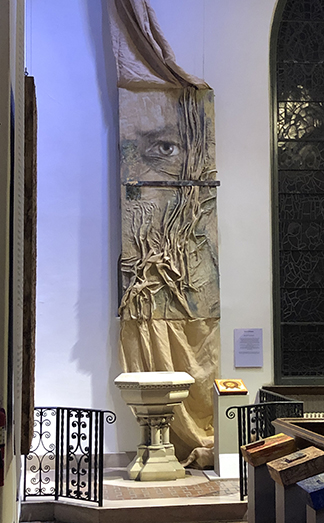
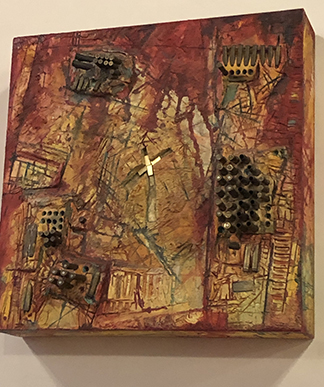
Placed behind a pedestal is a multimedia collage of fabric folded in such a way that it looks like vines reaching up to the eyes, separated by a metal hasp—in this representation all attention is drawn to the eyes of the portrait. The color red is used effectively in a minimalistic way, as is a vibrant blue giving the effect of a blood spatter reaching to the eyes.

Pawlowska’s works at times focus on the atrocities of war, featuring spent bullet casings that stand out in bas relief, making a two-dimensional work not only thought-provoking but chilling, with a broken cross at the center and the title, “I Hate War.” As a whole, Pawlowska’s “Icons” puts a modern spin on an ancient form of art.  They are transcendent as they provide a tether to mankind’s temporal state here on Earth. Connections to beyond the here and now are solely individualistic and carried within the viewers framework of reference.

Pawlowska’s paintings speak to the silent communique between a daughter and her mother, and that may well be her greatest work of all. Through her reverie, a greater hand came into play, guiding her every step of the way, lighting the path not only for herself but for all those that would see her works of art.

Art can sustain us in time of sorrow. Art can lift us out of the darkness and towards the light. Art can give us hope and imbue us with a sense of peace. Art has the power to transform lives. Amen.

“Icons in Transformation” runs through Nov. 3 at St. Stephen’s Episcopal Cathedral, 221 N. Front St., Harrisburg. Click this link for more information. Pictured above: “Your Face I Am Looking For” and “I Hate War”

“Mamacha Carmen” opens on Sept. 28 at the Paper Lion Gallery, 1217 Hummel Ave., Lemoyne. For more information, visit their Facebook page.

Continue Reading

More disruptions ahead as 3rd Street project concludes in Midtown Harrisburg

Construction work continued around the Broad Street Market today.

Harrisburg residents should brace themselves for one more round of disruptions in the heart of Midtown, as the 3rd Street corridor project comes to an end in the area.

Mayor Eric Papenfuse said today that the street will be milled and paved during a one-week period starting this Thursday, Sept. 26. This work will result in temporary, rolling road closures, as well as substantial parking restrictions.

“This last part will be disruptive since they have to shut down the street to mill and pave,” he said.

According to the construction schedule, milling will begin on Thursday at Boyd Street, an alley between Reily and Harris streets. It will continue south through Friday along the corridor to Forster Street.

Paving is slated to start on Monday, Sept. 30, and conclude on Thursday, Oct. 3. This schedule is dependent upon favorable, dry weather, said city Engineer Wayne Martin.

Martin said that motorists still can park overnight on the street once work has concluded for the day. However, all cars must be removed from the corridor by early in the morning, when work re-starts.

“If there’s no work, you can park there as long as you’re gone by 6:30 a.m.,” Martin said.

Cars that remain in the work area will be towed, he said.

The milling and paving affects not only N. 3rd Street, but adjacent side streets near the intersections, including portions of Reily, Basin, Calder, Sayford, Verbeke, Cumberland, Herr, Boas and Union streets.

Notably, this work will affect the area around the Broad Street Market during market hours this week. Milling is expected to take place in front of the market on Thursday, Martin said. No work will take place on Saturday or Sunday.

The affected streets will not be closed the entire time, but only when work is taking place. Once milling has occurred, the streets will reopen to traffic until they are paved. Newly paved streets will take about three hours to dry and cure before reopening, Martin said.

The streets also will be lined and painted, but that work is slated for later in October.

This milling and paving work will mark the end of the 3rd Street corridor project for Midtown Harrisburg. In Uptown Harrisburg, the project has already concluded.

Last week, Papenfuse said that the project would continue into next year for the downtown area south of Forster Street because of work at the Harrisburg University building site at S. 3rd and Chestnut streets and because the city has received a grant to install electric vehicle charging stations in front of the State Museum. The city also plans to complete the sidewalk-widening project around the state Capitol on N. 3rd Street from North to State streets.

This work will have to be completed before 3rd Street can be milled and paved in the downtown area.


3rd Street Paving Plan Timeline, Midtown 

Sept. 26: Milling operations starting north (at Boyd Street) and moving south
Sept. 27: Continue milling operations
Sept. 30: Pave tie-ins (intersecting side streets) at Reily, Basin, Calder, Sayford, Verbeke, Cumberland, Herr, Boas and Union streets
Oct. 1: Scratch coarse (first paving layer) Boyd to Forster
Oct. 2: Pave wearing coarse (second paving layer) north to south
Oct. 3: Finish wearing coarse (completion expected around noon)

Continue Reading

The Week that Was: News and features around Harrisburg.

Stop signs were back in the news this week in Harrisburg.

Harrisburg City Council held its first legislative session of the season, which offered a healthy chunk of city news this week. Find out what’s happening around town both inside and outside of city hall with our weekly news recap.

Artsfest will go on next year, as Harrisburg plans to take the three-day, arts-focused celebration in-house. The city plans to run the event after the former organizer, Jump Street, ceased operations. Check out how the city plans to make this happen.

CEO Charlotte Katzenmoyer is stressing Capital Region Water’s commitment to environmental action and progress. In a letter to the editor, she addresses criticisms leveled by an environmental nonprofit and defends a proposed stormwater fee. Read her entire letter here.

Harrisburg will interview at least two companies that may be interested in acquiring the city’s water/sewer system. Mayor Eric Papenfuse stressed that this was a preliminary step and did not mean that the city will definitely sell the asset. Read the story here.

Harrisburg Area Roller Derby (HARD) is more than a sports team. Sure, these women love the sport, but they also have forged close personal connections that belie the stereotype of roller derby. Our feature story offers insight into the team and some of the players.

Harrisburg University this weekend hosts the HUE Invitational, its second annual e-sports tournament. Teams from around the country will compete for cash prizes and honors in three video games. Learn what this is all about.

Harrisburg’s Urban Meadow may get extended, as the city has applied for a state grant to fund the project. If built, the walkway extension would run to N. 6th Street, near the new federal courthouse. Read the details here.

Julissa Morales is just 16 years old, but already a veteran activist, especially in defense of immigrant issues and rights. Our feature story tells you about this impressive young Harrisburg resident.

Mayor Eric Papenfuse said that his administration would retain two of the four stop signs along N. 3rd Street that had been targeted for removal. Eventually, Harrisburg City Council will make the final decision on whether to retain or remove the signs. Find out more about the decision here.

Nate Foster is likely a familiar face if you’ve attended a class at the Art Association of Harrisburg in recent years. He teaches illustration, and our fine arts writer offers a short profile of the man beneath the cap.

Rodrigo y Gabriela, a world-renowned acoustic duo, is making a stop in town as part of Harrisburg University’s music series. Find out how to attend the show here.

Sara Bozich has the cure for the boring blues, with more than 100 things to do this weekend. See what’s on her agenda by visiting her weekly blog of events in and around Harrisburg.

Simplicity is the theme of month for our food columnist, Rosemary. That philosophy has taken her to dishes that are short on time, but big on flavor. Read what’s cooking in Rosemary’s kitchen.

Do you receive TheBurg Daily, our weekly digest of news and events? If not, subscribe here!

Continue Reading

Letter to the Editor: Capital Region Water is committed to addressing environmental threats, concerns

The Susquehanna River in Harrisburg

Capital Region Water has put in place a comprehensive work plan to improve the health of local waterways; repair aging infrastructure and reduce combined sewer overflows; address localized flooding and stormwater runoff; revitalize neighborhoods through community greening; and meet mandatory state and federal clean water requirements.

Several measures of success already have been attained. Since 2013, Capital Region Water has invested $110.7 million on capital improvement projects, tackling critical water and wastewater needs while addressing years of deferred maintenance. A total of $315 million in investments are planned over the next 20 years as part of the City Beautiful H2O Program.

No one denies the challenges of maintaining and upgrading infrastructure that is more than a century old in some places, or in finding ways to pay for the work in a city where nearly one of every three residents lives below the poverty line. The affordability to residents needs to be part of the equation, and it has been with the plan Capital Region Water proposed.

Despite this success and these planned investments, the Environmental Integrity Project (EIP) on Aug. 22 issued a report that challenges the work of Capital Region Water and questions the innovative measures being adopted to clean up local waterways. The report contains serious flaws that make its findings deficient. Several claims need to be addressed to set the record straight:

***

MYTH: Capital Region Water is to blame for high bacteria levels and problems at City Island.

FACT: There is little correlation between bacteria concentrations at City Island, rainfall events, and combined sewer overflow (CSO) activity within Capital Region Water’s service territory. The Pennsylvania Department of Environmental Protection (DEP) assessment of Susquehanna River water quality, summarized in the 2016 Pennsylvania Integrated Water Quality Monitoring and Assessment Report, concludes that the shallow and wide physical characteristics of the Susquehanna River in the vicinity of Harrisburg limit mixing across the river. These characteristics create five parallel flow streams, where the center 80 percent of the river width is dominated by three upstream flow streams (the Susquehanna main stem, the Susquehanna West Branch, and the Juniata River). Local discharges hug the east and west banks (each approximately 10 percent of the River width). The DEP study makes clear that the river currents closest to the eastern shore do not mix with the currents along City Island. This same conclusion was reached through water quality sampling and modeling conducted in 2005 for the previous Harrisburg CSO Long-Term Control Plan. Because of these flow patterns, which are demonstrated through monitoring, bacteria concentrations near City Island often are higher than near-shore bacteria concentrations, indicating bacteria sources that affect the City Island beach, and keep it closed, are coming from upstream and not from CSO events. Interestingly, the EIP report contains no upstream or baseline water quality testing to establish the background bacteria concentrations coming from upstream.

***

MYTH: Capital Region Water actively chooses to discharge sewage vs. choosing treatment.

FACT: In a permitted combined sewer system (CSS), the same pipes that carry away sanitary sewage or wastewater from household use (such as toilet flushing and bathing) also carry stormwater from rooftops and pavement. During dry weather or light rainfall events, both stormwater and wastewater are carried to Capital Region Water’s Advanced Wastewater Treatment Facility (AWTF) for treatment before clean water is then released back into the Susquehanna River downstream of the City of Harrisburg. During moderate to heavy rainfall events, the combined system reaches volume capacity and a mixture of very dilute sewage and stormwater overflows into the Susquehanna River and/or Paxton Creek, as was intended by the system’s designer years ago. This is called a combined sewer overflow (CSO) event. Capital Region Water is responsible for 59 CSO structures in Harrisburg. Overflow events are a symptom of a 100-year-old designed combined system and not an operational choice. Capital Region Water’s Advanced Wastewater Treatment Facility is capable of treating up to 80 million gallons of wastewater each day and average flows are just above 20 million gallons each day. By rehabilitating the systems that collect and convey wastewater to resolve issues related to deferred maintenance and structural and/or maintenance deficiencies, as well as developing a Long-Term Control Plan (LTCP) to resolve capacity constraints and control the frequency, duration, and the volume of CSOs, Capital Region Water is and will continue to maximize capture and treatment at the AWTF and therefore limit the associated pollution into the Susquehanna River and Paxton Creek.

***

MYTH: Capital Region Water is not doing enough to address the issues.

FACT: No one denies the challenges of maintaining and upgrading infrastructure that is more than a century old. These problems didn’t surface overnight; they won’t be fixed overnight. To address these challenges, Capital Region Water has employed a parallel plan. One, rehabilitate the sewer system in order to catch up on decades of deferred operation and maintenance needs, including implementation of a comprehensive asset management system to ensure the sewer system continues to provide reliable service to customers. Two, implement wet weather controls to reduce combined and sanitary sewer overflows, including unauthorized releases, MS4 discharges, and eliminate backups onto streets and into basements. This includes both gray and green infrastructure. No one denies more must be done. But there is no easy solution and there is no cheap fix.

***

MYTH: Capital Region Water’s plan doesn’t spend enough to fix the problem.

FACT: Capital Region Water can only spend what its customers can afford. We have proposed $315 million in investments over the next 20 years as part of the City Beautiful H2O Program to repair aging infrastructure, address runoff and clean up waterways. A $40 million upgrade to our Advanced Wastewater Treatment Facility, finished in 2016, made it one of the most cutting-edge treatment facilities in the region, with improved operations to better protect the Susquehanna River. We’re also in the process of rehabilitating our large combined sewer interceptors and our primary pumping station to increase the volume of flow that reaches our AWTF. These are just a few examples of how far we have gone. But with all of these projects, affordability matters. Capital Region Water’s plan has defined implementation phases, with anticipated levels of CSO volume control achieved, and the estimated available level of expenditure within each phase so the authority can maintain wastewater rates at not more than 2 percent of the median annual household income within the city.

A financial capability assessment was completed in accordance with U.S. Environmental Protection Agency (EPA) requirements in order to assess the financial capability of Capital Region Water and its customers within the City of Harrisburg to pay for the plan. A high financial burden level, according to federal affordability guidelines, is expected to occur in Harrisburg when the anticipated additional capital costs are incurred by Capital Region Water over the next 10 years. However, some customers in Harrisburg are already experiencing economic hardship and affordability issues, and these conditions may worsen as capital spending continues, and rates increase in the future to support the $315 million level of spending.

The following key customer statistics highlight the limited financial capability:

  • Unemployment has ranged between 14 percent and 17 percent in recent years, which has averaged approximately 10 percentage points higher than national, state, and county levels.
  • Approximately 32 percent of the population is living below the poverty level, which is more than double the national, state, and county poverty levels.
  • The median household income of $33,289 (in 2015) is more than $20,000 lower than that of the national, state, and county, and is only approximately $8,000 higher than the poverty threshold for a family of four.
  • An estimated 25 percent of the households within the City of Harrisburg currently pay a wastewater bill that is more than 2 percent of their income, and approximately 30 percent of households have a combined water and sewer bill that exceeds 4 percent of income. Federal affordability guidelines state that there is a high financial burden when the total residential wastewater and stormwater costs reach 2 percent of the median household income (MHI).

All of these elements must be factored into Capital Region Water’s plan.

***

MYTH: Capital Region Water has avoided paying penalties or fines for CSO or other violations.

FACT: That’s not true. Capital Region Water has been assessed fines and has paid those fines in full. In lieu of more punitive fines that drain already limited resources, Capital Region Water supports investing the money back into the system to fix problems, modernize infrastructure, and hasten compliance. It is better to spend customer fees on improvements rather than penalties.

***

MYTH: Capital Region Water’s plan targets 60 percent capture.

FACT: Capital Region Water’s plan targets approximately 80 percent of CSO volume captured over the 20-year plan horizon. (In fact, the chart on Page 33 of the Overview of the full plan shows the 80 percent attainment, and that document is publicly available in Capital Region Water’s City Beautiful H2O Program Plan.) A plan that focuses on Susquehanna River water quality attainment is unaffordable over the planning horizon, estimated to cost approximately $530 million (2017 $), and would force residents out of their homes because of rates they could not afford.

***

MYTH: Capital Region Water’s plan relies too heavily on green stormwater infrastructure.

FACT: Capital Region Water evaluated the full range of CSO control alternatives, both centralized and decentralized (i.e. green infrastructure) stormwater control strategies, including deep tunnels, parallel interceptors with increased pumping and treatment capacity, an end-of-pipe satellite control strategy (i.e. large storage facilities), and a complete sewer system separation. The estimated cost of implementing these strategies approaches or exceeds $1 Billion. Decentralized strategies combining green and gray infrastructure within each of the program planning areas helps to solve existing problems regarding uncontrolled CSO discharges, significant structural deterioration, and hydraulic pinch-points presenting a heightened risk of unauthorized discharges (e.g., localized flooding and basement backups) in addition to achieving the larger goal of reducing CSO activity. Decentralized strategies such as satellite storage/treatment and green/gray water projects within neighborhoods maximize triple-bottom-line benefits and leverage non-traditional funding sources; and is the most cost-effective strategy.

Systemwide or centralized strategies do not assist in addressing collection system rehabilitation or neighborhood concerns such as basement backups or street flooding and they have the higher cost of treating the combined sewage when the treatment plant has the capacity to treat after the storm.

A decentralized (green and gray) control strategy, which is widely recognized as an effective approach, is preferred for the following major reasons:

  • It is affordable and cost-effective, meeting wet weather control objectives and supporting a multitude of multi-objective benefits, with significant opportunity for public-private partnerships to share implementation costs with CRW ratepayers.
  • It is flexible, installed in small, incremental investments throughout the system, using technologies that can be designed to also address unauthorized releases and integrate with sewer rehabilitation projects, and suitable for integration with a broad range of redevelopment and public works projects. Indeed, with the limited financial capabilities of CRW and the remaining uncertainty in the magnitude of collection system renewal needs, it may represent the only viable strategy to begin meaningful wet weather control.
  • It is balanced, providing CRW the opportunity to invest throughout the community as well as avoid areas of excessive community impacts. It does not favor or place undue burden on any part of the community and, in fact, is designed to “lift up” the community through strategic investments that benefit water quality, public health and safety, and promote re-investment in the community.
  • It builds upon the baseline level of control, with its initial focus on the rehabilitation and enhanced reliability of CRW’s AWTF and conveyance system, anticipated to provide significant wet weather control benefits within the first 10 years of program implementation, with deployment of decentralized controls in priority areas to “fill gaps” in existing system performance.
  • It has community support, consistently demonstrated through public engagement opportunities, and representing the only strategy that “gives back” to the community, potentially providing ancillary economic benefits that enhance the financial capabilities of CRW and its ratepayers.

***

MYTH: Capital Region Water is not doing enough to plan for higher rainfall amounts and more significant storms resulting from climate change.

FACT: Capital Region Water continually monitors rainfall and system performance, including CSO activity. The program will adapt to the reality of climactic conditions. Planning has been prepared using the historic data that is available and will continue to adapt as trends and regulations evolve.

Charlotte Katzenmoyer is CEO of Capital Region Water.

Continue Reading

Walk This Way: Harrisburg hopes to extend “urban meadow” to new courthouse area

The urban meadow in Midtown Harrisburg

Harrisburg hopes to extend an existing walkway by two blocks, offering a landscaped pedestrian link between the new federal courthouse and the heart of Midtown Harrisburg.

The city has applied for a $75,430 grant to PA WalkWorks, a program of the state Department of Health, to extend the “urban meadow” to N. 6th Street from its current terminus at Fulton Street.

“With the courthouse being built, we would like to see this extension,” confirmed Mayor Eric Papenfuse.

About a decade ago, three blocks of Boyd Street, from N. 3rd to Fulton streets, were transformed from a street alley into a pleasant walkway and bike path with the installation of pavers and native plants.

The project was part of a larger master plan to revitalize the area. In the early 2000s, the city acquired and cleared several blocks of blighted houses and commercial buildings along the 300- and 400-blocks of Reily Street.

The Harrisburg Redevelopment Authority eventually sold these blocks to GreenWorks Development and HACC, and they’re now surface parking lots. Recently, GreenWorks received a $2 million state grant to help fund a $26 million, 135-unit apartment and retail building planned for the 300-block of Reily.

The current urban meadow runs in back of these parcels.

Harrisburg wants to extend the urban meadow from its current terminus at Fulton Street (seen here) up Boyd Street to N. 6th Street, where a construction crane for the new federal courthouse can be seen in the background.

If received, the grant would pay for design work for the two-block extension up Boyd Street to N. 6th Street, making the walkway nearly ¼-mile in total. Papenfuse said the city also is applying for a Dauphin County gaming grant, which would help fund the remainder of the project, including construction.

City Council must ratify the application to PA WalkWorks, though the city has already submitted the application in order to meet an Aug. 30 deadline.

Continue Reading