“Out by Sunday”: With a property sale, a homeless camp disbands and long-time residents wonder where to go next

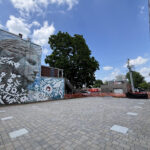
This tent camp sits in one of the abandoned buildings near the Mulberry Street Bridge in Harrisburg.

On Sunday, his community will be gone.

But, this past Tuesday, Enos Hake sat on his concrete patio in Harrisburg, listening to his radio. He greeted his neighbor, Dale, as he peddled by. He talked about his days as an ironworker, politics and hubbub about his neighbors.

The property at 1001 Mulberry St. has been sold, and the 30-plus people who live there in the abandoned buildings and truck trailers have been told that they need to be out by Sunday.

“This is going to impact a lot of people ‘cause they don’t know where they are going to go,” said Hake, who has called this abandoned lot home for four years.

Hake and his friend share a 6-by-12 foot concrete room they call “the man cave.” Their space holds mattresses on milk crates, fishing rods, coolers, basic necessities and books he got from a van that drops by.

Not all dwellings on the lot are so well appointed. One building holds about 10 tents, where individuals and couples live. Why tents in a building?

Under a billowy sky, with the screech of train tracks in the background, GarriAnn Hearn explained that having the tents inside another structure, even one with holes in the ceiling, offers a layer of protection from the elements.

“Having it inside gives a little bit more of a shelter, even though it’s not a good, enclosed shelter,” she said.

Hearn, co-founder of Market Square Friends, a local grassroots group that assists the homeless in Harrisburg, went on to explain that people can keep their belongings in their tents, as well. She said that those who live here have a measure of security.

“People don’t go beyond the fence who don’t know what’s beyond there,” she said. “It’s hard to imagine, but it’s a community.”

Enos Hake and GarriAnn Hearn, co-founder of Market Square Friends, sit outside Hake’s long-time home.

It’s a community that needs to disperse by Sunday.

“They’re telling us we have to go by Sunday morning,” said Maggie Nace, who’s lived there for two years. “No one has nowhere to go.”

Still, people are collecting their things.

“Everybody’s rushing to pack up so we don’t lose nothin’,” she said “There’s no way to move things.”

There’s an air of fear, resignation and doubt on the lot. Hake said that he’s heard many times that the lot would be sold.

This time, however, it’s not mere rumor. The former owner informed local social service organizations that the sale was happening, so that residents could prepare.

Those same agencies are concerned about the people there and the disruption to their lives. Hearn is a part of the Compassion Action Network, a collaborative group of local charities working together.

Market Square Friends, G2:10 Outreach and other groups serve food every Monday and provide personal hygiene items and clothes in a location near the Mulberry Street Bridge.

“We can serve folks now where we can congregate without getting in trouble,” she said.

Last week, they served 75 people. She doesn’t know where they will serve now.

Downtown Daily Bread offers breakfast and lunch, as well as a place to stay during the day.

“We’re the only place where people can come during the day and just be,” said director Anne Guenin. “People can come in and sleep and don’t have to worry about their stuff getting stolen.”

With the sale of the lot, more folks may be using Downtown Daily Bread’s services.

“Whether they will end up coming here during the day remains to be seen,” Guenin said.

Kim Corigliano’s tent sits just outside the lot under the bridge, and she’s not sure if she’ll be affected by the sale.

“It’s a shame,” she said.

She described her plans for the winter. She’ll create a wall by collecting discarded water bottles and “plug the holes in the chain link fence to block the wind,” she said.

Nace and her husband, Nate Phillips, aren’t sure they’ll be there this winter. They headed off to see about a room to rent.

John, who didn’t want to share his last name, said he may go to Bethesda Mission.

“Something to get back on my feet,” he said.

He said that he was once a roofer and has health problems. He added that people on the lot get along and keep each other informed of what’s going on.

Phillips and Nace returned from their search. Hake, still seated on his concrete slab, yelled a greeting and asked if they got the place.

“No, Dave got it,” they answered.

Hake didn’t seem too worried about his next steps.

“I was an iron worker,” he said. “I’m tough.”

Then he added that many people there were “scared ‘cause they don’t know what they are going to do.”

On the other side of the fence, the buildings are lost to the sumac, golden rod and ivy. Except for the occasional passerby, most people never realized that folks lived there.

Hake, Nace, Phillips and the rest of the folks here are about to lose a community that, as imperfect as it was, most people didn’t even know existed.

Find out more about Market Square Friends at www.marketsquarefriends.org and Downtown Daily Bread at their Facebook page. 

Continue Reading

New office, retail building proposed for downtown Harrisburg

A rendering of the proposed project

Over the last few decades, Market Street in downtown Harrisburg has been transformed by such projects as Whitaker Center, Harrisburg University and the Rachel Carson Building.

Another project is now on the boards that again would change the complexion and the skyline of the key commercial corridor.

Harristown Development and Select Capital Commercial Properties are teaming to build a new, mixed-use building in the center of the 300-block of Market Street, directly across from Strawberry Square.

“This is the last area on Market Street in the core of downtown that needs redevelopment,” said Harristown CEO Brad Jones. “This is the final piece.”

The 300-block of Market Street in Harrisburg, the future site of a new mixed-used building.

The developers envision a 10- to 12-story, 100,000-plus-square-foot office and retail building at 307 to 313 Market St. The building–called 311 Market Street–also would have several floors of parking and might include residential space.

For the past few years, Harristown has been purchasing properties to assemble the site. Last week, the company closed on the final, and largest, piece, buying the former Rite Aid drug store from the Camp Hill-based company for just over $1 million. That low-slung building has been empty since Rite Aid relocated a few years ago into Strawberry Square.

Jones said that plans are to demolish the existing structures, probably next year. In the meantime, the developers hope to recruit an anchor tenant.

He said that the building would suit any company or organization seeking a large amount of new office space in the heart of Harrisburg, such as a corporate headquarters. The building would be able to support 500 to 1,000 workers, he said, depending upon office configurations.

If construction is delayed following demolition, the developers would turn the site into a “pocket park” in the interim, a space that could be used for events, Jones said.

“We would have a nice transitional use,” he said.

Harristown this year applied for a state Redevelopment Assistance Capital Program (RACP) grant in the amount of $5 million for the project, which is estimated to cost $25 to $40 million in all. It didn’t receive the funds, but will apply again next year, Jones said.

Continue Reading

CRW extends comment period for proposed stormwater fee

A sign on Harrisburg’s lower river walk warns about the combined sewer system.

Capital Region Water is extending the public comment period for a proposed stormwater fee for Harrisburg.

The CRW board of directors on Wednesday night voted to extend the public review and comment period by almost a month, to Oct. 22.

“The month-long extension will ensure we have done all we can to give residents the opportunity to review and comment on a plan that is designed to improve the health of local waterways and enhance our neighborhoods,” said CRW CEO Charlotte Katzenmoyer, in a statement.

In June, CRW proposed a separate stormwater fee for most CRW customers beginning Jan. 1. It originally set a Sept. 25 deadline for comments, but the board decided to extend it to give residents more opportunities to voice their opinions, Katzenmoyer said.

In addition to receiving more than 70 comments to date, CRW has made dozens of presentations on the proposed fee at community meetings and forums. CRW also will give a presentation at a Harrisburg City Council meeting on Oct. 15.

Under the proposal, the average Harrisburg residential customer would pay a stormwater fee of $72 starting Jan. 1. Customers with larger properties, including many commercial customers, would pay more based on the total amount of impervious surface on their properties.

Until now, stormwater costs had been included in a customer’s wastewater bill, not broken out separately. If the stormwater fee is imposed, customers should experience less of an increase in the wastewater portion of their bills than they would have otherwise, CRW has said.

CRW said it expects the fee to raise about $5.3 million annually exclusively for stormwater operations and projects. It plans to invest $315 million over the next 20 years to upgrade its infrastructure and reduce the flow of stormwater into area waterways.

Harrisburg’s sewer system suffers from deferred maintenance going back decades, as well as an outmoded, combined design that allows untreated sewage to empty into the Susquehanna River during rainstorms. CRW is under a partial consent decree with the federal Environmental Protection Agency to slash the amount of sewage overflow.

Separately, Harrisburg is considering selling the city’s water/sewer system, interviewing interested, qualified private water companies beginning this week.

To learn more about and comment on CRW’s proposed stormwater fee, visit their website.

Continue Reading

2020 PA Farm Show theme emphasizes “opportunities” in agriculture

Farm Show milkshakes stand at the ready during the 2019 event.

The PA Farm Show is just 100 days away, and that milestone is being marked with the release of the theme for the 2020 show.

The state Department of Agriculture today announced that the theme will be “Imagine the Opportunities.”

“Each year, the Pennsylvania Farm Show uses a theme to convey our vision for the future of Pennsylvania agriculture,” said Farm Show Complex Executive Director Sharon Altland, in a statement. “This year, we see nothing but bright horizons and we want all of Pennsylvania to imagine how they can be a part of it.”

The 2020 Farm Show is slated for Jan. 4 to 11, featuring some 12,000 competitive exhibits.

According to the department, the theme builds upon the state’s first-ever comprehensive farm bill, actually a series of bills with broad bipartisan support signed into law in June. The $23 million legislation, in general, was meant to stimulate interest in agriculture through such measures as helping beginning farmers, funding research into specialty crops and assisting the dairy industry.

“This year’s Farm Show theme is inspired in part by Gov. Wolf’s ability to imagine a bright future for Pennsylvania agriculture through the support found in the PA Farm Bill,” said Agriculture Secretary Russell Redding, in a statement. “Thanks to this investment, the opportunities in Pennsylvania agriculture are boundless.”

Click here to see the just-released 2020 PA Farm Show promotional video on Facebook.

Continue Reading

Weekend Roundup with Sara Bozich

Happy Weekend!

Tonight is the LAST SoMa Block Party of 2019! Be sure to stop by and party with us one last time (Bonus: new mural on FULL display). I’m getting some much-needed mom-friend time and we’ll be there, too.

Friday I get my hair ‘did and good thing — on Saturday, I’m heading with the GK Visual crew to Pittsburgh. Our craft beer documentary, Poured in Pennsylvania, has been nominated for a Mid-Atlantic Emmy!! Winners will be announced Saturday night!

Sunday, we’ll head back and do some housework and football.


What are you doing this weekend?

(more…)

Continue Reading

Harrisburg’s state-appointed ICA down to four members, as chair submits resignation

The Intergovernmental Cooperation Authority met on Wednesday. From left: Kathy Speaker MacNett, David Schankweiler, Ralph Vartan, Audry Carter and Jeffrey Stonehill (authority manager).

Harrisburg’s Intergovernmental Cooperation Authority is down to four voting members, as the chairman today announced his resignation from the state-appointed board.

At the end of the ICA’s monthly meeting, Chair David Schankweiler announced his departure, saying that another “opportunity,” which he declined to specify, prevented him from continuing to serve on the body.

“I need to, as of today, resign as an authority member,” he said. “I’m disappointed having to do this because I’ve enjoyed serving with the authority and for the city.”

Gov. Tom Wolf and state legislative leaders appointed the ICA’s five voting members. Schankweiler, the former publisher of the Central Penn Business Journal, was appointed in January by state Senate Pro Tempore Joe Scarnati, who presumably would have the authority to appoint a replacement.

The remaining board members then voted to appoint Audry Carter, the ICA’s vice chair, as the new chair. ICA member Ralph Vartan was appointed as the new vice chair.

“It will be an honor to try and follow in your footsteps,” Carter said, following her appointment. “You helped us get through that incredibly steep learning curve.”

In addition to Carter and Vartan, the board’s voting members are UPMC Pinnacle executive Tina Nixon and attorney Kathy Speaker MacNett.

The ICA and the city are in the midst of finalizing a five-year financial recovery plan for the city. Mayor Eric Papenfuse, who attended the ICA meeting, said that City Council will meet in executive session next week to review changes to the draft Intergovernmental Cooperation Agreement.

Once that agreement is finalized and approved, Harrisburg will have the ability to exit Act 47, the state’s program for financially distressed municipalities.

Otherwise, the board heard a presentation Wednesday on the city’s finances by Bruce Weber, Harrisburg’s budget and finance director.

Weber said that 2019 revenues are coming in as expected. Property tax receipts are about flat compared to last year, he said. However, both earned income tax and local services tax revenues are higher than anticipated, indicating a relatively strong city economy. Judging by these receipts, Weber estimated that the city created some 1,500 jobs through the second quarter.

“I think it’s important to note that, while we have some long-term fiscal challenges, I think we’re in a period of stability now, and that’s important to note, broadly speaking,” Weber said.

Continue Reading

Letter to the Editor: Environmental group responds to Capital Region Water letter

A sign along Harrisburg’s lower river walk warns of the combined sewer overflow.


A September 19, 2019, letter to the editor published in TheBurg by Charlotte Katzenmoyer, executive director of Capital Region Water (CRW), titled “Capital Region Water is Committed to Addressing Environmental Threats, Concerns,” makes two factually incorrect statements about an August 22 report by the Environmental Integrity Project, titled “Sewage Overflows in Pennsylvania’s Capital.”

The letter incorrectly asserts that our report claims that: “Capital Region Water has avoided paying penalties or fines for CSO or other violations.” In fact, we make it clear on page 8 of our report that Pennsylvania fined the water and sewer authority 29 times for sewage violations from 2015 through 2018. However, the state failed to fine the authority for an additional 102 self-reported sewage violations over this time period (out of a total of 131 violations), meaning that only 20 percent of the violations resulted in penalties.

The letter from Capital Region Water also wrongly claims that our report says: “Capital Region Water’s plan targets 60 percent capture.”  Our report does not say that. On pages 5, 9, 11, 14, and 21 our report states that the water authority’s proposal would allegedly “reduce” the current volume of sewage and stormwater flowing on an annual basis into the Susquehanna River, from an annual average of 800 million gallons to about 300 million gallons annually. That 60 percent estimate is correct, based on numbers in Capital Region Water’s written plan, “City Beautiful H20,” and CRW did not dispute those numbers we discussed the figures with CRW in a meeting at their offices on June 6 or in subsequent emails.

However, it should be noted that it is very different to say that the authority’s plan would “reduce” the volume of sewage and stormwater pouring into the river by approximately 60 percent (which is true, according to CRW’s figures), and to say that the plan would “capture” 60 percent of the total volume in the system (which would include both the liquid being piped to treatment at the wastewater treatment plant and the liquid being discharged to the river.)  Our report only focused on the percentage of reduction in pollution flowing directly into the river, which produces a different number than what CRW is highlighting (the percentage of capture.)  

We think it’s more important to focus on reducing the pollution into the river, which is why we chose the language we selected.  The figure and language that CRW is highlighting makes their plan appear to be more effective, so I understand why the authority would want that framework and emphasis.  But as a kayaker on the Susquehanna River, what I am more concerned about (and what I suspect many people are concerned about) is reducing the amount of raw human waste that we actually encounter in the river. Thank you for the opportunity to set the record straight on those factual issues.

Tom Pelton is the director of communications for the Environmental Integrity Project.

Continue Reading

Harrisburg council, administration spar over water system future, meetings

Harrisburg City Council chambers on Tuesday

Two branches of the Harrisburg city government sparred on Tuesday night over an administration plan to interview private companies that have expressed initial interest in taking over the city’s water/sewer system.

At a work session, several City Council members questioned a plan by Mayor Eric Papenfuse to interview four companies that responded to a “request for information” (RFI) issued two months ago by the city.

“You put the cart before the horse,” said council President Wanda Williams. “You should have had a public meeting to explain what you’re considering. In actuality, you’re continuing this process without informing the council.”

Earlier on Tuesday, Papenfuse issued a statement saying that six entities had responded to the city-issued RFI, and the administration determined that four of those companies were qualified and experienced enough to warrant an informational interview. Those companies are:

  • Bryn Mawr-based Aqua America
  • Hershey-based PA American Water
  • Paramus, N.J.-based Suez North America
  • Boston-based Veolia American Water

The first interview is slated to take place on Wednesday, with the last on Oct. 8.

As he has previously, Papenfuse stressed to council that the interviews are for informational purposes only–that there is no formal bidding or sales process underway.

“All we’re doing is gathering information,” he said. “We’re trying to gather information in a clear and transparent way. If we go down that path, we’ll need to have a greater conversation.”

Nonetheless, council members said that they felt left out of the process and said that the public felt the same way.

“I’m receiving five and six emails a day saying that you’re not being transparent about the process,” Williams said.

Papenfuse said that he felt it was necessary to perform this “due diligence” before potentially going through a more public bidding process.

He cited two principal reasons for taking this first step.

First of all, he said that he wants to better understand the city’s options in light of continuing negotiations with the state-appointed Intergovernmental Cooperation Authority over a five-year financial plan for the city. Secondly, he wants to explore options for sewer system improvements other than those undertaken by the city’s municipal utility authority, Capital Region Water (CRW), which plans to impose a user stormwater fee starting Jan. 1.

“We have a comment period closing tomorrow for CRW for a major rate increase that will impact our residents,” Papenfuse said. “Council has not had a hearing despite CRW’s request to do so, despite my request to do so.”

Williams said that council has been attempting to set up a public meeting with CRW to discuss the proposed stormwater fee. That meeting is now scheduled for Oct. 15.

Papenfuse added that he hopes for concrete options from companies that will lead to less pollution flowing into the Susquehanna River and, ultimately, the Chesapeake Bay, at a cost that city customers can afford to pay.

CRW plans to spend some $315 million over the next 20 years to stem the flow of wastewater into area waterways. But Papenfuse has criticized that plan as incomplete and said that it doesn’t have  final approval from the federal Environmental Protection Agency.

In the end, council members seemed resigned that the interviews with the private companies would proceed, with Papenfuse pledging greater council and public involvement if the administration decides to take a next step.

“If recommendations come from those meetings, I will share them with council, as well as the underlying reasoning behind them,” Papenfuse said.

This story has been updated to include information about the upcoming CRW meeting with City Council.

Continue Reading

Harrisburg to interview 4 companies as it ponders selling water/sewer system

Capital Region Water at work on Allison Hill in Harrisburg

Harrisburg has received six responses to a request for information as it considers privatizing its water/sewer system.

Of those six, the city administration plans to interview four respondents due to their “experience operating comparable systems,” according to a statement from the city administration. They are all significant municipal water system companies with existing operations in the commonwealth:

  • Bryn Mawr-based Aqua America
  • Hershey-based PA American Water
  • Paramus, N.J.-based Suez North America
  • Boston-based Veolia American Water

The city will interview representatives from these four companies starting tomorrow and concluding on Oct. 8, according to Mayor Eric Papenfuse’s office.

In July, the administration released a “request for information” to gauge preliminary interest from companies in acquiring the city’s water/sewer system, setting a response deadline of Sept. 16.

Papenfuse has repeatedly said that the request for information was just a first step and that no decision has been made on whether to pursue privatization.

“We’re just in the information-gathering, due diligence mode,” he told Harrisburg City Council last week.

Papenfuse has also pledged public meetings in case the city does decide to proceed with selling the system. Currently, municipal utility authority Capital Region Water serves 20,300 water customers and 17,000 wastewater connections.

During a council meeting in August, numerous city residents spoke out against privatizing the system, and the administration has also received pushback from city council members.

Continue Reading

Developer seeks zoning change before launching projects in Midtown Harrisburg neighborhood

These empty lots at N. 6th and Reily streets, part of the MarketPlace neighborhood, look out over the 1500 Condominiums (left), the new federal courthouse under construction (center) and Bethesda Mission (right).

A Harrisburg developer has ambitious plans to build out a centrally located Midtown neighborhood, but first is seeking a zoning change that would permit greater density and more building options.

Seven Bridges Development hopes to acquire numerous parcels from the Harrisburg Redevelopment Authority to construct a variety of residential and commercial buildings in the MarketPlace neighborhood, a large swath of land that includes about 15 city blocks just north of the Broad Street Market.

First, however, the company wants to change the zoning for the area as the current zoning code does not permit much of the anticipated construction.

“Single-family houses are all you can build there [currently],” said Ian Wewer, director of development and operations for Seven Bridges. “It’s evident that no one is interested in building in the area. If you change the zoning, you might be able to change the area.”

The outlined area would be rezoned under the proposal.

Wewer spoke on Monday night at a community meeting that his company held at HACC’s Midtown 2 building, which attracted about 20 people.

He explained that the area currently is zoned “residential medium density,” in accordance with a prior plan exclusively for single-family townhomes.

The city—and then State College-based S&A Homes—built several clusters of townhouses to try to revive the once-blighted area. However, no houses have been built for more than a decade and, in June, the Harrisburg Redevelopment Authority bought back the remaining 58 empty lots from S&A.

Wewer said that his company believes that the area has tremendous potential, especially with the nearby construction of the new federal courthouse. However, Seven Bridges, he said, would only consider building if both more density and a greater mix of uses were allowed in order to make their projects economically viable.

Therefore, the company is proposing to change the neighborhood’s zoning to “commercial neighborhood.” According to the city’s zoning code, this zoning designation allows a mix of medium- and high-density residential and neighborhood retail activities and encourages “pedestrian-oriented uses, while avoiding auto-related uses.”

One of many empty lots sprinkled throughout the MarketPlace neighborhood.

Wewer declined to say specifically what Seven Bridges intends to build, stating that the zoning change must come before the company fleshes out and publicizes its plans.

However, he said that proposals likely would include a mix of apartments, houses, retail and office uses.

“We’re proposing mixed use,” he said. “We want to provide more opportunity for bringing in business and providing housing for people.”

Wewer also said that he would seek community input before making final design plans.

“I want to come in front of the community,” he said. “I want to come before the stakeholders and say—what do you want this to look like?”

The city Planning Commission is slated to hear the issue at its Oct. 2 meeting. If the commission approves the change, the proposal would go before City Council for a final decision.

Residents who attended Monday night’s meeting seemed generally to support Seven Bridges’ position.

“It’s creating opportunity for projects to happen, and I’m in favor of creating opportunities,” said Julia James, who owns a house within the MarketPlace footprint.

What will Seven Bridges do if the zoning code fails to change?

“If it doesn’t pass, we’ll walk away,” Wewer said. “That’s the bottom line. Capital Heights [another stalled development project] is next door, and there lots of opportunities to do single-family there—and they’re sitting vacant.”

Continue Reading