Harrisburg finances stable for now, rest of the year could be a “tough go.”

An empty 2nd Street in downtown Harrisburg.

Harrisburg’s finances are relatively stable, a month after the COVID-19 health emergency ground the nation’s economy to a halt.

Bruce Weber, the city budget and finance director, today said that Harrisburg is better positioned financially to deal with the national economic calamity than many other municipalities.

“We are in a much better position than, I would say, potentially many cities right now that are facing the similar crisis as we are,” Weber told members of the Intergovernmental Cooperation Authority (ICA), the state-appointed body tasked with approving and overseeing a five-year financial plan for the city.

Weber credited several factors unique to Harrisburg.

First, the city’s business mix, while service-oriented, is relatively stable, dominated by government, health care and professional services. Also, many of the city’s industrial and small businesses are regarded as “essential,” he said.

He contrasted Harrisburg’s situation with that of two nearby towns that have seen rapid economic growth in recent years. Derry Township, fueled by Hershey’s tourist attractions, has been dramatically impacted financially, while Lancaster—also reliant on tourism and closer to hard-hit Philadelphia—recently furloughed dozens of full- and part-time city workers, Weber said.

Moreover, Harrisburg went into the year with a balanced budget and a healthy fund balance, he said. The city is also saving about $50,000 a week after Mayor Eric Papenfuse implemented a hiring freeze in March affecting 38 unfilled positions. In addition, the city, as a self-insured entity, is realizing substantial health care savings because people are forgoing and delaying medical procedures.

Marita Kelley, the city’s Act 47 coordinator, said that her analysis supported Weber’s view.

“Fortunately, the city is in a good fiscal position in terms of fund balance,” Kelley said. “We give the leadership of the city a good deal of accolades for that.”

As of April 16, she said, the city had $33.9 million in its general fund and $6.6 million in its neighborhood service fund.

“I realize it’ll be a tough go in the next several months,” she added.

Weber agreed that the future was opaque, dependent upon unknowable factors, such as if the health emergency would end and when the economy would revive.

So, while the city’s first-quarter real estate tax receipts dipped only by about 4 percent, he said he was concerned about the rest of the year, especially employment-based revenue from the city’s earned income and local services taxes.

Due to the fluid situation, Papenfuse asked the ICA board to delay the deadline for the city’s final five-year financial plan until Oct. 31. The board agreed, but added that it would like interim financial updates for the next six months.

In other action, the ICA postponed two events it had announced for this year: a planned economic development summit and citywide “listening sessions.” Both may be rescheduled for later in the year if the pandemic eases and life returns to normal.

“The city must come through this and, ideally, it will be stronger and more resilient,” said Audry Carter, ICA chair.

Continue Reading

Gov. Wolf outlines phased approach to re-opening businesses, lifting restrictions

Gov. Tom Wolf (right) at a virtual press event on Wednesday.

Pennsylvania will use a three-color, three-phase system as it moves towards lifting stay-at-home orders and business restrictions, Gov. Tom Wolf said on Wednesday.

In an unusual evening press briefing, Wolf said that phases will be delineated by the colors red, yellow and green.

“We will not just be flipping a switch and going from closed to open,” he said.

To decide to move regions to a new phase, the state will use several metrics, including that a region shows fewer than 50 positive COVID-19 cases per 100,000 people over the course of 14 days. The state Department of Health will also use criteria such as testing rates, the ability to investigate cases, contact tracing capabilities and proximity to high-risk settings, as well as a data tool developed by Carnegie Mellon University.

The entire state is currently in the red phase, which includes strict social distancing, non-life sustaining business and school closures, and building safety protocols.The state issued the following graphic to demonstrate the phase:

In the interim yellow phase, some restrictions on work and social interactions will ease while others, such as closures of schools, gyms, and other indoor recreation centers, as well as limitations around large gatherings, will remain in place.

The green phase will remove the remaining stay-at-home orders, but will still require people to adhere to U.S. Centers for Disease Control and state health department guidelines. For an example, Wolf said that a face-mask requirement may remain even in the green phase if recommended by these entities.

Most likely, the northwest and north-central parts of the state will be the first to move to the yellow phase, on May 8, Wolf said.

He added that it’s possible that, depending upon the spread of the virus, a region could be moved back into a stricter phase.

“We will be keeping a constant watch on our COVID-19 case figures,” Wolf said. “And I will caution that we may announce a target date that will have to be pushed back due to new cases, or we might reopen some area or some businesses only to have them close again if the virus begins to resurge.”

Continue Reading

New COVID-19 cases show “flattened” curve; reported fatalities decrease

An image from the state Department of Health lab in Exton, Pa.

COVID-19 case data today remained in line with recent trends, as the state reported 1,156 new diagnoses of the virus.

The new cases bring the statewide total to 35,684 positive cases since the pandemic began in Pennsylvania in early March.

State Secretary of Health Rachel Levine has said that data over the past week show a “flattening of the curve” for new cases, which she says demonstrates that the state’s mitigation efforts are working.

“As we start to see the number of new COVID-19 cases decrease across the state that does not mean we can stop practicing social distancing,” Levine said.

Locally, total diagnosed cases are as follows:

  • Adams County: 92 cases (yesterday, 91)
  • Cumberland County: 207 cases (yesterday, 194)
  • Dauphin County: 422 cases (yesterday, 400)
  • Franklin County: 152 cases (yesterday, 143)
  • Lancaster County: 1,326 cases (yesterday, 1,295)
  • Lebanon County: 535 cases (yesterday, 525)
  • Perry County: 23 cases (yesterday, 20)
  • York County: 531 cases (yesterday, 517)

Philadelphia County continues to have the most confirmed cases with 9,696 cases, followed by Montgomery County with 3,294 cases. The two counties also have reported the most deaths from the disease: 365 and 230, respectively.

The state also reported 58 additional deaths from the disease, bringing the total to 1,622 fatalities across the commonwealth. These include both confirmed positive and probable deaths caused by the COVID-19 virus.

Around central PA, the COVID-19 fatality data now is as follows:

  • Adams County: 2 deaths (yesterday, 2)
  • Cumberland County: 6 deaths (yesterday, 6)
  • Dauphin County: 13 deaths (yesterday, 11)
  • Franklin County: 10 deaths (yesterday, 10)
  • Lancaster County: 86 deaths (yesterday, 88)
  • Lebanon County: 8 deaths (yesterday, 8)
  • Perry County: 1 death (yesterday, 1)
  • York County: 14 deaths (yesterday, 13)

Levine has said that, sometimes, fatalities may show a drop in certain areas due to subsequent data showing the person died in one county, but actually lived in another county, which may be the case today for Lancaster County.

Nursing homes and personal care facilities have been particularly hard hit by the virus. Out of total deaths, 845, or more than half, have occurred in residents from nursing or personal care facilities, according to the health department.

In nursing and personal care homes, there are now 5,337 resident cases of COVID-19, and 617 cases among employees, for a total of 5,954 at 407 distinct facilities in 39 counties, according to the health department.

Statewide, 171,956 coronavirus tests have been performed, with 136,272 people testing negative, according to the state health department. Yesterday, the state reported that 166,851 people had been tested for the virus.

Of the patients who have tested positive to date, the age breakdown is as follows, according to the health department:

  • Nearly 1 percent are aged 0-4
  • Nearly 1 percent are aged 5-12
  • 1 percent are aged 13-18
  • Nearly 6 percent are aged 19-24
  • Nearly 39 percent are aged 25-49
  • Nearly 28 percent are aged 50-64
  • 25 percent are aged 65 or older.

Most of the patients hospitalized are 65 or older, as are most of the reported deaths, according to the state. There have been no pediatric deaths to date.

Levine continued to emphasize that Pennsylvanians should do the following:

  • Wash your hands with soap and water for at least 20 seconds or use hand sanitizer if soap and water are not available.
  • Cover any coughs or sneezes with your elbow, not your hands.
  • Clean surfaces frequently.
  • Stay home to avoid spreading COVID-19, especially if you are unwell.

 “If you must go out, please make as few trips as possible and wear a mask to protect not only yourself, but others,” she said. “We need all Pennsylvanians to continue to heed these efforts to protect our vulnerable Pennsylvanians, our health care workers and frontline responders.”

 For more information, visit the PA Department of Health’s COVID-19 website.

Continue Reading

New grant program teed up to help Harrisburg small businesses survive crisis

A screen shot of Harrisburg City Council’s virtual work session on Tuesday

Impact Harrisburg will begin taking applications on Friday for a new “Business Stabilization Program,” a grant program meant to help city-licensed businesses weather the COVID-19 crisis.

At a virtual work session on Tuesday, Sheila Dow Ford, Impact Harrisburg’s executive director, told City Council that the program is meant to help small businesses and nonprofits pay their workers and their bills until economic activity resumes.

“The purpose is to help neighborhood businesses survive during the pandemic,” she said. “It is hoped that this assistance will help employers with emergency cash flow needs during this time and help retain and continue to pay employees where possible.”

The $1 million program will be jointly funded by Impact Harrisburg—a nonprofit set up as part of the city’s financial recovery program—and the city. The city’s $500,000 contribution will come from its “revolving loan fund,” a fund that once loaned money to private businesses in the city.

The new assistance program aims to provide eligible businesses and nonprofits that are under duress with “emergency” grants of up to $10,000. Businesses must have less than $1 million in annual revenue and demonstrate that they have lost at least 25 percent of their monthly revenue as a result of the crisis. Fifty percent of the fund will be directed to businesses with revenues of less than $500,000 a year, Dow Ford said.

“We are making a directed outreach to those businesses in the community that are the smallest of the small,” she said.

The grant can be used for various business expenses, including payroll, rent, utilities, vendor invoices and real estate taxes.

All city-licensed businesses, as well as nonprofits, are eligible, with a “strong preference” given to businesses owned by city residents and to businesses owned by women, minorities and other disadvantaged classes, Dow Ford said.

At the work session, council members seemed inclined to support funding the new grant program.

“I think an opportunity like this is needed in our community for small businesses,” said council member Ausha Green.

Council members asked several questions about ensuring accountability, and Dow Ford said that all awardees will have to legally affirm that they meet the eligibility requirements and will use the funds for the stated purposes.

The Impact Harrisburg board, not the city, will judge the applications, Dow Ford said. The board will make funding decisions around May 7, she said.

“Once we make these decisions, we will immediately begin to distribute the funds,” Dow Ford said. “We want to make this as fast and efficient and convenient as possible.”

City Council still needs to approve its contribution. The resolution doing so is expected to be on council’s agenda during its virtual legislative session next week.

For more information on the Business Stabilization Program, visit the Impact Harrisburg website.

Continue Reading

Burg Guest Blog: Reflections Amid the Pandemic

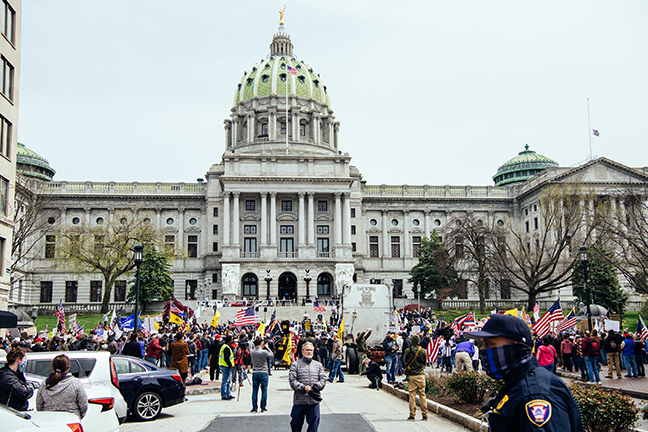
An image from Monday’s “Reopen PA” rally at the PA state Capitol. Photo: Dani Fresh

You know the saying, “Truth is stranger than fiction?” It rings true as we live through this pandemic. Nothing feels “normal” although plenty of us are referring to our new daily routines as our “new normal.”

Like last week’s trip to the grocery store—ordinarily a pretty routine task. But I don’t usually feel dread in the pit of my stomach or have to mentally prepare myself before the normally-mundane grocery trip. Maybe it was because I equipped myself with everything short of a plastic bubble—hand sanitizer, gloves, and bandana-turned-facemask. Taped arrows on the store’s floors pointed the way. I found myself involuntarily smiling at grocery store employees as they greeted me—from a safe distance of six feet away—but my smile froze under my mask as I remembered that: a) they couldn’t see it and b) the conditions didn’t really lend themselves toward being friendly. Neither one of which should be normal.

I tried following the arrows, and I tried not to judge other shoppers who weren’t arrow-followers. It was hard. I just wanted to zig-zag my way through the store, snagging the 15-or-so items on my list and get the heck out of there. One-way aisles with arrows threw a few curveballs into my plan. So did some of the eerily empty shelves.

I also tried avoiding people, which felt unnatural and wrong. Most shoppers had masks on like myself, which was honestly a bit scary. It felt like a crazy dream with a bizarre storyline about caricatured bank robbers. But then I spotted a few shoppers without masks. I didn’t know whether to feel mad or sad. But I definitely wanted to avoid them. What if they had COVID-19? It felt like fear and anxiety were lurking around every corner, every thought. And that shouldn’t be normal. I really wished it was all a bad dream from which I could wake up and shake off. None of us like living like this.

But this virus has taken hold of our lives, our routines, our culture and our country. No one is immune from being affected—the least of which are the thousands of people who have contracted COVID-19 and died as a result. I know I should feel lucky to be healthy, to be able to work from home, to have a home. We use the phrase “during these challenging times” a lot. Most of the time, I’m up for the challenge and I can keep a healthy and positive perspective, based on the facts and news, with a  healthy respect for those in our leadership and governmental roles. But sometimes the challenge and situation feels overwhelming. It hurts to see people hurting.

As a society, we Americans don’t like being told what to do. Our “normal” human habits and paths are being rerouted, detoured and cut off. The American dream is at stake for small business owners forced to close for this time of social distancing. My heart goes out to all of them, and as much as I want to encourage them to keep the faith, the likelihood is that they can’t all survive.

We also cherish our freedom in America. Freedom of religion is alive and well, as most churches creatively and ingeniously take services online. Freedom of speech is also alive—although many are questioning whether it is “well.”

Yesterday, hundreds of people rallied at our state capitol in Harrisburg. These pandemic protesters waved American flags, held handmade signs, many stood shoulder-to-shoulder, and only a few wore masks. Basically, these protesters exercised their freedom of speech. In a nutshell, drawing from the media reports, they were protesting “the new normal” and they want life to go back to “normal”—to their jobs and workplaces.

Those are all facts. But the judgments were levied on social media. And that’s when it hit me in the gut: This pandemic, for a little while, halted us in our tracks and therefore halted a lot of the hate—especially political partisanship and the great divides in American opinion. It was pushed to the background, where it’s been simmering on the proverbial backburner. We all had bigger fish to fry for a few weeks. But with weekend protests in other states, and then our own Pennsylvania protest yesterday, it feels like “the great divides” are boiling once again.

You could feel the hate, anger, frustration and anxiety through social media comments, in response to yesterday’s rally. Insults were hurled at the protesters from all directions—for their lack of social distancing, for the grammatical errors on their signs, for their “stupidity,” and there were those who said they hoped all the protesters came down with the virus. There was even one rogue comment, containing a grammatical error itself, that attacked the media for “framing” the story because the headline, “Hundreds rally at state Capitol to protest shutdown, to ‘reopen PA,’” didn’t say the opposite—that most Pennsylvanians stayed home.

Good journalism summarizes a story in the headline and tells the story in the paragraphs to follow (and the story I’m referring to, did this). Good journalism also reveals new perspectives—ones we may not have considered before—and attempts to uncover motivations. So what motivated people to rally? For many, it appeared to be loss of a job, loss of a way of life, and fear. For others, it appeared to be a black and white case of support of our president and hatred of our governor’s political party—especially his ability to affect change over our way of life. A politicization of the pandemic.

We are living in a gray area that a lot of us are calling “unprecedented.” Most of us are muddling through as best we can. I think one conclusion we can draw is that we’re all mourning the loss of control over our lives. It’s just that we’re expressing that loss in different ways.

At one end of the spectrum are those who are expressing hatred, attacking others and twisting facts and current events to suit their agendas. When people lash out, attack or insult, those actions made under stress reveal their motivation and true character.

At the other end of the spectrum, we have those being lauded by many as heroes—healthcare workers, emergency responders, grocery store workers, medical and scientific researchers, and lots of people doing good. My neighbor is one of these people—she’s baking cookies today and delivering them in cheer packages. Another friend donated dozens of pizzas to a hospital. A teacher friend is uploading daily French and Spanish Facebook lessons. Lots of friends are sewing and donating facemasks, calling and zooming to check on friends and family. These are “the helpers,” as Mr. Rogers called them. Their actions, to bridge gaps and divides, to heal and help—to reach through this time of social distancing with a human touch—reveal their motivation and true character as well.

Karen Hendricks is president of Hendricks Communications, a frequent Burg contributor and host of TheBurg Podcast.


Continue Reading

PA Health Department reports another jump in COVID-19 deaths; new case numbers remain stable

PA Secretary of Health Rachel Levine (right)

New COVID-19 cases remained restrained but fatalities increased substantially in Pennsylvania, as the state today reported an additional 360 deaths from the disease.

The fatalities, which now include both confirmed positive and probable COVID-19 cases, mean that 1,564 Pennsylvanians have died from the disease since the pandemic began in early March.

According to state health Secretary Rachel Levine, deaths include 1,264 confirmed cases and 300 probable cases. A probable case is defined as someone who has shown symptoms consistent with COVID-19 and who can be linked to a confirmed case, but who was not tested for the disease.

In central PA, reported deaths also increased substantially. The COVID-19 fatality data now is as follows:

  • Adams County: 2 deaths (1 more than yesterday)
  • Cumberland County: 6 deaths (2 more than yesterday)
  • Dauphin County: 11 deaths (2 more than yesterday)
  • Franklin County: 10 deaths (10 more than yesterday)
  • Lancaster County: 88 deaths (22 more than yesterday)
  • Lebanon County: 8 deaths (3 more than yesterday)
  • Perry County: 1 death (unchanged)
  • York County: 13 deaths (7 more than yesterday)

Nursing homes and personal care facilities have been particularly hard hit by the virus. Out of total deaths, 796, or about half, have occurred in residents from nursing or personal care facilities, according to the health department.

Levine has said previously that some data reported on Tuesdays may be greater than expected on a day-to-day basis due to less reporting over weekends.

She has also stated that there is a lag between increases in newly reported cases and increases in death rates. Two weeks ago, the commonwealth showed a spike in new cases before that rate began to fall.

The health department today also reported 1,296 newly diagnosed COVID-19 cases as of midnight, bringing total cases in the commonwealth to 34,528 since the pandemic began. This data is similar to the number of new cases reported over the past week.

Locally, total diagnosed cases are as follows:

  • Adams County: 91 cases (yesterday, 85)
  • Cumberland County: 194 cases (yesterday, 186)
  • Dauphin County: 400 cases (yesterday, 386)
  • Franklin County: 143 cases (yesterday, 115)
  • Lancaster County: 1,295 cases (yesterday, 1,236)
  • Lebanon County: 525 cases (yesterday, 502)
  • Perry County: 20 cases (yesterday, 20)
  • York County: 517 cases (yesterday, 493)

“As we start to see the number of new COVID-19 cases decrease across the state that does not mean we can stop practicing social distancing,” Levine said.

Philadelphia County continues to have the most confirmed cases with 9,391 cases, followed by Montgomery County with 3,154 cases. The two counties also have reported the most deaths from the disease: 363 and 223, respectively.

Statewide, 166,851 coronavirus tests have been performed, with 132,323 people testing negative, according to the state health department. Yesterday, the state reported that 162,952 people had been tested for the virus.

Of the patients who have tested positive to date, the age breakdown is as follows, according to the health department:

  • Nearly 1 percent are aged 0-4
  • Nearly 1 percent are aged 5-12
  • 1 percent are aged 13-18
  • Nearly 6 percent are aged 19-24
  • Nearly 39 percent are aged 25-49
  • Nearly 28 percent are aged 50-64
  • 25 percent are aged 65 or older.

Most of the patients hospitalized are 65 or older, as are most of the reported deaths, according to the state. There have been no pediatric deaths to date.

In nursing and personal care homes, there are 5,026 resident cases of COVID-19, and 572 cases among employees, for a total of 5,598 at 396 distinct facilities in 38 counties, according to the health department.

“We must continue to stay home to protect ourselves, our families and our community,” Levine said. “If you must go out, please make as few trips as possible and wear a mask to protect not only yourself, but others. We need all Pennsylvanians to continue to heed these efforts to protect our vulnerable Pennsylvanians, our health care workers and frontline responders.”

Levine continued to emphasize that Pennsylvanians should do the following:

  • Wash your hands with soap and water for at least 20 seconds or use hand sanitizer if soap and water are not available.
  • Cover any coughs or sneezes with your elbow, not your hands.
  • Clean surfaces frequently.
  • Stay home to avoid spreading COVID-19, especially if you are unwell.

For more information, visit the PA Department of Health’s COVID-19 website.

Continue Reading

Bob’s Art Blog: Earth Day at Home

“My Inner Nirvana” by Katelyn Buchan

The 50th anniversary of Earth Day takes place tomorrow.

“April brought us springtime and the promise of the flowers,” wrote musician Dave Loggins back in 1972.

We all could use a reason to celebrate this spring when a month ago looked very dark on the horizon. Wednesday, April 22, is over the hump day, and it is important to celebrate Earth Day if only in our hearts and with our friends (with social distancing as life’s yardstick times two) and loved ones. The theme this year is climate change, and there is positive news on that forefront. For now, we visit vignettes from art before and after the stay-at-home order.

Katelyn Buchan, featured artist on view before the pandemic hit at Elementary Coffee Co.’s North Street location, shares an affinity with her love of nature. Among otherworldly motifs, Ms. Buchan finds that painting centers her spirit and focus as was depicted on the wall at Elementary. Her philosophy reflects a mood of inner peace and transcendence that we all long to feel during these uncertain times. Her paintings are rich in color and texture. “My Inner Nirvana” is a dramatic oil on canvas. The thought process behind the painting reveals an artist in touch with a greater meaning of life when she states, “I bow in gratitude…to nature.”

Just a few blocks away at St. Stephen’s Cathedral’s Riverfront Gallery, artist John McNulty’s oil paintings are also behind shuttered doors for now. Paintings include “Summer Shade,” which provides depth and movement in a monochromatic, lush verdant tree creating its own respite for peace and tranquility. “Chronicle,” a study in close-up of a multicolored tree branch in its stages of growth, reflects light and shadows. “Conversations” shows friends congregating, which speaks to the gratitude we will share when we can all be together again. Among other accolades attributed to McNulty is being recognized as one of the Seven Lively Artists and as a painting instructor for the Hershey Area Art Association. In addition, he is one of the artists in residence at the Millworks (Studio 210 to be exact) and is a painter whose medium of choice for now is sumptuous oils. Representative of earth’s beauty are his studies of trees in their rebirth of the seasonal cycle to lift the spirit of on-lookers yet to be. Both artists share a love and appreciation for the natural beauty around them.

“Conversation” by John McNulty

This Earth Day is all the more remarkable in that it is the golden anniversary of the first one held back in 1970. There is a certain irony in that the one thing we are able to do this time around is hug a tree. The universal theme celebrated worldwide in 193 countries is climate change. For those bowing in humble reverence to Mother Earth, now is a great time to recalibrate how the world going forward can globally alter the climate change crisis. As recently editorialized by a bio-scientist in the New York Times, there is already a dramatic change in the reduction of greenhouse gases released in the atmosphere due to nations all around the world staying at home. The air is already noticeably cleaner in China and Italy from this reversal.

Through this all, we hope we will have more compassion for one another, a greater sense of community and gratitude for the slowed-down time with family which, for some, led to time working on creative endeavors together. On a recent sunny afternoon, neighborhood budding artists created color chalk flowers, rainbows, stars and hearts to bring smiles to those enjoying time outdoors—a relevant reminder that the innocence of children sheds a light that we, as adults, sometimes lose sight of in our focus on the very things we have no control over. It is the children who continue to believe in and see the beauty all around us, especially during this special time of year. (Pictured: “Rainbow” by Brandi, Madden and Kendall.)

Go safely outdoors and breathe in the fresh air, sunshine and take in the beauty of nature. Keep safe and positive and hopeful. These are some “Pieces of April … for a morning in May.”

Art can sustain us in uncertain times, enrich our lives when it seems there is little else to offer solace, and give us hope that through the creativity of the human spirit, mankind will not only endure but survive and thrive in the days ahead.

Continue Reading

Hundreds rally at state Capitol to protest shutdown, to “reopen PA.”

The crowd at the Capitol steps at the height of today’s rally.

They brought homemade anti-shutdown signs.

They waved large American and pro-Trump flags.

They circled the state Capitol building and honked their horns. And then they circled around and honked some more.

Today, hundreds of people gathered at a “Reopen PA” rally on the steps of the PA Capitol, on the sidewalk across the street and in vehicles that repeatedly drove around the block.

They were there to protest Gov. Tom Wolf’s orders to shut down “non life sustaining” businesses and to stay at home, measures taken about a month ago to try to contain and fight the COVID-19 pandemic, which, as of today, has infected at least 33,232 Pennsylvanians and killed 1,204 since early March.

There were signs that said, “Every Business Is Essential,” and others that read, “#Fake Crisis,” “Crossfit Is Essential,” “I Want My Nails Done,” and “Jesus Is My Vaccine,” among many others.

Some rally-goers wore face masks, as required by the state health department, but most did not. The crowd in and around the Capitol steps was heavy, with almost no one observing the six-foot social distancing requirement.

The rally was loud, but appeared peaceful. There were few counter-protestors, and the Capitol and state police kept cars and trucks moving in front of the statehouse, despite large crowds on both sides of N. 3rd Street.

When asked why they came out to protest, people cited two main reasons.

First, they said that Wolf’s business shutdown was destroying small businesses and, in fact, numerous commercial vehicles—landscapers, construction companies, a junk hauler and others—repeatedly circled the Capitol. Secondly, they stated that they believed that the “stay-at-home” and other orders issued by Wolf infringed on their civil liberties.

“He [Wolf] is not a dictator,” said Ed Collins of Lancaster County. “He can’t tell me what to do. To me, it’s really that simple.”

Of the dozen or so people interviewed for this story, most also said that they supported President Donald Trump, as evidenced by the many Trump flags, “Trump Pence 2020” signs and “MAGA” hats.

One vendor was doing a brisk business hawking $5 T-shirts that said, “Four More Years,” while another stand sold everything from American flags to “Trump 2020” face masks.

“We want real Republicans in office, not fake ones like [Utah Sen.] Mitt Romney,” said Will Crispen, who drove to Harrisburg today from Berks County with his family.

Several state legislators spoke at the rally, including Reps. Aaron Bernstein (R-Beaver/Butler/Lawrence) and Russ Diamond (R-Lebanon).

“I believe that every one of you is essential and every one of your businesses is life-sustaining,” Diamond told the cheering crowd.

He then accused Wolf of arbitrariness in deciding which businesses remained open and which ones had to close.

“Arbitrarily picking winners and losers is not life-sustaining,” he said.

Wolf today did announce a May 8 date to begin repealing some of his business closure and stay-at-home orders, saying that loosening restrictions would happen gradually and regionally “based upon the data.”

For one rally-goer, however, May 8 seemed like a world away.

“We don’t want to wait until May 8,” said May Pierson of Montgomery County. “We want it all opened today, right now.”

Continue Reading

Gov. Wolf sets May 8 for “gradual” reopening of state economy

Gov. Tom Wolf (right) spoke today during a virtual press conference

Gov. Tom Wolf has set a date of May 8 to begin a “gradual” reopening the state’s economy, though he urged residents to continue practicing social distancing and other safety measures.

Wolf today set that target date to begin the process of business re-openings, though he emphasized that ending the shutdown would be regional, likely beginning with rural counties that have shown relatively few confirmed cases of COVID-19.

“We’ve done the mitigation stage in a measured, commonsense way, and the plan is to move out of this stage in a measured, commonsense way,” he said.

The areas hardest hit by the COVID-19 pandemic would likely to be the last ones to have the business shutdown end.

“We’re going to do this on a regional basis,” he said. “If we open in rural area, it doesn’t mean we’ll end the shutdown or stay at home order in a place like Philadelphia.”

Wolf made his remarks in an online news conference as hundreds of people gathered at the state Capitol to protest the business shutdown and stay-at-home orders, many carrying anti-shutdown signs and waving pro-Trump flags. In addition, the state today reported the fewest number of newly diagnosed COVID-19 cases in three weeks.

Wolf also stressed that Pennsylvanians should continue measures such as staying at home and social distancing, even after shutdown orders end.

“If we go too quickly, this might be unsafe for people,” he said. “If we move too quickly, people may not want to go to work because they’re afraid, or may not want to go into a store to buy something because they’re afraid.”

Last week, Wolf set six criteria for businesses to reopen, including:

  • Re-openings will be “data driven,” will be based upon “quantifiable criteria” and will be targeted and regional.
  • Before allowing businesses to reopen, the state will issue “guidance and recommendations” for employers and workers.
  • Reopening will necessitate the availability of “adequate personal protective equipment” and “diagnostic testing.”
  • Reopening will require a monitoring and surveillance program allowing the commonwealth to deploy “swift actions” for containment or mitigation.
  • Protections for vulnerable populations, especially at congregate care facilities and prisons, will remain in place throughout the reopening process.
  • Limitations on large gatherings unrelated to work will remain in place for the duration of the reopening process.

Wolf also set May 8 for the resumption of residential and commercial construction projects that have not been given an exemption under the current shutdown order. In Pennsylvania, the construction industry has been especially vocal in protesting the mandated closing of “non life sustaining” businesses.

In addition, Wolf said that 176 state-owned liquor stores began curbside pickup operations today. Under the plan, there is a limit of six bottles per order, with credit cards the only accepted form of payment. At pickup, customers will be required to present identification before the order is delivered.

Wolf today also said that he would sign Senate Bill 841, approving qualified Pennsylvania notaries public to perform remote online notarizations, which will allow auto dealerships to conduct limited car sales and leasing operations through online sales.

“I want to caution that we will not be resuming operations as they were in February,” Wolf said. “We’re going to continue to take precautions that limit our physical contact with others, and we will closely monitor this to see if it can be done safely.”

Continue Reading

New COVID-19 cases fewer than 1,000, lowest daily rate in weeks

Pennsylvania reported fewer than 1,000 new COVID-19 infections today for first time in about three weeks.

The state Department of Health today said that 948 Pennsylvanians were diagnosed with the virus as of midnight.

This is the lowest daily number of new cases reported since March 31.

With the additional cases, 33,232 state residents have now been diagnosed with the disease.

The health department also reported 92 additional deaths from the disease, bringing total fatalities in the commonwealth to 1,204.

As of midnight, the COVID-19 fatality data now is as follows:

  • Adams County: 1 death (unchanged)
  • Cumberland County: 4 deaths (unchanged)
  • Dauphin County: 9 deaths (unchanged)
  • Franklin County: 0 deaths
  • Lancaster County: 66 deaths (6 more than yesterday)
  • Lebanon County: 5 deaths (1 more than yesterday)
  • Perry County: 1 death (unchanged)
  • York County: 6 deaths (unchanged)

As of midnight, total diagnosed cases were as follows:

  • Adams County: 85 cases (yesterday, 80)
  • Cumberland County: 186 cases (yesterday, 182)
  • Dauphin County: 386 cases (yesterday, 368)
  • Franklin County: 115 cases (yesterday, 111)
  • Lancaster County: 1,236 cases (yesterday, 1,188)
  • Lebanon County: 502 cases (yesterday, 484)
  • Perry County: 20 cases (yesterday, 20)
  • York County: 493 cases (yesterday, 481)

“As we start to see the number of new COVID-19 cases decrease across the state that does not mean we can stop practicing social distancing,” said Secretary of Health Rachel Levine.

Philadelphia County continues to have the most confirmed cases with 9,038 cases, followed by Montgomery County with 3,040 cases. The two counties also have reported the most deaths from the disease: 262 and 184, respectively.

Statewide, 162,952 coronavirus tests have been performed, with 129,720 people testing negative, according to the state health department. Yesterday, the state reported that 158,854 people had been tested for the virus.

Of the patients who have tested positive to date, the age breakdown is as follows, according to the health department:

  • Less than 1 percent are aged 0-4
  • Nearly 1 percent are aged 5-12
  • 1 percent are aged 13-18
  • 6 percent are aged 19-24
  • 39 percent are aged 25-49
  • 28 percent are aged 50-64
  • 24 percent are aged 65 or older.

Most of the patients hospitalized are 65 or older, as are most of the reported deaths, according to the state. There have been no pediatric deaths to date.

““We must continue to stay home to protect ourselves, our families and our community,” Levine said. “If you must go out, please make as few trips as possible and wear a mask to protect not only yourself, but others. We need all Pennsylvanians to continue to heed these efforts to protect our vulnerable Pennsylvanians, our health care workers and frontline responders.”

Levine continued to emphasize that Pennsylvanians should do the following:

  • Wash your hands with soap and water for at least 20 seconds or use hand sanitizer if soap and water are not available.
  • Cover any coughs or sneezes with your elbow, not your hands.
  • Clean surfaces frequently.
  • Stay home to avoid spreading COVID-19, especially if you are unwell.

 For more information, visit the PA Department of Health’s COVID-19 website.

Continue Reading