Harrisburg school district to launch new cyber option for students

Susan Sneath, Harrisburg school district’s chief academic officer (far right), at a board meeting last year.

Come fall, Harrisburg school district students will have another way to learn, as district officials have announced a new, full-time cyber school.

On Monday night, district officials unveiled the Harrisburg Virtual Learning Academy, which is meant to broaden educational options and offer an alternative to cyber charter schools.

“Early on, we asked our teachers to make calls to get feedback from our families. This was way back in March,” said Susan Sneath, chief academic officer for the district. “They were already telling us there was no way they were going to send their children back to [brick and mortar] school.”

Sneath knew the district needed to have another option for students. Thus, the Harrisburg Virtual Learning Academy (HVLA) was established.

According to the district, the HVLA will be full-time and free to Harrisburg students. The program offers K-12th grade enrollment, in which each student is provided a Chromebook.

This differs from the district’s existing Cougar Academy, which is a “blended” cyber program that requires that students also spend time inside the classroom. In contrast, HVLA is fully remote.

Students will receive recorded instruction from teachers with additional meetings as needed. While the school is primarily online, there are face-to-face tutoring options, including English language arts and math. Special education teachers, English as a second language teachers and reading specialists will be available to provide support.

Sneath explained that students will continue to receive academic advising through an assigned counselor and can expect outreach from a social worker to aid with social and emotional needs. Technology support will be readily available, as well, during school hours.

The school district plans to use trained educators from the Montgomery County Intermediate Unit, an entity that supports local school districts. Additional faculty, such as counselors and academic advisors, will come from Harrisburg staff.

Students in HVLA can participate in academic advancement such as Advanced Placement courses and “gifted” programs. They will also be tied to their neighborhood’s school, which will allow access to all special events and extracurricular activities such as picture day, athletics and prom.

All HVLA students are considered Harrisburg Cougars, Sneath confirmed. They will all receive a diploma from the Harrisburg school district.

In the past, students in the district seeking online education have often looked to cyber charter schools, but Sneath hopes that this option curbs that.

“We want to keep our kids, and we want to provide the very best for our kids,” she said. “We developed HVLA with that in mind.”

HVLA will not take the place of the district’s remote learning plan for students in the case that students can’t return to school buildings in the fall. The cyber school is only for those who enroll.

“The intent of the people who enroll in HVLA is that they are going to stay in HVLA,” Sneath said.

With a proposed budget for the 2020-21 academic year that’s looking tight, Sneath hopes grant funding will help with cyber school costs.

The virtual school will go live by mid-August, Sneath said.

“I wouldn’t be in public education if I didn’t think brick and mortar was the very best way to educate kids,” Sneath said. “However, my hope and dream for HVLA is that parents in Harrisburg feel that their school district is supporting what they want.”

For more information about the Harrisburg Virtual Learning Academy, call 717-703-4000 and mention you are interested in HVLA or email [email protected]. Visit the district’s website for updates.

Continue Reading

COVID-19 widespread in Dauphin County, midstate nursing homes, as state releases facility data

PA Department of Health Secretary Rachel Levine (right) at Tuesday’s press briefing

Nearly half of all COVID-19-related fatalities in Dauphin County have occurred among residents of nursing homes, the state Department of Health disclosed today.

As of Tuesday, 24 of the county’s 50 deaths from the disease have occurred in these congregant care facilities, according to the department. In all, 313 of 989 total cases have occurred in the facilities, including 260 residents and 53 staff members.

According to the health department, in Dauphin County, the cases have primarily occurred in three nursing homes:

  • Spring Creek Rehab and Nursing Center: 169 resident cases, 21 staff cases, 14 fatalities
  • Country Meadows of Hershey: 47 resident cases, 16 staff cases, 10 fatalities
  • Premier at Susquehanna Nursing & Rehab: 44 resident cases, 16 staff cases

Today marks the first time that the department has publicly revealed detailed case and death data from long-term care facilities. Since the magnitude of the problem at these facilities has begun to be known, the department has been under increasing pressure from the press and local officials to release this information publicly.

“As I have said, long-term care facility residents are among our most vulnerable Pennsylvanians with the global pandemic of COVID-19,” health department Secretary Rachel Levine said. “We want their families to have the latest information on what is going on the facilities where their loved ones reside.”

In Cumberland County, four facilities together account for 307 cases (253 resident and 54 staff cases) of the county’s 540 positive COVID-19 cases. Forty of the county’s 42 deaths have occurred in nursing facilities. According to the health department, this includes:

  • Sarah A. Todd Memorial Home: 40 resident cases
  • Shippensburg Health Care Center: 88 resident cases, 18 staff cases, 23 deaths
  • The Gardens at Camp Hill: 51 resident cases, 15 staff cases, seven deaths
  • The Gardens at West Shore: 74 resident cases, 21 staff cases, 10 deaths

No Perry County facilities have recorded cases, according to the department.

In the midstate, Lancaster County has recorded the most nursing home cases. Throughout the county, there are 666 resident cases, 155 staff cases and 145 fatalities among 33 facilities, according to the health department.

Statewide, Brighton Rehab and Wellness Center in Allegheny County has had the most cases: 358 among residents and 25 among staff, with 76 fatalities, according to health department data.

In response to the spread of COVID-19 in nursing and long-term care facilities, the commonwealth has begun testing all residents and staff, Levine said. The state recently began employing members of the National Guard to assist in the effort.

Click below to download the health department’s full Excel spreadsheet of COVID-19 cases in PA nursing home/long-term care facilities. COVID-19 LTCF Data_5-19-20

Continue Reading

New COVID-19 cases down again in PA, though death rate remains high

An image from the state Department of Health lab in Exton, Pa.

New COVID-19 cases dipped significantly across the commonwealth today, though fatalities from the disease remained elevated.

The state Department of Health reported 610 new COVID-19 cases in Pennsylvania for the period ending at midnight. Today’s new case data is among the lowest since late March.

With the additional cases, 63,666 Pennsylvanians have now been diagnosed with the coronavirus.

New cases in PA peaked in early April at nearly 2,000 cases, but have shown a gradual, relatively steady decline since, despite greater levels of testing for the virus over that time period. New daily cases have been below 1,000 for more than a week.

Of the new cases today, 187 are in residents of nursing and personal care homes.

Locally, total diagnosed cases are as follows:

  • Adams County: 194 cases (yesterday, 194)
  • Cumberland County: 540 cases (yesterday, 525)
  • Dauphin County: 989 cases (yesterday, 978)
  • Franklin County: 644 cases (yesterday, 631)
  • Lancaster County: 2,593 cases (yesterday, 2,552)
  • Lebanon County: 880 cases (yesterday, 877)
  • Perry County: 41 cases (yesterday, 41)
  • York County: 866 cases (yesterday, 857)

Overall, 18.2 percent of PA residents tested have shown to be positive for the virus.

The health department also reported another 119 fatalities, meaning that 4,624 Pennsylvanians have died from the disease over the past two months. Of the newly reported fatalities, 59 were residents of nursing or personal care homes.

Around central PA, the COVID-19 fatality data now stands as follows:

  • Adams County: 5 deaths (yesterday, 5)
  • Cumberland County: 42 deaths (yesterday, 41)
  • Dauphin County: 50 deaths (yesterday, 50)
  • Franklin County: 27 deaths (yesterday, 25)
  • Lancaster County: 259 deaths (yesterday, 252)
  • Lebanon County: 24 deaths (yesterday, 21)
  • Perry County: 1 death (yesterday, 1)
  • York County: 18 deaths (yesterday, 18)

Statewide, Philadelphia County continues to have the most confirmed cases with 16,487 cases, followed by Montgomery County with 6,063 cases. The two counties also have reported the most deaths statewide from the disease: 1,109 and 575, respectively.

“As counties move from red to yellow, we need all Pennsylvanians to continue to follow the social distancing and mitigation efforts in place,” health Secretary Rachel Levine said.

So far, the state has moved 37 counties, mostly in the western and northern areas, into the yellow phase. On Friday, 13 more counties, including Cumberland, York, Perry and Adams counties, will enter the yellow phase.

Nursing homes and personal care facilities have been particularly hard hit by the virus. Out of total deaths, 3,145, or 68 percent, have occurred in residents from nursing or personal care facilities, according to the health department.

In nursing and personal care homes, there are 13,813 resident cases of COVID-19, and 2,191 cases among employees, for a total of 16,013 at 557 distinct facilities in 44 counties, according to the health department.

In addition, about 4,600 of total cases in PA are in health care workers.

Statewide, 349,700 coronavirus tests have been performed, with 286,034 people testing negative, according to the state health department. Yesterday, the state reported that 340,609 people had been tested for the virus.

Of the patients who have tested positive to date, the age breakdown is as follows, according to the health department:

  • Nearly 1 percent are aged 0-4
  • Nearly 1 percent are aged 5-12
  • Nearly 2 percent are aged 13-18
  • Nearly 6 percent are aged 19-24
  • Nearly 37 percent are aged 25-49
  • Nearly 26 percent are aged 50-64
  • Nearly 29 percent are aged 65 or older.

Most of the patients hospitalized are 65 or older, as are most of the reported deaths, according to the state.

Levine continued to emphasize that Pennsylvanians should do the following:

  • Wash your hands with soap and water for at least 20 seconds or use hand sanitizer if soap and water are not available.
  • Cover any coughs or sneezes with your elbow, not your hands.
  • Clean surfaces frequently.
  • Stay home to avoid spreading COVID-19, especially if you are unwell.

 “We must continue to protect our most vulnerable Pennsylvanians, which includes our seniors, those with underlying health issues, our healthcare workers and our first responders,” Levine said. “I am proud of the work that Pennsylvanians have done so far, but we cannot stop now, we must continue to take the necessary steps to protect ourselves from COVID-19.”

For more information, visit the PA Department of Health’s COVID-19 website.

Continue Reading

Tales from the Pandemic: Harrisburg University captures a unique time in our history

The front entrance to Harrisburg University on Market Street

Some days, it feels like we are frozen in time, each day blending with the last.

But the COVID-19 pandemic is actively making history, and Harrisburg University hopes to preserve a piece of it.

“This is an opportunity to share stories,” said Glenn Williams, professor of advanced manufacturing, augmented reality and robotics. “Since we are a community at HU, we should share ours.”

The university, with Williams taking the lead, launched “HU Stories: Facing the 2020 Pandemic Together” last week. The project will collect reflections from students, faculty, staff, donors and others who consider themselves part of the HU community.

Reflections on these lived experiences can take the form of the written word, photography, videography, song, art, etc. Once submitted to the school, they will be published to HU’s website and social media channels.

“By sharing, you realize you aren’t doing this by yourself,” HU President Eric Darr said.

Williams recognized that the university’s specialization in science and technology may cause people to see the intellectual side of the students over the emotional side.

“What hit me was the personal side of [the pandemic], the impact on people,” he said. “It made me realize HU is a science school, but people have feelings.”

The school will compile the submissions into a digital and perhaps physical book to keep as a time capsule. Williams hopes that, in years to come, people will look back on the stories and get a glimpse of what it was like to live through the pandemic.

The “HU Stories” project is just one way the university is trying to help students navigate life during the crisis.

Williams explained that much of his inspiration for the project came from Darr’s discussion about what HU was already doing to support students. Darr mentioned that the school provided housing, food and health services for students even after HU closed its campus.

“We recognize this is and continues to be a stressful time for all of us,” Darr said.

From the HU students to the custodians to the president, everyone is affected by the pandemic, and Williams hopes this project will provide a release.

“These stories should be captured so they can be documented,” he said. “Their experiences 50 to 100 years from now can be shared and read.”

The submission form for the “HU Stories” project can be found here. For more information, visit Harrisburg University’s website.

Continue Reading

Harrisburg school district approves preliminary budget with big deficit but no tax increase

The Harrisburg school district’s Lincoln administration building

The Harrisburg school district on Monday night approved a preliminary budget for next school year, using federal aid to close a substantial budget gap.

District Receiver Janet Samuels OK’d the $157.6 million spending plan, which does not raise school taxes for the 2020-21 year.

The district took a $4.2 million hit due to the COVID-19 pandemic and resulting economic crisis. Unexpectedly, the district had to lower expected revenue from earned income taxes, PILOT tax payments, real estate taxes and increases in the state’s basic and special education subsidies.

To help close the deficit, the district was awarded a $4.7 million grant from the federal Coronavirus Aid, Relief and Economic Security (CARES) Act. However, those funds expire Sept. 30, according to Acting Superintendent Chris Celmer.

“It’s going to take time to work through logistics of how we are able to spend that,” he said.

Celmer said that, if additional state funding doesn’t eliminate the deficit, a staff realignment may help, along with the CARES Act funding.

The 2020-21 budget is $8.6 million higher than the current, 2019-20 school year’s projected final budget. Employee salaries and benefits, along with other higher expenses, are causing the increased spending, according to the district.

A final virtual budget workshop is scheduled for June 15. A final decision on a 2020-21 spending plan is expected on June 22.

The proposed final budget will be available to the public on the district’s website for 30 days before the final meeting in June.

Continue Reading

Elderly, ill constitute far majority of COVID-19 deaths in PA, says state

PA Department of Health Secretary Rachel Levine (right) at Monday’s press briefing

The far majority of coronavirus-related deaths in Pennsylvania have been in older people and, particularly, those with pre-existing illnesses.

The state Department of Health on Monday released its first weekly report with a breakdown of data from deaths attributed to COVID-19.

According to the data (see chart), as of Monday, 3,927 of 4,505 total deaths, or 87.5 percent, were of people 65 years and older.

“Clearly, the data from Pennsylvania and from other states and other countries show that seniors are most at risk of having severe complications to COVID-19 and tragically passing away,” said health Secretary Rachel Levine.

Source: Pennsylvania Department of Health: “Weekly Report for Deaths Attributed to COVID-19.

In addition, the commonwealth reported that the far majority of people who died had “co-morbidities,” or other illnesses, besides COVID-19.

“The seniors that would be most at risk are those with other types of medical co-morbidities or other medical conditions,” Levine said. “We know that those individuals are most at risk from COVID-19.”

The department today reported 4,529 incidents of “co-morbidities” among deceased patients, including heart disease, cancer and diabetes. This incident count is higher than the actual death count because some patients had multiple diagnosed illnesses.

Source: Pennsylvania Department of Health: “Weekly Report for Deaths Attributed to COVID-19.

Levine said that, while younger people have lower death rates from COVID-19, they still are at risk for contracting serious cases of the illness.

“There are others at risk,” she said. “They have a much less death rate, but they do have significant rates of illness and that includes young adults and middle-aged adults.”

She added that children have a very low incidence of death from COVID-19, but are at risk from “the new multi-system inflammatory condition.

At her press briefing on Monday, Levine also explained that her department is now using death certificate information to determine the resident county of people who have died from the disease.

To date, 68.5 percent of total deaths in PA have been in residents of nursing and other care homes. These people sometimes officially resided in a different county from the location of the facility.

Because of this, county-by-county breakdowns of deceased patients changed significantly on Monday, particularly in Dauphin, Cumberland and Lancaster counties. These changes are indicated by the following summary for the greater Harrisburg area comparing deaths reported today to deaths reported yesterday:

  • Adams County: 5 deaths (yesterday, 6)
  • Cumberland County: 41 deaths (yesterday, 48)
  • Dauphin County: 50 deaths (yesterday, 39)
  • Franklin County: 25 deaths (yesterday, 13)
  • Lancaster County: 252 deaths (yesterday, 187)
  • Lebanon County: 21 deaths (yesterday, 19)
  • Perry County: 1 death (yesterday, 1)
  • York County: 18 deaths (yesterday, 16)

“One of the things we have to deal with is in terms of the differences between where a person passed away and what county they might be from and how that gets reported,” Levine said.

Continue Reading

PA reports 822 new COVID-19 cases; disease fatalities elevated again

An image from the state Department of Health lab in Exton, Pa.

The commonwealth continued to report new COVID-19 cases below 1,000, though fatalities from the disease jumped again.

The state Department of Health today reported 822 new COVID-19 cases in Pennsylvania for the period ending at midnight. This marks more than a week with new case numbers below 1,000, the first time this has happened since March.

With the additional cases, 63,056 Pennsylvanians have now been diagnosed with the coronavirus.

New cases in PA peaked in early April at nearly 2,000 cases, but have shown a gradual, relatively steady decline since, despite greater levels of testing for the virus over that time period.

Case numbers on Mondays have tended to be lower due to less reporting to the health department over the weekend, according to Secretary Rachel Levine.

Of the new cases today, 179 are in residents of nursing and personal care homes.

Locally, total diagnosed cases are as follows:

  • Adams County: 194 cases (yesterday, 189)
  • Cumberland County: 525 cases (yesterday, 522)
  • Dauphin County: 978 cases (yesterday, 963)
  • Franklin County: 631 cases (yesterday, 621)
  • Lancaster County: 2,552 cases (yesterday, 2,508)
  • Lebanon County: 877 cases (yesterday, 874)
  • Perry County: 41 cases (yesterday, 40)
  • York County: 857 cases (yesterday, 851)

Overall, 18.5 percent of PA residents tested have shown to be positive for the virus.

The health department also reported another 87 fatalities, meaning that 4,505 Pennsylvanians have died from the disease over the past two months. Of the newly reported fatalities, 29 were residents of nursing or personal care homes.

Today, the state’s county-by-county fatality data has changed significantly. This seems to be because the state now is relying on addresses recorded in registered death records. The majority of fatalities in PA have occurred in nursing homes, whose residents often had their official residences in a different county from the facility.

Around central PA, the COVID-19 fatality data now stands as follows:

  • Adams County: 5 deaths (yesterday, 6)
  • Cumberland County: 41 deaths (yesterday, 48)
  • Dauphin County: 50 deaths (yesterday, 39)
  • Franklin County: 25 deaths (yesterday, 13)
  • Lancaster County: 252 deaths (yesterday, 187)
  • Lebanon County: 21 deaths (yesterday, 19)
  • Perry County: 1 death (yesterday, 1)
  • York County: 18 deaths (yesterday, 16)

Statewide, Philadelphia County continues to have the most confirmed cases with 16,340 cases, followed by Montgomery County with 6,012 cases. The two counties also have reported the most deaths statewide from the disease: 1,080 and 566, respectively.

“As counties move from red to yellow, we need all Pennsylvanians to continue to follow the social distancing and mitigation efforts in place,” Levine said.

So far, the state has moved 37 counties in the southwest portion of the state into the yew phase. On Friday, 13 more counties, including Cumberland, York, Perry and Adams counties, will enter the yellow phase.

Nursing homes and personal care facilities have been particularly hard hit by the virus. Out of total deaths, 3,086, or 68.5 percent, have occurred in residents from nursing or personal care facilities, according to the health department.

In nursing and personal care homes, there are 13,626 resident cases of COVID-19, and 2,111 cases among employees, for a total of 15,737 at 561 distinct facilities in 44 counties, according to the health department.

In addition, 4,479 of total cases in PA are in health care workers.

Statewide, 340,609 coronavirus tests have been performed, with 277,553 people testing negative, according to the state health department. Yesterday, the state reported that 332,904 people had been tested for the virus.

Of the patients who have tested positive to date, the age breakdown is as follows, according to the health department:

  • Nearly 1 percent are aged 0-4
  • Nearly 1 percent are aged 5-12
  • Nearly 2 percent are aged 13-18
  • Nearly 6 percent are aged 19-24
  • Nearly 37 percent are aged 25-49
  • Nearly 26 percent are aged 50-64
  • Nearly 29 percent are aged 65 or older.

Most of the patients hospitalized are 65 or older, as are most of the reported deaths, according to the state.

Levine continued to emphasize that Pennsylvanians should do the following:

  • Wash your hands with soap and water for at least 20 seconds or use hand sanitizer if soap and water are not available.
  • Cover any coughs or sneezes with your elbow, not your hands.
  • Clean surfaces frequently.
  • Stay home to avoid spreading COVID-19, especially if you are unwell.

“We must continue to protect our most vulnerable Pennsylvanians, which includes our seniors, those with underlying health issues, our healthcare workers and our first responders,” Levine said. “I am proud of the work that Pennsylvanians have done so far, but we cannot stop now, we must continue to take the necessary steps to protect ourselves from COVID-19.”

For more information, visit the PA Department of Health’s COVID-19 website.

Continue Reading

New COVID-19 cases continue a gradual decline in Pennsylvania

An image from the PA Department of Health lab in Exton

Newly diagnosed COVID-19 cases dipped again in PA, as the state reported one of the lowest daily case totals in six weeks.

The state Department of Health reported 623 new COVID-19 cases in Pennsylvania for the period ending at midnight. This marks a week with new case numbers below 1,000, the first time that has happened since March.

With the additional cases, 62,234 Pennsylvanians have now been diagnosed with the coronavirus.

New cases in PA peaked in early April at nearly 2,000 cases, but have shown a gradual, relatively steady decline since, despite greater levels of testing for the virus over that time period.

Case numbers on weekends have tended to be lower due to less reporting to the health department, according to Secretary Rachel Levine.

Of the new cases today, 190 are in residents of nursing and personal care homes.

Locally, total diagnosed cases are as follows:

  • Adams County: 189 cases (yesterday, 185)
  • Cumberland County: 522 cases (yesterday, 515)
  • Dauphin County: 963 cases (yesterday, 938)
  • Franklin County: 621 cases (yesterday, 601)
  • Lancaster County: 2,508 cases (yesterday, 2,470)
  • Lebanon County: 874 cases (yesterday, 873)
  • Perry County: 40 cases (yesterday, 40)
  • York County: 851 cases (yesterday, 835)

Overall, 18.7 percent of PA residents tested have shown to be positive for the virus.

The health department also reported another 15 fatalities, meaning that 4,418 Pennsylvanians have died from the disease over the past two months.

The majority of new fatalities—14—were residents of nursing or personal care homes.

Around central PA, the COVID-19 fatality data now stands as follows:

  • Adams County: 6 deaths (yesterday, 6)
  • Cumberland County: 48 deaths (yesterday, 48)
  • Dauphin County: 39 deaths (yesterday, 39)
  • Franklin County: 13 deaths (yesterday, 13)
  • Lancaster County: 187 deaths (yesterday, 186)
  • Lebanon County: 19 deaths (yesterday, 19)
  • Perry County: 1 death (yesterday, 1)
  • York County: 16 deaths (yesterday, 16)

Statewide, Philadelphia County continues to have the most confirmed cases with 16,140 cases, followed by Montgomery County with 5,872 cases. The two counties also have reported the most deaths statewide from the disease: 1,022 and 620, respectively.

“As counties move from red to yellow, we need all Pennsylvanians to continue to follow the social distancing and mitigation efforts in place,” Levine said.

So far, the state has moved 37 counties in the southwest portion of the state into the yew phase. On Friday, 13 more counties, including Cumberland, York, Perry and Adams counties, will enter the yellow phase.

Nursing homes and personal care facilities have been particularly hard hit by the virus. Out of total deaths, 3,057, or 69.2 percent, have occurred in residents from nursing or personal care facilities, according to the health department.

In nursing and personal care homes, there are 13,447 resident cases of COVID-19, and 2,091 cases among employees, for a total of 15,447 at 558 distinct facilities in 45 counties, according to the health department.

In addition, 4,451 of total cases in PA are in health care workers.

Statewide, 332,904 coronavirus tests have been performed, with 270,670 people testing negative, according to the state health department. Yesterday, the state reported that 327,836 people had been tested for the virus.

Of the patients who have tested positive to date, the age breakdown is as follows, according to the health department:

  • Nearly 1 percent are aged 0-4
  • Nearly 1 percent are aged 5-12
  • Nearly 2 percent are aged 13-18
  • Nearly 6 percent are aged 19-24
  • Nearly 37 percent are aged 25-49
  • Nearly 26 percent are aged 50-64
  • Nearly 29 percent are aged 65 or older.

Most of the patients hospitalized are 65 or older, as are most of the reported deaths, according to the state.

Levine continued to emphasize that Pennsylvanians should do the following:

  • Wash your hands with soap and water for at least 20 seconds or use hand sanitizer if soap and water are not available.
  • Cover any coughs or sneezes with your elbow, not your hands.
  • Clean surfaces frequently.
  • Stay home to avoid spreading COVID-19, especially if you are unwell.

“We must continue to protect our most vulnerable Pennsylvanians, which includes our seniors, those with underlying health issues, our healthcare workers and our first responders,” Levine said. “I am proud of the work that Pennsylvanians have done so far, but we cannot stop now, we must continue to take the necessary steps to protect ourselves from COVID-19.” 

For more information, visit the PA Department of Health’s COVID-19 website.

Continue Reading

Bob’s Art Blog: Art Gone Wild

Part I: Folklore and Fact: Fairies, “Friends” and a Farrago (What put the “wild” in Wildwood)

Legend has it that magical creatures, sprites and fairies reside amongst the lichens and moss found in Wildwood Park. Will-o’ the wisps light up the nights on the lake, and whispers from wee folk are heard on the walking trails if you listen closely.

The lore surrounding the environ speaks to this haven for nature and its otherworldly inhabitants. The 229 acres comprising the space within the park’s parameters have been designated as a natural habitat now approaching 120 years in operation. The superstition, “knock on wood,” has its origins in the days of yore when the Celts roamed Europe. People would run into the woods to share secrets then literally knock on the trees, so the spirits abiding within would not hear what was divulged.

“The Last Wave” by Beau and Jana MacGinnes at “Art in the Wild”

In late afternoon, Wildwood Park becomes a photo from an album of bygone years—blue sky, calm water, a lone heron on the lake and twee chipmunks frolicking among the ground cover. It wasn’t always that way. Wildwood Park’s history has had its share of ups and downs over its six score years.

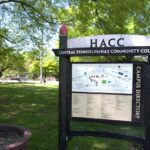
It was originally called Wetzel’s Swamp. In 1901, Wildwood Lake was established by Harrisburg as part of a national movement called “City Beautiful,” incorporating elements of interest well advanced for the day. It housed a zoo that counted “lions and tigers and bears” oh my…(just kidding) among its constituency. Seriously, the zoo was home to a whimsical farrago of animals that included elk, buffalo, a black bear and a barrel full of monkeys, 24, in fact, exotic and enchanting. The zoo was a popular feature from the 1920s through the 1940s. The menagerie included a mountain lion, muskrat, raccoon, mink and white-tailed deer among the attractions. Where the deer and antelope played was situated on the acreage today that is the HACC campus. Riding stables, boating concessions and a ball field all provided entertainment and recreational opportunities. Combine the legend and lore, and therein lies the foundation for “Wildwood.”

The park fell to disrepair and ended up becoming a dumping site by the 1960s. Also, later in that decade, the Audubon Society, through a study, determined Wildwood to be ideal for a nature center with programming as a natural extension. The Dauphin County commissioners purchased the land we recognize today as Wildwood Park for the magnanimous sum of $1 in 1976 with the blessing of Harrisburg City Council and a land transfer. The nonprofit “Friends of Wildwood” was established in 1987 and, in 1989, the American lotus, native to Wildwood, was placed on the endangered plant species list. In 1992, philanthropist and one of Wildwood’s greatest “friends,” Benjamin Olewine, established a trust and, in 1999, the $4-million-plus Olewine Nature Center opened. To this day, it stands as a cherished treasure. The center anchors the park as the repository for education, enlightenment and entertainment of the outdoor variety.
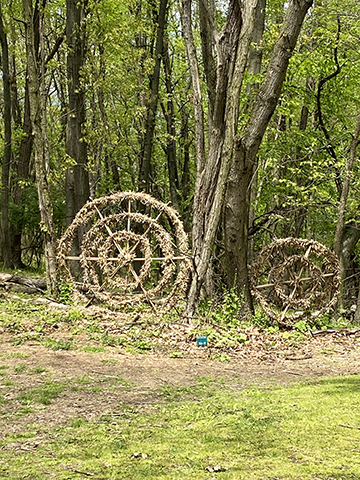
“Kindred Spirits” by Eve Gurbacki

This nod to Wildwood’s storied past acknowledges Wildwood’s friends and Dauphin County Parks and Recreation’s role, as well as Harold Plasterer, the original zookeeper, historians Floyd Demmy and Ernest Morrison and the generosity of Benjamin Olewine. So, in the spirit of knocking wood, I have left that bit of history out of the bag. There you have, in part, some of the backstory—what put the ”wild” in Wildwood.

Speaking of history, the 2020 edition of “Art in The Wild,” an annual event now in its eighth year, owes its success to the visionaries steering its committee.

Elizabeth Johnson’s humble demeanor and gentle spirit belies the embodiment of a passionate advocate for the environment, particularly that of Wildwood Park. She is assisted in her mission by longstanding committee members Marcy Brenner and Jim Caufield, equally invested in the gift “Art in the Wild” brings to the residents of Dauphin County. As in most endeavors, it takes a village, and, in this case, perhaps a forest, which includes committee members Donna Curancy-Seltzer, Patricia Garcia, Moe Hickey, Carol Lopus, Michelle McKeown, Mara Shall and Olivia Susskind, who all do their part to make this annual event a success. Park Manager Chris Rebert nurtured the first seven years with a passion and love before handing the torch to Richelle Corty, the park’s environmental educator. Sending emails and making personal calls to all the entrants, she ensured participation and kept everyone up to date on all the changes as they occurred.


Part II: “Art in the Wild” Installations 2020

Nature and art are irrepressible forces as are the artists creating. As the seasons evolve, so does the landscape. You can almost hear the gentle hum that stops for a brief reverie, then begins anew.

“Art in the Wild,” like any other art event, relies on the artists to deliver the goods. What started out as the largest field of participants (20), dwindled to a smaller group (due to the pandemic) of committed environmental artists.
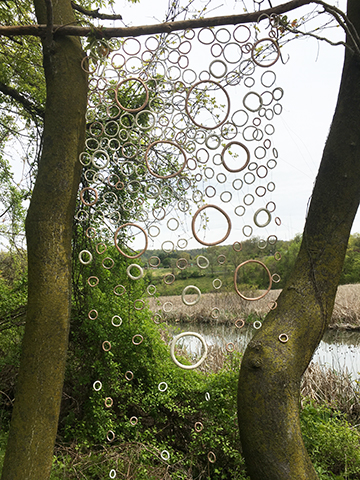
“Rings of Reflection” by Suzanne Pagel

Past winners truly stepped up to the challenge solely for arts sake. Two teams, Eve Gurbacki and Adrianne Zimmerman along with Beau and Jana MacGinnes, won back-to-back, first-place awards and have been at the vanguard since AITW’s inception.

Advancing this year’s theme of harmony, Gurbacki spread the visual field with crop circle totems to Mother Earth in her installation entitled “Kindred Spirits.” The MacGinnes team pushed an apocalyptic vision to new heights in “The Last Wave,” with a tsunami of a wave reaching towards the heavens, so powerful in its scope that it leaps the path to the other side. In fact, both use wide angles in promoting visual acuity as 20-20 comes into focus.

New to the mix, Suzanne Pagel created a triptych of transformation incorporating hanging ceramic disks using filament that gives the sense of being trapped in a spider web, capturing the very essence of art’s fragility in her piece, “Rings of Reflection.” “Ecospheric Tones,” created by Jill Lippert, is, on the surface, a sphere replete with pinecones camouflaging the wind chimes within.
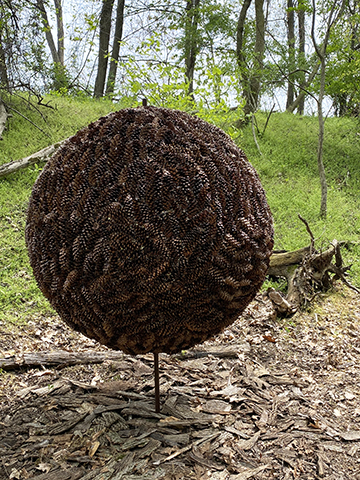
“Ecospheric Tones” by Jill Lippert

In fairness to the other entrants, no more spoilers will be revealed as viewers need to experience the installations by walking the 3.1-mile trail. They say competition is good for the soul, and everyone likes to be recognized, but the core group of AITW winners over the past few years share a mutual admiration and appreciation for each others’ work. It embodies a sense of camaraderie more than competition. Perhaps a landscape leitmotif will run through the installations, offering individual takes on the chosen theme, “Woodland Harmony.” Jim Caufield, at last year’s awards ceremony, spoke to the level of involvement, citing the number of installations to date, which now tops 100 with this year’s offering. Mick Corman, film/video teacher at Capital Area School for the Arts, graciously videotaped the installations, as the students who previously did so were unable to this year.

By all accounts, there have been more visitors to the park since the pandemic began in March, which has resulted in greater public interest and awareness than ever before. Up close and personal is still the best way to view AITW while practicing social distancing. “Art in the Wild” has become an annual rite of spring, like the geese migrating back north, the sight of the first robin and the buds blooming on the trees. This time around promises art in nature from seasoned veterans and first-time entrants presenting a varied collection of installations for the public’s consideration, rendered refreshingly radiant. It speaks to this dedicated group. They have created monuments to nature out of fertile imaginations, from conceptualized theme to articulated achievement.

What could very well be the only new art event in the area for spring opens to the public on May 16 and runs through September’s end.


Continue Reading

New COVID-19 cases remain just below 1,000 in PA

An image from the state Department of Health lab in Exton, Pa.

New COVID-19 cases today again were just below 1,000 in PA, as the state health department reported 989 newly confirmed cases.

This marks six days in a row with new case numbers below 1,000, the first time that has happened in about six weeks.

With the additional cases, 61,611 Pennsylvanians have now been diagnosed with the coronavirus.

New cases in PA peaked in early April at nearly 2,000 cases, but have shown a gradual, relatively steady decline since, despite increasingly greater levels of testing for the virus over that time period.

Of the new cases today, 320 are in residents of nursing and personal care homes.

Locally, total diagnosed cases are as follows:

  • Adams County: 185 cases (yesterday, 183)
  • Cumberland County: 515 cases (yesterday, 492)
  • Dauphin County: 938 cases (yesterday, 912)
  • Franklin County: 601 cases (yesterday, 580)
  • Lancaster County: 2,470 cases (yesterday, 2,428)
  • Lebanon County: 873 cases (yesterday, 863)
  • Perry County: 40 cases (yesterday, 36)
  • York County: 835 cases (yesterday, 828)

Overall, 18.8 percent of PA residents tested have shown to be positive for the virus.

The health department also reported another 61 fatalities, meaning that 4,403 Pennsylvanians have died from the disease over the past two months.

The majority of new fatalities—52—were residents of nursing or personal care homes.

Around central PA, the COVID-19 fatality data now stands as follows:

  • Adams County: 6 deaths (yesterday, 6)
  • Cumberland County: 48 deaths (yesterday, 41)
  • Dauphin County: 39 deaths (yesterday, 41)
  • Franklin County: 13 deaths (yesterday, 17)
  • Lancaster County: 186 deaths (yesterday, 186)
  • Lebanon County: 19 deaths (yesterday, 19)
  • Perry County: 1 death (yesterday, 1)
  • York County: 15 deaths (yesterday, 16)

Statewide, Philadelphia County continues to have the most confirmed cases with 16,032 cases, followed by Montgomery County with 5,797 cases. The two counties also have reported the most deaths statewide from the disease: 1,021 and 614, respectively.

“As counties move from red to yellow, we need all Pennsylvanians to continue to follow the social distancing and mitigation efforts in place,” said health Secretary Rachel Levine.

So far, the state has moved 37 counties in the southwest portion of the state into the yew phase. On Friday, 12 more counties, including Cumberland, York, Perry and Adams counties, will enter the yellow phase.

Nursing homes and personal care facilities have been particularly hard hit by the virus. Out of total deaths, 3,043, or 69.1 percent, have occurred in residents from nursing or personal care facilities, according to the health department.

In nursing and personal care homes, there are 13,257 resident cases of COVID-19, and 2,075 cases among employees, for a total of 15,332 at 556 distinct facilities in 44 counties, according to the health department.

In addition, 4,432 of total cases in PA are in health care workers.

Statewide, 327,836 coronavirus tests have been performed, with 266,225 people testing negative, according to the state health department. Yesterday, the state reported that 319,832 people had been tested for the virus.

Of the patients who have tested positive to date, the age breakdown is as follows, according to the health department:

  • Nearly 1 percent are aged 0-4
  • Nearly 1 percent are aged 5-12
  • Nearly 2 percent are aged 13-18
  • Nearly 6 percent are aged 19-24
  • Nearly 37 percent are aged 25-49
  • Nearly 26 percent are aged 50-64
  • Nearly 29 percent are aged 65 or older.

Most of the patients hospitalized are 65 or older, as are most of the reported deaths, according to the state.

Levine continued to emphasize that Pennsylvanians should do the following:

  • Wash your hands with soap and water for at least 20 seconds or use hand sanitizer if soap and water are not available.
  • Cover any coughs or sneezes with your elbow, not your hands.
  • Clean surfaces frequently.
  • Stay home to avoid spreading COVID-19, especially if you are unwell. 

“We must continue to protect our most vulnerable Pennsylvanians, which includes our seniors, those with underlying health issues, our healthcare workers and our first responders,” Levine said. “I am proud of the work that Pennsylvanians have done so far, but we cannot stop now, we must continue to take the necessary steps to protect ourselves from COVID-19.” 

For more information, visit the PA Department of Health’s COVID-19 website.

Continue Reading