Gov. Wolf pledges reforms to improve police training, accountability in PA

PA Gov. Tom Wolf (right) at his press conference late on Thursday

Gov. Tom Wolf on Thursday laid out a multi-part plan designed to improve relations between police and communities, focused on law enforcement accountability and training.

Wolf said that he was taking the actions following nearly a week of protests in cities throughout Pennsylvania condemning racism and police brutality.

“We can no longer afford to have two Pennsylvanias and two Americas,” Wolf said. “Unfairness is pernicious, and it can spread like a cancer unless we can stop it.”

Wolf said that he decided to take these actions after meeting with officials in Harrisburg and Philadelphia. Yesterday, Wolf marched with Harrisburg Mayor Eric Papenfuse, police Commissioner Thomas Carter, other community leaders and a group of protesters from the state Capitol building through Midtown Harrisburg.

Wolf’s recommendations include:

  • Creation of a deputy inspector general within the Pennsylvania Office of State Inspector General focused on deterring, detecting, preventing and eradicating fraud, waste, misconduct and abuse amongst state law enforcement agencies.
  • Creation of a Pennsylvania State Law Enforcement Advisory Commission that reviews allegations of misconduct by state law enforcement personnel.
  • Providing technical assistance to municipalities from the Pennsylvania Commission on Crime and Delinquency (PCCD) to encourage the creation of local citizen advisory boards.
  • Creation of a Racial and Ethnic Disparities Subcommittee under the Criminal Justice Advisory Committee at PCCD.
  • Reviewing training and education of officers. All training academies for law enforcement must review current use-of-force training standards and form a workgroup to develop model training standards to ensure that officers receive the best instruction in interacting with the public.
  • Enhancing current mental health initiatives and offering targeted mental health supports for officers to deal with trauma and reduce stigma for getting help.
  • Work with the legislature on reforms, including legislation proposed that provides for improved access to police videos, an oversight board for officer training and continuing education, a special prosecutor in deadly force cases, interdepartmental law enforcement hiring reform and PTSD evaluation for police officers.

“Some of it requires some legislation, but most of it, I can do quickly, and I will,” he said.

Earlier on Thursday, Harrisburg City Council members also vowed reform of police practices within the city.

Wolf added that he also would seek to address longstanding inequalities against people of color.

“I’m going to continue to fight for more education funding and for help for minorityowned businesses,” he said. “These fights do not have an end point, and we won’t know when we’ve won, but we have to keep going to make our commonwealth fairer and more equal for everyone.”

Continue Reading

Harrisburg council vows reform to help prevent police misconduct, abuse

Members of Harrisburg City Council knelt in silence for nine minutes today outside of city hall. From left: Danielle Bowers, Shamaine Daniels, Ausha Green, President Wanda Williams, Ben Allatt and Dave Madsen.

City Council plans to take substantive action to prevent potential police misconduct in Harrisburg, officials said today.

Council member Ausha Green, chair of the council’s public safety committee, vowed to introduce legislation that would help prevent potential abuse and that would enhance civilian oversight.

“Our communities have suffered,” she said. “They’ve suffered long enough.”

Green spoke following nine minutes of silence by six members of city council, most spent kneeling, out of respect for George Floyd, the Minneapolis man killed last week in the custody of that city’s police, and in support of recent protests for equal rights and black lives.

Green said that she was considering various types of legislation to reform police use-of-force policy. This might include a ban on chokeholds and mandate the explicit approval of the police commissioner before the use of tear gas during demonstrations.

“You’ll see legislation to fight against police brutality,” she said. “We need to have accountability on the part of our police and our community leaders.”

In the recent past, council also has discussed forming a citizen’s advisory board and more community policing efforts. Green said that she would consider both of these measures, as well.

In part, the city’s past community policing efforts have been hobbled by budget constraints and by its inability to retain trained officers. Green said she would like to see more Harrisburg residents, especially people of color, recruited into the city’s police force.

Council would need to ensure that any legislation does not violate existing police labor contracts, Green said. This issue has hobbled reform attempts in many cities in recent years.

Green emphasized two other points.

First, she said that the city needs the cooperation of the Capitol police and the state police, since they’re often used for crowd control and for backup in Harrisburg. In fact, she said, it was the state, not city police, that used pepper spray during a clash between police and protesters last Saturday.

Secondly, she noted that she regarded the proposed reforms as mostly precautionary since the Harrisburg police and the community, she said, tend to have a good relationship.

“At the end of the day, we all want the same thing,” she said. “We want a safe community.”

Continue Reading

COVID-19 diagnoses in PA continue long, steady decline

A chart of daily COVID-19 cases and deaths. Source: PA Department of Health

New cases of COVID-19 mirrored recent days, with the PA Department of Health today reporting 537 new positive cases for the period ending at midnight.

This marks 25 days straight with new case numbers below 1,000 in Pennsylvania. Yesterday, the department reported 511 new cases.

With the additional cases, 73,942 Pennsylvanians have now been diagnosed with the coronavirus.

Cases peaked in early April at nearly 2,000 daily new cases. Since then, cases have shown a gradual decline, despite increasingly greater testing levels for the virus..

Locally, total diagnosed cases are as follows:

  • Adams County: 263 cases (yesterday, 260)
  • Cumberland County: 657 cases (yesterday, 654)
  • Dauphin County: 1,404 cases (yesterday, 1,385)
  • Franklin County: 785 cases (yesterday, 782)
  • Lancaster County: 3,301 cases (yesterday, 3,267)
  • Lebanon County: 997 cases (yesterday, 994)
  • Perry County: 64 cases (yesterday, 62)
  • York County: 1,038 cases (yesterday, 1,037)

Overall, 15.1 percent of PA residents tested have shown to be positive for the virus.

The health department also reported another 75 fatalities, meaning that 5,817 Pennsylvanians have died from the disease since March. Not all of these deaths necessarily occurred in the past 24 hours, as the health department constantly updates its data.

Around central PA, the COVID-19 fatality data now stands as follows:

  • Adams County: 8 deaths (yesterday, 8)
  • Cumberland County: 54 deaths (yesterday, 53)
  • Dauphin County: 87 deaths (yesterday, 85)
  • Franklin County: 38 deaths (yesterday, 37)
  • Lancaster County: 315 deaths (yesterday, 310)
  • Lebanon County: 36 deaths (yesterday, 34)
  • Perry County: 3 deaths (yesterday, 3)
  • York County: 28 deaths (yesterday, 27)

Statewide, Philadelphia County continues to have the most confirmed cases with 18,888 cases, followed by Montgomery County with 7,351 cases. The two counties also have reported the most deaths statewide from the disease: 1,359 and 702, respectively.

“As Pennsylvania continues to move forward in the process to reopen, we need to remember that the threat from COVID-19 has not gone away,” health Secretary Rachel Levine said.

So far, the state has moved 57 of Pennsylvania’s 67 counties into the less restrictive yellow phase, including all of the Harrisburg area except Lancaster County. By June 5, the remainder of the state will exit from the red phase.

Nursing homes and personal care facilities have been particularly hard hit by the virus. Of total deaths, 3,895, or 67 percent, have occurred in residents from nursing or personal care facilities, according to the health department.

In nursing and personal care homes, there are 15,848 resident cases of COVID-19, and 2,740 cases among employees, for a total of 18,588 at 611 distinct facilities in 44 counties, according to the health department.

In addition, about 5,601 of total cases in PA are in health care workers.

Statewide, 490,884 coronavirus tests have been performed, with 416,942 people testing negative, according to the state health department. Yesterday, the state reported that 481,674 people had been tested for the virus.

Of the patients who have tested positive to date, the age breakdown is as follows, according to the health department:

  • Nearly 1 percent are aged 0-4
  • Nearly 1 percent are aged 5-12
  • Nearly 2 percent are aged 13-18
  • 6 percent are aged 19-24
  • Nearly 37 percent are aged 25-49
  • 25 percent are aged 50-64
  • 28 percent are aged 65 or older.

Most of the patients hospitalized are 65 or older, as are most of the reported deaths, according to the state.

Levine continued to emphasize that Pennsylvanians should do the following:

  • Wash your hands with soap and water for at least 20 seconds or use hand sanitizer if soap and water are not available.
  • Cover any coughs or sneezes with your elbow, not your hands.
  • Clean surfaces frequently.
  • Stay home to avoid spreading COVID-19, especially if you are unwell.

“As counties move into the yellow and green phases, we must take personal responsibility to protect others,” Levine said. “Wearing a mask, continuing to maintain social distancing, and washing your hands frequently are all steps we can take to help protect others, including our most vulnerable Pennsylvanians, our essential workers and our healthcare system.” 

For more information, visit the PA Department of Health’s COVID-19 website.


Continue Reading

Weekend Roundup with Sara Bozich

Many restaurants, breweries, wineries, distilleries are opening to outdoor dining this weekend. Capacity is limited; be sure to call your favorite spot or visit Facebook (because why have a website that’s up to date) for updates and availability. Are you on the email list? In addition to getting this weekly update directly in your inbox, I load it with a bunch of other fresh, original content. Sign-up here. Summer’s here; it’s time to grill — Get your burger patties, steaks, chicken, and more at R.G. Hummer Meats + Cheese. You’ll also wanna stock your fridge with local beer and wine. Plus, we have some of the best places to get cocktails to-go (now that you can!) — and your best picks for local entertainment (virtually, of course).

Top Picks:

Thursday

Friday

Saturday

Sunday

Top picks to-go/delivery


Continue Reading

COVID-19 cases in PA remain stable with 511 new daily positives

An image from the PA Department of Health lab in Exton

New cases of COVID-19 continued to level off in PA, with the state Department of Health today reporting 511 new positive cases for the period ending at midnight.

This marks 24 days straight with new case numbers below 1,000 in Pennsylvania. With the additional cases, 73,405 Pennsylvanians have now been diagnosed with the coronavirus.

Cases peaked in early April at nearly 2,000 daily new cases. Since then, cases have shown a gradual decline, despite increasingly greater testing levels for the virus.

Of the new cases reported today, 92 are in residents of nursing and personal care homes.

Locally, total diagnosed cases are as follows:

  • Adams County: 260 cases (yesterday, 255)
  • Cumberland County: 654 cases (yesterday, 644)
  • Dauphin County: 1,385 cases (yesterday, 1,359)
  • Franklin County: 782 cases (yesterday, 781)
  • Lancaster County: 3,267 cases (yesterday, 3,218)
  • Lebanon County: 994 cases (yesterday, 980)
  • Perry County: 62 cases (yesterday, 62)
  • York County: 1,037 cases (yesterday, 1,028)

Overall, 15.2 percent of PA residents tested have shown to be positive for the virus.

The health department also reported another 75 fatalities, meaning that 5,742 Pennsylvanians have died from the disease since March. Not all of these deaths necessarily occurred in the past 24 hours, as the health department constantly updates its data.

Of the newly reported fatalities, 24 were residents of nursing or personal care homes.

Around central PA, the COVID-19 fatality data now stands as follows:

  • Adams County: 8 deaths (yesterday, 8)
  • Cumberland County: 53 deaths (yesterday, 52)
  • Dauphin County: 85 deaths (yesterday, 77)
  • Franklin County: 37 deaths (yesterday, 36)
  • Lancaster County: 310 deaths (yesterday, 306)
  • Lebanon County: 34 deaths (yesterday, 33)
  • Perry County: 3 deaths (yesterday, 3)
  • York County: 27 deaths (yesterday, 26)

Statewide, Philadelphia County continues to have the most confirmed cases with 18,785 cases, followed by Montgomery County with 7,242 cases. The two counties also have reported the most deaths statewide from the disease: 1,359 and 702, respectively.

“As Pennsylvania continues to move forward in the process to reopen, we need to remember that the threat from COVID-19 has not gone away,” health Secretary Rachel Levine said.

So far, the state has moved 57 of Pennsylvania’s 67 counties into the less restrictive yellow phase, including all of the Harrisburg area except Lancaster County. By June 5, the remainder of the state will exit from the red phase.

Nursing homes and personal care facilities have been particularly hard hit by the virus. Of total deaths, 3,621, or 63 percent, have occurred in residents from nursing or personal care facilities, according to the health department.

In nursing and personal care homes, there are 15,752 resident cases of COVID-19, and 2,719 cases among employees, for a total of 18,471 at 611 distinct facilities in 44 counties, according to the health department.

In addition, about 5,557 of total cases in PA are in health care workers.

Statewide, 481,674 coronavirus tests have been performed, with 408,269 people testing negative, according to the state health department. Yesterday, the state reported that 472,255 people had been tested for the virus.

Of the patients who have tested positive to date, the age breakdown is as follows, according to the health department:

  • Nearly 1 percent are aged 0-4
  • Nearly 1 percent are aged 5-12
  • Nearly 2 percent are aged 13-18
  • 6 percent are aged 19-24
  • Nearly 37 percent are aged 25-49
  • 25 percent are aged 50-64
  • 28 percent are aged 65 or older.

Most of the patients hospitalized are 65 or older, as are most of the reported deaths, according to the state.

Levine continued to emphasize that Pennsylvanians should do the following:

  • Wash your hands with soap and water for at least 20 seconds or use hand sanitizer if soap and water are not available.
  • Cover any coughs or sneezes with your elbow, not your hands.
  • Clean surfaces frequently.
  • Stay home to avoid spreading COVID-19, especially if you are unwell.

“As counties move into the yellow and green phases, we must take personal responsibility to protect others,” Levine said. “Wearing a mask, continuing to maintain social distancing, and washing your hands frequently are all steps we can take to help protect others, including our most vulnerable Pennsylvanians, our essential workers and our healthcare system.” 

For more information, visit the PA Department of Health’s COVID-19 website.

Continue Reading

PA will allow schools to reopen July 1; districts must develop safety plan

Harrisburg’s Lincoln School

Schools in PA can begin to re-open on July 1, though districts must have in place health and safety plans based on federal and state guidance.

The state Department of Education today gave school districts in all “yellow” and “green” zones permission to reopen on that date as long as they develop plans based on guidelines from the federal Centers for Disease Control and Prevention and the state Department of Health.

By July 1, all of Pennsylvania’s 67 counties should be in either the yellow or green phase of the state’s three-phase reopening plan. On Friday, all remaining red phase counties, mostly in the southeast portion of the state, are due to enter the yellow phase.

“The Wolf administration remains committed to the safety and welfare of students, faculty and staff, and any reopening plan must be rooted in these principles,” said Secretary of Education Pedro A. Rivera, in a statement. “As school leaders resume instruction in the 2020-21 school year, the department recognizes the need for preliminary guidance to aid in planning for a return to in-person instruction, delivery of services, and resumption of extracurricular activities.”

According to the department, plans must encompass several elements:

  • identifying a pandemic coordinator or team to lead response efforts
  • steps to protect higher-risk children and staff
  • processes for monitoring students and staff for symptoms
  • guidelines for hygiene practices
  • processes for cleaning and disinfecting
  • guidelines for the use of face masks
  • protocols for social distancing
  • procedures for restricting large gatherings

The plans must be approved by local school boards and posted on the school or district public website before a school reopens. The plans must also be submitted to the state education department.

According to Rivera, the plans should be tailored to the unique needs of each school and reflect a comprehensive, community approach created in consultation with local health agencies.

The guidance applies to school districts, charter schools, regional charter schools, cyber charter schools, career and technical centers and intermediate units. Nonpublic schools are strongly encouraged to create plans tailored to their unique needs and post them on their websites.

Postsecondary schools in the yellow and green phases can resume in-person instruction on June 5 following the development of a health and safety plan. The guidance applies to colleges, universities, seminaries, trade schools and adult basic education programs. Institutions must adhere to proper physical distancing guidelines and other general public health and safety considerations informed by guidelines released by the CDC and DOH, according to the education department.

“Educators, students and caregivers have done a remarkable job as we all navigate through this pandemic,” Rivera said. “Now we need to direct our energy to focus on how to resume instruction in the 2020-21 school year. We fully expect students to return to classrooms in some capacity and are confident that schools will use this guidance to build a framework that best meets the unique needs of their students and communities.”

Continue Reading

Community Comment: Statement from UPMC Pinnacle Board

UPMC Pinnacle is deeply saddened by the recent events in our nation and in our community. Although we are heartbroken–and the news can be dispiriting–we must together move forward and stand against racism in all its forms. Racism threatens our communities from within, and must be removed from our institutions, from our systems, and from our hearts if we are to live up to our ideals as Americans and to create the just society that we all deserve. 

We hope that from this and far too many similar tragedies we can together learn lessons and address the issues — some broad and some very specific — in our society that will make it stronger, more just, more caring, and more sustainable. 

UPMC Pinnacle has zero tolerance for hate and violence in our workplace and in our community, and we are committed to working with our neighbors and our staff to heal, to learn, and to come together to create positive solutions.

Our society needs healing. UPMC Pinnacle is profoundly committed to helping our community find that healing.

Douglas Neidich is chair of the UPMC Pinnacle board, on behalf of the board of directors.

Continue Reading

Chain Reaction: Fractures in the global supply chain may spark new links, locally.

A screen grab of David Iwinski, who spoke at Tuesday’s webinar.

Fractures and breakdowns in the global supply chain—a pandemic-laced crisis—may actually present opportunities for south central Pennsylvania’s manufacturing sector.

That was the topic of a Zoom webinar attended by about 100 area manufacturing, economic development and state officials on Tuesday. It was presented by two Pittsburgh-based experts on international business, Dennis Unkovic and David Iwinski, Jr.

“We see a domino-effect of implications… with much greater issues to come,” said Iwinski, managing director of Blue Water Growth LLC.

Understanding the reasons behind the supply chain breakdown requires a little background in China’s factories.

Iwinski, who traveled to China 65 times since 1985, described Chinese factories as mini-cities where employees not only work, but also live in dormitory-style housing. These mini-cities were shut down for the Chinese New Year holiday—a time when the Chinese traditionally return to the hometowns in an “extraordinary migration.” There are no unemployment benefits in China. Many workers remained in their hometowns, picked up new jobs, wary of returning to dormitory-style housing conditions amid the COVID-19 climate.

Meantime, factories are now trying to exist on 30 to 40 percent of their returning workforce while replacing and retaining the remaining 60 percent. Volumes are down and quality is down.

“These problems started to flow overseas, into shortages, masked by panic buying,” said Iwinski.

Just as Chinese factories started to ramp back up, the United States shut down due to the pandemic—“the last straw in decades of changes” between the two countries, Iwinski said.

So what does this have to do with south central Pennsylvania companies?

“We think there’s going to be a large-scale, simultaneous supply chain realignment,” Iwinski. “If all your supplies are coming out of China, you’re at extreme risk.”

They offered three critical pieces of advice. First, they cautioned business leaders to be pessimistic regarding forecasts of recovery from China. Secondly, they advised businesses to conserve capital and resources. And lastly, they implored attendees to either realign or re-shore their supply chains now.

Unkovic held up his iPhone.

“It’s made of 32 component parts from 11 different countries. This is the concern we have—companies relying on component parts are going to see shortages in the future—it’s going to keep them from creating finished goods,” said Unkovic, an international law partner at Meyer, Unkovic & Scott LLP. “We think this is going to be an extremely tumultuous next three to five years.”
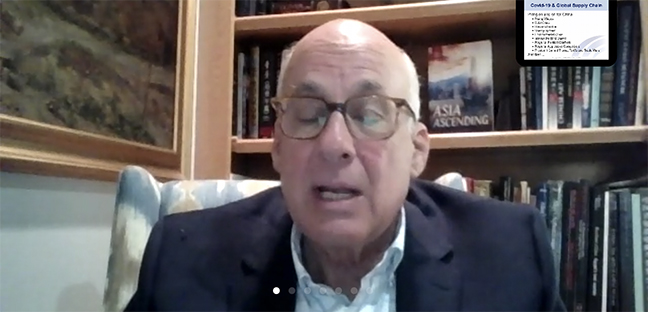
A screen grab of Dennis Unkovic

Both experts see a silver lining—an opportunity for Pennsylvania manufacturers.

“We want strong Pennsylvania companies and a strong Pennsylvania economy,” Iwinski said. “Timing is of the essence—we’re all coming to this realization, but capacity is not unlimited. So, there are lines to get into (other) factories—there are backups.”

Tina Weyant, founding executive director of the World Trade Center (WTC) Harrisburg, said it was critical to apprise regional companies of this situation because there’s never been a supply chain breakdown of this magnitude. But she hopes area companies are inspired by the opportunities presented.

“We have a generally strong manufacturing industry with a lot of knowledge, and we have the benefit of being very diversified, so I think we can ramp up, although it will be a challenge.”

There are currently 2,900 diverse manufacturers in south central Pennsylvania’s nine counties accounting for 16 percent of the workforce.

“In general, the region’s manufacturers got through the pandemic fairly well—a lot were able to stay open,” said Leigh Ann Wilson of MANTEC, a private, nonprofit organization based in York. “The concern is the next quarter, because sales drop off will happen.”

Leigh Ann Wilson of MANTEC

There are also pre-pandemic workforce issues.

“There are lots of jobs open,” Wilson said. “More people are able to stay at home right now due to unemployment funding—there’s not a huge incentive for them to return to work. But the jobs are there—highly skilled jobs.”

Two area manufacturers producing unique components for niche markets gathered valuable takeaways from today’s webinar.

“It was a great recap of the current global situation,” said Kerry Woods, sales manager at PR Hoffman, a Carlisle manufacturer of highly specialized components such as glass optics and silicon carbide semiconductors.

As many as 70 percent of PR Hoffman’s customers, accounting for $5 to $8 million in sales, are in exports to Europe, China, Japan and additional Asian markets. Their components are utilized in 5G networks, satellites, electronic vehicles and autonomous engineering.

Instead of having difficulties receiving component parts from Chinese manufacturers, they have the reverse problem—trying to retain their Chinese customer base.

“We’ve been operating in fire drill mode. We have many customers in China—we’re seeing the impact of their extended Chinese New Year holiday… we’ve had problems getting freight into China,” Woods said.

PR Hoffman’s 35 essential employees continued working throughout the pandemic. Woods said the company made many adjustments to align with health and safety guidelines.

Chris Tarsa, is president and CEO of C.L. Sturkey, a Lebanon-based manufacturer that is one of a handful of worldwide manufacturers for microtome knives used by hospitals and laboratories in biopsies and other medical procedures.

While his company is not reliant upon Chinese-produced components, it gave Tarsa pause in another area.

“It’s pretty clear that China is not the reliable business partner many think they are. We’re looking at putting our blades in China, but now I’m cautious as a result of today’s webinar,” Tarsa said.

Many area business leaders on the call asked about the strength of the American manufacturing sector.

“I believe based on a lifetime in international business that we’re sitting in the most innovative nation in the world—that’s based on us having the best universities in the world,” Iwinski said. “But the deeper reason—it’s culture. This country was formed by adventurers, malcontents, weirdos, risk-takers—it’s in our guts. In China, the nail that sticks up is hammered down. But innovation is our core and key. I know I’m on a soap box, but I love this soap box.”

For more information, see mantec.org and wtccentralpa.org.

Continue Reading

New COVID-19 cases rise a bit, but remain within longer-term decline

A chart of COVID-19 cases and tests in PA. Source: PA Department of Health

New COVID-19 diagnoses rose slightly on a day-over-day basis, but still continued a trend of long-term decline.

The PA Department of Health today reported 612 new positive cases for the period ending at midnight.

This marks 23 days straight with new case numbers below 1,000 in Pennsylvania. With the additional cases, 72,894 Pennsylvanians have now been diagnosed with the coronavirus.

Cases peaked in early April at nearly 2,000 daily new cases. Since then, cases have shown a gradual decline, despite increasingly greater testing levels for the virus (see chart).

Yesterday, the state reported jut 356 new cases, but data has tended to be lower following weekends due to less reporting to the state health department.

Of the new cases reported today, 115 are in residents of nursing and personal care homes.

Locally, total diagnosed cases are as follows:

  • Adams County: 255 cases (yesterday, 250)
  • Cumberland County: 644 cases (yesterday, 635)
  • Dauphin County: 1,359 cases (yesterday, 1,303)
  • Franklin County: 781 cases (yesterday, 777)
  • Lancaster County: 3,218 cases (yesterday, 3,189)
  • Lebanon County: 980 cases (yesterday, 972)
  • Perry County: 62 cases (yesterday, 61)
  • York County: 1,028 cases (yesterday, 1,013)

Overall, 15.4 percent of PA residents tested have shown to be positive for the virus.

The health department also reported another 100 fatalities, meaning that 5,667 Pennsylvanians have died from the disease since March. Not all of these deaths necessarily occurred in the past 24 hours, as the health department constantly updates its data.

Of the newly reported fatalities, 40 were residents of nursing or personal care homes.

Around central PA, the COVID-19 fatality data now stands as follows:

  • Adams County: 8 deaths (yesterday, 8)
  • Cumberland County: 52 deaths (yesterday, 52)
  • Dauphin County: 77 deaths (yesterday, 74)
  • Franklin County: 36 deaths (yesterday, 35)
  • Lancaster County: 306 deaths (yesterday, 297)
  • Lebanon County: 33 deaths (yesterday, 33)
  • Perry County: 3 deaths (yesterday, 3)
  • York County: 26 deaths (yesterday, 26)

Statewide, Philadelphia County continues to have the most confirmed cases with 18,703 cases, followed by Montgomery County with 7,172 cases. The two counties also have reported the most deaths statewide from the disease: 1,346 and 696, respectively.

“As Pennsylvania continues to move forward in the process to reopen, we need to remember that the threat from COVID-19 has not gone away,” health Secretary Rachel Levine said.

So far, the state has moved 57 of Pennsylvania’s 67 counties into the less restrictive yellow phase, including all of the Harrisburg area except Lancaster County. By June 5, the remainder of the state will exit from the red phase.

Nursing homes and personal care facilities have been particularly hard hit by the virus. Of total deaths, 3,597, or 63.4 percent, have occurred in residents from nursing or personal care facilities, according to the health department.

In nursing and personal care homes, there are 15,660 resident cases of COVID-19, and 2,696 cases among employees, for a total of 18,356 at 609 distinct facilities in 44 counties, according to the health department.

In addition, about 5,523 of total cases in PA are in health care workers.

Statewide, 472,255 coronavirus tests have been performed, with 399,361 people testing negative, according to the state health department. Yesterday, the state reported that 461,713 people had been tested for the virus.

Of the patients who have tested positive to date, the age breakdown is as follows, according to the health department:

  • Nearly 1 percent are aged 0-4
  • Nearly 1 percent are aged 5-12
  • Nearly 2 percent are aged 13-18
  • 6 percent are aged 19-24
  • Nearly 37 percent are aged 25-49
  • 25 percent are aged 50-64
  • 28 percent are aged 65 or older.

Most of the patients hospitalized are 65 or older, as are most of the reported deaths, according to the state.

Levine continued to emphasize that Pennsylvanians should do the following:

  • Wash your hands with soap and water for at least 20 seconds or use hand sanitizer if soap and water are not available.
  • Cover any coughs or sneezes with your elbow, not your hands.
  • Clean surfaces frequently.
  • Stay home to avoid spreading COVID-19, especially if you are unwell.

“As counties move into the yellow and green phases, we must take personal responsibility to protect others,” Levine said. “Wearing a mask, continuing to maintain social distancing, and washing your hands frequently are all steps we can take to help protect others, including our most vulnerable Pennsylvanians, our essential workers and our healthcare system.”

For more information, visit the PA Department of Health’s COVID-19 website.

Continue Reading

Let’s Eat: First “Saturday Nights in the City” to feature more than a dozen Harrisburg restaurants for outside dining

Mangia Qui and Rubicon will be among the restaurants participating in this weekend’s “Saturday Nights in the City.”

Do you long for a hearty Tuscan ribeye from Mangia Qui? Can you practically taste an artichoke pizza from Cork n Fork or the shepherd’s pie from McGrath’s?

Then I have the news you’ve been waiting to hear for nearly three months.

These three are among more than dozen restaurants that will participate this weekend in the first “Saturday Nights in the City,” an outdoors dining event sponsored by the city and the Harrisburg Downtown Improvement District.

Late today, the city released the first lineup of restaurants for the June 6 event. They are:

    • Stock’s on Second
    • Carley’s Ristorante and Piano Bar
    • Café Fresco
    • Second Street Shawarma
    • Sawyer’s
    • Bourbon Street Saloon
    • Zembie’s Sports Tavern
    • McGrath’s Irish Pub
    • Taste Buffalo
    • Arooga’s
    • JB Lovedraft’s MicroPub
    • Federal Taphouse
    • Mangia Qui
    • Rubicon
    • Cork & Fork
    • Burger Yum
    • Bollywood Bar & Grille
    • The Brick Haus
    • Los Tres Cubanos
    • Taco Solo

Each weekend in June, Harrisburg will close down several streets to permit restaurants to set up tables and serve outdoors. These streets are N. 2nd Street from Market Street to Pine Street and portions of North Street and State Street (see map).

“We know that businesses have faced challenges and struggles during this pandemic,” Harrisburg Mayor Eric Papenfuse said. “I encourage residents to come support their favorite restaurants safely as we work together to get through these difficult times.”

This initiative will run on Saturdays for the entire month of June from 6 to 9 p.m. On June 13, Ad Lib Craft Kitchen and Bar is expected to join the lineup.

“I applaud the efforts of the city of Harrisburg to allow for street closures on behalf of the struggling restaurant industry,” said Mangia Qui co-owner Staci Basore. “This will allow for much needed revenue as well as provide us an opportunity to integrate on-premise dining, in conjunction with our ongoing delivery and takeout platform. We will be measured in our approach with regards to the safety and health of our guests and staff.”

Since mid-March, restaurants have been prohibited from offering dine-in service due to the COVID-19 pandemic. Harrisburg is now in the “yellow” phase, which allows for outdoors dining following certain state regulations.

As a result of the event, the following streets will be closed from 3:30 p.m. to 10 p.m. on Saturday:

  • 2nd Street from Market to Pine streets
  • State Street from Church to N. 2nd Street westbound
  • North Street from Susquehanna to N. 3rd streets westbound

Papenfuse said that the city plans to enhance police and security presence for the event.

Continue Reading