PA averaged about 500 new daily COVID-19 cases over past week, state says

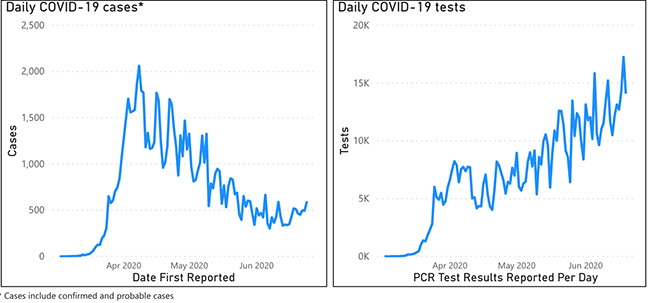
Charts of daily new cases and tests over time. Source: PA Department of Health

New COVID-19 cases in PA remained relatively stable this week, with the state reporting an average of just over 500 new diagnoses over the last seven days.

With today’s update, the state Department of Health has reported an average of 515 new cases per day since last Friday. For the past 24 hours, the department confirmed 600 new positive cases throughout Pennsylvania.

Cases peaked in early April at nearly 2,000 daily new cases. Since then, cases have shown a gradual decline, despite increasingly greater testing levels for the virus.

With the additional cases, 84,370 Pennsylvanians have now been diagnosed with the coronavirus, an increase of 3,608 over the past week.

Locally, total diagnosed cases are as follows:

  • Adams County: 324 cases (prior Friday, 309)
  • Cumberland County: 830 cases (prior Friday, 768)
  • Dauphin County: 1,917 cases (prior Friday, 1,725)
  • Franklin County: 902 cases (prior Friday, 872)
  • Lancaster County: 4,280 cases (prior Friday, 3,911)
  • Lebanon County: 1,300 cases (prior Friday, 1,226)
  • Perry County: 86 cases (prior Friday, 79)
  • York County: 1,428 cases (prior Friday, 1,229)

Overall, 11.7 percent of PA residents tested have shown to be positive for the virus.

The department also reported an additional 180 deaths since last Friday, meaning that 6,579 Pennsylvanians have died from the disease since March.

Around central PA, the COVID-19 fatality data now stands as follows:

  • Adams County: 12 deaths (prior Friday, 11)
  • Cumberland County: 63 deaths (prior Friday, 61)
  • Dauphin County: 132 deaths (prior Friday, 118)
  • Franklin County: 42 deaths (prior Friday, 42)
  • Lancaster County: 354 deaths (prior Friday, 344)
  • Lebanon County: 43 deaths (prior Friday, 40)
  • Perry County: 5 deaths (prior Friday, 5)
  • York County: 43 deaths (prior Friday, 35)

Statewide, Philadelphia County continues to have the most confirmed cases with 21,203 cases, followed by Montgomery County with 8,301 cases. The two counties also have reported the most deaths statewide from the disease: 1,587 and 794, respectively.

“As nearly the entire state is now in the green phase, we must remain committed to protecting against COVID-19,” health Secretary Rachel Levine said.

With the exception of Lebanon County, all of the Harrisburg area is now in the “green” phase of reopening, which means fewer restrictions on businesses and gatherings. Gov. Tom Wolf stated today that Lebanon County would enter the green phase on July 3.

Nursing homes and personal care facilities have been particularly hard hit by the virus. Of total deaths, 4,518, or 68.6 percent, have occurred in residents from nursing or personal care facilities, according to the health department.

In nursing and personal care homes, there are 17,527 resident cases of COVID-19, and 3,162 cases among employees, for a total of 20,689 at 678 distinct facilities in 51 counties, according to the health department.

In addition, about 6,395 of total cases in PA are in health care workers.

Statewide, 719,081 coronavirus tests have been performed, with 634,711 people testing negative, according to the state health department. A week ago, the state reported that 637,218 people had been tested for the virus.

Of the patients who have tested positive to date, the age breakdown is as follows, according to the health department:

  • Nearly 1 percent are aged 0-4
  • 1 percent are aged 5-12
  • 2 percent are aged 13-18
  • Nearly 7 percent are aged 19-24
  • Nearly 37 percent are aged 25-49
  • Nearly 25 percent are aged 50-64
  • Nearly 28 percent are aged 65 or older.

Most of the patients hospitalized are 65 or older, as are most of the reported deaths, according to the state.

Levine continued to emphasize that Pennsylvanians should do the following:

  • Wash your hands with soap and water for at least 20 seconds or use hand sanitizer if soap and water are not available.
  • Cover any coughs or sneezes with your elbow, not your hands.
  • Clean surfaces frequently.
  • Stay home to avoid spreading COVID-19, especially if you are unwell.

“Pennsylvania has been a model for the country on how to reopen effectively using a careful, measured approach,” Levine said. “However, the virus has not gone away. Each of us has a responsibility to continue to protect ourselves, our loved ones and others by wearing a mask, maintaining social distancing and washing our hands frequently. Together we can protect our most vulnerable Pennsylvanians, our essential workers and our healthcare system.”

For more information, visit the PA Department of Health’s COVID-19 website.

Currently, we are providing a COVID-19 data update weekly, each Friday, or as breaking news warrants.

Continue Reading

Burg Books: “Out in Central Pennsylvania” tells story of our area’s LGBTQ community

Despite being born in Arizona, William Burton spent the majority of his life in big cities. As soon as he could, he moved to Houston, then Boston. These major cities, Burton called “safe havens” for some gay people.

“I realized I’ve been living in a bubble,” he said. “I lived in areas that had laws that protected me. I had gay neighborhoods. I had social networks right outside my door… I had an entirely different experience than people in central Pennsylvania.”

This drove Burton to explore the queer history of our area. Four years later, he released his book, “Out in Central Pennsylvania: The History of an LGBTQ Community.”

Burton, along with his co-author and head of the LGBT History Project, Barry Loveland, held their look launch on Wednesday night via Midtown Scholar’s virtual book talk series. In lieu of Pride Month, the bookstore collaborated with the LGBT Center of Central PA. The authors were joined by Frank Pizzoli, editor and publisher of the Central Voice, Central PA’s LGBTQ newspaper.

Burton discussed what prompted him to tell these stories, many of which were unknown to the general public.

“Most of the stories that have been written were about large urban areas,” he said. “You don’t think about non-urban areas, and that’s what this book’s about.”

The book discusses the formation of central PA’s gay community and some of the activists and organizers behind it. With the suggestion of their publisher, Penn State Press, the book is broken down chronologically.

The first chapter is about discovery and what it was like for people in this area to come out. There were stories about how people’s families and communities reacted to their queerness.

A section on early life documented what gay bars were like in this area and the police raids that plagued them prior to the Stonewall riots in New York City.

“I was blown away,” Burton said. “The stories of harassment, discrimination, how the networks formed, the people that did them…”

Most of the information came from oral stories collected by the LGBT History project, which started in 2012, as well as newspapers and newsletters. The stories were used to bring the book to life and create more of a personal touch.

“A lot of them are very emotional kinds of stories,” Loveland said. “It’s been amazing to collect these stories and tell these stories in this kind of approach.”

Aside from sharing queer history, the authors hope the book helps educate young people who are still in the midst of fighting for equality.

And they seem to be on the right path already. One audience member said that, as a young trans person living in a small town, the book inspired them in a way “bigger” heroes don’t.

“I hope I can do for the next generation what my queer predecessors did for me,” they said.

According to Burton, writing this book opened his eyes to many of the trials and tribulations the rural queer community has been through. He hopes that writing this will help others do the same.

“Hopefully, some of the young people that don’t know the history, that they’ll be inspired and say ‘Maybe I can make a difference too,’” he said.

You can purchase “Out in Central Pennsylvania” on the LGBT Center’s website. A portion of the proceeds goes towards funding the LGBT History Project.

Continue Reading

UPMC launches “Healthy Harrisburg,” program designed to help residents manage chronic illness

UPMC Pinnacle in Harrisburg

Organizations across the country recently have been taking steps towards inclusivity and equity in their services.

UPMC Pinnacle has had this goal in mind for a while now.

The healthcare provider is launching “Healthy Harrisburg,” a program offering resources for people facing chronic illness who lack adequate access to healthcare.

“Data from our community health needs assessment shines light on where health disparities are in our community,” said Tina Nixon, vice president of Mission Effectiveness, Diversity & Inclusion at UPMC Pinnacle.

“Healthy Harrisburg” will begin as two, eight-week series of activities focused on fitness demonstrations, educational sessions, insurance enrollment and healthy living mentorship. The program starts on July 11 and will look for Harrisburg residents who are managing obesity, diabetes and hypertension. Adults 18 years or older can register.

Nixon hopes the initiative will especially help the uninsured and underinsured population, as well as communities of color.

“One of the things the COVID crisis did for us is put a spotlight on disparities in communities of color,” she said. “This helped move the initiative forward.”

UPMC Pinnacle will partner with faith-based organizations, fitness instructors, businesses and health experts to provide education for participants. They have also been deliberate about finding professionals of color to lead events, Nixon said.

Porcha Johnson, founder of Black Girl Health, a digital outreach organization, will host some events. Her organization’s mission parallels UPMC’s.

“We need to improve access, but we also need to improve education,” Johnson said. “I hope they get the motivation and knowledge they need to take action steps.”

The first day of the program will be virtual, but Nixon said UPMC will be monitoring the crisis to decide if events can be held outdoors.

Activities include Zumba, strength training, smoking cessation education and diabetes education, among others.

When the weeks of education and interaction are over, Pinnacle staff will follow up with participants to monitor their lifestyles and changes in health.

“I always look at it as meeting people where they are,” Nixon said.

After the first two series of “Healthy Harrisburg,” the initiative may expand across the seven UPMC hospitals.

“We are really trying to make Harrisburg a great place for everyone,” Nixon said.

For more information or to register for Healthy Harrisburg, visit https://www.pinnaclehealth.org/classes-and-events/join-the-healthy-harrisburg-initiative-2020/. To learn more about Black Girl Health, visit their website.


Continue Reading

Weekend Roundup with Sara Bozich

Happy Weekend! I’m checking out a soon-to-open restaurant today and have a day of photo shoots (and fun) with my girls on Friday, but otherwise, plans are sparse. We’re still laying low AND like, we have a toddler, so … Hoping to visit a friend’s pool to cool off at some point and get some cheddar wurst on the grill with a fresh salad from my garden! Hiya, Are you on the email list? In addition to getting this weekly update directly in your inbox, I load it with a bunch of other fresh, original content. Sign-up here. I also recommend following me on IG.

Top Picks:

Thursday

Friday

Saturday

Sunday

Top picks to-go/delivery


Continue Reading

Capital Region Water votes to delay stormwater fee until Oct. 1

Capital Region Water fixes a water main earlier this year.

Capital Region Water will delay its new stormwater fee for three months, citing the coronavirus pandemic as the reason.

The CRW board voted on Wednesday night to begin to impose the fee on Oct. 1, instead of July 1, due to the “economic hardship” resulting from the virus.

“While the delay is intended to provide temporary relief to our customers, it does not diminish Capital Region Water’s commitment to improving local water quality, the associated regulatory responsibility, or the financial cost of system stewardship,” said CRW board Chair Marc Kurowski, in a statement.

CRW voted last year to begin charging its Harrisburg customers a separate stormwater fee on Jan. 1, a date later moved up to July 1 and now delayed until October.

Under the plan, most residential customers will be charged an additional $6.15 per month. That amount equates to $74 per year. The non-residential rate will fluctuate based on the amount of impervious surface on commercial properties.

Currently, the cost of stormwater service is included in the wastewater fee. CRW has said that customers should see a slower rise in the wastewater portion of their bill once stormwater service is separated out.

CRW plans to spend some $315 million over the next 20 years to slash the amount of wastewater that flows into Paxton Creek and the Susquehanna River during heavy rains. That plan relies heavily on building out green infrastructure to prevent stormwater from overwhelming the city’s antiquated combined stormwater/wastewater system.

“Millions of dollars of system repair and maintenance are necessary to address decades of deferred investment in both the combined and separate stormwater systems,” Kurowski said.

Continue Reading

Harrisburg to open parks for pre-4th fireworks, begins tracking illegal use

Harrisburg Mayor Eric Papenfuse gives a press conference on Wednesday.

Keep buying those fireworks, but be careful where you set them off.

The city is opening spaces for Harrisburg residents to light fireworks this year in hopes of curtailing illegal usage, Mayor Eric Papenfuse announced on Wednesday.

On July 3, from 7 to 10 p.m., four parks will be open, allowing safe firework fun with the supervision of Fire Bureau officials. Participants have the options of Sunshine Park, 7th & Radnor Playground, Reservoir Park by the basketball courts and the 14th Street Open Space Park.

“We have been having some issues with fireworks being set off at all hours of the night,” Papenfuse said. “It’s a quality of life issue. This is not just in Harrisburg, but throughout PA […] and across the country.”

According to Fire Chief Brian Enterline, there have been dangerous incidents when rules regarding fireworks have not been followed. He said there were three or four fires throughout the 4th of July weekend last year.

The fire chief reminded people that it is illegal to set off fireworks within 150 feet of an occupied building. He added that, in order to participate in the firework event on the 3rd, you must be 18 years or older, not under the influence of alcohol or drugs and fireworks must be consumer-grade.

All You Can Inc.’s Ralph Rodriguez suggested the event to the mayor in the hope that it will bring the community together and present a solution to Harrisburg’s illegal fireworks problem.

“I look forward to this initiative,” he said.

Harrisburg Young Professionals of Color also partnered with the city to come up with the idea for mapping illegal firework usage with geographic information system (GIS) technology.

Reports will allow the city to see where hotspots for firework activity are.

Residents can call the city’s communications team at 3-1-1 or 717-255-6571 to report illegal activity. Papenfuse encouraged contacting the city that way, rather than calling 9-1-1.

“We are hoping we can help our residents build community by setting off fireworks in a controlled location,” Enterline said.

For more information, visit Harrisburg’s website.


Continue Reading

Young Professionals of Color in home stretch of funding 30 Harrisburg classroom projects

For four years, the Harrisburg Young Professionals of Color have raised funds for city classrooms. This year is their biggest one yet.

Typically, they host a gala fundraiser event, but with the COVID-19 crisis, that’s been off the table. Surprisingly, that hasn’t been a problem.

“This year, we’ve raised all the money for the classrooms and we haven’t even thought about the gala,” co-founder Kimeka Campbell said.

Each year, teachers in the Harrisburg School District come to the YPOC with special projects they would like funded. Campbell explained these aren’t typical pencils and paper fundraisers, but the money goes toward items like non-traditional seating, technology or clubs.

In the past, teachers used donated money for things like a garden club and gaming club.

The goal this year was to raise money for 20 classrooms, $500 going to each class. However, in less than a week from their start date in early June, they had already raised $11,000, enough for 22 classrooms. Since then, Campbell updated the goal to 30 classrooms or $15,000. Close to 300 people have donated through both Facebook and GoFundMe.

“It’s exploding and it’s crazy,” she said.

Campbell credited the public generosity to the recent events surrounding the death of George Floyd and several other black men and women at the hands of police officers.

“People are asking what they can do to help,” she said. “We appreciate how the Harrisburg community is stepping up.”

As of Wednesday morning, Campbell said they are $900 shy of their goal.

To learn more about the Harrisburg Young Professionals of Color, visit their website. For updates or to donate to the Adopt-a-Classroom fundraiser, visit their Facebook page.


Continue Reading

Perilous stretch of Forster Street in line for big improvements, pending grant award

Forster Street in Harrisburg looking west towards Front Street and the Harvey Taylor Bridge.

If Harrisburg City Council has its way, major improvements will be coming down the road for Forster Street.

On Tuesday night, council unanimously approved submission of a grant application for $832,437, which would fund work to reduce the width of Forster Street between the Harvey Taylor Bridge and N. 2nd Street, among other changes.

“This is a new grant. It just came into existence,” said city Engineer Wayne Martin, at last week’s council work session, where the grant application was discussed in detail. “It’s federal transportation funds, so there are only so many certain roadways in the city that are eligible for those funds.”

The application, part of the “Capitol Gateway” project, now goes for approval to the Harrisburg Area Transportation Study (HATS), a regional transportation planning body covering Dauphin, Cumberland and Perry counties.

“It is a high-priority project,” Martin said. “I think it will score well. It’s been mentioned in about six different HATS safety transportation studies that have been done.”

Martin said the area is the most crash-prone in the city, with 47 vehicle crashes recorded between 2015 and 2018 within 250 feet of the intersection of Front and Forster streets.

Currently, the wide road already has one lightly used “slip” traffic lane westbound and lacks crosswalks at two intersections. The pedestrian intersections that do traverse Forster Street–one at Front Street and one at 2nd Street–are not compliant with federal Americans with Disabilities Act (ADA) requirements.

If received, the funds would be dedicated to reducing road width, creating new pedestrian crossings, replacing curbs, building bump-outs and installing landscaping.

The actual cost of the project is nearly $1.1 million. The city would provide its 20-percent match of $245,818 by taking on the pre-construction design and inspection process, Martin said.

In 2015, the state paved Forster Street but did not install ADA-compliant ramps. In fact, the project removed a crosswalk on the eastbound side of the Front and Forster intersection.

Martin said that the project is a perfect fit for the HATS grant, as HATS studies already have identified the area as currently unsafe for motorists, pedestrians and bicyclists. It also is a regional connector between the city and suburbs, as well as a major commuter route.

During last week’s work session, several council members wondered why this project was selected over other high-priority road projects, such as improvements to State Street on Allison Hill.

“I want to make sure that we’re investing equally in all parts of our city,” said council member Ausha Green. “With Vision Zero, I know that one of the biggest focuses is State Street. So, to me, I would have rather seen that be a focal point of a major grant like this as opposed to something downtown.”

Martin said that the city was pursuing a parallel effort to improve pedestrian safety on State Street in its “rapid response” effort, which is part of the city’s “Vision Zero” program to eliminate pedestrian fatalities.

Mayor Eric Papenfuse has said that the city has been in negotiations with the state Department of Transportation both to allow the improvements to State Street and to help pay for them.

“State Street has been a priority since Vision Zero was enacted,” Martin said. “The only reason we selected this one is because of its current ranking on the (HATS) Regional Transportation Plan because it has that regional transportation importance. It hits all the requirements. It would be almost hard not to fund, and that would give us the opportunity to look for other sources for State Street.”

In other council action on Tuesday night, members unanimously approved a grant application for $250,000 to the PA Department of Community and Economic Development’s Greenways, Trails and Recreation Program. If received, the money would help fund the city’s planned Chutes and Ladders Playground in Reservoir Park.

The city currently has raised $500,000 of the estimated project cost of just over $1 million, which includes installation of an ADA-compliant permeable parking lot. Of the previously raised money, $250,000 has come from a state Department of Conservation and Natural Resources grant and the other $250,000 from federal Community Development Block Grant funds.

On Tuesday, City Council unanimously approved two other infrastructure-related measures:

  • A resolution to enter into an agreement with Philadelphia-based Kimley-Horn & Associates for engineering and design services for improvements to Chestnut and Walnut streets downtown, including new sidewalks and curbs, with a maximum cost of $165,000, funded with a state grant.
  • A resolution to enter into an agreement with Mechanicsburg-based Wilson Consulting Group for engineering services to extend the Boyd Street Urban Meadow from Fulton to N. 6th Street, with a maximum cost of $75,000, funded by a Dauphin County gaming grant. According to Martin, the agreement is for pre-construction design services, and the city is seeking funding for actual project construction.
Continue Reading

Harrisburg council proposes citizen’s advisory board to guide policing policy, improve relations

Harrisburg police vehicle

Harrisburg is reviving a proposal to create a citizen’s advisory board to help improve relations and communications between city residents and the Police Bureau.

City Council on Tuesday night introduced an ordinance that would create a “Citizens Law Enforcement Advisory Committee,” a seven-person body that would act as a liaison between residents and the bureau, as well as help promote effective communication, make policy recommendations and gather information, among other responsibilities.

Two weeks ago, council members held a silent vigil and a press conference in front of city hall, vowing then to make changes in police policy. At that event, council member Ausha Green, chair of the public safety committee, said that council may consider forming a citizen’s police advisory board.

Council briefly considered creating such a body several years ago, but never acted on the proposal.

In its currently proposed form, the citizen’s committee would consist of seven volunteer members, each residing in different policing districts. City Council would appoint four members and the mayor would appoint three, all subject to approval by the full council.

According to the proposal, the board’s core functions would be:

  • Fostering a better understanding of the role of law enforcement and reviewing policies, practices and data.
  • Providing residents with a forum to voice concerns about police interactions and responses and to facilitate change in law enforcement practices.
  • Promoting policies and practices for the protection of the community to ensure “fair, just and dignified treatment.”
  • Providing recommendations to the police bureau, the mayor and city council.
  • Foster positive relationships and understanding between residents and the police.

The ordinance was not discussed in detail at the meeting, but was placed into council’s public safety committee for deliberation at the June 30 work session.

Click here to read the full text of the proposed ordinance.

Continue Reading

Harrisburg School District approves 2020-21 budget, deficit eliminated by COVID relief funding

Receiver Janet Samuels speaks at a virtual Harrisburg school board meeting on Monday night.

Harrisburg school district Receiver Janet Samuels gave her approval on Monday night to a $158.2 million district budget for the 2020-21 school year.

The district originally was looking at a $4.2 million deficit in the spending plan due to shortfalls caused by the COVID-19 pandemic, but one-time federal CARES Act funding of $4.7 million filled the gap.

There will be no tax increase this year.

“To be at the point where we have a structurally balanced budget—I’m happy where we are today,” Acting Superintendent Chris Celmer said.

The original deficit projection came with lower expected revenues from earned income taxes, PILOT tax payments, real estate taxes and increases in the state’s basic and special education subsidies, all caused by the pandemic’s economic fallout.

The one-time relief funding may aid the district this year, but could result in a tighter budget next year if the economy doesn’t improve.

The $158.2 million budget compares to a $155 million final budget for the 2019-20 school year. The increased spending is due to increased employee salaries and benefits and other higher expenses.

Business Administrator George Longridge explained the changes to the discount, base and penalty periods of real estate taxes. The tax timing will mirror the city’s, giving taxpayers until Dec. 31 to pay without penalty.

“We are changing a bit because of the stresses of times right now,” he said. “We want to try and provide a little break for the community.”

For more information, visit the Harrisburg School District’s website.


Continue Reading