Up from the Ashes: Dauphin-Middle Paxton Historical Society strives to rebuild after devastating fire

Vintage business signs, gone.

Doctor bags and portraits of Dr. and Mrs. Heck themselves, gone. Original paintings from local artists, gone. Military uniforms, gone. A schoolroom, with old wooden desks, staged to welcome children ready to dip their pens into the inkwells, gone.

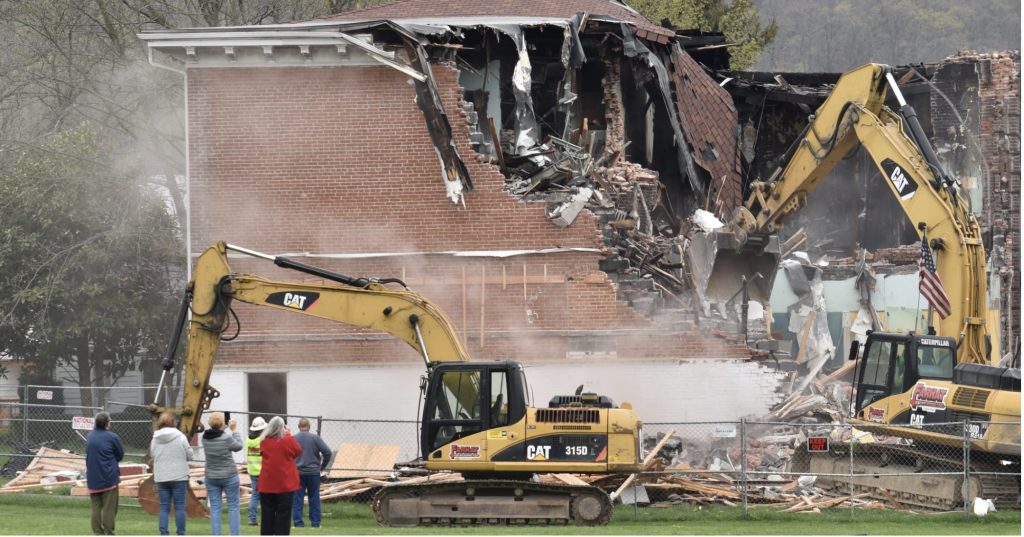
All went up in flames in the early morning of Sunday, Oct. 17, 2021. The home of the Dauphin-Middle Paxton Historical Society, with a meeting place, library and museum, was a total loss.

“We had a whole curio cabinet of cornhusk dolls made by two sisters,” said library Manager Kathy Fisher. “You can’t replace something like that. Financially, they weren’t worth much, but they represented someone from our community, and making them is kind of a lost art.”

What survived the fire were a few archived or scanned documents and photos, plus the rugged determination of a society that perseveres. An organization devoted to preserving the past is working toward a future that includes a new home. To help raise funds toward that day, the society is holding a Heritage Day Gala, Sept. 17 at the Peter Allen House, an event venue and Middle Paxton’s oldest house.

Worth It

Pre-fire, the society’s home was a former, 19th-century Central Dauphin School District schoolhouse rented from its owner, Dauphin Borough. Post-fire, members hold monthly programs at Zion Lutheran Church in Dauphin, while the board meets at the borough building.

The fire, possibly sparked by an electrical problem, didn’t take everything. Society stalwarts praise the firefighters who entered the building’s gutted-but-standing portion, when the heat subsided to salvage what they could.

“They brought out our family-tree binders, all of our original photograph collections,” Fisher said.

Those photos and some irreplaceable items, such as diplomas from the schoolhouse graduates, are undergoing professional restoration, a costly but high-priority process.

Society members held their collective breath before demolition of the ruins, as a backhoe operator gingerly plucked waterlogged file cabinets from the second floor before they could plunge to the first.

Ironically, the society had hosted its annual Heritage Day and celebrated the borough’s 250th anniversary the day before the fire. Items staged for display and left out overnight were consumed, but one society member just plumb forgot to bring out a precious set of Civil War discharge papers donated by the soldier’s great-great-granddaughter.

The documents stayed snug in a fireproof cabinet, undamaged by the water and smoke that seeped into other materials.

“We were so thrilled,” Fisher said. “You don’t duplicate those things.”

Some of the smoky items salvaged are stored in donated maritime shipping containers. Other damp, charred materials are now in Fisher’s basement. A Toshiba office copier donated by state Rep. Sue Helm occupies Fisher’s foyer, and society members show up for copying sessions to make the smelly, fragile documentation useable again for research and consultation.

“It’s been a tremendous amount of work, but it’s worth it to preserve our history,” Fisher said.

Artifact donations are resuming. There’s a 1950 wedding dress, Lion’s Club memorabilia, and uniforms from World War II.

“Dauphin and Middle Paxton were in all the wars,” said museum Manager Jeannette Bender. “They were very dedicated to being in the military, all the way back to the Civil War, and of course, the Revolutionary War.”

The society continues to attract new members. Dynamic programming helps. So does Fisher’s engaging newsletter, sharing quirky news items from the area’s past, like the 1931 tidbit, “Cow Chokes on Apple.” And from summer 1936, “Girls are to be forbidden from wearing any attire that goes to the extreme of shorts and backless dresses in the upriver borough (Dauphin) where the Chief Burgess, C.H. Welker, has warned he will prosecute anyone on the streets in what he calls disrespectful costumes.”

A rebuilding committee is exploring options and funding—and possibly, if Fisher has her way, divine intervention.

“I would love to see the Lord just give us a piece of property somewhere, an old house where we could add on a big meeting room,” she said. “We would love to have something historic to make into our museum.”

Fundraisers have included a successful flea market and sales of the annual calendar. Residents and organizations opened their wallets. A childcare center’s penny war raised $1,200.

“A lot of people can’t give a lot, but what they give is so much appreciated,” Bender said.

The Sept. 17 gala, emceed by radio host, RJ Harris, will include high-end raffle items. Peter Allen House owner Frank Pinto donated use of the nearly 300-year-old venue because, “if you forget your past, you’ll never understand your present.”

The society is blessed with “leadership and the sense of community,” Pinto added. “Everywhere you look, it abounds with pride. You had a series of great leaders, and everyone’s a volunteer. It might be part of their nature.”

Won’t Give Up

Incorporated in 1787, Middle Paxton is a rural township just minutes north of Harrisburg, the kind of place where mountains seem to rise from the banks of the Susquehanna River.

It’s also the kind of place where residents cook up such ideas as planting a Statue of Liberty replica mid-river on an abandoned bridge pier. Families stay for generations. Children leave for college and career but then return. Over the centuries, residents have worked the fields, canals, railroads and riverfront industries.

Society members mourned the loss of the artifacts presenting a picture of that tightknit community.

“I know losing a family member is terrible, but this was close to it for me,” Fisher said. “It’s my life. Other than my family, it’s what I do. It’s so heartbreaking. It still is. If I think about it too long, I can start crying all over again.”

Salvaging some items provided relief, she said, and demolition of the old schoolhouse meant it was time to move on.

Maybe it’s the sense of community that fuels the urge to keep going, Bender added.

“We’re not going to give up,” she said. “We’re not going to give up.”

The Heritage Day Gala, benefiting the Dauphin-Middle Paxton Historical Society, takes place Sept. 17 at the Peter Allen House, 1801 Peters Mountain Rd., Dauphin. Tickets go on sale Aug. 1. For information on the gala and society programming, visit www.dauphin-middlepaxtonhs.weebly.com.


If you like what we do, please support our work. Become a Friend of TheBurg!

Continue Reading

August Editor’s Note

I’m sometimes asked what I get the most phone calls about.

That is, what do our readers complain about most often?

Is it our news stories, our community coverage, or maybe my very insightful commentary each month?

No, no and nope.

That honor goes to—drumroll please—our puzzles.

Nearly every month, TheBurg publishes two puzzles, a crossword and a Sudoku, the only magazine content not locally produced (they’re syndicated, and we pay to use them).

Chances are, when I hear an upset person on my voicemail, they’re unhappy about one puzzle or the other—or both.

In the past, complaints have included that we omitted a puzzle, that the answer key was on the wrong page, or that the puzzle was difficult to read. More recently, people have told me that the crossword boxes were too small and that the Sudoku, labeled “easy” by the puzzle-maker, wasn’t easy at all.

Whew—the life of an editor! Well, as an old boss of mine used to say, tongue planted firmly in cheek, that’s why we get paid the big bucks.

Please know that we take all concerns seriously. Sometimes, limited resources affect our ability to respond, such as not having enough reporters or pages. But we always try to maximize what we have to put out the best product possible.

Along those lines, I again would like to thank all of our “Friends of TheBurg” for helping us supplement our resources, so we can continue to robustly serve this community—which includes publishing our popular puzzles.

Next month, after two-plus years of pandemic delay, we’re going to have our much anticipated “launch party” for the program. All Friends can join us at the historic King Mansion on Sept. 8 for a wonderful night of food, beverage, music and more—and socialize with TheBurg staff! There’s still time to go to our website, become a Friend of TheBurg, and receive an exclusive invitation.

Enjoy our August issue—and happy puzzling, everyone!

Lawrance Binda
Co-Publisher/Editor-in-Chief

Click here to read our August magazine.

If you like what we do, please support our work. Become a Friend of TheBurg!

Continue Reading

Who Picks Your Produce? An appreciation of the workers who get your fruit, veggies from farm to table

Ernesto DeJesus

Lettuce. Peaches. Watermelon. Apples.

Much of the local produce enjoyed by central Pennsylvanians each summer, each delicious bite, is harvested by hand.

“Everything we do is hands-on, from weeding to harvesting to packing,” said Dwayne Lebo, owner of Oak Grove Farms in Mechanicsburg.

Thirty workers tend to Oak Grove’s 265-acre farm.

“I mean, if we were not to have those guys, I’m not sure we could even get enough to supply our own store,” Lebo said.

About half of the workers are local and half arrive from Mexico through the federal government’s H-2A program, which allows farms to hire seasonal foreign workers if locals are not available. Farms are required to hire local workers rather than H-2A if they apply for a job, said Karen Paulus, owner of Mt. Airy Orchards in Dillsburg.

Mt. Airy hires six H-2A workers each year, and typically it’s the same crew.

“They pretty much do 100% of all of our harvest, except for pick your own,” Paulus said.

That harvest includes the Community Supported Agriculture (CSA) boxes that people sign up to receive each month. Those boxes include an assortment of in-season fruits and vegetables.

The H-2A program requires employers to provide housing, transportation to and from the work site, funds for travel from and to the worker’s home country, guaranteed hours, and a minimum pay rate of $15.54 an hour.

“Sometimes, people get a misunderstanding that we hire them [foreign workers] because they’re cheaper, but they’re absolutely not cheaper,” Paulus said. “They’re worth it because they’re hardworking, and they’re good guys. They’re dependable guys.”

While Paulus feels “blessed beyond measure” by the crew of H-2A workers, she also recognizes why these workers travel so far from home.

“It’s a difficult situation because I’m blessed immensely with them being here, and we’re so incredibly thankful, and they’re such good people and so hardworking,” she said. “At the same time, it hurts my heart to know that conditions are so bad in their home country that they need to do something like this to provide for their families.”

Impressed

Both Paulus and Lebo said that they began participating in the H-2A program because it was getting more difficult to find local folks to do the seasonal work. It wasn’t always that way.

“The first couple of years, in the ‘90s, it was nothing for us to have 80 to 100 kids [teenagers] picking strawberries,” Lebo said.

However, vacations, sports camps, church camps and other activities have dwindled the numbers down to about seven, she said.

Not all local farmers use H-2A workers. Strites’ Orchard, just outside Harrisburg, uses all local labor on its 300 acres. Its proximity to Harrisburg, Middletown and Steelton gives the farm an edge in a pool of employees to draw from, said owner Jon Strite.

“People like to knock kids these days, like they don’t know how to work anymore, but we’ve been pretty lucky spotting really good kids to help us get through the season,” Strite said. “Every time I’m working with those guys, I’m just impressed.”

He credits seasonal workers with helping him develop a good work ethic.

“You saw how hard they worked, growing up as a kid working next to them,” he said. “You kept up with them, or they made fun of you. But once you kept up with them, they gave you respect. I had a great time growing up around those guys. I’m blessed that way.”

But misperceptions exist about field workers.

“I think people think they’re all illegal,” Strite said. “That’s just not the case.”


Hard Work

These local farmers greatly appreciate and have good relationships with their farm hands.

Paulus pointed out that workers have a choice about which farms to work at, so farmers like her want to treat them right.

“We want them to choose us,” she said.

Strites’ and Oak Grove have employees who have been with them for as many as 20 years.

Market manager Ben Langford began his time at Strites’ at 14 years old as a cashier and field worker. He still picks with the seasonal folks. Noah Yeich began working at Strites’ when he was 14, too. At 21, he “does a little bit of everything” on the farm, including picking.

“It’s hard work,” he said as he set up an irrigation line under the hot July sun. “Not everybody’s cut out for it.”

Ernesto DeJesus has only been picking for a few months, but labored as a field worker in the 1980s before working in a hospital. Bored as a retiree, he decided to venture out into the fields again.

“A lot of people don’t know where their food comes from and who picks it,” said DeJesus, harvesting peas on a 90-degree day.

The local green peas, crunchy cucumbers, juicy peaches, tart berries and plethora of other produce that grace our tables each summer come from nearby farms. But, without their field workers, these farmers could not get their product to market for us to enjoy.

“There are no machines to do what they do,” Lebo said. “My business doesn’t exist without them.”

Mt. Airy Orchards is located at 522 E. Mt. Airy Rd., Dillsburg; www.mtairyorchards.com
Oak Grove Farms is located at 846 Fisher Rd., Mechanicsburg;
www.oakgrovefarmsinc.com
Strites’ Orchard is located at 1000 Strites Rd., Harrisburg;
www.stritesorchard.com


If you like what we do, please support our work. Become a Friend of TheBurg!


Continue Reading

Good Times, Bad Times: Harrisburg, going up, going down

Illustration by Rich Hauck

I’ve been feeling nostalgic lately.

This month marks the 14th year since the birth of TheBurg, causing me to reflect on my time in this unique, sometimes great, often frustrating little city.

To use a Harrisburg-appropriate metaphor—there’s been a lot of water under the (Market Street) bridge.

And, in this case, water is the appropriate medium, since much of my pondering seems to take place during walks and runs along the river.

Water seems to have that effect upon people. Based upon folks I see sitting alone on the river steps, staring off into the liquid distance, I’m not the only one lost in thought.

Personally, I’ve been reflecting upon the status of our city—things that have gotten better, or have gotten worse, since I arrived here.

Always in search of a good column topic, I thought I would share my ideas with readers. This short list is not meant to be complete or indisputable. These are simply a few things that struck me as I strolled pensively down the river walk.

Going Up

1. City Government

When I came to Harrisburg, the municipal government was on the brink of fiscal collapse—and then it fell off that brink. So, sure, I started covering the city at a historic low, when it seemed it had nowhere to go but up. Nonetheless, Harrisburg should take pride in how far it’s come in balancing its budget, expanding core services, and getting out of the death spiral of deficit and debt.

2. City Roads

In the 1950s, the city conspired against its own future by tearing through neighborhoods, replacing buildings, businesses and people with acres of asphalt. When I got here, I felt that the city’s main streets were too wide, too fast and too decrepit. A lot of progress has been made since. The long list includes 3rd Street, 7th Street, State Street and, most profoundly, N. 2nd Street, which is being reclaimed as a two-way, neighborhood road. As commuting gets replaced by home and hybrid work models, the commonwealth and the city should rethink other roads, including Forster Street, Front Street and the rest of 2nd, helping to stitch the city back together.


3. Broad Street Market

Before coming to Harrisburg, I lived near Eastern Market in Washington, D.C., and loved the crowds, the variety, the vibe. I found none of that here. Around 2009, the Broad Street Market was the proverbial “diamond in the rough,” two beautiful old market buildings that suffered from a lack of vendors, a lack of customers and chronic neglect. Then came new market leadership and a rapid renaissance, as people rediscovered this marvelous asset. Having said this—the pandemic and recent management flux have taken their toll, requiring renewed vision, commitment and stability going forward.


And Going Down

1. Downtown

In recent years, downtown Harrisburg has suffered the one-two punch of crazy parking rates and a terrible pandemic. COVID then became the plague that kept on plaguing, first emptying the downtown of people and then ushering in a new era of work-from-home. The one saving grace—several developers, led by Harristown, had the vision years ago that downtown’s future would be more residential than office. How right they were. Going forward, the city should do everything in its power to facilitate this long-term trend towards a vibrant, livable downtown, encouraging walkability, development, density and amenities.


2. River Walk Steps

In 2019, Harrisburg laid fresh concrete on the lower river walk, which had suffered years of neglect and decay. The project, though, stopped there, leaving the crumbling steps that descend into the river to crumble even further. Certainly, fixing the river walk steps is an expensive, extensive endeavor, but the city needs to begin thinking seriously about how to preserve this treasure from our City Beautiful past, even if it takes many years to complete. Otherwise, we’ll need to resign ourselves to watching the Susquehanna River slowly reclaim its muddy banks.

3. Homelessness

I don’t know if there are more people living on the streets today than when I arrived in Harrisburg. However, as the city redevelops, homeless encampments seem to have become more concentrated, pushed more towards the river. Some occupy private land that is overgrown and undeveloped, but is for sale. Some day, maybe not too far in the future, someone will buy these long-vacant, well-located riverfront parcels, and people way smarter than me on this issue will need to ponder what comes next for the folks who live there now.

In creating this list, I thought about many possible areas of progress and decline. Some, such as the school performance, I regarded as “about the same” as when I arrived. Others, such as crime, were a mixed bag—some encouraging trends and some discouraging ones. And then there were a few runners-up: Midtown (a lot better), bike/pedestrian safety (a lot worse).

Perhaps you have your own ideas on what’s better—or not—in Harrisburg over the past decade or two. If so, email them to me. If I can gather enough thoughtful responses, I’ll publish a follow-up column online.

If you need some quiet inspiration, I strongly recommend a long, contemplative stroll along our beautiful riverfront.

Lawrance Binda is co-publisher/editor-in-chief of TheBurg.


If you like what we do, please support our work. Become a Friend of TheBurg!

Continue Reading

August News Digest

A summary of Harrisburg news over the past month

Development Projects Approved

Several Harrisburg development projects focused on serving lower-income residents will move forward following a City Council legislative session last month.

Council took action to push forward an affordable housing development for South Harrisburg, as well as a childcare center, the Catherine Hershey School for Early Learning.

Council unanimously voted to approve a lot consolidation and land development plan for “Sycamore Homes,” a 23-unit affordable apartment building planned for the 1400-block of Sycamore Street, near Foose Elementary School.

Harrisburg developer George Fernandez, CEO of Latino Connection, explained that the $3.4 million project will offer high-quality studio units to lower-income residents.

“What drives us is helping to change what the face of low income looks like,” he said.

Fernandez said that he hopes to begin construction by this fall, with the project completed by fall 2023.

Additionally, council approved a lot consolidation and land development plan for the Catherine Hershey School for Early Learning, which has proposed a childcare facility and school in Uptown Harrisburg.

The building will occupy a 3.44-acre area bounded by Peffer, N. 7th, Muench and N. 6th streets. The school is an arm of the Milton Hershey School and would offer free care and pre-K education to 150 low-income and at-risk children, from birth to 5 years old.

According to Executive Director Senate Alexander, the school will focus on providing kindergarten readiness programming and family support options.

“I look forward to it,” council member Ausha Green said. “I think it’ll be great for the community.”

The project is slated for completion in spring 2024. The school still will need to secure street vacations for several small roads on the project site.

In other news, council approved a resolution to create “Hot Spot Saturdays,” a summer initiative to encourage residents to participate in six community cleanup events, which will take place throughout July, August and September in Harrisburg.


Maclay Street Bridge to be Replaced

A critical link in Harrisburg is set for an upgrade, as PennDOT prepares to replace the Maclay Street Bridge.

Last month, the PA Department of Transportation unveiled its project website and opened up the comment period for its plan to replace the bridge, which carries about 25,000 vehicles a day. The comment period lasts through Aug. 5.

Under the current schedule, the $35 million project would begin in 2024 and last for about two years. The project extends from the Maclay Street/7th Street intersection to Julia Street, which is a half-block west of Cameron Street.

PennDOT describes the existing, 82-year-old bridge as in “poor condition with advanced deterioration to the primary load carrying members.”

Major elements of the bridge project include:

  • Construction of a new, four-span steel girder bridge over the Norfolk Southern Harrisburg Rail Yard, replacing the existing, seven-span bridge, which was built in 1940.
  • Raising the profile of the Maclay Street roadway to increase the vertical clearance of the bridge from 21 feet to 23 feet to better accommodate double-stacked rail cars.
  • Widening of Maclay Street from four lanes to five lanes in the project area.
  • Addition of bicycle lanes in both the eastbound and westbound directions.

As part of the project, the small bridge carrying Maclay Street over Paxton Creek also will be replaced.

The width of both bridges will be increased from 62 feet to 86 feet. The new bridges will have five 11-foot-wide lanes, two 6-foot-wide bike lanes, and two 8-foot-wide sidewalks.

According to PennDOT, construction will be performed in stages while maintaining three lanes of traffic and at least one sidewalk in each stage. The temporary lane configuration will carry two lanes of traffic westbound into the city and one lane of traffic eastbound out of the city.


2022-23 School Budget Passed

The Harrisburg School District has approved a budget for the 2022-23 school year, a spending plan that includes a 3.36% property tax hike.

At a board meeting in late June, Receiver Dr. Lori Suski approved a $223.8 million budget, and the school board voted 6-1 to increase the property tax rate from 29.78 to 30.78 mills. Board Director Roslyn Copeland voted against the increase; directors Jaime Johnson and Terricia Radcliff were not in attendance.

“I am very happy that the board saw fit to approve of the tax structure because that enables us to have a balanced budget and enables us to move forward with some necessary projects for the district,” Suski said.

With the increase, taxpayers pay $30.78 per every $1,000 in assessed property value. However, the 5,609 households in Harrisburg that receive the homestead exemption will actually see a small decrease in their taxes, according to Dr. Marcia Stokes, the district’s business administrator. Additional property tax relief funds this year will increase the exemption, she said.

The district’s 2022-23 budget includes the use of millions of dollars in federal COVID relief funds, making the spending plan much higher than last year’s $184.8 million budget.

The approved final budget is slightly lower than the district’s originally proposed $224.2 million budget.

Harrisburg received an influx of about $50 million in Elementary and Secondary School Emergency Relief (ESSER) funding, which it plans to use on projects such as the renovation and reopening of the district’s Steele Elementary School. The district also plans to replace HVAC systems across schools with the funding.

The budget also pays for day-to-day expenditures like instruction, special instruction and staffing costs.


Post Office Set to Move

By the end of the year, Harrisburg’s downtown post office will have a new address.

Last month, Harristown Enterprises announced that the Federal Station Post Office will relocate about one block away, inside of Strawberry Square.

Specifically, the post office will occupy about 2,000 square feet of space on the 300-block of Market Street, in the long-vacant storefront location last occupied by the restaurant, the Gingerbread Man, which closed in 2014, according to Harristown, which owns Strawberry Square.

“We are delighted to announce this news to the public, and we believe Strawberry Square is an excellent location for the new U.S. post office,” said Brad Jones, Harristown’s president and CEO.

The space will be built out and the move completed by the end of 2022, Jones said.

Earlier this year, the federal government sold the Ronald Reagan Federal Building, located at N. 3rd and Walnut streets, to Seychelles-based Global Ocean Investments for $10 million.

As a result, all federal offices located in the building must move, including the post office. The building is expected to be entirely vacant by early 2023.

New building owner Justin Etzin has said that he plans to redevelop the 56-year-old, 251,000-square-foot structure as a 200-unit apartment building with several restaurants and bars.

The federal building sale was prompted by the construction of a new federal courthouse at N. 6th and Reily streets in Harrisburg. The $201 million courthouse project, which includes 243,000 square feet of space, is nearing completion, according to the U.S. General Services Administration.


Plants + Pints Returns

Harrisburg, chew on this—a festival devoted to healthy eating will return this month following a pandemic-induced hiatus.

Plants + Pints Harrisburg, formerly called Harrisburg Veggie Fest, plans to bring the community together to educate people on living a healthy and eco-conscious life by highlighting local farms, vegan and vegetarian businesses and other plant-based products. And, in a unique, central PA twist, there also will be craft beer.

“It’s a wellness community event with a focus on wellness, PA agriculture and craft beer,” said organizer Sara Bozich, CEO and founder of Sara Bozich Events.

The festival will take place from 1 to 4 p.m. on Saturday, Aug. 27, in Strawberry Square in Harrisburg.

The event, produced in partnership with Harristown Enterprises and presented by UPMC in Central PA, will benefit two local nonprofit organizations: Downtown Daily Bread and Harrisburg River Rescue and Emergency Services.

Bozich said that the idea came from Harristown Enterprises CEO and President Brad Jones, who has vegan family members and loves craft beer. Jones attended an event in Philadelphia spotlighting plant-based companies and local craft breweries and wanted to bring it to Harrisburg.

The event will feature more than two-dozen plant-based vendors, as well as DJ duo His&Hers and six craft breweries. Bozich also stated that, although everything is plant-based, anything not vegan will be clearly specified.

General admission tickets for adults are $20 and youth ages 12 to 21 are $10. Anyone under 12 years old is free.

Bozich stated that this is an event for everyone, not just those who follow a plant-based lifestyle.

“It’s a community event,” she said. “And proceeds are going back to the community.”


Home Sales Dip, Prices Up

Home sales slipped while prices rose in June, according to the latest report on previously owned houses in the Harrisburg area.

For the three-county region, a total of 770 houses sold in June, compared to 826 in June 2021, as the median price rose to $264,050 from $230,000 last year, said the Greater Harrisburg Association of Realtors (GHAR).

In Dauphin County, sales dipped to 349 homes versus 389 last June, but the median price increased to $230,500 from $209,000, GHAR said.

Similarly, in Cumberland County, sales slipped to 374 houses, compared to 404 in June 2021, as the median price rose to $315,000 versus $256,750 in the year-ago period, according to GHAR.

Perry County had 43 homes sell in June, an increase of 10 houses from a year ago, as the median price rose to $219,950 from $200,000 in June 2021, GHAR said.

In June, houses also were selling quickly, as “average days on the market” decreased to 13 days versus 16 days last June, according to GHAR.

20 in Their 20s

It soon will be time for local up-and-coming professionals to take the spotlight.

Harrisburg Young Professionals (HYP) announced that nominations are now open for its 2022 “20 In Their 20s” class.

“It’s a good opportunity to highlight people doing good work in their communities,” said HYP Board President Jade Honey.

Anyone between the ages of 20 to 29 who lives or works in Dauphin, Cumberland or Perry counties is eligible for nomination. The nominee must contribute to making a difference in their community or workplace. Twenty young people will be selected and honored.

Nominations are open through Aug. 8. For more information, visit www.hyp.org.

On Nov. 9, HYP will host its “20 In Their 20s” awards ceremony at the Hilton Harrisburg. Tickets for the event will go on sale Sept. 7.


So Noted

Beacon Clinic for Health and Hope last month was awarded a $25,000 grant from the Highmark Foundation. The grant will allow the Harrisburg-based healthcare clinic to improve its technology systems and offset some staffing costs, according to Beacon.

Blaze Pizza opened last month at 4401 Jonestown Rd. in Colonial Park. It’s the second Harrisburg-area location for the California-based fast-casual restaurant chain, which has about 300 locations nationwide.

David Ozmore last month was named the new president and CEO of the Harrisburg Area YMCA. Ozmore, a long-time YMCA staff member, will assume the post on Aug. 1, replacing long-time CEO Richard A. Curl, who is retiring.

Gina Seibert last month was named the incoming chief financial officer for PSECU. Seibert, who has been with the Susquehanna Township-based credit union for 19 years, replaces Carol Noblit, who announced her retirement.

Harristown Enterprises last month said that it planned to remove the “Chockablock Clock” from Strawberry Square, using the space for a larger stage and second-floor, cantilevered meeting room. The clock, an audio-kinetic ball machine, was designed by George Rhoads and installed in the atrium in 1988.

H*MAC is now a “Live Nation” venue, it was announced last month. Under the multi-year agreement, Live Nation, a leading live entertainment company, will be H*MAC’s exclusive booking partner for the 1,200-person capacity Capitol Room, the largest of several performance spaces in the sprawling arts and restaurant complex in Midtown Harrisburg.

Raising the Bar will open soon in the first-floor commercial space of the newly renovated “Carpets and Draperies” apartment building in the 1500-block of N. 3rd Street in Midtown Harrisburg. Bakery owners Casey Callahan and Timishia Goodson will expand their hours and offerings, which will include sandwiches and coffee, while retaining their stand in the Broad Street Market.

Raymour & Flanigan cut the ribbon last month on its new showroom at 4661 Lindle Rd. in Swatara Township. The retailer offers a wide variety of furniture and décor for home and office.

Steve Sanchez, president of Camp Hill-based JDK Group, has been elected president of the International Caterer’s Association. In this role, he will help spearhead the ICA’s direction for the next two years.


Changing Hands

Argyle St., 41: L. & E. Keefer to Neidlinger Enterprises LLC, $49,900

Barkley Lane, 2518: L. & B. Grotjan to A. Jayapal, $131,000

Benton St., 631: D. Clark to J. Bonilla, $140,000

Berryhill St., 1421: Integrity First Home Buyers LLC to S. Kundilepurayil, $139,995

Berryhill St., 1620: R. Kessler to G. Taylor, $75,000

Berryhill St., 2436: F. Phan to J. Charlton, $96,500

Boas St., 106: A. Nascone to E. Cannady, $210,000

Briggs St., 207: S. & K. Plummer to M. Vogel, $95,000

Briggs St., 255 and 248 Oliver Alley: Eastern State Investments to SJL Rentals, $625,000

Briggs St., 1810: Federal Home Loan Mortgage Corp. & New Rez LLC to Your New Home LLC, $72,008

Calder St., 107: L. & M. Ferenbaugh to LE Real Estate Trust, $135,000

Calder St., 115: JMW Property Group LLC to W. Boehi & J. Leberman, $258,000

Camp St., 645: J. Gulbin to LHV Properties II LLC, $63,500

Catherine St., 1624: Shope Rentals LLC to First Choice Home Buyers LLC, $40,000

Chestnut St., 1935: N. Doan to J. Hallager, $108,000

Conoy St., 108: D. Wendling to Ashkay Properties LLC, $170,000

Crescent St., 309: R. & B. Lehman to J. Hamilton, $55,000

Crescent St., 328: Z. Gonzalez to C. Rodriguez, $70,000

Derry St., 1521: K. Bitner to 2020 Real Estate Ventures LLC, $60,000

Derry St., 2024: T. Evans to Bertao Family Investments Penn LLC, $70,000

Derry St., 2029: S. Ginder to S. Bailey, $147,400

Derry St., 2348: K. Saengmuang to R. Harbaugh, $70,000

Derry St., 2626: F. & M. Morris to Portee Properties LLC, $155,000

Duke St., 2446: R. Martin to T. Desta, $83,500

Duke St., 2452: M. & D. Graeff to P. Carter, $124,900

Elm St., 1644: First Choice Home Buyers LLC to D. Boyle, $50,000

Forster St., 2011A: L. & E. Keefer to Neidlinger Enterprises LLC, $64,900

Forster St., 2013: L. & E. Keefer to Neidlinger Enterprises LLC, $59,300

Green St., 1020: J. & H. Piper to R. Chelsey, $185,000

Green St., 1630: B. & L. Bauman to Big Leaf Properties LLC, $200,000

Green St., 1702: J. & S. Lebron to J. Barrie, $245,000

Green St., 1908: G. & T. Washington to L. Silverberg, $241,000

Green St., 2015: National Residential Nominee Services Inc. to A. & W. Jamgochian, $280,000

Green St., 2146: J. & S. Compton to R. Gillette, $65,000

Green St., 2237: J. Compton to El Gamwo LLC, $115,000

Green St., 2338: E. Chattah to D. Harris, $159,000

Hale Ave., 204: BP Real Estate Investment Group LP to D. & L. McKinnie, $255,000

Hamilton St., 202: D. & R. Stachow to SJL Rentals LLC, $160,000

Hamilton St., 334: D. Monzon to Bitsy & Tino Enterprises LLC, $135,000

Harris St., 416: M. Riegel to M. Gomez, $130,000

Herr St., 267: S. & D. Kaplan to J. & R. Thompson, $230,000

Hoerner St., 117: A&K Investments Partnership LLC to Y. & J. Colon, $85,000

Holly St., 1937: CR Property LLC to M. & E. Kaiser, $125,000

Industrial Rd., 4230: Cottage Real Estate LLC to 4230 Industrial Rd. LLC, $2,175,000

Jefferson St., 2620: M. Galvez to A. Rosario, $60,000

Jefferson St., 2717: L. & E. Keefer to Neidlinger Enterprises LLC, $61,400

Jefferson St., 2717: L. & E. Keefer to Neidlinger Enterprises LLC, $64,900

Kelker St., 232: J. & A. Webb to 232 Kelker LLC, $195,000

Kensington St., 2006: S. Carr to A. Ryabukha, $65,500

Lewis St., 100: E. & Y. Friedman to W. Yankey & N. Scarcia, $249,000

Lexington St., 2558: Neidlinger Enterprises LLC to RA Love Homes LLC, $159,500

Liberty St., 1412: Mainline Funding Group Inc. to D. Boyle, $55,225

Logan St., 1931: Capital Real Estate Group to D. Boyle, $40,000

Logan St., 2141: E. Alacantara to Neidlinger Enterprises LLC, $52,000

Logan St., 2143: Neidlinger Enterprises LLC to M. Estrada, $130,000

Logan St., 2163: Neidlinger Enterprises LLC to M. Estrada, $130,000

Logan St., 2417: DMA Rentals LLC to J. Mbuthia, $105,000

Manada St., 1938: W. & N. Williams to L. Lobos, $115,000

Market St., 1641: M. & G. Stiffler to J. & M. Gonzalez, $46,250

Market St., 1642: Lynn & Ryan Investment Properties LLC to 2020 Real Estate Ventures LLC, $51,000

Market St., 1917: S. Lynch to SPG Capital LLC, $118,500

May St., 916: A. Weedon to Integrity First Home Buyers LLC, $45,000

Mercer St., 2425: S. Hill to K. & T. Monroe, $96,100

Muench St., 313: Awakening Enterprises LLC to R. Cortes, $93,000

Mulberry St., 1813: EB & ZEE LLC to JM Thrift & Vintage LLC, $69,360

Mulberry St., 2004: T. Taylor to Z. Roudi & M. Maniari, $119,995

Naudain St., 1529: Keim Brothers LLC to D. & S. Tucker, $50,999

North St., 1836: B. & R. Lomax to J. Paulino, $85,000

North St., 1838: B. & R. Lomax to T. Bauserman & J. Hoskins, $76,500

North St., 1906: T. Davis & R. Wilder to S. Patterson, $72,000

N. 2nd St., 1117: 1117 N. 2nd Street LLC to CWJK Holdings LLC, $497,000

N. 2nd St., 1601: Lynn & Ryan Investment Properties LLC to D. & A. Hoffman, $370,000

N. 2nd St., 2135: Heller Investments to T. Wadlinger, $142,855

N. 2nd St., 2802: P. Kessler to K. & J. Reed, $244,900

N. 2nd St., 2812: J. & K. Reed to L. & N. Hunsinger, $420,000

N. 2nd St., 3228: R. & C. McAllister to Toch Investments LLC, $70,000

N. 3rd St., 1708: D. Cobb to Y. Miller, $185,000

N. 3rd St., 2014: S. & C. Payson to C. & L. Eby, $270,000

N. 3rd St., 2500 & 2518: Kesher Israel Congregation to M. & A. Reuveni, $200,000

N. 5th St., 3138: S. Cameron to L. Confer, $166,000

N. 6th St., 2607: A. Clark to B. Costa, $50,000

N. 12th St., 43: J. Hardy to Neidlinger Enterprises LLC, $45,000

N. 12th St., 54: J. Achenbach to I. Colon, $42,000

N. 15th St., 1215: A. & M. Hayden to T WY Enterprise LLC, $48,000

N. 18th St., 614: Neidlinger Enterprises LLC to RA Love Homes LLC, $159,900

N. 19th St., 712½: Neidlinger Enterprises LLC to M. Estrada, $149,900

N. Front St., 1525, Unit 312: R. & C. Chaudhuri to J. Bowles, $180,000

N. Front St., 1525, Unit 504: J. Brown to W. & L. Renz, $284,900

N. Front St., 1525, Unit 507: C. Tomlinson to X. Samuel, $135,000

Peffer St., 216: Grentals LLC and Wix Wenger & Weidner to 216 Peffer LLC, $220,000

Pennwood Rd., 3015: S. & F. Harp to D&J Properties, $80,000

Pennwood Rd., 3133: M. Mumma to BP Real Estate Investment Group LP, $98,000

Putnam St., 1620: A. Adams to J. Alvarez, $160,000

Race St., 558: M. Kramer to F. Yarwood, $172,500

Radnor St., 625: R. Rammouni to Integrity First Home Buyers LLC, $95,000

Reel St., 2412: Integrity First Home Buyers LLC to D. Tobe, $139,995

Reel St., 2732: Neidlinger Enterprises LLC to RA Love Homes LLC, $149,500

Regina St., 1700: Safarii Properties LLC to A. Miller, $210,000

Reily St., 215: B. & L. Bauman to Big Leaf Properties LLC, $200,000

Rose St., 931: P. Van Rossum to W. & K. Hemler, $52,500

Rudy Rd., 2257: K. Krusko to B. & A. Dunfrund, $275,000

Rudy Rd., 2482: 2482 Rudy Road Trust to K. Ross Seals, $84,000

Seneca St., 530: Neidlinger Enterprises LLC to RA Love Homes LLC, $159,500

Seneca St., 615: M. & G. Toro to N. Dunbar, $95,500

S. 14th St., 328: M. Valdez to J. Meija, $50,000

S. 14th St., 349: G. Vargas to D. Boyle, $45000

S. 14th St., 437: Integrity First Home Buyers LLC to Chand Living Trust, $139,995

S. 16th St., 566: M. Dones to D. Illanes, $68,000

S. 18th St., 1323: McCoy Rentals LLC to R. Rammouni, $62,000

S. 19th St., 1111: K. Saqib to D. Strausbaugh, $188,000

S. 19th St., 1125: Mann Realty Associates to J. Halkias, $205,000

S. 19th St., 1129: M. Montano to R. Gutierrez, $147,000

S. 20th St., 614: G. Hanslovan to Neidlinger Enterprises LLC, $65,000

S. 21st St., 1000: K. Roach to Golden Brick Road LLC, $607,143

S. 27th St., 803: B. Turner & B. Faulkner to M. Arellano & V. Bravo, $150,000

S. Cameron St., 1327: J. Swigart to Rainey’s Lighthouse LLC, $95,000

State St., 112: Pennsylvania Republican Home Inc. to Priestly Fraternity of St. Peter Inc., $750,000

State St., 231, Unit 805: M. Tantardini to B. Azevedo, $185,000

Swatara St., 2042: Integrity First Home Buyers LLC to D. Boyle, $43,500

Swatara St., 2051: J. & L. Krum to K. McClain, $123,000

Verbeke St., 1330: K. Byers to J. Castro, $190,000

Wendy St., 1126: Keystone K9 LLC to Warnell LLC, $1,850,000

Whitehall St., 2021: Sunny Day Real Estate Solutions LLC to M. McCall, $155,000

Wiconisco St., 564: D. Fernandez to J. Cruz & A. Sanchez, $160,000

Wyatt St., 310: M. & E. Shapiro to G. Archer, $142,500


Harrisburg property sales, June 2022, greater than $40,000. Source: Dauphin County. Data is assumed to be accurate.


If you like what we do, please support our work. Become a Friend of TheBurg!

Continue Reading

Life Lessons: Tri-County OIC helps area adults continue their education, seeks volunteers

Kathy Watkins-Lewis

Continuing her education as an adult has been an uphill battle for Kathy Watkins-Lewis.

The 70-year-old Harrisburg resident started pursuing her GED when her son was young. She wanted to be able to help him with his homework. Now, he’s 51, and Watkins-Lewis is still working towards her goal.

“There was always something hindering me,” she said. “I’ve had a lot of personal trauma. But this is a promise that I made to myself. I’m doing this for me.”

While Watkins-Lewis has needed to pause and resume her studies for years, slowly chipping away at her goal, Tri-County OIC has remained a constant support in her life.

The organization, located on Maclay Street in Harrisburg, provides adult education courses to local residents. Every year, hundreds of adult learners like Watkins-Lewis come to the OIC to receive assistance in getting a high school equivalency diploma, learning English and for vocational and digital literacy help. They also offer a program for those re-entering society after prison.

According to Bill Gustafson, tutor recruiter for the OIC, like Watkins-Lewis, many participants in the organization’s programs take years to complete their courses. Getting an education as an adult comes with unique challenges like childcare, transportation and financial issues, he said.

Gustafson started as a volunteer at the OIC when he retired and was looking for a way to help people. But he quickly discovered how rewarding the experience was for him, as well.

“People are happy to be here and to achieve their goals,” he said. “It’s just great. I can’t think of a better way to spend my time.” 


Where You Should Be

With the recent migration of refugees from Afghanistan and the likely influx of Ukrainian refugees, Tri-County expects the demand for its English as a Second Language (ESL) classes to increase.

The organization is currently in need of volunteers for that program in the form of tutors, classroom aides and one-on-one helpers. Only know English? According to Annette Reiff, volunteer coordinator, that’s actually a good thing, as tutors encourage students to only speak English in the classroom to assist in the learning process.

New volunteers for the program will undergo orientation and training and don’t need any experience in education to serve, Reiff explained. All Tri-County OIC asks is that they make a commitment to volunteering for a longer period of time.

“I think it’s the most rewarding experience you can have,” Gustafson said. “This is where you should be.”

Tri-County OIC has operated in Harrisburg since 1965, as part of a nationwide alliance of OIC’s. Over the years, the local organization has grown and taught classes at over 75 locations in the Harrisburg area.

“People come because they know people here will help them change,” Gustafson said.


Degrees & Dreams

While Watkins-Lewis originally started the process of getting her GED when her son was young, she’s now working towards the same goal alongside her grandchildren.

“I tell them, ‘don’t wait until you’re as old as me to get this education,’” she said.

Still, her age has never deterred her from pursuing education, although there have been times where she considered giving up. Watkins-Lewis remembers when she talked to an OIC tutor about the personal struggles she was going through.

“You can open up to them,” she said. “It’s like a family. I love them.”

Watkins-Lewis hopes to receive her high school equivalency diploma in the near future and then wants to take courses at a community college, she said. Getting an education is the best way she can find to better herself.

The staff and volunteers of the OIC would agree. According to Reiff, education is one of the best ways to help someone get out of poverty and find job opportunities. But it’s also a way to find renewed hope for the future. For Watkins-Lewis, that hope has remained strong through the years, thanks to the support from volunteers at the OIC.

“They take the time out of their busy schedules to teach us,” she said. “They really don’t have to. I really appreciate it.”


Tri-County OIC is located at 500 Maclay St., Harrisburg. For more information or to sign up to volunteer, visit
www.tricountyoic.org.

If you like what we do, please support our work. Become a Friend of TheBurg!

Continue Reading

All the Buzz: The Capital Area Beekeepers Association and Pennsylvania State Beekeepers Association are attracting new members, like bees to honey

Gary Carns is busy as a bee.

He was in the midst of an eight-day road trip covering 28,000 miles when we connected on the phone. He had a schedule to keep. He was due in South Carolina the following day for a delivery of some precious cargo—bees. Actually, 50,000 bees.

“I run bees from South Carolina to Pennsylvania and New York and back again, supplying them to orchards,” said Carns, of Millersburg. “I have a 4-year old vehicle—and let me see, I have 216,000 miles on my odometer right now.”

A full-time beekeeper, Carns serves as president of the Capital Area Beekeepers Association (CABA). It’s a growing hobby and profession that’s all the buzz, thanks to greater awareness about the importance of pollinators—especially bees—to our crops and environment, amid harmful effects of climate change on the pollinator population.

Bees are also pretty fascinating.

“Honeybees are the only living organism that doesn’t harm any other living organism,” Carns said. “In fact, when they visit a plant, they leave it better. The honeybee is an amazing creature.”

Carns, 59, is an eighth-generation beekeeper. His son, 14, represents the up-and-coming ninth generation.

“I’ve been doing it since 1969, when I started helping my dad,” Carns said.

Back then, the region’s beekeeping association was called the Dauphin County Beekeepers. Carns has been “heavily involved” the past 10 years as a CABA officer.


New Bees, Newbies

More than 200 Harrisburg-area residents belong to CABA, with about 25 newbies joining their ranks this year, having completed CABA’s 34th annual short course on beekeeping. It covers everything from how to establish a bee colony to bee biology and disease, hive management, and the sweet rewards of harvesting honey.

Membership is growing, Carns said, because “people are starting to realize the food bees make—honey—is a perfect food, and they’re starting to realize how important bees are for the pollination of our food.”

That food includes fruit orchards such as Strites’ Orchard, just outside Harrisburg, where CABA bee boxes provide a mutually beneficial exchange. CABA bees help pollinate Strites’ trees and crops—such as cherries—while gathering nectar, which they take back to CABA’s hives, where the insects work collaboratively in colonies to turn it into golden honey.


Sweet Spot

CABA also has maintained a bee yard at HACC in Harrisburg since 2016. Volunteers from the organization began clearing brush and debris from a 2-acre plot in the winter of 2020 in order to establish a community pollinator garden. Members researched and designed the garden to include plants that are both native to central Pennsylvania and pollinator-friendly.

The garden, adjacent to the Capital Area Greenbelt, not only provides beautiful scenery for passing bikers, runners and hikers to enjoy, but it elevates awareness and cultivates a greater appreciation for these tiny insects.

HACC’s hives also provide hands-on experience—for those in full beekeeping suits, of course.

“We’re trying to introduce people who have never had bees to beekeeping,” Carns said. “So twice a month or so, we show people what their bees should look like at HACC.”

CABA has another unique educational use for the HACC bee yard. Through a partnership with the national nonprofit Hives for Heroes, they introduce military veterans to beekeeping through free training and mentoring.


Buzzwords

CABA is one of 37 clubs dedicated to nurturing and growing beekeeping across the state.

“Beekeeping continues to grow in popularity, although a little more slowly than it has in the previous decade,” said Mark Gingrich, 54, of Gingrich Apiaries in Dover, York County. He’s currently president of the Pennsylvania State Beekeepers Association (PSBA).

People seem to be attracted to—even falling in love with—beekeeping.

“Keeping bees is reasonably inexpensive to get started,” Gingrich said. “Most people love the learning process and are fascinated with how bees function as social insects, cooperative care of young, overlapping generations and the division of labor for a common cause.”

Current environmental buzzwords—pollination and climate change—are also powerful motivators for many new beekeepers.

“Both wild and managed pollinators face a wide array and ever-changing list of stressors,” Gingrich said. “They—in combination with changing weather trends— contribute to a national annual honey bee loss as high as 42%. In Pennsylvania, bees indirectly create many jobs and help support families devoted to growing fruits and vegetables.”

An estimated 80% of state crops rely on pollination, according to the Pennsylvania Department of Agriculture.


Sweet Rewards

Gingrich got into beekeeping almost 20 years ago—as an entry-level, and affordable, way to be involved in the agricultural industry.

“I’ve always had a passion for agriculture,” said Gingrich, who grew up in 4-H and FFA. “As time passed, it became apparent to me that I would never have the resources available to overcome the economies of scale necessary for me to farm at a level beyond just a hobby. Beekeeping, at a sideliner level, provided me the opportunity to enter the arena at a considerably lower investment level.”

Beekeeping, like the lives of bees themselves, seems to rely on a fine balancing act of science and environment, work at an individual level, as well as key connections to a hive of activity at the community level.

“The reasons for keeping bees are many—from supporting the planet we share to the sweet reward of honey after a successful year,” Gingrich said, “But, for me, it also provides a certain joy in teaching others the craft.”

To learn more about the Capital Area Beekeepers Association and the Pennsylvania State Beekeepers Association, see cabapa.org and pastatebeekeepers.org, respectively.


If you like what we do, please support our work. Become a Friend of TheBurg!
Continue Reading

Fighting Force: Become one with the fun with the Jedi Sith Alliance

Central PA Jedi Sith Alliance participants

“I like…to share the love of ‘Star Wars,’” said Andrew Rinier, through his menacing red and black Darth Maul makeup, spiky horns dotting his head.

He shares this love of “Star Wars” through the Central PA Jedi Sith Alliance (JSA). To bring the non-Star Wars versed into the conversation, Jedi’s represent all that is good in “the Force,” while the Sith choose to use this power for evil.

JSA performs choreographed Jedi/Sith fight scenes, complete with light sabers, elaborate costuming, and audience participation at events in central Pennsylvania—all for no charge.

Jason Baker explained that, because it’s a Star Wars Fan Club recognized by Lucasfilm, Ltd., they can’t charge for appearances. However, they do accept donations for local charities and to cover their expenses. Though money has zero to do with why they do, what they do.

“How often do you get to say, ‘I own a light saber, how about you?’” said Eryka Ward, who performs as the character, Ja’En Nexu.

At a recent practice, the yellow, red, blue and green light sabers swooshed through the air with their distinctive whirring sound, as Nick Marquette, fight director, guided the group’s movements, followed by the clack, clack, clack of contact.

JSA requires no experience to join the group, but some folks arrive with skills.

Cindy Hanwell had sword-fighting experience and discovered JSA at a PA Farm Show Complex Comic-Con event.  She tried out the group.

“We came to a practice, and they couldn’t get rid of us,” said Hanwell dressed in her Ashoka Tano costume, with orange and white face makeup and a handmade, blue-and-white, foam, fabric and papier mâché headdress that dropped over her shoulders like pigtails.

Members can challenge themselves to increase their skills or keep it simple.

“We can incorporate any skill level into what we do,” Hanwell said.

It’s not only adults who participate. Five-year-old Vera Lenker performs as a Wampa and Baby Yoda. She prefers the dark side of the Force “because my dad likes the dark side, “she said.

“Generally, Sith don’t like Jedi. They have too many rules,” said Vera’s dad, Curtis.

He brings her along to the hour-long, weekly practices, which involve dinner afterwards.

“You can blame me for her nerdiness,” he said.

The group embraces its Star Wars nerdom, and members agree that making people smile is their favorite part of it all.

“When we go to events, people love it, kids love it, and a lot of adults are interested,” said Baker.

Children are often a bit scared, but they still muster up the courage to hug the imposing Darth Maul, and folks are always drawn to the light sabers.

“We got to go to parades and everything, and people cheering us on,” Ward said. “I wanted more of that in my life.”

Group members also enjoy the camaraderie, learning new skills, and the active, overall fun of participating.

“You see something you loved as a kid, and now you get to do it as an adult,” Ward said.

For many, it’s a family affair. Baker and his two sons have performed for about five years.

“It is something I thought my son would like, and it was something we could get out and do,” Baker said.

Folks don’t need to be “Star Wars” super-fans to participate. Baker enjoyed “Star Wars” about as much as the average person before he joined, but the group has elevated his interest.

“This has put us over the top,” he said.

While there’s much fun to be had, the group also needs to consider safety. The fight director choreographs the saber battles, and there’s lots of practice. The costume supervisor makes sure that the costuming allows for movement in battle. Scenes are recorded and uploaded to YouTube so that members can work on them at home, as well.

In his persona as Darth Maul, but with his blue eyes and soft-spoken nature letting his real self shine through, Rinier summed up JSA’s mission.

“To share the love for ‘Star Wars,’ and give the best performance we can give,” he said.

To learn more about the Central PA Jedi Sith Alliance, visit www.centralpajsa.org.


If you like what we do, please support our work. Become a Friend of TheBurg!

Continue Reading

Mining Your Roots: A trip to coal country helps our writer connect with her great-grandfather

Stephanie Kalina-Metzger and Ignatz Kalina

I remember very little about my great-grandfather, Ignatz Kalina.

I have but one picture of him—a fading black-and-white photo of the two of us, sitting together on a couch, in his living room in Taylor, Pa. I seem to recall that day when I, young and squirmy, was forced to sit for a photo when I had so much to explore in those new-to-me surroundings.

With the ongoing Ukrainian/Russian conflict, I’ve been thinking more about him and my great-grandmother, Paulina, who left the region for the United States in 1907 while they both were in their 20s.

My mother remembers just a few visits before my parents divorced and recounts how Paulina welcomed me enthusiastically, scooping me from her arms when I was an infant and scurrying to a back room to quietly sing to me in her native language. I, sadly, have no photos, nor recollection of Paulina, who passed a decade before Ignatz. With my father gone, I have relied on the internet to gain a little more insight into their lives.

Ignatz worked for the Moffat Coal Co., which I was able to confirm when I discovered his name on a list of mining accidents. He was struck in the jaw when a bar slipped while he was working as a trackman’s helper. Evidently, he advanced in his profession to become a full-fledged miner, certified to work with explosives only later in life. “Pop” lived to be 86 years old. The man who toiled in the damp, dark recesses of the earth for many years, was, by accounts, hale and hearty and managed to escape the perils of black lung—a condition that struck down so many of those who worked in his profession.

When I unearthed his address in Taylor and learned I could tour the coal mine where he worked, I decided that a road trip was in order. My husband agreed to do the driving, and off we went to scout out the house where my granddad, Ignatz’s son, grew up.

During road trips, I usually have my head buried in a book or in dozens of periodicals that I drag along. I mention this because, when I finally glanced up, about two blocks from the house, my eyes fell upon a street name: Myron Thomas Court. I pointed this out to my husband, explaining that Myron Thomas was my dad’s first and middle name. It’s almost as if he was aware of the pilgrimage and was giving me a little nudge. A few minutes later, we were parked in the front of a cozy-looking, well-kept house where my grandfather was raised and where my great-grandmother toiled in the kitchen, making the delicious sausage that was a carefully kept secret.


In His Footsteps

After seeing the house, I was ready to learn more at the mine where my great-grandfather toiled, so we headed off to the Lackawanna Coal Mine Tour in nearby McDade Park. I can’t help but admit it was a bit of a thrill to walk the same path that Ignatz walked so many years ago.

When we arrived, staff provided us with a hair net and a hard hat before inviting us to watch a short film about coal mining. Afterwards, we browsed the small gift shop while awaiting the call for the tour to start.

When it was our turn, we joined about 25 others and piled into a bright yellow car to make our descent into the mine. I had a few butterflies as we moved slowly down, 300 feet into the abyss, thinking that it was unnatural for living humans to be comfortable beneath the earth. When we arrived at the bottom and were permitted to exit the car, I breathed a sigh of relief.

Our guide led us through the cramped, wet 1860s-era mine and described various duties performed by the workers. We learned that, in 1902, the certified rate paid for laborers was 18 cents an hour and breaker boys (those who separated the coal from impurities) earned 13 cents—the same as mule drivers. Engineers made $78 a month and nippers, who were in charge of opening and closing the heavy wooden doors that sealed the mines when miners would pass through with coal carts, were paid the least at 11 cents an hour, likely due to their young age.

We also learned that mine employees always had to be on guard, especially for electrocution hazards. Our guide relayed a story about a mule whose ear touched a wire and was struck dead on the spot, landing on the damp ground with a sickening thud. Eventually, makeshift mule hats were employed to keep this from happening.

As we made our way through the mine, we peered into the boss’ office, a small space hacked out of a mine wall and looking rather rustic. I can imagine “Pop” Kalina peering in and waving a friendly hello here and there.

At the end of the tour, guests were given “mining certificates,” earned by doing little but observing how these men contributed to the fabric and success of America through their grit, hard work and determination.

I left feeling a debt of gratitude to those who came before—for their intestinal fortitude, their pride and their work ethic. I’m very proud to count my great-grandfather among that group of fine men.

The Lackawanna Coal Mine Tour is located at 1 Bald Mountain Rd., McDade Park, Scranton, and is open from April 1 through Nov. 30.  For more information, visit www.visitnepa.org/listing/lackawanna-coal-mine-tour/196.

If you like what we do, please support our work. Become a Friend of TheBurg!

Continue Reading

Soldier, Athlete, Leader: Victoria McCallum blends talents, skills to make her mark in Harrisburg

Victoria McCallum. Photo courtesy of Deanna Arroyo

You might say that Victoria McCallum has a very eclectic resume.

It’s not everyday that you meet someone with the following credentials: artist, soldier, entrepreneur, athlete.

She lives her life as an Army National Guard staff sergeant, a business owner and “Best Warrior” competitor.

“Ultimately, I really just wanted someone to tell me what do to,” said McCallum of her decision at 17 to join the National Guard.

She described her life before that as “always living in between things” and credits an extended church family for helping her through those young years.

“It was me making a lot of decisions to make sure that I had the best outcome in life despite what was going on around me, “ she said.


A Balance

After high school, McCallum studied at the University of the Arts in her hometown of Philadelphia, at a school she never realized existed. It was kismet.

Walking down Broad Street, she came upon the school, discovered that it was dedicated to arts education and decided to enroll, eventually graduating with a bachelor’s degree in fine arts.

After graduation, she experienced what many graduates do—fear.

“I was kind of panicking,” she said. “I had an arts degree, and I wasn’t sure what I was going to do right after school.”

Then a seemingly unlikely partner, the Army, offered her a job. Recruiting and retention needed a graphic designer, and she jumped at the chance, serving in that capacity for a few years.

After a stint in the private sector, McCallum found herself in Harrisburg, a city she admits that she had completely misunderstood.

“I was actually pretty surprised Harrisburg was a city,” she said. “I always considered it a city of like a Capitol building surrounded by trees. So, when I got here, I was so amazed. I just felt like Harrisburg has so much character.”

That’s when she and her business partner created Na’toria Marketing and Design Solutions.

“I felt that a lot of minority businesses in Harrisburg didn’t have the marketing tools that they needed to be aesthetically competitive against their non-minority competitors,” she said. “And I felt that maybe that’s something that we can provide to this specific community.”

McCallum, 32, described Na’toria’s client base as eclectic and diverse, serving people in real estate, construction and even self-published authors.

In the meantime, the National Guard continued to need help, so she went back to work on active duty. She’s been juggling her military life and entrepreneurial life since.

She credits her team with enabling her to balance it well.

“They [the Na’toria team] are why Na’toria is still growing strong, because as a soldier and non-commissioned officer, I don’t believe that I have to do everything myself,” she said. “I rely on the team. I know how to delegate.”


Want It All

The Pennsylvania Army National Guard has also allowed McCallum to compete in the state’s “Best Warrior” competition for the title of “Non-Commissioned Officer of the Year.”

Participants are invited to enter this seven-day event, which includes weapons qualifications, a written exam, Army combat fitness tests, a 12-mile march with a 35-pound pack, grenade throwing (yes, grenade throwing!), and night-into-day land navigation.

The competition begins at the company level, and participants rise through brigade then state levels. McCallum made it to the state level.

“I was actually really excited to even be considered for the competition, and originally my goal was to get to brigade level,” she said.

McCallum didn’t think she was eligible for the competition, because, at 19, she was diagnosed with type-1 diabetes. So, she had to battle just to stay in the National Guard.

In the end, she didn’t win the competition, but is proud that she did well.

“It was a way for me to prove that, not only was I not a liability, but I can also be very successful,” she said.

McCallum credits her husband, who was willing to forgo their planned trip to Morocco, for her ability to compete in Best Warrior and for helping her make this complex life work.

“He makes me feel like I can do anything, and I just love him for that,” she said.

McCallum also credits the Army for cultivating leadership in her “as being a soldier and then being a leader.”

“I’ve experienced a lot of terrible leadership, and some great leadership,” she said. “And so I have learned to take lessons from both to develop the leader I want to be, and I know what I don’t want to be.”

Far from her days of moving and chaos, McCallum has defined her life and has plans for her certified minority-owned business—internships, partnerships and employing creatives.

“I want artists to be paid for their work,” she said. “I want them to feel valued and important. I want my minority business to succeed. I want other businesses to consider minority businesses. I want it all.”

For more information on Na’toria Marketing and Design Solutions, visit www.natoria.co.

If you like what we do, please support our work. Become a Friend of TheBurg!


Continue Reading