





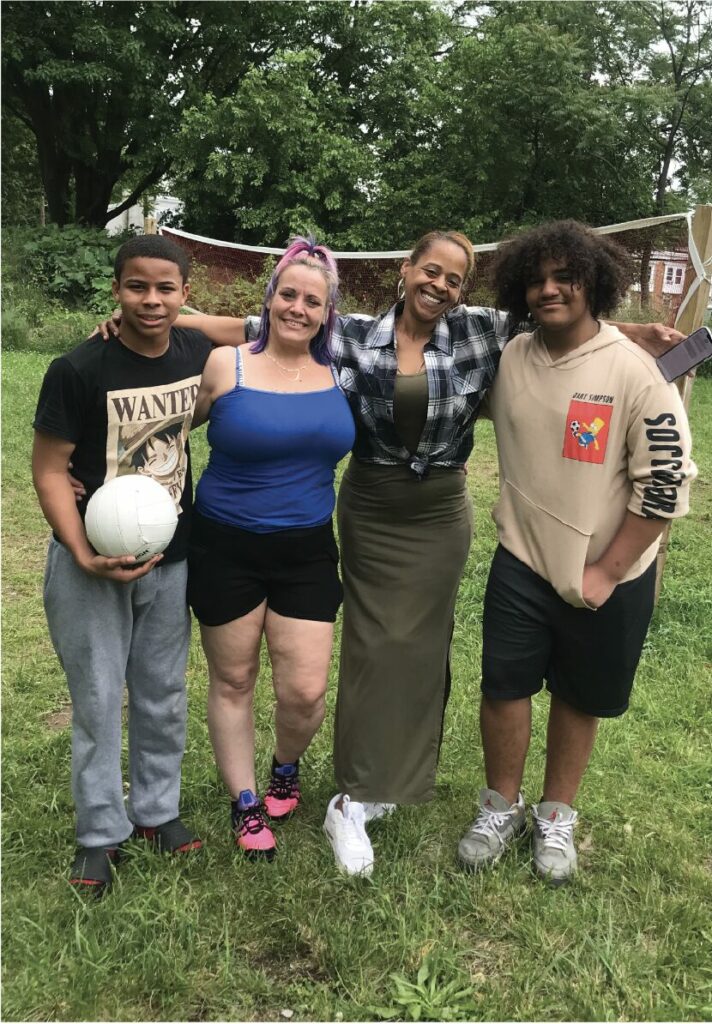
Friends and neighbors Ty’rez Johnson, Malissa Gaddy, Tracy Daouda and Elijah Whitcomb pose in front of the volleyball net built by Malissa Gaddy.
Malissa Gaddy longs for a better view from her home in Harrisburg’s Allison Hill. At the moment, she sees a vacant block and occasional dumping ground.
“If they don’t put something here, it’s going to continue to be a dumpster,” she said. “I don’t like looking out my back door, and I think it’s time for the Hill to actually have some greenery. If we don’t have educational things for these children to learn from, as in what plants actually do, they’re going to continue to walk by a flower and stomp on it.”
If all goes as planned, Gaddy’s wish will come true. Private citizens, nonprofits and the city government are collaborating to transform a scrubby, vacant plot at 15th and Swatara streets into a public park. The proposal met some resistance from housing advocates, but neighbors are excited. Tucked into Allison Hill’s sloping back streets, Swatara Street Park could bring a green oasis to a tight-knit, under-resourced community.
Park Dreams
The park project began around 2021, when Char Magaro, restaurateur and environmental activist since 1988, retired and sold Tracy Mansion, home of her last restaurant. She crossed the street and sat on a Riverfront Park bench dedicated to her climate-change fight.
“I’m sitting there thinking, ‘I’m 73 years old, and I want a win,’” she told TheBurg on a tour of the proposed park.
Magaro found the site through Tri County Community Action’s resident-driven action plan, “Heart of the Hill.” There at 15th and Swatara, blighted homes had been demolished, and new homes built on the next block were generating momentum. The 700 residents surveyed said they wanted a park there, with a playground and flexible green space.
The Swatara Street Park plan aligns with the residents’ core values of housing and public space, sense of community, safety and engaging youth, said Tri County Community Action CEO Jen Wintermyer.
And when those values collide, such as housing vs. public space, it’s a matter of managing “a delicate balance,” she said. Existing homes tucked throughout Allison Hill can be rehabbed or demolished for new-builds, while an empty block creates an “opportunity zone.” Magaro’s approach—bringing in dollars from private donors and grants while respecting the community’s wishes—presents “a win across every level.”
“Every community needs green space,” Wintermyer said. “It raises property values. It gives people a reason to want to move into a community. It makes it more family-centric and family-friendly, versus an urban house after house after house.”
Phase one will bring passive recreation to eight of the housing lots in the plot—seven donated by the Harrisburg Redevelopment Authority, and one bought from Tri County Community Action.
Two remaining lots, when purchased from their private owners, are earmarked for phase two, with active recreation for children developed with residential input, Magaro said.
In plans drawn by Debra A. Kirkpatrick of Dauphin County-based Landscape Architectural Design, native pollinator perennials line a handicapped-accessible pathway. A rain garden absorbs stormwater. Kids hop across stepping stones.
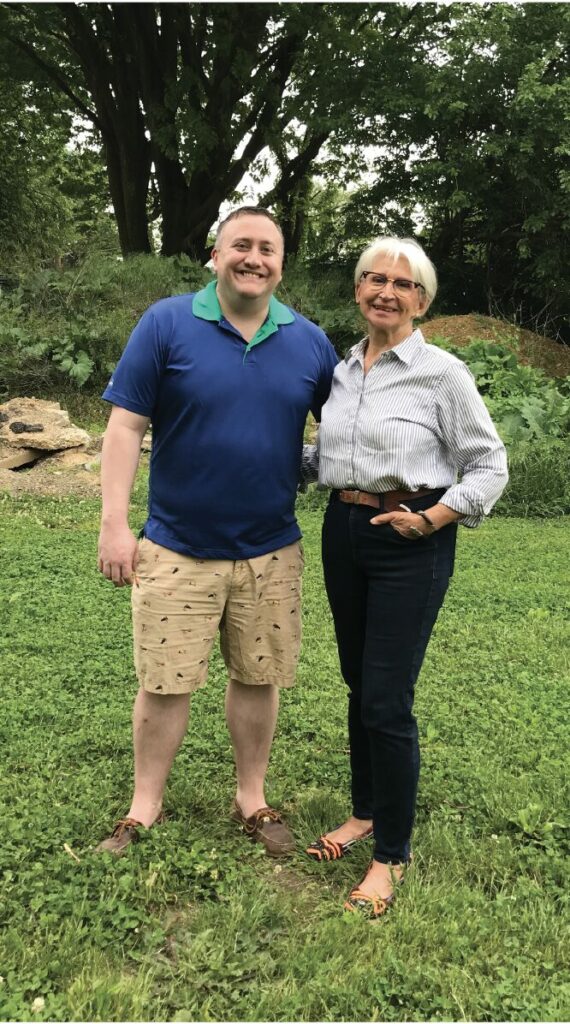
Alex Reber & Char Magaro
The red dawn cedar tree at the center is non-native, Magaro admits, but “it’s durable.”
“The trunk looks like something out of a fairy tale,” she said. “I can see the kids getting that connection with nature.”
When Alex Reber, secretary-treasurer of the Harrisburg Redevelopment Authority and owner of a Harrisburg-based accounting firm, joined the effort, he helped the park win a $72,000 Dauphin County gaming grant. Funds raised from private contributions, grants and donated land currently total about $218,000, and organizers are seeking a matching grant from the Pennsylvania Department of Conservation and Natural Resources.
The project aligns with city and county comprehensive plans, and “Heart of the Hill” shows public support, said Reber, who lives in Millersburg.
“The really exciting thing about this is I think it could become a model of a public-private partnership,” he said.
Especially in a city that can’t afford to take on another park, the collaboration of private citizens, nonprofits and government is “the perfect way” to develop and maintain neighborhood assets, said Wintermyer. Each brings pieces that complete the puzzle.
“The government can’t do it by itself,” she said. “There’s not enough dollars, and there’s too much need.”
Uplift Not Displacement
With two members absent, Harrisburg City Council unanimously ratified the park’s DCNR grant application, but the plan initially encountered some skepticism. Council member Lamont Jones told TheBurg that he would have preferred dividing the lot between a park and badly needed housing.
Parks can become gentrifying when they raise property values and entice landlords to sell their rental homes—and push out residents, Jones said. From New York City’s Central Park to Harrisburg’s Capitol Park, history shows marginalized communities displaced in the name of beautification, he said.
“One thing we do know, it will beautify the community, but I’m just hoping the people there will be able to continue to live there and grow as that community grows,” Jones said.
Beautification “absolutely can” gentrify when improvements price out residents from their homes, said Wintermyer. That’s why Tri County Community Action performs dual duty in community development and social services.
“While the physical and built-in environment is being improved, we’re also making those investments into the families, to strengthen them and grow their economic prosperity,” she said.
With funding in place, work is slated to begin in spring 2025. On an adjoining lot, Capital Region Water is building a community garden, part of its City Beautiful H2O initiative to reduce Harrisburg’s runoff water pollution.
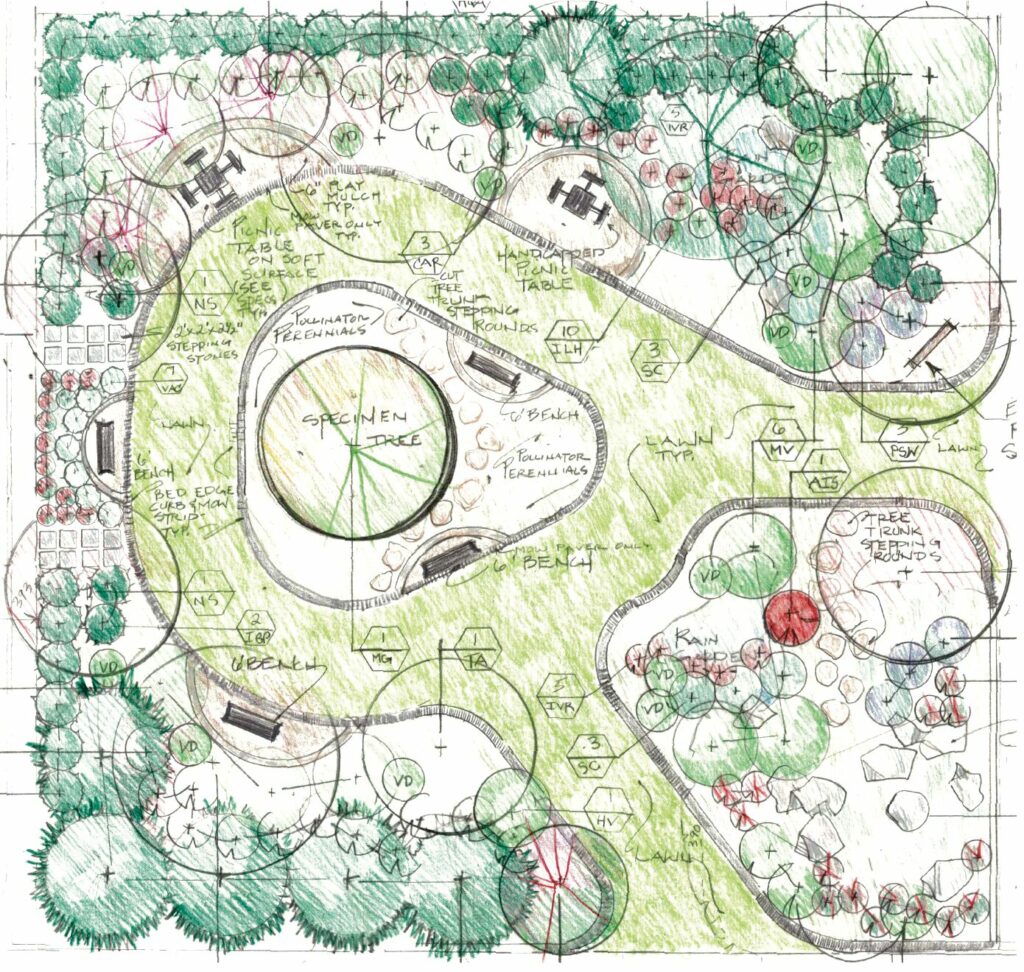
Park rendering by Debra A. Kirkpatrick
A park complements Capital Region Water’s green infrastructure and plans for controlling combined sewer overflow, reducing backups into streets and basements and complying with the Clean Water Act, said External Affairs Manager Rebecca Laufer.
“Green spaces help to reduce stormwater runoff and mitigate the risk of flooding by absorbing and filtering rainwater,” she said, in a statement.
Eventually, the city of Harrisburg is expected to take over the park. The administration of Mayor Wanda Williams has been “100% supportive” while protecting the city’s interests, said Reber. A five-year maintenance plan—a condition for moving forward—shows ongoing fundraising to generate the $10,000 needed annually for seasonal landscaping. The rest of the year, volunteers from South Allison Hill Homeowners & Residents Association, Tri County Community Action, Wildheart Ministries and the Rotary Club Environmental Committee, co-chaired by Magaro and Reber, will conduct regular cleanups.
Wintermyer views Tri County’s cleanup responsibilities through a community-building, shared-ownership lens.
“Part of our role is, yes, to make sure maintenance is done, but let’s get the neighbors who are using the park engaged in the process, as well,” she said.
Asked how the park dovetails with Wildheart Ministries’ revitalization efforts in Allison Hill, Director Tannon Herman called the project’s momentum “bittersweet”—bitter for its lack of housing, sweet for its “promises fulfilled.” It is a place for adults to rest and for kids to “just run around and be kids,” he said.
“When Char said, ‘This is what I’m going to do,’ and it happened, it may not be what everybody wanted, but she at least followed through,” Herman said. “I have a lot of respect for anybody who’s going to do work in the community who’s actually going to do what they say. Having a space that has a vision to not just become beautiful but also to stay beautiful is something to celebrate.”
Green Vision
From the future park site, Magaro can see the spot where she started her first catering business. Today, she lives in East Pennsboro Township, across the river from Harrisburg. She tells potential backers from outside the city, “This is our community.”
“It’s easier to get things done on a community level,” she said.
As the project moves forward, next-door neighbor Gaddy believes in her village of Harrisburg. She plans to help the park with whatever is needed, “as long as it’s not growing anything. I’m not a grower.” On Saturdays, she plays volleyball with kids on a net she erected there.
The park is for children, she said, because “kids are our future.”
“The main thing is to give the kids not just another playground, not just another basketball court, not just another something that’s going to go to waste or the kids are going to misuse, but something they can educate themselves on as well as be a part of the community, something they might see as beautiful,” Gaddy said.
If you like what we do, please support our work. Become a Friend of TheBurg!