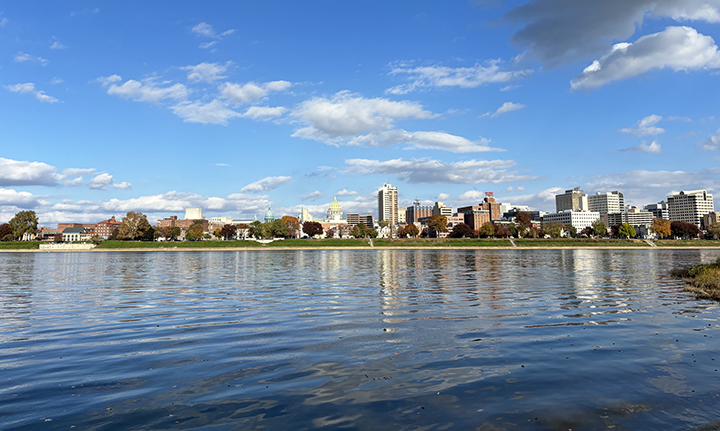
Downtown Harrisburg, from City Island
Like all capital cities, Harrisburg has always carried more symbolic weight than its size might suggest. Decisions made in Harrisburg shape the present and future of life for everyone in the state. Pennsylvania residents gather here to make their voices heard on all kinds of policy issues. People often come to Harrisburg—the Capitol, if not necessarily the city—as a demonstration site for the challenges and possibilities inherent in running a commonwealth. This outsized platform presents Harrisburg with the unique opportunity to act as a demonstration site of a different kind: to lead by example and become Pennsylvania’s most age-friendly, livable city.
Like all of Pennsylvania, Harrisburg is aging. According to the U.S. Census, around 1 in 5 people in Harrisburg are over the age of 60, and that number is expected to increase as we stay healthier and live longer. This changing demographic is an opportunity. Many older Harrisburg residents have lived here their whole lives, making our community ties and living historical knowledge stronger than ever before. With its relatively low cost of living, many people choose Harrisburg and the surrounding area as a place to retire, bringing their lifetimes of skills and experience with them. Older people have more free time to volunteer, spend more on travel and leisure, and succeed as entrepreneurs more often than their younger counterparts. They are drivers of our local economy and keystones of our community. Harrisburg is already benefitting from being an appealing place to grow older; we could enhance that appeal by joining the age-friendly movement as an Age-Friendly Community and developing an “Age-Friendly Action Plan.”
The age-friendly movement began with a simple but powerful idea: every community should be a wonderful place for people of all ages to live, work, and play. Today, the movement has formalized into the Network of Age-Friendly States and Communities, which is managed globally by the World Health Organization and supported nationally by AARP. There are over 1,000 Age-Friendly Communities in the United States, including 13 in Pennsylvania. Each Age-Friendly Community in the network commits to create an Age-Friendly Action Plan, the network’s hallmark instrument of positive change. The Age-Friendly Action Plan is the most widely recognizable and best-supported mechanism available for local planning to support older adults: if Harrisburg were to join the network, we would benefit from decades of research, a proven framework, loads of resources, and peer-to-peer support to guide our work.
Harrisburg’s first Age-Friendly Action Plan could be transformative in three ways. First, it could help the city organize practical quality-of-life improvements for older residents and people with disabilities, driving economic growth and elevating wellbeing. Second, it could give the commonwealth a highly visible local demonstration site for Pennsylvania’s broader aging agenda, generating public support and possible funding opportunities. Third, it could set an example for the nation of how a capital city can align local government, county aging services, state agencies, transportation providers, health systems, housing organizations, civic institutions, and residents around a shared plan for lifelong independence.
The timing is unusually good. Pennsylvania is already moving in this direction. “Aging Our Way, PA,” the commonwealth’s 10-year plan for older adults, is described by the Department of Aging as a roadmap to meet the needs of older Pennsylvanians and improve services for a rapidly growing older population. In 2025, Gov. Josh Shapiro announced Pennsylvania’s designation by AARP as an Age-Friendly State, connecting the designation to a whole-of-government approach to helping older adults live with dignity, independence, and support. (Pennsylvania Government)
That statewide designation creates a natural question: where should the commonwealth show what “age-friendly” means in practice? Harrisburg is the obvious answer. It is home to the Capitol Complex, state agencies, advocacy organizations, health and human service institutions, transit assets, senior housing, riverfront amenities, and neighborhoods where aging-related needs are not abstract. The city could become the place where Pennsylvania demonstrates how a statewide plan is translated into local improvements people can see and feel.
For Harrisburg to become an Age-Friendly Community, we must begin with a mayoral letter of commitment. In addition to being an application requirement, this first step would publicly commit city hall to developing an “Age-Friendly Action Plan.” To develop an effective plan, city hall will need support. A successful steering committee would bring together a wide variety of local government and community partners, including the Dauphin County Area Agency on Aging, Senior Community Centers, healthcare providers, downtown businesses, transit providers, housing organizations, faith communities, and many more.
The work would start with listening. Older residents and caregivers should be asked where the city works for them and where it fails them. Which intersections feel unsafe? Which bus stops lack seating or shelter? Which public buildings are hard to enter? Which neighborhoods lack accessible grocery access, health care access, or safe walking routes? Which residents are socially isolated? Which communication channels actually reach older adults who are not online? The baseline assessment should combine surveys, neighborhood listening sessions, walking audits, transit access reviews, service data, and lived-experience mapping. The results of this assessment could then be used to develop a community-driven, eminently actionable plan focused on four key pillars: transportation and mobility, outdoor spaces and public buildings, housing, and civic participation and engagement.
Transportation and mobility should be a top priority. For older adults, transportation is often the difference between independence and isolation. Harrisburg’s “Age-Friendly Action Plan” could prioritize safer crossings, better sidewalks, more accessible bus stops, and easier connections among senior housing and amenities like healthcare facilities, grocery stores, parks, and the Capitol Complex. This would also align with broader research on Age-Friendly Communities, which emphasizes that the field must move beyond aspiration into assessment, implementation, and evaluation of the physical and social environments that support active aging and independence. (White Rose Research Online)
Outdoor spaces and public buildings could become the most visible part of the effort. Harrisburg already has important assets: the Susquehanna River, Riverfront Park, City Island, the Capitol grounds, neighborhood parks, libraries and public buildings. But age-friendly design asks a practical question: can people actually use these places safely and comfortably? Benches, shade, lighting, curb cuts, public restrooms, accessible entrances, well-marked crossings, snow removal and safe walking routes are not luxuries. They are the infrastructure of participation.
Housing should be a third pillar. Harrisburg’s Age-Friendly Action Plan could connect to home repair, accessibility modifications, affordable senior housing, preservation of naturally occurring affordable housing, and zoning or redevelopment policies that support people across the life course. Age-friendly housing is not only about senior buildings. It is about ensuring that neighborhoods can meet people’s changing needs over time, so that they can continue to contribute to their communities.
The fourth pillar should be civic participation and social inclusion. This is where Harrisburg’s capital city role becomes especially powerful. An age-friendly Harrisburg could host regular civic forums connecting older adults and caregivers with city officials, county aging services, state agencies, legislators and community organizations. The city could create an annual Capital City Aging Forum, neighborhood-based listening sessions, intergenerational volunteer projects, and a public dashboard showing progress on age-friendly commitments. Pennsylvania’s own “Aging Our Way, PA” implementation structure already includes quarterly updates, which Harrisburg could mirror locally by reporting visible progress to residents on a predictable schedule. (Pennsylvania Government)
A signature project could make the effort real: an Age-Friendly Capitol Corridor linking the Capitol Complex, Strawberry Square, the train station, Riverfront Park, senior housing, bus stops, and downtown services. The project could showcase the infrastructure improvements in the Age-Friendly Action Plan, including safer crossings, better lighting, seating, accessible wayfinding, bus stop improvements, public restrooms, and a clear pedestrian route that works for older adults, people with disabilities, visitors, workers, and families. The corridor would make age-friendly infrastructure real for every user of this high-traffic area.
Peer-reviewed research supports this kind of practical orientation. Reviews of age-friendly cities and communities show growing attention to implementation, evaluation, social inclusion and the built environment. The literature also warns that broad age-friendly frameworks can become too general unless communities adapt them to local conditions, define clear indicators, and create mechanisms for older residents to influence decisions. In other words, the designation matters only if it leads to a cycle of assessment, action, measurement and course correction. (Cambridge University Press & Assessment)
That should be Harrisburg’s guiding principle. The city should not simply declare itself age friendly. It should use designation as a management framework: commit publicly, listen seriously, measure honestly, act visibly and report regularly. The most valuable improvements may not be glamorous. A bench in the right place, a safer crosswalk, a readable sign, a reliable ride, an accessible entrance, a repaired sidewalk, a social connection, or a clear phone number can determine whether an older resident remains connected to community life.
If Harrisburg does this well, the benefits would extend beyond city limits. The commonwealth could use the capital city as a living demonstration of “Aging Our Way, PA.” Legislators and state agency leaders could see age-friendly policy not as a report on a shelf, but as a local operating model. Other municipalities could borrow tools, indicators, walking audit methods, dashboard templates and partnership structures. Residents would gain practical improvements. And Harrisburg would strengthen its identity as a capital city not only where government happens, but where Pennsylvania demonstrates what it means to age with dignity, independence and belonging.
The best case for “Age-Friendly Harrisburg” is therefore not sentimental. It is strategic. Pennsylvania has already made a statewide commitment. Harrisburg can show what that commitment looks like on the ground.
Note: Both Jessie Pierce and Kevin Hancock were involved in the development and publication of “Aging Our Way, PA,” Pennsylvania’s 10-year plan for older adults. Dr. Hancock oversaw the project and led stakeholder engagement as a special advisor to the Secretary of Aging. Ms. Pierce continues to work for the Department of Aging as special assistant and is leading the statewide “Age Friendly” initiative in partnership with AARP Pennsylvania.
References
AARP. (n.d.). AARP network of age-friendly states and communities. Retrieved May 12, 2026, from https://www.aarp.org/livable-communities/network-age-friendly-communities/
AARP. (n.d.). How to enroll in the AARP network of age-friendly states and communities. Retrieved May 12, 2026, from https://www.aarp.org/livable-communities/network-age-friendly-communities/joining-the-network.html
AARP. (n.d.). The 8 domains of livability: An introduction. Retrieved May 12, 2026, from https://www.aarp.org/livable-communities/network-age-friendly-communities/info-2016/8-domains-of-livability-introduction.html
AARP. (2025). Pennsylvania joins the age-friendly network. https://www.aarp.org/livable-communities/network-age-friendly-communities/states/pennsylvania-joins-the-age-friendly-network.html
Dauphin County. (n.d.). Area Agency on Aging. Retrieved May 12, 2026, from https://www.dauphincounty.gov/government/human-services/area-agency-on-aging
Dauphin County. (n.d.). Transportation. Retrieved May 12, 2026, from https://www.dauphincounty.gov/government/human-services/area-agency-on-aging/services/transportation
Ladner, Justin. (2023). Older Adults Lead the Way in American Volunteerism. How Older Adults Lead the Way in American Volunteerism – NationSwell
Mehta, Kumar. (2022). Older Entrepreneurs Outperform Younger Founders—Shattering Ageism. Forbes. Older Entrepreneurs Outperform Younger Founders—Shattering Ageism
Pennsylvania Department of Aging. (n.d.). Aging Our Way, PA: A plan for lifelong independence. Retrieved May 12, 2026, from https://www.pa.gov/agencies/aging/aging-our-way-pa
Pennsylvania Department of Aging. (n.d.). Aging Our Way, PA quarterly updates. Retrieved May 12, 2026, from https://www.pa.gov/agencies/aging/aging-our-way-pa/aging-our-way–pa-quarterly-updates
Shapiro, J. (2025, May 29). Governor Shapiro announces Pennsylvania’s designation as an age-friendly state by AARP, delivering on promise to implement a statewide master plan to support older Pennsylvanians. Commonwealth of Pennsylvania. https://www.pa.gov/governor/newsroom/2025-press-releases/gov-shapiro-pennsylvania-designation-age-friendly-state-by-aarp
Taylor, Mia. (2025). New Report Reveals the Highest Spending Generation of Travelers. TravelPULSE. New Report Reveals the Highest Spending Generation of Travelers | TravelPulse
Torku, A., Chan, A. P. C., & Yung, E. H. K. (2021). Age-friendly cities and communities: A review and future directions. Ageing & Society, 41(10), 2242–2279. https://doi.org/10.1017/S0144686X2000094X
van Hoof, J., Marston, H. R., Kazak, J. K., & Buffel, T. (2021). Ten questions concerning age-friendly cities and communities and the built environment. Building and Environment, 199, Article 107922. https://doi.org/10.1016/j.buildenv.2021.107922
World Health Organization. (n.d.). The WHO age-friendly cities framework. Retrieved May 12, 2026, from https://extranet.who.int/agefriendlyworld/age-friendly-cities-framework/
World Health Organization. (n.d.). About the global network for age-friendly cities and communities. Retrieved May 12, 2026, from https://extranet.who.int/agefriendlyworld/who-network/
World Health Organization. (2018). The global network for age-friendly cities and communities: Looking back over the last decade, looking forward to the next. https://www.who.int/publications/i/item/WHO-FWC-ALC-18.4