Photos provided by Ashcombe Farm
While camping a few weekends ago, a tiny white moth crawled across our picnic table.
It was a small action that guided the course of our adventuring this month, highlighting how slowing down and allowing space for wonder can lead to new and exciting ventures.
Delighted by the fuzzy body and feather-like antennae of the tiny creature, my kid had the brilliant idea to create a moth out of found objects in nature, one that could live with us longer than the wild moth on our picnic table. Always eager for chances to combine art and science, we decided to learn more about moths to gain an understanding of how their bodies work and why each part is important before building our own.
At the end of our camping trip, we headed to the library to check out books on moths. Many of the books that detail the science of moths also touch on the wonderful world of butterflies. The two actually share the genus lepidoptera. You may be surprised to learn that butterflies are technically classified as a type of diurnal moth, meaning they are active during the day.
Try a brainstorming activity by creating a chart of animals that are diurnal vs. nocturnal. List animals on each side of the chart, then discuss why you think it may be beneficial for those animals to be active during day vs. night. For moths and butterflies, we learned that the big feathery antennae of moths are adaptations to their lifestyle flying in darkness. The feathery antennae maximize their sense of smell because the greater the surface area, the higher the sensitivity. These antennae give moths the incredible talent of locating food sources several miles away. Ask your kid if they can think of other nighttime animals with specialized skills.
Craft & Release
Now that we understood moths a little better, it was time to build our own. To make yours, use a pinecone for the body and pack it with moss, creating a round look and soft, fuzzy feel. Sticks or pieces of hay work for the six legs. For the antennae, use ferns to emulate a feathery look. Though moths rely on their sense of smell for food navigation, they do still have eyes, and we used mulberries to make ours, then snacked on the leftovers. Another great topic to discuss with your family is how pollinators like moths and butterflies help make fruit like mulberries.
Butterflies and moths thrive in areas that are thick with native plants. Native plants have been proven to attract pollinators up to four times that of a non-native shrub or perennial. Some popular choices for our region are milkweed, sunflowers, foxglove, wild blue phlox and the delicious fruiting trees of apple and mulberry.
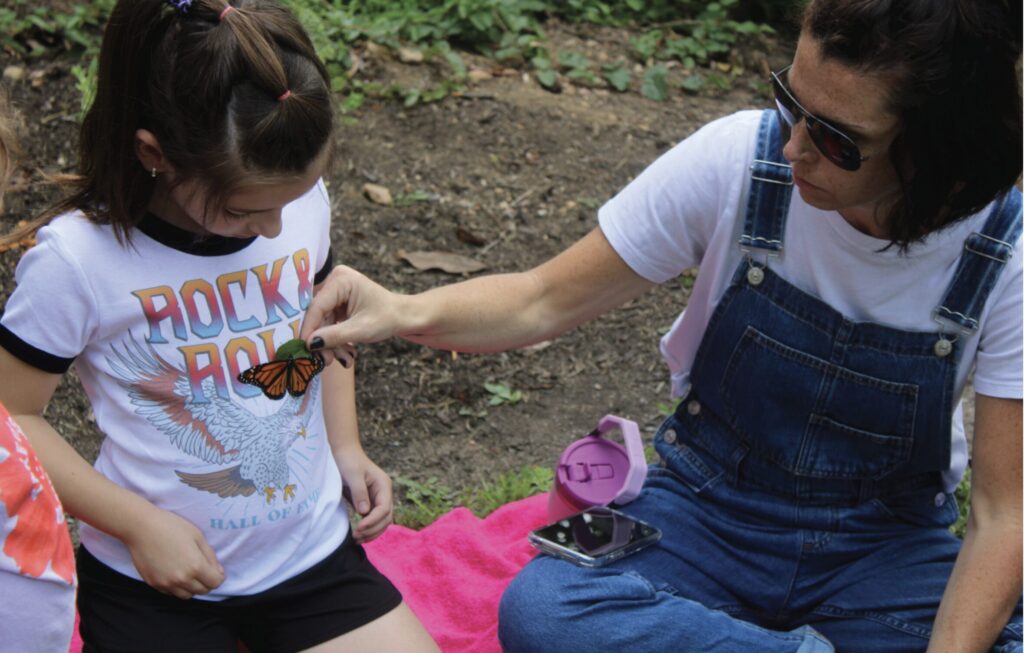
Ashcombe Farm is hosting a perfect event to combine education on pollinators while celebrating butterflies. Located in Mechanicsburg, their annual Butterfly Day festival and release will take place on Saturday, Aug. 1 from 10 a.m. to 2 p.m. Created with the intention of recognizing the importance of pollinators, there will be an educational “Plants & Pollinators” talk during the festival with guidance on how to create pollinator friendly habitats at your home. The day includes free kids’ crafts, activities and a petting zoo too. There will also be artisan vendors and food trucks to keep everyone in the family fed and happy.
A secondary facet to Ashcombe Farm’s Butterfly Day is the memorial release of butterflies after the festival, honoring and remembering loved ones in an uplifting way. To adopt a butterfly to release with your family, visit Ashcombe Farm’s website or stop by their shop.
Get Your Hands Dirty
To get involved in gardening outside of the home, you can join one of Harrisburg’s several community gardens or gardening clubs. The Berryhill Community Garden and the Dauphin County Community Garden are great options. If you’re interested in gardening with a team, the Penn State Master Gardeners is having a workday at the Five Senses Garden on July 3 at 9 a.m. Wildwood Park is having a volunteer workday on Saturday, July 11 at 10 a.m.
By pausing to appreciate one tiny moth that crawled across our picnic table, we embarked on a month-long journey of activities and learning. Like the pollinators who flit about keeping plants thriving, children flutter from one moment to another as fast as a moth’s wing beat. This month, we remembered the importance of appreciating moments between, pauses and spaces of wonder that allow us to appreciate little things that may wander our way.
Ashcombe Farm is located at 906 Grantham Rd., Mechanicsburg. Learn more about events at ashcombe.com.
Berryhill Community Garden is located at 2405 Berryhill St., Harrisburg.
Dauphin County Community Gardens is located at 1599 Elmerton Ave., Harrisburg.
The Five Senses Garden is located at 1350 N. Harrisburg St., Harrisburg.
Wildwood Park is located at 100 Wildwood Way, Harrisburg.
If you like what we do, please support our work. Become a Friend of TheBurg!