

Harrisburg School District officials speak with the Intergovernmental Cooperation Authority.
Harrisburg city and the school district share a unique set of challenges, including financial issues arising from past overspending and a declining tax base, which both were discussed by city officials at a Wednesday meeting.
At the Intergovernmental Cooperation Authority’s (ICA) monthly meeting, board chair Doug Hill welcomed top officials from the Harrisburg school district to present an overview of the district’s finances.
“You have a comparable history to ours,” Hill told district Superintendent Benjamin Henry and Chief Financial Officer Marcia Stokes. “Not identical, but have had some financial issues that you’ve wrestled with, with some success, as has the city.”
While the entities operate separately, both entered into various forms of state oversight around 15 years ago due to unlinked financial management issues.
As the city was plagued by mounting debt from a failed waste-to-energy incinerator project, the school was almost simultaneously struggling with debt caused by hundreds of millions in school renovations. The state placed the city under Act 47, a program for financially distressed municipalities, in 2010. Two years later, in 2012, the state appointed a chief recovery officer for the school district. Still struggling in 2019, the state appointed the district a receiver.
While the district exited state receivership last year, Stokes emphasized the city and schools’ situations are to some extent linked as the district can not exit financial monitoring until the city itself exits its own recovery status under Act 47.
Hill noted another overlap between the two.
“We are all reliant on some of the same tax bases,” he said.
It’s a tax base that often proves challenging for two entities already struggling financially. Stokes noted during her presentation that in 2011, the district had just under $1.6 billion worth of taxable assessed value. Last year, it dropped to under $1.5 billion.
“Over nearly a 15 year history, where most municipalities are increasing in assessed value, we have continued to decline,” Stokes said.
She added that properties in Harrisburg have a greater percentage of untaxable assessed value than those that are taxable. This is largely due to the sprawling state footprint, an entity that does not pay property taxes. As a high-poverty, underfunded district, Harrisburg schools also rely heavily on state aid. Stokes said 60% of district revenue comes from the state.
“If we made a perfect world and all of our properties in our municipality were taxable, that would be another $49 million per year that the district would be able to generate in tax revenue,” Stokes said. “$49 million every year we never can tap into for a source for supporting education.”
ICA board member Kathy Speaker MacNett said that a big obstacle—in the way of both the city and the district’s retention of a more taxable population—was the reputation of Harrisburg schools.
“Young couples move here, establish home bases, and when kids come into the picture—they go elsewhere,” MacNett said.
Henry said the district was looking to address this problem by sharing more of its success stories.
“We have great schools. We have kids that get scholarships to go off to college. We have some great opportunities for our kids in the community, but we have to get out there and tell the story,” he said.
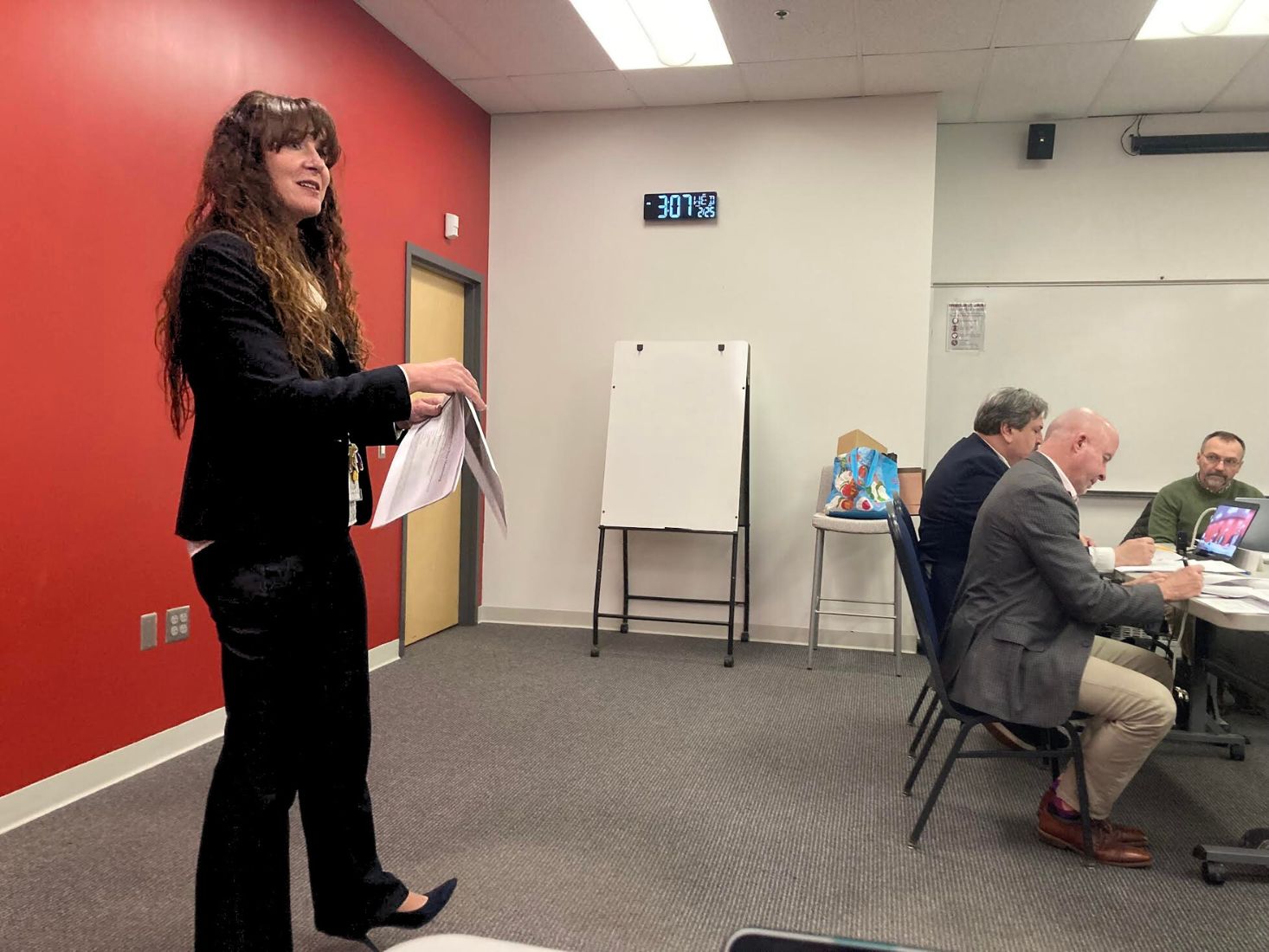
Marcia Stokes presents to the Intergovernmental Cooperation Authority.
He and Stokes listed a few: the district brought back its musical theater program last year (after roughly two decades without one), started an eSports league, and has secured a fleet of 13 crossing guards to help elementary school students walk to school.
Stokes said in the future the district would be interested in collaborating more closely with the city to go after grants that would be beneficial to both parties and to increase the availability of out-of-school activities for students.
“We need to focus on becoming a suitable choice for the residents within the community and that means improving both our image and our product that we’re putting out there,” Stokes said. “And if we can do that, then I think that’s a contribution we can make into the revitalization of the city itself.”
Henry said that the district works hard every day to make change happen.
“We have to turn the corner on what we’re producing and we are doing this every day. But again, it takes all of us,” he said. “It can’t take the school district in isolation. It takes the whole community to come together in order to move the needle on academics and get people to understand that we have a great city.”
To learn more about the ICA, visit its website.
If you like what we do, please support our work. Become a Friend of TheBurg!