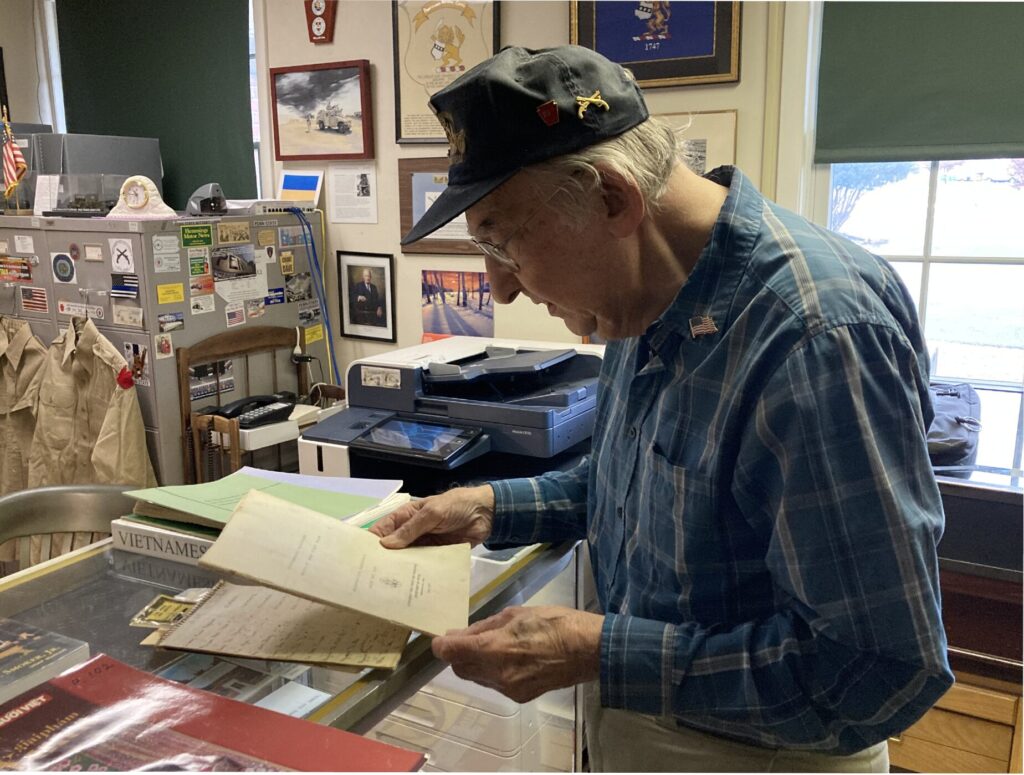
Charles Oellig, director/curator of the Pennsylvania National Guard Military Museum at Fort Indiantown Gap, examines items included in the collection from when the post housed Vietnamese refugees following the fall of Saigon in April 1975.
In 1975, Fort Indiantown Gap in Lebanon County was filled with nearly identical, nondescript, white two-story barracks buildings dating to World War II.
An abundance of these buildings, many empty at the time, led to “the Gap” playing a key role in what is considered the largest refugee resettlement effort in American history—assisting those fleeing South Vietnam and elsewhere from southeast Asia after the fall of Saigon, which occurred 50 years ago, in April 1975.
Many of these buildings have been torn down since then. But some remain, including one home to the Pennsylvania National Guard Military Museum, Building 8-57, which contains a remarkable collection of memorabilia from when Indiantown Gap served as a camp for the refugees.
In the months following the fall of Saigon, President Gerald Ford and Congress authorized the evacuation and resettlement of about 140,000 refugees from South Vietnam and Cambodia.
Fort Indiantown Gap was one of just four military installations throughout the country selected to house the refugees. The others were Camp Pendleton in California, Fort Chaffee in Arkansas and Elgin Air Force Base in Florida.
“The buildings and the space were available here to do it,” said museum Director/Curator Charles Oellig.
More than 30,000 Vietnamese and Cambodian refugees lived in the World War II-era barracks at Fort Indiantown Gap on their way to permanent resettlement during the late 1970s. They were housed in four different areas of the Gap—known as areas 3, 4, 5 and 6.
White engineering tape—samples of which are included in the museum’s collection—was used to cordon off the areas and to contain the refugees within them.
“(The refugees) were told that they were not allowed outside that boundary, and they scrupulously observed that rule,” according to Frank H. Smoker Jr., a retired major general and former commander of the Pennsylvania Air National Guard who wrote a history of Fort Indiantown Gap.
Smoker, who flew five combat missions into Vietnam, and his wife were actively involved with the refugees at the Gap. The Smokers sponsored a Vietnamese family as well as a young Vietnamese jet pilot. Smoker died in 2010 at age 85.
After arriving at the Gap, the refugees awaited processing by social service agents who helped them locate sponsors and jobs.
During this time, they attended English language classes, participated in sports, and searched for employment in Pennsylvania, according to a history of Indiantown Gap’s role in the resettlement of the refugees by Stephanie Hinnershitz, a historian and professor of security and military studies.
Indiantown Gap quickly gained a reputation as a “fast” processing center, according to Hinnershitz.
The first refugees arrived in June 1975, and, by mid-December, 22,228 had been sponsored by Americans into local communities, according to Smoker.
By the early 1980s, about 12,000 refugees had found work and sponsors in Philadelphia, Pittsburgh and Harrisburg alone, making Pennsylvania the state with the third-largest population of refugees at the time, after California and Texas.
Scholarly, Personal
The museum at the Gap is an excellent starting point for anyone wanting to know more about the day-to-day life experiences of the Vietnamese and Cambodian refugees at the installation.
The collection includes a two-volume set of “Good Land,” or “Dat Lanh” in Vietnamese, a newsletter in both English and Vietnamese published for the refugees. The museum edition is the only complete set of the newsletter that Oellig knows of.
The collection also includes military manuals, orientation handbooks and records regarding the camp at the Gap, information on sponsors, and various bits and pieces that offer insight into what life was like for the refugees, such as meal tickets and photos of weddings and other significant events.
From June through mid-December 1975, 74 weddings of refugees took place at Indiantown Gap, as well as 128 births and 10 deaths, according to Smoker.
The collection is not on permanent display at the museum, but Oellig is happy to accommodate anyone wishing to visit Building 8-57 to see the memorabilia.
Over the years, many Vietnamese and others have come to the museum to do research on the refugee camp at the Gap. The research is scholarly but at times intensely personal, as in the case of a woman who started to cry upon finding her father’s name among those who had come through the camp.
Neither Oellig nor the museum were at the Gap back then—the museum was dedicated in 1986. But Oellig’s personal connections with refugees who passed through the Gap extend beyond just those coming to do research.
While getting hearing aids not long ago, Oellig noticed that the woman who tested him wore a badge with the last name of Tran.
“I said, ‘That looks like a Vietnamese name,’ and she said, ‘My grandparents came over from Vietnam,’” Oellig said. “She wasn’t 100% sure, but she thought they came here through Fort Indiantown Gap, because they settled in this area.”
Pennsylvania National Guard Military Museum is located at Fort Indiantown Gap, Annville.
To arrange to see the collection of artifacts from the Vietnamese and Cambodian refugee camp, contact Charles Oellig at 717-861-2402, or by email at [email protected].
If you like what we do, please support our work. Become a Friend of TheBurg!