Tag Archives: Karl Singleton

Large field of candidates to run for Harrisburg mayor, City Council, as nominating deadline passes

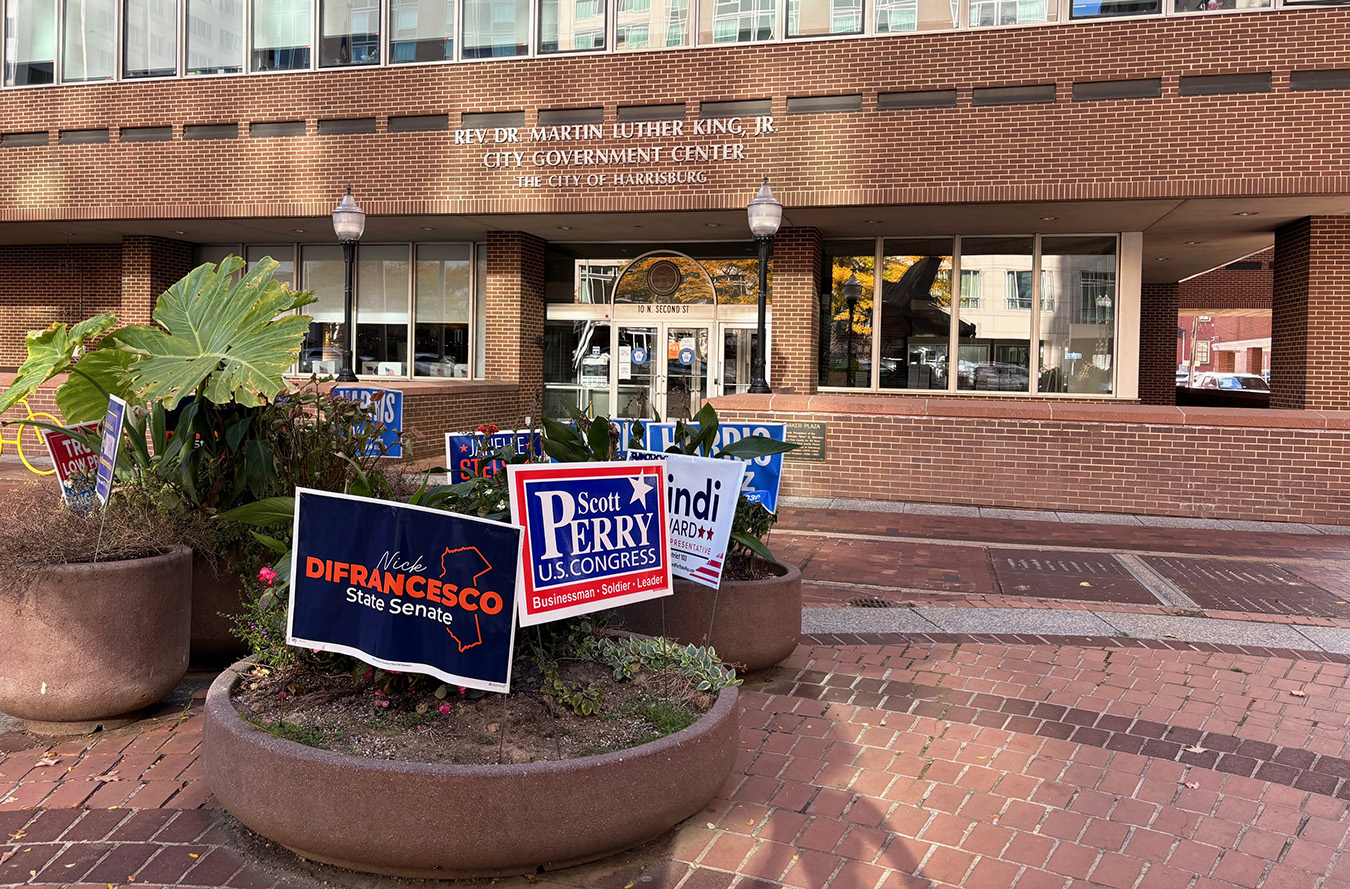
Campaign signs outside of Harrisburg city hall last November

Harrisburg voters soon will cast ballots in highly competitive primary races for mayor and council, as the deadline passed on Tuesday for candidates to submit their nominating petitions.

For mayor, incumbent Wanda Williams faces a large field of Democratic competitors, including city Treasurer Dan Miller, City Council member Lamont Jones, community activist Tone Cook Jr. and former candidate Lewis Butts Jr., according to the Dauphin County Bureau of Registration & Elections.

Williams is vying for a second term in office, following a long tenure on city council. Miller, in his third term as treasurer, also has served on city council and as city controller. Jones is serving his second year on council. Cook hasn’t held elected office previously but is known as an anti-crime and anti-gun violence advocate. Butts has run unsuccessfully for mayor several times before.

All candidates are Democrats. No Republicans filed to run for mayor for the May 20 primary.

For city council, three incumbents, all Democrats, submitted nominating petitions for re-election for the four, four-year seats: Ausha Green, Jocelyn Rawls and Ralph Rodriguez. Three-term incumbent Shamaine Daniels did not file for re-election, leaving one seat open.

In addition to the incumbents, challengers Leslie Franklin, Lisa Glenn, Sharon Horne, Elyse Irvis, Robert Lawson, Willie Ross, Rich Sanders, Lori Saulisbury, Karl Singleton and Basir Vincent filed to run in the Democratic primary for council.

Like in the mayoral election, no Republicans chose to run for council in Harrisburg, an overwhelmingly Democratic city.

For city controller, attorney Karen Balaban filed for the Democratic nomination. Notably, long-time controller Charlie DeBrunner did not submit for re-election. No Republicans filed to run.

The Harrisburg school board has four, four-year seats and one, two-year seat up for grabs this year.

At the petition deadline, Democratic incumbents Roslyn Copeland, Danielle Robinson, Brian Carter and Jaime Johnsen filed for the four, four-year seats, while Annie Hughes, appointed to the board last year, will run for the two-year seat. No Republicans filed to run.

Dauphin County also has elections for several row offices this year.

For prothonotary, incumbent Matt Krupp of Harrisburg is seeking re-election, running as a Republican. Harrisburg resident Antonio Carreno is the sole Democrat seeking the office.

The clerk of courts primary is competitive, as Tina Nixon and Timothy Pianka, both of Harrisburg, are vying for the Democratic nomination. John McDonald is seeking the Republican nomination for the office.

For county coroner, long-time incumbent Graham Hetrick is seeking another term, running as a Republican. John Harris Jr. filed for the Democratic nomination.

The candidate fields are preliminary, as petition signatures can be challenged through March 18. The ballot will be finalized on March 26, with the primary election slated for May 20.

The candidates in this story are those listed by Dauphin County as of 5 p.m. on Tuesday. We will update the story if candidates are added or removed. Click here to see the full list of candidates running for office in Dauphin County.

If you like what we do, please support our work. Become a Friend of TheBurg!

Continue Reading

Harrisburg Council re-votes, confirms Broad Street Market construction manager

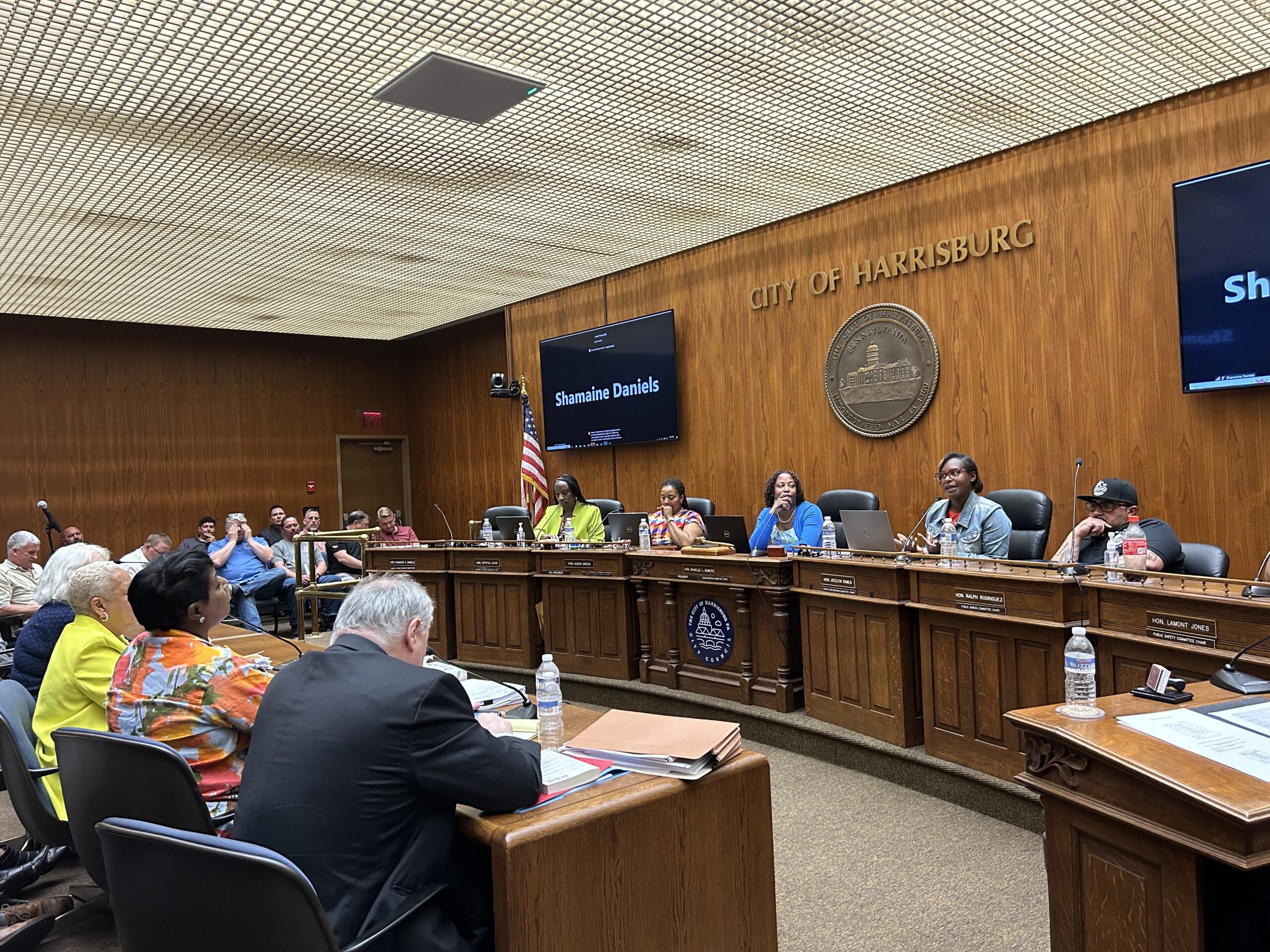
Harrisburg City Council meeting on Tuesday

A project to rebuild the Broad Street Market’s fire-damaged brick building can now take a step forward, following a contentious council meeting. 

Harrisburg City Council on Tuesday reversed its previous rejection of the city’s selected construction manager for the rebuild, allowing the project to move forward. 

Council voted 4-3 in favor of hiring Harrisburg-based Alexander Building Construction Co. as the construction manager to oversee the market rebuild, with council members Lamont Jones, Jocelyn Rawls and Danielle Bowers voting “no.”  

At a meeting two weeks ago, council voted down the contract, 5-2, several members claiming that the selection process was inequitable and that the selection committee was not diverse. Previously, council members Crystal Davis and Ralph Rodriguez voted against the contract, but changed their votes during the reconsideration on Tuesday. All other council members voted the same as they did previously. 

Following council’s original rejection of the resolution, the city administration objected to council’s claim, saying that the selection was fair. Officials also noted that they would need to restart the selection process, which could take anywhere from four to six months. Following the decision, Mayor Wanda Williams, the market’s board of directors and local state representatives, among others, spoke out against council’s “no” vote. 

Williams maintained her position when she spoke to council at Tuesday night’s meeting. 

“The process was not flawed,” she said. “I put who I felt is competent [on the scoring team]. I am the mayor, let me do my job.” 

With a construction manager now hired for the rebuild, the city can now move forward with hiring a general contractor, architect and other contractors for the market. Officials have shared that the brick building restoration will likely take around two to three years.  

“I’m excited and appreciative that City Council reconsidered their prior vote, and we’re looking forward to construction on the brick building getting underway,” said Eric Hagarty, chair of the market’s board. “Now the two-year clock on when doors can open begins, and we get to start planning for a future that includes having the brick building reopened.” 

Rodriguez said that he changed his vote on Tuesday to a “yes,” after meeting with city officials and community members to discuss the resolution. 

“The optics of the selection process seemed and appeared flawed,” he said. “Yes, the process should be transparent […] yes, the portion too should be fair and equitable, although, in my very own opinion, it’s not the step where we can really hold accountability up. That occurs in the next step with the actual selection of those who will do the work.” 

Rawls maintained her opposition to the resolution on Tuesday, stating that, while she does not oppose Alexander as the manager, she still felt the selection process was unfair. She also voiced concern that Karl Singleton, the city’s chief equity and compliance officer, wasn’t involved in the process.  

Singleton spoke during public comment in support of council’s equity concerns. 

“There is no one up here who wants this to be rebuilt more than me,” Rawls said. “But I will not allow you all to go down in mud […] because a process wasn’t full of integrity and honor and respect. The process was flawed and we need to change that process today.” 

During their previous council meeting, Rawls also took issue with inconsistencies found on her copies of the city’s scoring rubric that was used to score potential contractors. According to Williams, Rawls was accidentally given a draft copy of the rubric, which contained a typo that was later corrected.  

Williams also pointed out during the meeting that council unanimously passed at least eight prior city contract agreements this year that used the same scoring procedure. She also said that she will continue to use the same city employees on the scoring team. 

Prior to council’s re-vote, some community members urged council to reconsider and approve the construction manager, while others spoke in favor of council’s concern about fairness in the selection process. 

“You need to keep more of the money here,” said Earl Harris, a local pastor and Harrisburg resident. “If you’re going to build a community where 73% are Black and brown, where do we fit in this process? We need to be included.” 

Another Harrisburg resident, John “Joesmooth” Palmer, said that he just wanted to see the market restored as soon as possible. 

“All I want to know is what’s taking so long,” he said. “Let’s get this thing done, let’s not make any excuses. Ten months is too long.” 

If you like what we do, please support our work. Become a Friend of TheBurg!


Continue Reading

Harrisburg City Council re-opens Youth Commission application, includes younger students

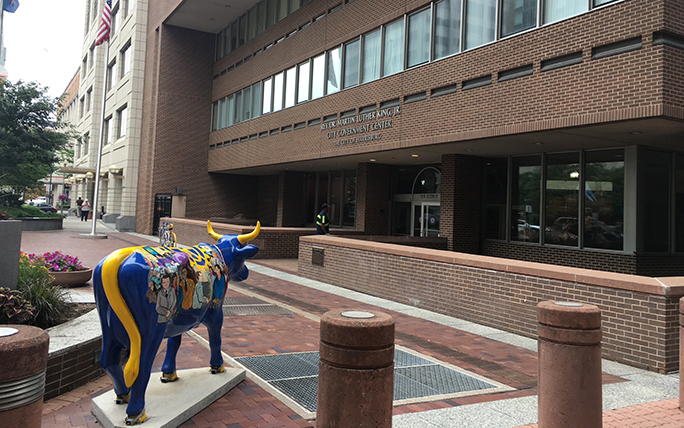
Harrisburg’s MLK City Government Center

In an effort to include city youth in government affairs, Harrisburg City Council has re-opened the application process for its Youth Commission.

Council and the city reinstated the program in June, after a pandemic hiatus. Although the application was open earlier this summer, the board was put on hold while the city made changes to the qualification requirements.

The application process is now open again, but this time to residents between the ages of 11 and 18. Previously, only 14- to 18-year-olds could apply.

“This is an opportunity to be proactive and allow youth to showcase their talents,” said Karl Singleton, the city’s equity and compliance officer. “These are our future leaders.”

Any student who previously applied for the commission is asked to reapply through an online submission form.

Council, the city and the Harrisburg School District will jointly select 11 students to serve. Four students will be selected from the district’s schools, four will come from Harrisburg career academies, and four will be chosen from city charter and private schools. Council member Jocelyn Rawls will oversee the commission.

Students interested in applying must complete an application, write a short essay and submit two letters of recommendation. The deadline for submission is on Sept. 15 at 5 p.m. Once selections are made, the commission will hold its first meeting in mid-October.

For more information, contact the City Clerk’s office at 717-255-3060.


If you like what we do, please support our work. Become a Friend of TheBurg!


Continue Reading

Harrisburg, Dauphin County to partner to study contracting opportunities for diverse city businesses

Harrisburg Mayor Wanda Williams, along with city and county officials, announced a disparity study on Wednesday.

According to Harrisburg officials, there are city businesses whose services have long been undervalued.

Harrisburg, along with Dauphin County and nonprofit Impact Harrisburg, will conduct a disparity study to determine how and where the city can provide more opportunities to diverse businesses and contractors.

“The disparity study will clearly highlight not only which businesses have been negatively impacted in terms of lack of access, but it will talk about ways to make it equitable,” explained Karl Singleton, the city’s equity and compliance officer, at a press conference on Wednesday.

In May 2021, Harrisburg City Council passed a resolution to enter into an agreement with Impact Harrisburg to conduct the study. However, it had been on hold until now.

According to Singleton, the study will evaluate how well the city has historically utilized disadvantaged businesses in its contracting and procurement. Within the study, they hope to get a grasp on the number of available minority, women, disabled and LGBTQ-owned businesses in Harrisburg and the opportunities, or lack thereof, that they’ve had. From there, the study will make recommendations for next steps for the city to take to better utilize and assist diverse businesses.

According to Singleton, a large part of the gap in opportunities for disadvantaged business owners comes from a lack of access to financial resources. He believes the disparity study will help.

“This hopefully gives us an access point to which banks and other financial institutions can now look upon these business and say they’re not only capable, but they’re ready, willing and able,” he said.

Econsult Solutions, LLC will perform the study at a total cost of $250,000, funded in equal parts by the three partners.

Singleton expects the study to be completed within a year.

Mayor Wanda Williams explained how important it is that the city and county are working together on this initiative, a partnership between governing bodies that hasn’t always been smooth, she said.

“It is the first of many important steps towards creating that better tomorrow for Harrisburg,” Williams said.


If you like what we do, please support our work. Become a Friend of TheBurg!


Continue Reading

January News Digest

Comprehensive Plan Draft Criticized, Defended

Harrisburg’s draft comprehensive plan faced a cool reception from business leaders and city administrators last month, as the city Planning Commission hosted its first hearing on the document following a months-long dispute between the city and the plan’s author.

During a hearing in City Council chambers, members of the business community said the plan stepped on the toes of property owners and private developers. They feared that the proposals for land use would restrict investment in the city.

Private citizens and representatives from neighborhood associations were more supportive. Those who spoke out commended the plan’s goals to connect parks and neighborhoods and to redesign roadways for pedestrians and cyclists.

The plan, developed by the Harrisburg-based Office of Planning and Architecture, aims to guide development and urban planning in the city for the next 20 years. The project was delayed more than a year after OPA’s principal, Bret Peters, feuded with the city about compensation, deadlines and proposals in the plan.

Mayor Eric Papenfuse wants the Planning Commission to discard the consultant’s draft entirely and adopt a new draft written by the city’s Planning Bureau. He said their in-house plan includes many of the best ideas from Peters’ draft, but is less specific and ideological.

“[Peters’] plan is a recipe for disaster,” Papenfuse said. “It’s unworkable and unsalvageable.”

Other business professionals offered more specific criticisms.

Attorney Charles Courtney spoke on behalf of his client, Adam Meinstein, who owns the former U.S. Postal Service building at 813 Market St. The draft comprehensive plan recommends dividing that property between commercial, residential and business uses. Courtney said that the specificity of the plan limited his client’s discretion for how to develop the property.

“We need to have a broader view,” Courtney said. “If and when that property is developed, all the stakeholders will want to work together and not have it hamstrung by language in the comprehensive plan.”

Kevin Kulp, president of the Harrisburg Senators, said that the plan would be catastrophic for businesses on City Island. It calls for the elimination of all surface parking on City Island and for parking to be relocated to a garage on the island and overflow lots in downtown Harrisburg.

“We don’t have enough parking as it is, and we need every bit of it,” Kulp said.

Geoffrey Knight, director of the city’s Planning Bureau, said that the plan Harrisburg adopts needs to guide development, not direct it. If an owner did not want to develop a property according to a mandate in the comprehensive plan, Knight said, the owner would have to seek a waiver from the Planning Commission, which is the first body to consider land use proposals.

Some residents came out in support. Joyce Gamble, leader of Camp Curtin Community Neighbors United, said her organization supported the plan and hoped to work with the city to shepherd it to approval. Zach Monnier, a North Street resident, said he appreciated proposals that would make renters stakeholders in their neighborhoods.

Peters later rejected the charge that he did not prioritize private business interests in his draft. Raising the aggregate real estate values in Harrisburg is central to the plan, he said, and will benefit property owners as well as residents. He also said that Harrisburg needed the kind of specific planning that made many attendees at the meeting balk.

“Laissez faire real estate and planning have been practiced in this city for 50 years, and it hasn’t worked,” Peters said.

Planning Commission members will consider the input from the meeting when they convene on Feb. 5.


Mayor’s Aide Loses Job

A senior mayoral aide who was found liable in civil court for threatening an Allison Hill resident is no longer employed with the city.

Communications Director Joyce Davis confirmed last month that Karl Singleton, former senior advisor to Mayor Eric Papenfuse, has not been employed with the city since Papenfuse learned about the court ruling. Davis could not say whether Singleton had resigned or been fired.

In December, Singleton appeared before Magisterial District Justice David O’Leary for a hearing on a civil suit filed last July by Allison Hill resident Timothy Rowbottom. Rowbottom said in court that Singleton threatened his life during a heated argument on May 9, a week before the primary municipal elections, following a debate between mayoral primary candidates at the Hilton Harrisburg.

“I’m from Hall Manor, you should be scared of me,” Singleton allegedly told Rowbottom, referring to Harrisburg’s largest public housing complex, according to the court ruling. “I know where you live; I can have you taken out.”

Rowbottom, who campaigned for Papenfuse challenger Jennie Jenkins during the mayoral primary, allegedly made racist remarks to Singleton prior to the argument. He admitted to calling Singleton “a sorry excuse for a black man” and that he (Rowbottom) “is blacker than [Singleton] ever will be,” stated the court ruling.

O’Leary found Singleton liable for making malicious threats. The judge also said that Singleton’s political position compounded his liability.

Since Rowbottom admitted in court that he was unapologetic for his racially inflammatory remarks and claimed he was unafraid of Singleton, O’Leary only awarded the plaintiff nominal damages.

Davis said she was unaware of any plans to replace Singleton, whose position was incidentally reduced to part-time in January. Papenfuse said during budget hearings in December that the recent addition of a full-time business advisor to his cabinet reduced the need for a full-time aide.


City Officials Sworn In

Harrisburg officials invoked a spirit of optimism and cooperation last month, as the city swore in its returning mayor and most of City Council.

In city hall, newly inaugurated District Justice Hanif Johnson administered the oath of office to Mayor Eric Papenfuse, Treasurer Dan Miller and council members Wanda Williams, Shamaine Daniels, Ben Allatt, Dave Madsen and Ausha Green.

At the ceremony, Papenfuse cited the progress Harrisburg has made during his first term following the financial crisis that nearly bankrupted the city and sent it into state receivership.

“Today, Harrisburg is not a symbol of failure,” he said. “In Pennsylvania and throughout the nation, Harrisburg is a glowing symbol of renaissance and renewal.”

He credited his fellow elected officials, city workers and residents for “the optimism and hope that is so palpable on our streets today.”

“Yes, we have achieved a lot working together these past four years, but much work lies ahead,” he said.

Following the ceremony, City Council held a brief reorganization meeting, unanimously re-electing Williams as council president. Allatt took over as vice president by a 4-3 vote over Councilman Westburn Majors. Daniels, who served previously as vice president, was not re-nominated.

Williams said that, for 2018, her principal goal is ensuring the construction of the police substation on Allison Hill. The city plans to raise a 1,600-square-foot modular building on S. 15th Street, with a planned opening in the late summer. Completion of the city’s comprehensive plan is another priority, she said.


Brewpub RFP Issued

Have you always dreamt of running your own brewpub? If so, you may want to give Harristown a call.

Harristown Enterprises last month issued a request for proposals (RFP) as it seeks a qualified entrepreneur to open a brewpub or full-service restaurant in a large space on Market Street long occupied by the Gingerbread Man.

CEO Brad Jones said Harristown went this route after several potential deals fell through for the space.

“We really want to get the word out,” Jones said. “We think there are a lot of people out there who will find this to be a really attractive deal.”

The 6,000-square-foot space, part of Strawberry Square in downtown Harrisburg, has been empty since the Gingerbread Man closed down in 2014.

The RFP lists several criteria:

  • Brewery or distillery with a full-service restaurant or a brewpub or restaurant with a liquor license
  • A lease of at least seven years
  • Operations seven days a week

Harristown plans to charge $10.50 per square foot of rentable space for the first year and is offering to help defray the cost of the build-out. If interested, Harristown requires a business plan, resumes and financial information by Feb. 5.

“We feel the downtown is underserved for breweries,” Jones said. “That’s the one thing we’re missing.”


U.S. Marshal Killed

A deputy U.S. marshal was killed and a York City police officer wounded last month after gunfire erupted in an Allison Hill residence, where members of a federal fugitive task force went to serve a warrant to a Harrisburg woman.

Deputy U.S. Marshal Christopher David Hill, 45, of York County, an 11-year veteran of the Marshals Service, was killed in the gun battle.

Kevin Sturgis of Philadelphia, who opened fire at the officers, later succumbed to gunshot wounds, said law enforcement officials. The subject of the warrant, Shayla Lynette Towles Pierce, was taken into custody at the scene, charged with making terroristic threats with a weapon, officials said.

According to U.S. Attorney David J. Freed, officers in the U.S. Marshals Fugitive Task Force arrived at the residence in the 1800-block of Mulberry Street just after 6 a.m. to serve Pierce an arrest warrant. After they announced their presence and entered, they apprehended her on the second floor of the dwelling.

After placing Pierce in handcuffs, Freed said, gunfire erupted from the second floor of the residence. Hill and York City police officer Kyle Pitts were both struck. Hill died of his wounds at UPMC Pinnacle Hospital, Freed said. Pitts underwent surgery and is expected to fully recover.

Sturgis fled to the first floor of the building and exited through the front door while firing his weapon, officials said. Officers returned fire and killed him.


School Board Vacancy

The Harrisburg school district is accepting applications for a vacancy on the school board.

Board member Matthew Krupp resigned his seat last month after assuming the elected office of Dauphin County prothonotary.

Applicants have until mid-February to submit their applications. The successful candidate will serve out the remainder of Krupp’s four-year term.

For more information, visit the school district’s website.


Major Gift for SAM

The Susquehanna Art Museum last month announced a $2 million donation from local art collectors, Marty and Tom Philips.

As a result of the donation, the museum building, located in Midtown Harrisburg, has been renamed the Susquehanna Art Museum at the Marty and Tom Philips Family Art Center. The gift is contingent on SAM raising at least $1 million in matching funds over the next two years.

In addition, SAM last month announced naming gifts from the S. Wilson and Grace M. Pollock Foundation, which will lend its name to the Education Center Gallery, and Saul Ewing Arnstein & Lehr LLP, which will have its name above the museum’s entry portico.


So Noted

2K Networking announced a change of ownership last month, as Josh Hinkle, former director of business development, acquired the Harrisburg-based technology company. He took over from former CEO Glenn Pepo, who will stay on as a consultant.

Barley Snyder, which has locations throughout central and eastern Pennsylvania, last month opened its newest office in downtown Harrisburg. The office is staffed with 10 attorneys formerly of Rhoads & Sinon and is located in that firm’s former space at the M&T Bank building.

RSR Realtors last month named Jamie Berrier as president of the Lemoyne-based real estate company. She succeeds Greg Rothman, who will remain as a partner and board chairman, the company said. Moreover, RSR named Jim Koury as CEO, Garrett Rothman as vice president and broker of record and Bill Rothman as treasurer.

Smith Land & Improvement Corp., headquartered in Camp Hill, announced last month that Richard E. Jordan III, formerly chief operating officer, is now president and CEO. He replaced his father, Richard E. Jordan II, who will retain the role of chairman of the board.

The Foundation for Enhancing Communities (TFEC) announced last month the availability of more than 120 scholarship funds available to Pennsylvania students administered by its organization. For more information about scholarship opportunities or to apply, visit www.tfec.org.

Vista, a provider of autism services in eight counties in central PA, last month appointed Kirsten Yurich as chief executive officer. In this role, Yurich, previously the organization’s chief clinical officer, will oversee all operations of the Vista School, the Vista Foundation and Vista Adult Services.


Changing Hands

Balm St., 57: K. & R. Thames to C. & S. Epps, $50,000

Boas St., 318: M. Webb to C. Hughes, $144,000

Boas St., 1815: Harrisburg Rentals LLC to S. Henry, $64,000

Chestnut St., 2014 & 2015 Zarker St.: R. & B. Cielinski to T. Smallwood, $33,500

Croyden Rd., 2962: J. & R. Harle to M. Cabrera, $48,000

Cumberland St., 121: L. Williams to J. & K. Bowser, $59,000

Derry St., 1525: J. Rissler to M. & A. Mekhaiel, $40,000

Derry St., 2641: L. Knoll to E. Chandler, $79,900

Dunkle St., 631: B. Drake to A. Eubanks, $64,900

Emerald St., 521: N. Clelan to C. Gibbs, $84,900

Green St., 1509: R. Stare to A. & K. Tyson, $95,500

Green St., 1936: D. Marquette to G. Tsambas, $210,000

Green St., 2106: J. Evans to Segue Systems LLC, $39,010

Greenwood St., 2506: N. Hanna & J. Parisi to T. Davis & J. Martinez, $99,000

Hanna St., 106: S. Fahey to D. Frank, $174,000

Herr St., 1933: Bajwa & Rana LLC to N. & M. Gill, $250,000

Julia St., 1945: J. & S. Pagliaro to Kanta Estates LP, $230,000

Kelker St., 622: PA Deals LLC to End Properties LLC, $54,000

Lenox St., 1935: J. & K. Alvarez to B. McKinley, $72,500

Lewis St., 308: A. Dittman to C. Engvall & A. Bryant, $112,000

Lewis St., 322: J. Chelgren to K. Franklin, $60,000

Logan St., 2417: W. Blackway to Y. Aquayo & I. Class, $41,000

Market St., 810, 812 & 900 and 12, 21 & 23 N. 9th St., and 24 & 26 N. 10th St.: 812 Market Street LLC & Twenty Lake Holdings to 812 Market Inc. & L&B Realty Advisers LLP, $1,600,000

Market St., 1301: J. & S. Kim to 80 Second Street LLC, $180,000

Nagle St., 121: D. Gadel to P. Donohoe & J. Augustine, $182,000

North St., 1721: D. Hawkins to R. Scott, $40,000

N. 2nd St., 1813: E. Pettis & C. Barker to J. Bailey, $81,500

N. 2nd St., 2141: D. Kumpf to T. & J. Perla, $117,500

N. 2nd St., 2838: S. & B. Blank to Diamond Real Estate Solutions Inc., $90,000

N. 2nd St., 3224: K. Petrich to B. Najia Property LLC, $39,000

N. 3rd St., 512: Genex Properties to RLJG Inc., $80,000

N. 3rd St., 1209: N. Riess to R. Abel, $129,000

N. 3rd St., 1616: W. Taylor & C. Pimentel to T. Breitsprecher, $100,000

N. 6th St., 2470 & 2472: F. & E. Karnouskos & Sixth Street Holdings LLC to Rivas Property Investments LLC, $80,000

N. 17th St., 94: S&S Property Management to N. Booth, $34,000

N. Front St., 1525, unit 402: R. & R. Fried to S. Anthony, $205,000

Penn St., 1930: J. McSurdy & J. Lentini to T. Holderman, $157,400

Penn St., 2139: Central Penn Properties to PA Capital Area Investments LLC, $30,000

Pennwood Rd., 3210: J. Clark to A. & G. Powell, $117,500

Reily St., 313: Judy Fisher 2004 Trust to E. Krokonko, $77,000

Rose St., 925: D. Niles to R. Ritchie, $80,000

Rumson Dr., 281: G. Burdsal to J. Runyan, $72,000

Seneca St., 226: R. Ralls to I. Billington, $127,000

S. 2nd St., 316: Diamond Real Estate Solutions LLC to A. Radford & N. Towne, $110,000

S. 13th St., 14: H. & L. Grajales to B. Crews, $67,000

S. 14th St., 1414: A. & G. Evans to City of Harrisburg, $55,000

S. 14th St., 1416: G. Evans to City of Harrisburg, $51,500

S. 14th St., 1429: J. Newhouse to City of Harrisburg, $45,000

S. 25th St., 638: PA Deals LLC to Mid-Atlantic IRA James Eshelman IRA, $60,000

S. 26th St., 734: Secretary of Housing & Urban Development and Information Systems Networks Corp. to J. Gilpatrick, $41,000

S. 29th St., 526: Kusic Capital Group LLC to R. Morris & A. Courtney, $150,000

S. Front St., 629: Harrisburg PA Properties LLC to J. Snyder, $50,000

S. Front St., 709: D. Smith to L. Foster, $182,900

State St., 1730: Mussani & Co. LP to Next Generation TC FBO Akhter Parvez IRA, $60,750

State St., 1911: JP Homes Inc. to G. & E. Varghese, $34,000

Susquehanna St., 1637: Harrisburg Rentals LLC to S. Henry, $83,900

Susquehanna St., 1716: L. Caro to S. Goodman, $98,500

Valley Rd., 2317: M. Thomas to G. & K. Kooiker, $144,000

Walnut St., 401: M. Tamanini to B. Kowalczyk, $100,000

Continue Reading

He’s Gone: Harrisburg mayoral advisor out after adverse court ruling.

Harrisburg city hall

A senior mayoral aide who was found liable in civil court for threatening an Allison Hill resident is no longer employed with the city, according to a Harrisburg official.

Communications Director Joyce Davis confirmed on Monday morning that Karl Singleton, former senior advisor to Mayor Eric Papenfuse, has not been employed with the city since Tuesday, Jan. 9 — the same day that Papenfuse learned about his court ruling from a Burg reporter. Davis could not say whether Singleton had resigned or been fired.

TheBurg reported last Tuesday that Singleton appeared before Magisterial District Justice David O’Leary on Dec. 19 for a hearing on a civil suit filed last July by Allison Hill resident Timothy Rowbottom. Rowbottom said in court that Singleton threatened his life during a heated argument on May 9, a week before the primary municipal elections, following a debate between mayoral primary candidates at the Hilton Harrisburg.

“I’m from Hall Manor, you should be scared of me,” Singleton allegedly told Rowbottom, referring to Harrisburg’s largest public housing complex, according to the court ruling. “I know where you live; I can have you taken out.”

Rowbottom, who campaigned for Papenfuse challenger Jennie Jenkins during the mayoral primary, allegedly made racist remarks to Singleton prior to the argument. He admitted to calling Singleton “a sorry excuse for a black man” and that he (Rowbottom) “is blacker than [Singleton] ever will be,” stated the court ruling.

In the ruling entered on Dec. 27, O’Leary found Singleton liable for making malicious threats. The judge also said that Singleton’s political position compounded his liability.

Since Rowbottom admitted in court that he was unapologetic for his racially inflammatory remarks and claimed he was unafraid of Singleton, O’Leary only awarded the plaintiff nominal damages.

On Monday morning, however, Rowbottom said that he did take Singleton’s threats seriously. He also said he’s even more afraid now that Singleton no longer holds a position in city hall.

“I had to take him straight,” Rowbottom said. “I’m more afraid now than before. I’m terrified for my life every day.”

Davis said she was unaware of any plans to replace Singleton, whose position was incidentally reduced to part-time in January. Papenfuse said during budget hearings in December that the recent addition of a full-time business advisor to his cabinet reduced the need for a full-time aide.

Both Singleton and Papenfuse declined to comment this morning.

Continue Reading

Judge finds mayor’s aide liable for threatening resident.

A senior aide to the mayor has been found liable in civil court for threatening a Harrisburg resident after a mayoral debate in May, according to court documents and individuals involved in the case.

Karl Singleton, senior advisor to Mayor Eric Papenfuse, appeared before Magisterial District Justice David O’Leary on Dec. 19 for a hearing on a civil suit filed by Timothy Rowbottom in July 2017. Rowbottom alleged that Singleton threatened his life during a heated argument on May 9, a week before the primary election, following a debate between primary candidates at the Hilton Harrisburg.

Due to statements Rowbottom made during the argument and in court, however, O’Leary only fined Singelton nominal damages.

Rowbottom, who campaigned for mayoral primary candidate Jennie Jenkins in the spring, said on Tuesday that members of Papenfuse’s administration have impeded his business projects in the city. He owns and hopes to develop a parcel of land on S. 18th Street in Allison Hill.

The judicial ruling, which was issued by O’Leary on Dec. 27, affirmed that Rowbottom was “unhappy” with his treatment by the city administration, particularly Singleton, who publicly mocked him by blowing him kisses and calling him “cutie.”

The ruling goes on to detail the argument that took place at the Hilton on the night of May 9.

“I’m from Hall Manor, you should be scared of me,” Singleton allegedly said, referring to Harrisburg’s largest public housing complex.

When Rowbottom told Singleton he was not afraid, the mayor’s advisor allegedly responded with a threat.

“I know where you live, I can have you taken out,” Singleton allegedly said.

According to the ruling, Rowbottom, who is white, admitted that he has called Singleton a “sorry excuse for a black man” and said that he (Rowbottom) is “blacker than [Singleton] ever will be.”

O’Leary said that Singleton clearly threatened Rowbottom in a malicious way, and that his political role compounded his liability.

“If there is anything a politician, or an aide to a politician, should not do, it’s making thinly veiled threats of violence to a political opponent on the eve of an election,” O’Leary wrote. “This is the United States, not the People’s Republic of Harrisburg.”

Rowbottom’s initial suit asked for $12,000 in damages, the maximum that is allowed in MDJ court. O’Leary said that he only found Singleton liable for $100 in damages, plus $190 in court costs, since Rowbottom said in court that he was unafraid of Singleton’s remarks and unapologetic for his racially inflammatory comments.

Papenfuse said he could not comment on Tuesday about whether the court ruling would affect Singleton’s employment with the city.

“This is the first I’ve heard about the ruling,” Papenfuse said. “I’ll have to look into it.”

Singleton’s position in city hall was incidentally reduced to part-time this month. During budget hearings in December, Papenfuse said that the recent appointment of a full-time business administrator, Marc Woolley, reduced the need for a full-time advisor. Singleton currently works for the city three days a week.

Singleton did not deny any of the events described in the judge’s ruling, but did suggest that O’Leary’s decision was unjust.

“It’s white supremacy at its finest,” Singleton said.

Rowbottom appeared at City Council on Tuesday evening to present materials related to his alleged mistreatment by city administrators. He alleges that the city wrongfully denied his business permit applications and is responsible for code violations.

Papenfuse said after the council meeting that the allegations have no merit, adding that Rowbottom failed to meet the city’s criteria for obtaining a business permit.


Update, Monday, Jan. 15: Since this report was published, Karl Singleton left his post in the mayor’s office. Learn more here.

Continue Reading

Heated Exchange: Harrisburg council, administration argue over political influence, alliances

Harrisburg’s newest councilman, Dave Madsen, posed for a picture following last night’s long, sometimes heated, City Council meeting.

A discussion about mayoral term limits and political alliances in Harrisburg drew sharp words at a Tuesday night council meeting, ultimately ending with the City Council president accusing the mayor of trying to influence a council selection process.

Council is considering a resolution that would limit Harrisburg mayors to serving two, four-year terms. The bill was first introduced at the Aug. 29 legislative session and discussed again at Tuesday’s non-voting work session.

While the consensus on council seems to favor term limits, Mayor Eric Papenfuse said that he would only support an ordinance that established term limits on all elected offices.

“It’s a problem to have the legislative branch impose term limits on the executive branch,” Papenfuse said.

He also said that city hall needed to engage the public on the issue and compromise on the length of the term limit before making any change.

Williams agreed that term limits should apply to all branches of government, but then accused the mayor of interfering with legislative activities by trying to influence council votes. The exchange that followed, wherein Papenfuse defended his right to express opinions to council people, became a referendum on the perceived mistrust between the city’s executive and legislative branches.

Williams rebuked Papenfuse for allegedly texting members of council to tell them how to vote in the selection of a new council person. Council held a special session on Tuesday to appoint a replacement for Jeffrey Baltimore, a councilman who resigned last month.

Dave Madsen got the four-vote majority he needed to take the vacant seat, an appointment that only lasts about four months until the winner in the November election can claim the seat. Papenfuse, though, favored another nominee, Brian Ostella. He drew Williams’ ire for sharing his preference before Tuesday’s vote.

“How are we going to be transparent if you text a council person to select a certain individual?” Williams asked Papenfuse. “You should not have been involved in that process—how can we work together if you keep doing things like that?”

Papenfuse defended sending text messages to councilmen Westburn Majors and Cornelius Johnson, saying that he only told them how he would vote if he were called in to break a tie.

“The mayor gets to participate if there’s a tie, so I thought they should know where I stand if there was,” Papenfuse said. “I expressed my opinion that, for a four-month term with the budget vote coming up, that Brian Ostella would be a good addition to council.”

Williams accused Papenfuse of sending a text message to Councilwoman Destini Hodges, who was absent from last Thursday’s special meeting when council began the selection process.

Hodges voted for Madsen at Tuesday’s meeting, bringing his vote total to four and ending the election. If she had voted for Ostella, however, there could have been a tie between the two nominees. Papenfuse denied texting her about the vote.

“I had no conversation with Hodges at all,” Papenfuse said.

The long evening ended with Karl Singleton, special assistant to the mayor, getting into a heated exchange with Williams. He implied that Papenfuse had every right to voice his preference and that, in any case, Madsen was the choice of Williams’ backer, Jimmy Pianka.

Following this tense, loud exchange, Madsen got up briefly to say, “I look forward to working with all of you in a constructive manner.”

Author: Lizzy Hardison
Lawrance Binda contributed to this story.

Continue Reading

Harrisburg School Board Moves Forward with Organic Composting Project

The Harrisburg School District met on Nov. 21.

The Harrisburg School District met on Nov. 21.

One man’s trash is another student’s educational opportunity.

Or at least that’s the reasoning of the Harrisburg School Board, which approved a resolution to support the installation of an organic waste composting facility at last night’s meeting.

The resolution allows the school district to start working with the city to develop and operate a facility for educational and operational uses at its property at 1901 Wayne Ave.

“The authentic learning opportunities are boundless,” said board Director Judd Pittman.

The district currently uses the Susquehanna Township property, near Capital Region Water, for bus and leaf storage, said Solicitor Samuel Cooper. The district is mandated to use the land for an educational purpose, Cooper said.

“This is a golden opportunity for students to learn about composting and other environmental aspects,” he said.

The district is still in a preliminary planning phase for uses for the composting facility, which also will be accessible to city residents.

A waste analysis completed last year showed that food waste created most of the weight of the garbage the school district disposed, Pittman said. The school pays for trash disposal by weight, which means a composting facility for food waste will reduce the cost for the school.

The city approached the school board with this idea about a year ago. The next steps to further the project are approval from Susquehanna Township’s zoning board and possibly a period of public input, Cooper said.

“It is normal procedure that the public will have a chance for comment,” Cooper said.

More news from the Nov. 21 school board meeting:

  • Superintendent Dr. Sybil Knight-Burney led attendees in a moment of reflection for Shanice and Destiny Johnson, school children who died in a recent fire.
  • The district is working with law enforcement to adapt HACC’s active shooter procedure.
  • Chief Recovery Officer Audrey Utley said the district is creating “action plans” to address staff absenteeism and a task force to strategize how to minimize teacher absenteeism.
  • The board approved 21 budget transfer items; five requests for facility use; seven fundraiser requests; 10 fiscal items regarding contracts or agreements; and personnel appointments, promotions, resignations and tenures.
  • Harrisburg Education Association President Jody Barksdale gave five letter-sized envelopes filled with stories from staff and students to board President Danielle Robinson. “You don’t have the opportunity to come in and see what prevents us from teaching,” Barksdale said. The letters detailed persistent struggles teachers face on a day-to-day basis. Barksdale urged the board to offer mental health support students dealing with grief, poor coping skills and sexual abuse.
  • Karl Singleton, senior advisor to Mayor Eric Papenfuse, urged the board to employ staff and sign contracts with people of color and women. He noted that he saw few people of color and women working on recent construction at the district’s baseball field. He invited board members to a Dec. 14 session on reducing negative police and minority contact.

Author: Danielle Roth


Continue Reading

Creative Thinking

FloridaWeb3

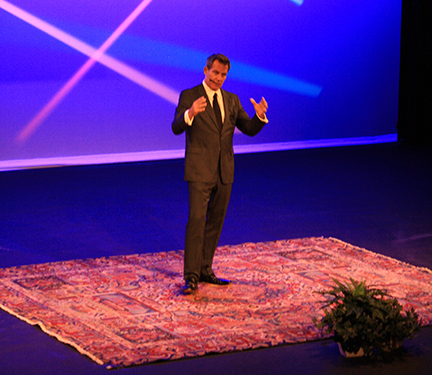
Urbanist Richard Florida speaks at Penn State Harrisburg.

Postindustrial cities like Detroit, Pittsburgh and Harrisburg have had an uphill economic climb since the glory days of cars, steel and railroad. But bringing industry and manufacturing jobs back into cities may not be the solution to grow urban areas and draw in the next generation of workers.

So says renowned urbanist and author Richard Florida, who spoke last week at the “PNC Thought Lecture Series” held in Penn State Harrisburg’s new Student Enrichment Center.

On a stage straight out of “TED Talks,” Florida outlined his theory on urban renewal. It’s based not on looking back at our manufacturing past, but in looking forward to our creative future and what he describes as the ”creative class.”

In his book “The Rise of the Creative Class,” Florida defines the group to include “people in science and engineering, architecture and design, education, arts, music and entertainment whose economic function is to create new ideas, new technology and new creative content.”

“We [once] used physical labor and natural resources to create wealth,” said Florida, who serves as the director of cities at the Martin Prosperity Institute at the University of Toronto. “[Today], the human mind is the means of production.”

Florida asserted that people like artists, musicians, entrepreneurs and technology professionals add to the vibrancy of an area. It’s this vibrancy—not necessarily jobs per se—that attract young people to a city.


Quality of Place

Florida said that he began to question the basic economic model of “if you have good jobs, the people will come” as a professor at Carnegie Mellon, when he asked his class if they would stay to work in the Pittsburgh area. The answer, he said, was a resounding “no.”

“They wanted to go to San Francisco, New York City or Seattle because these places had energy and excitement, places they could fit in,” he said.

“Quality of place” is what draws people to a city, Florida said. This quality includes natural features, open space, a diverse feel and a variety of activities such as symphonies, operas, ballet, cafes and restaurants.

Another part of city renewal is the presence of gay and lesbian communities, but not necessarily because of the individuals themselves. Florida asserted that communities that welcome gays and lesbians also embrace diverse ways of thinking. He said that great cities invest in the three “T’s”: talent, technology and tolerance.

One of these creatives is Jessica Bacon, creative director of design at Smile Spinners, a fabric and sewing boutique in Marysville. She attended the Florida speech at Penn State Harrisburg.

“I wanted a creative opportunity,” she said, explaining why she came to the Harrisburg area. “I want to build something.”

Karl Singleton, senior advisor to Mayor Eric Papenfuse, was also in the crowd. He advocated, “capturing local talent to enliven the school system,” hence encouraging the kind of creativity that Florida says is necessary to revitalize cities.

Rob Shoaff and Shaina Carter, two Maker Fellows from the Foundry Makerspace, are on board with that idea. In their jobs, they bring STEAM (Science, Technology, Engineering, Arts, Mathematics) into the classrooms of Harrisburg schools. Carter, who fellows at Downey Elementary, said that the program is “bridging the gap between community and school, bringing in community partners and bringing in technology.”

The quality of schools is vital because, as Florida said, young people often stay in a city until their children are of school age—then move out for a better school district.


Innovation and Growth

According to Florida, the numbers for the Harrisburg area shake out like this: 93,000 creative class workers, 67,000 working class workers and about 151,000 service class workers, who typically have the lowest paying jobs.

In some cities, creative class workers are moving into lower-income areas, pushing up property values and displacing long-time residents. So, how does a city bring everyone into the fold as neighborhoods change? Florida’s conclusion is to increase the pay of lower-income service jobs.

He likened this idea to the state of factory jobs prior to World War II and used his father as an example. He stated that, before the war, nine members of his father’s family needed to work in factories and other jobs just to keep the family afloat. Post-war, however, factory jobs paid better, allowing parents to own homes, purchase cars and send their children to college.

“We decided, as a society, led by Franklin Roosevelt and Henry Ford, that, in order to grow the economy so that working people could buy clothes and buy cars and buy air conditioners, we needed to pay them enough,” he said.

We can, he said, do the same thing for service workers today.

“We can give them higher pay, make their jobs better and involve them in innovation,” he said.

This, he said, would help invest all workers in their communities and foster the collaboration needed for a city to grow.

“When people get together in communities, we are more productive, we are more than the sum of its parts,” he said. “We create great, powerful communities that create innovation and growth.”

Author: Susan Ryder

Continue Reading