Tag Archives: HMAC

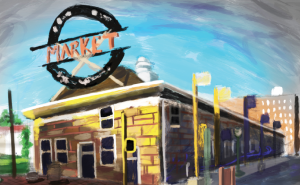
Stocked Market: So–have you been to the Broad Street Market lately?

illustration by Rich Hauck.

illustration by Rich Hauck.

“This market is rocking!”

A few weeks back, on a Saturday afternoon, an enthusiastic Ryan Hummer gave me his assessment of the action at the Broad Street Market.

The thing is—I hadn’t asked him.

My wife and I were at his stand, Hummer’s Meats, collecting our usual provisions for the coming week, when he spontaneously shared his excitement over the crowds of people elbowing their way through the narrow aisles of the brick building.

“Quite a change,” I said.

“Day and night,” he responded.

Hummer’s Meats is a market stalwart, and the family traces its roots there back to the 1920s. Ryan is the fifth generation to cut meat and, for a while, it looked like he might be the last of his family to sell anything inside Harrisburg’s only city market.

“I’m just about out of here,” he told me four years ago, after an infestation of bugs and rodents forced the market to shut down, the second time it had closed in two years for basically the same reason.

Back then vendors were at wit’s end—angry with management, with the board, even fighting with each other. The market still had its regulars, but, on many market days, more people seemed to be working there than shopping there.

The 150-year-old market was in the same funk as the rest of Harrisburg—a once great place now dirty, depopulated and struggling.

Then something happened—or, more accurately, a series of somethings.

Ask vendors what that was, and you’re likely to hear a trio of reasons: better management, a better mix of vendors and a better neighborhood.

Two years ago, Ashlee Dugan was appointed market manager followed, last year, by Beth Taylor. The vendors I spoke with described both women as caring, committed and competent, with a hands-on, problem-solving style of management. They also praised them for helping to bring stability to a market long plagued by turmoil.

Importantly, Dugan and Taylor put recruitment of new, high-quality vendors near the top of their priority lists, and that effort has born fruit.

On a typical Friday or Saturday, large crowds huddle around three newcomers that have their stands in a row in the brick building: Radish & Rye Food Hub, Evanilla doughnuts and Elementary Coffee Co. But it’s not just the newbies. Long lines often greet the hungry at long-timers like Fisher’s Deli, Lil’s Pretzels and Peach Ridge Produce. The newer vendors, though, clearly have injected life and brought fresh faces into the market.

Lastly, the neighborhood in general—and the Millworks in particular—deserve some credit, vendors told me.

For years, Midtown Scholar Bookstore was about the only complementary business to the market. But, over the past year, Zeroday Brewing, H*MAC (especially the Kitchen and the monthly HBG Flea), the Susquehanna Art Museum and the Millworks have recruited people into Harrisburg. Several vendors singled out the Millworks not so much for generating pedestrian traffic across Verbeke Street (though there is some of that), but for introducing—or reintroducing—folks to Midtown, some who return to shop at the market.

Interestingly, not one vendor I spoke with cited the once-ballyhooed Broad Street Market Task Force as a player in the improvement. More than two years ago, the city formed the task force to make recommendations on how to improve the market and, last year, the group issued its report.

Perhaps most significantly, the task force suggested changing the market’s complex management structure, currently a multi-tiered mess consisting of the city, the Broad Street Market Corp. and Historic Harrisburg Association. Instead, the report said, the market should become a nonprofit entity, which would better enable it to raise money and operate smoothly.

That hasn’t happened yet, nor have the report’s other suggestions been implemented (with the possible exception of slightly expanded market hours). Still, progress—substantial progress—has been made, judging by the large crowds and seemingly satisfied vendors. So then what’s the lesson?

Well, leadership matters a lot and, by leadership, I mean committed, every day, on-the-ground (not board-level) leadership. Secondly, synergy matters a lot. It was tough to get outsiders to venture into a desolate Midtown but got easier once several new businesses created a buzz and more options in the neighborhood, allowing people to walk from one place to another.

What doesn’t matter so much? Bureaucracy, reports, endless meetings. Perhaps, one day, the market will shed its layers of overseers. But, until then, it clearly can make headway regardless. As for the task force’s other recommendations—heck, we already knew the market needed infrastructure improvements, better hours and a focus on good food.

The Broad Street Market, like Midtown itself, has been struggling for decades, and numerous administrations and consultants have devised plans to fix it. Nothing seemed to work. All the reorganizations and master plans could not solve its two greatest problems: a dearth of high-quality, focused leadership and, most importantly, a lack of customers.

After years of almost nonstop woe, people have been returning to the market. It seems so sudden and unexpected, but perhaps it shouldn’t be any surprise that, as Midtown goes, so goes the Broad Street Market.

Lawrance Binda is editor-in-chief of TheBurg.
 

Continue Reading

Measuring Up: Can Harrisburg Put Itself Back Together?

James Fallows wrote a fascinating and insightful article for the March edition of The Atlantic titled “How America is Putting Itself Back Together.” Fallows’ essay provides a powerful and persuasive counter-argument to the prevailing political and media-driven narrative of America as a country in decline.

Over the past three years, Fallows and his family visited numerous small- and medium-sized cities throughout the country (i.e., not NYC, SF, LA and DC). The real story, he writes, is not that of a country in decline, but one of rebirth and resurgence. (He cites Pittsburgh and Allentown as two examples from Pennsylvania.) While some point to problems the country as a whole is said to have, most people he talked to refuse to acknowledge that those “other people’s problems” affect where they actually live and work.

Taken as a whole, America is still the land of invention, renewal, talent, assimilation, creativity and opportunity. While many are led to believe we are on the wrong track nationally, that story runs contrary to what is actually happening, according to Fallows. This may not be convenient for politicians running for office or media outlets that believe that only bad news sells, but it is a truth that is out there for those who spend the time to look, as he did.

I found Fallows’ observations to be exactly right, both from my travels around the country and here in our small city of Harrisburg. As I’ve often said in this column, don’t believe the bad news you read. Ninety-five or even 99 percent of what happens here every day tends to be positive, even it you have to wait monthly for TheBurg to read about it.

Fallows also suggests a way to evaluate the health of small cities and towns in the United States. His “Eleven Signs A City Will Succeed” is an instructive way of looking at the issue. So, I thought it would be a good exercise to take those 11 criteria and grade Harrisburg on the “Fallows scale.” Below is my attempt. No doubt your grades will be different based on your perspective. I find just thinking about these criteria and how we are doing in them can help determine how to move our city forward.

  • Divisive national politics seem a distant concern. Grade: B+. If this were “state” instead of “national” politics, the grade would go down, but, in general, I find that the many folks who hold strong views on national issues are quite willing to work together to make the local area, particularly the city, a better place. Many people who will never vote for the same presidential or gubernatorial candidate routinely work together on civic matters like the Downtown Improvement District, Harrisburg Chamber, Harrisburg Young Professionals and the like. The recent dust-ups between city and county leaders, however, prevent this category from being a solid A.
  • You can pick out the local patriots. Grade A. This one is easy. Harrisburg has both a broad-based group of civic leaders and a deep pool of talent that work daily to make the city better. It also has young talent rising through its ranks. Just look at the list of emerging leaders in HYP or the three newest members of City Council.
  • “Public-private partnerships” are real. Grade C. This item is hard to grade. On the one hand, a number of successful initiatives fall into this category: Whitaker Center, Harrisburg University, Harristown Development Corp. and Senators Baseball being a few. On the other hand, some of our biggest disasters do too: the former Harrisburg incinerator (now properly run by LCSWMA), the initially failed project at Cameron and Herr streets and the Wild West Museum, among others. The Civil War Museum may fall into either category, depending whom you talk to. Clearly, we have room for improvement here.
  • People know the civic story. Grade C. This category also highlights the strength of our city and a great weakness. For all the efforts of the Central Penn Business Journal, Harrisburg Magazine, Historic Harrisburg Association and, yes, TheBurg, to tell the real—and very encouraging—civic story about our city, the paper of record across the river runs a fairly constant drumbeat of doom and despair. Venture into the comment section of PennLive on nearly any article about the city (not that I recommend it), and you will see what giving public forum to a tiny minority of the disaffected will do to your civic psyche. Until PennLive vastly changes its ways, which are driven primarily by the motive to garner clicks for advertiser ratings rather than promote responsible discussion, it will continue to impede a healthy civic story about Harrisburg.
  • They have a downtown. Grade B+. From great restaurants, coffee shops and bars, a lively arts scene, 3rd in the Burg and new apartments and condos, downtown is alive and well. However, many people correctly associate retail with a healthy downtown and, in this area, Harrisburg lags. Retail is tough, however, and it mostly follows residents, not leads them. As more people move downtown, more amenities and retail will follow.
  • They are near a research university. Grade D. I have often wondered what Harrisburg would look like if Penn State Harrisburg (the largest Penn State campus outside of State College) were actually in Harrisburg, instead of Middletown. There is no substitute for having a major research university physically located in your city as anyone from Madison, Columbus or Austin can tell you. But the good news is that, after 10 years, Harrisburg University has found its footing and is on its way to becoming a major institutional anchor and economic generator for the city.
  • They have, and care about, a community college. Grade B+. For what we lack in #6, we make up a lot of ground with this one. Both HACC and now Harrisburg University are important community educators in Harrisburg. Both are committed to the city and improving its overall health and reputation. Other area colleges like Messiah and Temple have also taken a welcome interest in the city by sending their students downtown during and after college, providing a bit of the college-town vibe.
  • They have unusual schools (K-12 level). Grade C. Harrisburg’s public schools are undeniably troubled, but this criterion involves “distinctive” schools. Harrisburg has several, led by the Capital Area School for the Arts Charter School, SciTech High and Math Science Academy, as well as several excellent parochial schools. My grade may have been higher, but Fallows adds that the average resident should be able to list these schools quickly as a source of pride. Unfortunately, the district’s general poor performance casts a shadow over other schools in the city.
  • They make themselves open. Grade B. Harrisburg is a diverse city on many levels, a source of both strength and strain from time to time. We welcome a variety of immigrants and visitors, whether to our colleges or for housing. We have been supporters of various religions and lifestyles long before those things were acceptable elsewhere. Some may argue that we have a long way to go, and I would not disagree, but we are no doubt ahead of many other parts of the country.
  • They have big plans. Grade A. Fallows means this as a government-led category, but, in Harrisburg, we tried that once, and it came crashing down around us. Today, city leadership is focused on basic competence, as it should be. The big plans come from the city’s entrepreneurial class. Witness St@rtup, WebpageFX, The Laus Group restaurants, Urban Churn, Stash, Char’s, AndCulture, Mangia Qui, Midtown Scholar, The Millworks, HMAC, The MakeSpace and many others with big plans that are happening today. One civic item Fallows also referenced is urban infrastructure. When 2nd Street is returned to two-way traffic, Harrisburg will take a major step toward putting that part of the city back together again.
  • They have craft breweries (and small distilleries). Grade A. Harrisburg boasts Zeroday Brewing, Appalachian Brewing Company, Midstate Distillery and Troegs (a legacy Harrisburg company, so we still claim them). A few other breweries are slated to open this year. Let me add Little Amps coffee shop, which gives the same vibe. All fantastic.

Overall grade: solid B. On the items city residents can actually control, things are improving and have a very bright future. On those we cannot (schools, research universities and suburban media), we suffer. As an artist acquaintance of mine, who recently moved to Harrisburg from Chicago, told me, “There are few places around the country where you can have so much, for so little.” We need more people (and attitudes) like him to come help us grow.

J. Alex Hartzler is publisher of TheBurg.

Continue Reading

House Hunters Harrisburg: As amenities, confidence grow, so does interest in living in the city.

Screenshot 2016-02-26 16.41.00A year ago, Jared Blouch packed up his belongings and did something that, until recently, would have seemed decidedly backwards.

He sold his house in Mechanicsburg and moved into Harrisburg.

He was tired of the commute and traffic into the city each day, he said. So, he found a beautiful, historic house that he also thought was very affordable and started a new way of life that included—egads—walking.

“I like that everything is so close, and I don’t have to drive far,” said Blouch, who purchased on Green Street. “I can get everything I want right there.”

Blouch became so enamored with his new neighborhood that he quickly became an activist for it, joining the board of Friends of Midtown and serving as president of the Olde Uptown Neighborhood Association.

Blouch’s introduction to Midtown Harrisburg could hardly be more different than that experienced by Ray Davis, who moved there in 1986.

“I bought my house on Green Street, and I drove my mother by and she looked at me, and she looked back at the house and said, ‘Are you serious?’” he said.

Davis, a familiar licensed real estate agent in central PA, and particularly in Harrisburg, laughed as he recalled the memory.

“She had no experience with city living,” he said. “So, she put her hand on my knee and said, ‘Is it safe?’”

In those three decades in Harrisburg, Davis has seen many changes—from the transition of the plasma center on Reily Street to the current Midtown Cinema; from rows of empty buildings to the recent surge of new businesses in Midtown.

“We didn’t have anything—anything!” he stressed. “It was so different than it is now.”

Today, Midtown residents have numerous restaurants, nightspots and even a brewery among a long list of amenities just a short stroll away. In part, that’s what may be driving new interest in living in the heart of the city, said Davis.

“Comparing 2011 to 2015, there were literally twice as many sales,” he said.

In 2011, the data (price range of $50,000 to $250,000) showed that 49 houses were sold in the 17102 zip code, which includes North Street to Maclay Street and Front Street to N. 7th Street. In 2015, the same zip code totaled 99 units sold. Even more encouraging, the average time on the market for those 99 units was 87 days, just below the average of 90 days in the surrounding suburbs.


Faring Better

Wendell Hoover, Harrisburg’s other go-to agent, looked past the borders of the 17102 zip code to find that the dips and peaks of the average sales price over a six-year period told the same story.

Including data from downtown, Midtown and Uptown, the average sales price was $97,241 in 2010. In 2011, the average sales price dropped drastically to $85,339 then dropped further in 2013 to $75,058. The last two years have seen a reversal. The 2015 figures show a 22 percent increase since 2013 to an average price of $91,600.

The low numbers in 2011 were not unique to Harrisburg as the country experienced a bursting of the housing bubble. Harrisburg, however, was experiencing other challenges, financially and politically, over those years. Now, the opinion of the city has changed, said Hoover, who credited this improved perception as the main factor behind the current upswing.

“There were just so many negative things, and there were very few positive things before, so that’s the biggest trend—people have changed their viewpoint,” he said. “Whether they’re first-time homeowners or they’re investors, you need to have that confidence in the immediate market, and now a lot of people do.”


More Attractive

Hoover has been a realtor in central PA for six years and, during that time, he, too, has observed many of the changes in the city and optimistically foresees continued growth.

“Interest rates, although they might inch up, will remain relatively low, and the economy, although not good for everyone, has incrementally improved,” he said. “I don’t see much to stop this positive momentum, particularly as we get more things in Midtown.”

Hoover cited the opening of the Millworks and the expansion of the Harrisburg Midtown Arts Center as two important recent projects that have made the neighborhood more attractive to buyers.

“There are different venues I could point to, but it doesn’t necessarily have to be restaurants,” he said. “It’s just things that people can walk to.”

The desire to live in a walkable city is something that both Davis and Hoover have noticed from clients such as young professionals, first-time homebuyers and empty-nesters looking to downsize.

“I can’t put a particular amount of weight on it, but I believe the trend going forward is people wanting a house in a walkable community, and Harrisburg is definitely that,” Hoover said. “Some areas more than others, but that’s the biggest demand, particularly in Midtown. That’s a trend that I’ve seen for several years, but I’ve seen it grow in the last year or two years.”

The city’s walkability is not only attractive to potential homebuyers, but also to renters. The rental market is another facet of Harrisburg’s housing market that’s been trending up.

“The rental market was always good and remained good,” Hoover said. “Even during the time when people didn’t have the confidence in the overall market, they were at least willing to rent. They wanted to be in Midtown, they wanted to be in Uptown, but they weren’t convinced that maybe the market wasn’t going to get worse.”

And, in fact, developers have been responding to the growth in rental demand, with many new apartment buildings—particularly high-end renovations of historic buildings—coming on the market over the past couple of years. LUX, Walnut Court and COBA are a few examples of recently renovated multi-dwelling buildings. This year, both Harristown Enterprises and WCI Partners will add significant new rental inventory to downtown and Midtown.

Some of those renters eventually turn into homeowners.

“Renters who are renting upper-end properties, if they decide to stay, or when they decide to stay here, they turn into really good buyers,” Davis said. “They’re having a good experience in the city, and they want to stay.”

Both realtors also have had a growing number of clients moving to the city from larger metropolitan areas. These buyers, or renters, are attracted to Harrisburg because of the amount of space they can get for their hard-earned money compared to the cities they came from, the realtors said.

“Folks coming from those areas really help our values because they see value where natives don’t,” Davis said. “But do I see a big trend of that? I don’t know if it’s a huge trend, but it’s happening.”

What do the next five years hold? If demand continues, perhaps developers will begin to build single-family homes. The city’s new construction market—unlike the growing multi-family segment—has seen little action for many years.

“The city isn’t like Lower Paxton Township or Silver Spring Township, where they’re building new stuff all of the time,” said Davis. “[Zip code] 17102 doesn’t really have anywhere to go other than a few townhomes up at the [Broad Street] market.”

So far, Blouch appears happy with his choice to ditch “the boonies” for city life. Not only is he within blocks of places like Little Amps Coffee Roasters, Alvaro Bakery and Zeroday Brewing Co., but he’s met “tons” of people in his first year in Harrisburg.

“This works for me because I’m very social,” he said. “I’m more of a city person. I like being around other people.”


Continue Reading

Ups & Downs: Harrisburg and the unsettled, topsy-turvy, can’t-make-up-its-mind year.

A heated election, nagging parking problems and lots of bickering—Harrisburg, as usual, didn’t lack for drama in 2015.

Once again, it’s time for my annual Top 10 list of Harrisburg news events. Each January, I revisit and rank the stories that I believe had the greatest impact on the capital city over the prior year.

In some ways, Harrisburg had a good year (continued redevelopment) and in some ways a bad year (stubbornly high crime). All in all, 2015 was a year that started off with great expectations of progress, had plenty of highs and lows and ended up decidedly mixed.
Screenshot 2015-12-27 12.04.13

  1. Kipona Chaos. The last thing that Harrisburg needed was to feed the perception that the city is unsafe—and that’s exactly what it got as scores, hundreds (who really knows?) of youth went on a Labor Day weekend rampage. The trouble began with an argument between two teenagers just as the annual Kipona festival was wrapping up for the night. Soon, crowds of kids descended on the riverfront and, emboldened by their numbers, began roaming through streets in Midtown and Uptown, vandalizing cars (including the police chief’s!) and a convenience store. One teenager accidentally shot himself in the leg. Eventually, arrests were made, but not before the damage had been done both to property and to the city’s always-fragile image.
    Screenshot 2015-12-27 12.04.24
  1. Bar Brawl. What responsibility does a business have to its community? I asked that question in a blog post last year after the city tried to shut down several bars it deemed problematic. The 3rd Street Café in Midtown fought back, appealing revocation of its business license to the Dauphin County court. The owner claimed he couldn’t be held responsible for what his patrons did just outside his bar; the city disagreed. At press time, the judge still had not decided whether the bar stays open or closes.
    Screenshot 2015-12-27 12.04.30
  1. Front Street Fix. First came the lane closures, then the tree cutting, then—oh boy—the noise. By early summer, Harrisburg was divided in two: those who approved of PennDOT’s redesign of Front Street and those who didn’t. In the end, it wasn’t the commuters, reduced to two lanes, who bore the brunt of the project, but those who lived along the street, shocked to discover that PennDOT could, and did, work all night long. However, due to their sacrifice, Harrisburg now has a smooth, less forbidding road, which, on most days, begs the question—why were there ever three lanes to begin with?
    Screenshot 2015-12-27 12.04.50
  1. Nightmare at the Museum. What’s messier than a splatter painting studio? The financial tangle that the Susquehanna Art Museum found itself in just months after opening the doors to its beautiful new facility in Midtown. To sum up: two entities laid claim to one $1.2 million state grant—JEM Group (the project’s general contractor) and Fulton Bank, which wanted to get paid after SAM defaulted on a $3 million loan. The sides chose negotiation over litigation, and, by year-end, an agreement was at hand, which provided some funds to both entities and allowed the museum to stay open.
    Screenshot 2015-12-27 12.06.21
  1. Midtown Resurgence. At this time last year, the following places did not exist: The Millworks, Zeroday Brewing, the SAM building, Next Step Performance and both The Kitchen and The Capitol Room at HMAC. They all opened last year, and, in October, WCI Partners began converting the Moose Lodge/Ron Brown complex to mixed-use space, bringing back an entire city block that had been shuttered for a decade. In other words, 2015 was a landmark year for Midtown’s main commercial stretch. Unfortunately, it wasn’t all good news. SAM’s financial troubles clouded the picture, and another big project, GreenWork’s proposed “Education Row,” went nowhere. Will last year’s new projects finally push Midtown past the tipping point, ending its annoying one-step-forward, half-a-step-back routine?
    Screenshot 2015-12-27 12.06.28
  1. Parking Redux Redux. When it comes to Harrisburg’s parking system, if it’s not one thing, it’s another. Parking meter revenues topped projections, but nagging enforcement problems and weak garage usage provided far less income than was expected. One bright spot: Mayor Eric Papenfuse’s gamble—which lowered happy hour rates downtown and provided four free hours of parking on Saturday—paid off, so those parker-friendly measures should continue. So, for the third straight year, parking scores a spot on my annual Top 10 list. To steal a quote from the Washington Post’s Chris Cillizza—congrats, or something.
    Screenshot 2015-12-27 12.06.36
  1. Papen-fights. City Council, the county commissioners, the Harrisburg Regional Chamber, the Hershey-Harrisburg Regional Visitors Bureau—if there was an entity to tussle with, Mayor Papenfuse tussled. October may have been the low point, with Council President Wanda Williams repeatedly calling him “a liar” followed by public squabbles with both HHRVB and the Chamber/CREDC. By year-end, the mayor and his frenemies had mostly walked back their disputes, agreeing to work towards resolutions or at least a détente.
    Screenshot 2015-12-27 12.09.07
  1. Council Shakeup. Eric Papenfuse is not a shy guy (see above). On TheBurg Podcast, he boldly stated that City Council needed new blood and who, in his opinion, should stay and go. He got his way. Following a spirited election, city residents voted in three new council members, substantially changing the tenor of the seven-member body. I rank this story high not because of the 2015 campaign, per se, but because of what it could mean for the city—and the mayor’s legislative priorities—in 2016.
    Screenshot 2015-12-27 12.09.15
  1. Harrisburg Less Strong. “Harrisburg Strong” began to show its weak spots as the city’s financial recovery plan failed to deliver expected revenues for a second straight year. In 2015, city revenue was about $6 million less than projected by the Strong Plan. Papenfuse said that the plan’s architects had made overly optimistic projections and that some critical revenue sources, such as from the aforementioned parking, were soft. To fix the structural deficit and deliver an acceptable level of city services, the mayor called for a tripling of the local services tax and greater revenue from commercial sanitation enforcement as part of his 2016 budget.
    Screenshot 2015-12-27 12.09.21
  1. Reed Arrested. There was no contest for the year’s No. 1 story, as former Mayor Steve Reed’s arrest was not just Harrisburg news but national news. Love him or hate him, Reed reigned over the city for 28 years, commandeering a comeback built upon a combination of bricks, mortar, debt and delusion. In the end, he was indicted on nearly 500 criminal counts covering various theft, fraud and corruption charges. The sight of agents hauling hundreds of museum-quality Wild West artifacts out of Reed’s poorly maintained Cumberland Street house is one this city will not soon forget.

So, what’s the final verdict on 2015? There were plenty of ups and downs, but, in the end, I think we were marginally better off as a city on Dec. 31 than we were on Jan. 1. Not a lot. Not enough. And probably not as much as I had hoped or expected. But, all in all, we’ve moved forward a few squares.

Lawrance Binda is editor-in-chief of TheBurg.
Continue Reading

Culture Capital: The capacious, renovated Capitol Room set to host major events at H*MAC

Screenshot 2015-12-27 12.32.19The nearly completed restoration of the Capitol Room, a turn-of-the-century art deco ballroom located at the Harrisburg Midtown Arts Center (H*MAC), is the latest chapter in one of the area’s most ambitious renovation projects.

It joins Stage on Herr and the recently opened Kitchen & Gallery Bar to form a complex that aspires to be Harrisburg’s “one stop shop for arts and culture.”

“This is the last surviving ballroom from the early 1900s left in Harrisburg,” said H*MAC founder and managing partner John Traynor. “When it’s fully operational, we’re going to be able to do music events here every weekend. That’s a lot of music and a lot of entertainment.”

The Capitol Room is spacious, and, being a ballroom, has no pillars or other obstructions to get in the way of good sightlines to the stage. The maple wood floor is original, and banks of arched windows grace the room on two sides. There is a bar in the back of the room and a door that leads out to an inviting balcony where event-goers can relax with a beer or a glass of wine and enjoy the beautiful view of the state Capitol.

The stage is an adequate size to house the national bands that Traynor hopes to showcase in the space, as well as theatrical productions by the center’s resident company, the H*MAC Theater Troupe. For the artists’ comfort, there are also greenrooms and bathrooms behind the stage. A Juliet balcony, which sits at mezzanine level in the back of the ballroom, is still to be renovated.

“It will be for the VIPs,” said Traynor. “We’ll have a private bar and bathrooms, and, obviously, everyone who sits up there will have a great view of the stage.”

The Capitol Room is a multi-use space that can be configured to hold a variety of events ranging from concerts, parties and theatrical events to fundraisers and weddings. It can accommodate as many as 500 guests for banquets and many more for theater-style seating or standing events. Traynor says that, while the ballroom opened up this past June, the public will have to wait until the spring to see big musical events there.

“We still have some work to do to get in a top-notch sound system,” he said. “This is a very expensive ticket item, and we want to make sure that the audio is perfect.”

In the meantime, the Capitol Room is fully operational as a banquet facility and has other uses, as well. The space hosted several holiday parties last month, and wedding receptions are scheduled for this year. A monthly arts flea market has started there, with more than 40 vendors and upwards of 1,000 people attending recently. The annual stage production of “The Rocky Horror Show,” which previously had been held at Stage on Herr, was moved upstairs this past Halloween for a successful two-day run, and some smaller acoustic concerts are also planned.

Now that the Capitol Room is open, Traynor says that H*MAC has much more to offer the community.

“You can come for the evening, have a drink at Stage on Herr, have dinner at the restaurant and then come up for the show,” he said.

H*MAC also plans to do a lot more programming and may sometimes run simultaneous shows at both venues.

“Our dream is to be as eclectic and welcoming to all kinds of possibilities,” he said.

The renovated structure that H*MAC now occupies was built 100 years ago as the city’s Jewish Community Center which had, aside from the ballroom, a swimming pool, kosher kitchens and classrooms for a yeshiva. During its heyday, the ballroom was used for weddings, bar mitzvahs and other celebrations.

The building later housed the Harrisburg Police Athletic League, with the ballroom converted to a basketball court.

“When I first saw the room, I remember thinking, ‘OK, we don’t have to change the wheel,’” he said. “What we just need to do is restore this beautiful old ballroom to what it was, a place for the community.”

The resulting Capitol Room has plenty of old-world charm, but don’t expect to find a lot of fancy chandeliers or other finery.

“We still have the curtains to do, but we intentionally left the room very simple and basic,” said Traynor. “This way, it is a blank canvas where anything can happen.”


The Capitol Room is located in the Harrisburg Midtown Arts Center (H*MAC), 1110 N. 3rd St., Harrisburg. For more information, visit www.harrisburgarts.com or call 717-412-4342.

Continue Reading

Mid-Winter Warm-up: Hot young bands break the chill.

Lower Dens. Photo courtesy of Shawn Brackbill.

Lower Dens. Photo courtesy of Shawn Brackbill.

A new year, a fresh start. Well, here in Harrisburg, we’re starting the year off with a bang.

Deep in the cold of winter, some hot up-and-coming bands and artists will be making their way through the capital. Rich with heartfelt songwriting, retro stylings and dreamy nostalgia, each artist brings a unique take on the pop music craft. So lace up your winter boots, get out your mittens, and make it out for the month’s slate of superb music.

LOWER DENS, 1/20, 9PM, THE MILLWORKS, FREE, 21+: This Baltimore indie-pop band, headed by acclaimed artist Jana Hunter, has earned accolades from many of music’s top critics, including the coveted “Best New Music” label from Pitchfork. Their latest album, “Escape from Evil,” has propelled them even further into the spotlight, making their stop here in Harrisburg all the more special. Described as “queer retrofuturism” by the folks at Pitchfork, Lower Dens harkens back to traditional pop song structures even as they push artistic boundaries and employ innovative and experimental textures. Whether you are already familiar with their work or looking to discover a new, off-kilter favorite, this band is of such quality that they demand to be checked out.

WEEKENDER w/SUBURBAN LIVING, 1/23, 11PM, H*MAC, $5, 21+: Philadelphia’s Weekender is a dreamy chillwave band akin to Washed Out and Toro y Moi. Shimmering melodies and fuzzed out guitars ooze pop nostalgia, all while sounding fresh and current. They’ll be touring in support of their second EP, “Floaty, Feeling Blue.” This new record features lush analog synthesizers, reinforcing the band’s warm, warped aesthetic. Weekender will be joined by Suburban Living, also from Philadelphia. Equally poppy with a similarly retro aesthetic, the band conjures up New Order dancy-ness, a perfect complement to Weekender’s trippy psychedelia.

TYLER MICHAEL LAW w/JESSE BARKI, 1/29, 6:30PM, LITTLE AMPS DOWNTOWN, $5 SUGGESTED DONATION: Tyler Michael Law is a folk singer of the traditional American pedigree. Hailing from Shippensburg, he approaches songwriting firmly rooted in the blues and protest music tradition. He will be joined by Annville’s Jesse Barki. More stripped down than Tyler, Jesse’s somber acoustic music drips with emotion. Both artists are storytellers, making the intimate setting of this show fitting. I strongly recommend you brave the January chill to warm up with a latte and take in the sounds of two men who wear their hearts on their sleeves.

Mentionables: John Kadlecik Band, 1/2, Abbey Bar; Stephen Lee & Evy Zee, 1/8, Little Amps Downtown; Andromeda, 1/9, H*MAC; Rivers, 1/9, The Millworks; Southside Johnny & the Asbury Jukes, 1/22, Whitaker Center

Continue Reading

Musical Notes: Songs for the Season


Typically, this column is focused on rock and pop music. However, sometimes, I just can’t resist getting into the holiday spirit. And seeing as Harrisburg is home to many superb holiday concert events, it seemed only fitting that we take a break from the guitars and drums and focus on a more seasonally appropriate sound. So, put a scarf around your neck, sip a little eggnog and gather the family for some of our most joyful celebrations of the holiday.
 
HARRISBURG GAY MEN’S CHORUS, 12/6, 4PM, UNITARIAN CHURCH OF HARRISBURG, $15: The Harrisburg Gay Men’s Chorus has been combining a love of music with a mission for presenting gay-positive entertainment for 29 years. Although they are a mainstay of Harrisburg cultural events, they have also performed across the country alongside such ensembles as the Manhattan Philharmonic and the Turtle Creek Chorale. This year’s holiday concert, “Just Say ‘Yes’ to an ‘80s Christmas!” is dedicated to Nancy Reagan and the rest of her esteemed decade. The chorus encourages all attendees to wear their most audacious shoulder pads and spray up some big hair in the spirit of the former first lady. Expect a lot of holiday spirit with just a dash of tongue-in-cheek.
 
THE MANHATTAN TRANSFER, 12/16, 7:30PM, WHITAKER CENTER, $47.50-$65: This famed vocal ensemble traces its roots to 1969. Founded by Tim Hauser, a former marketing executive and New York cab driver, the group has gone through numerous line-up changes while always staying true to its swinging doo-wop roots. The Manhattan Transfer has recorded with some of the greatest vocalists and songwriters in the history of pop, including Bette Midler, Tony Bennett, James Taylor and Smokey Robinson. The group will be performing a holiday-themed concert that is sure to be a treat for the whole family.
 
SUSQUEHANNA CHORALE: 12/18, 8PM, MESSIAH COLLEGE, PARMER HALL, $20/$25: The Susquehanna Chorale is the ensemble-in-residence at Messiah College. The 36-member chamber choir has received national accolades, and their annual holiday concert has become a central Pennsylvania tradition. This year’s performance, “A Candlelight Christmas,” features a rendition of Respighi’s “Laud to the Nativity.” Their performance will take place within Parmer Hall, the remarkable centerpiece of the college’s High Center for Worship and Performing Arts. Considering the chorale’s track record, this should prove to be an evening of peerless artistry.
 
Mentionables: Tomáseen Foley, 12/2, Rose Lehrman Arts Center; Pitch Blak Brass Band w/the West Philadelphia Orchestra, 12/5, H*MAC; Rivers w/Indian Summer Jars, 12/12, Abbey Bar; Trans-Siberian Orchestra, 12/18, Giant Center; Jeffrey Gaines, 12/26, H*MAC; Wizards of Winter, 12/29, The Forum


Continue Reading

A Poverty of Action: It’s time for the private sector to take greater responsibility to improve this city.

Illustration by Rich Hauck.

Illustration by Rich Hauck.

Recently, my wife and I ventured down Route 283, as we do a few times a year, to experience Lancaster’s First Friday.

I say “experience” because that’s what it is. On a beautiful, warm evening, the downtown blocks in and around Prince Street were so crowded that it was difficult to walk, customers and browsers wandering in and out of the shops along the city’s Gallery Row.

And I thought (as I have before): This is what a historic downtown should look like—shops and restored storefronts oozing character and commerce. And, as usual, I thought of how far Harrisburg, with few shops and much of its historic downtown leveled, is from this small-city charm.

Therefore, I was pretty surprised when, just a couple of weeks later, I read about a new study from Franklin & Marshall College’s Floyd Institute for Public Policy that said that, basically, I was a sucker. I had fallen for—well, maybe not quite a mirage, but certainly a distortion of what Lancaster really was.

The report, titled “Lancaster Prospers?” gave a devastating assessment of the state of the city, saying that downtown was an island of prosperity surrounded by a sea of poverty. In fact, outside the downtown core, per-capita income had fallen in each of the city’s other 13 neighborhoods, many by double-digits, from 2000 to 2013.

“The intensification of disparities between and within areas of the city has the potential to fray the fabric of social life,” warned the report.

A defensive Mayor Rick Gray later wrote an op-ed that called the Floyd Institute’s report “shallow” and “simplistic” and said his city, in addition to investing downtown, had poured “tens of millions of dollars” into impoverished neighborhoods.

“We can only wonder what the city would look like today without the economic development and investment Lancaster has seen over the past 10 years,” Gray said in the Lancaster daily, LNP.

And, again, I thought of Harrisburg.

Lancaster and Harrisburg are very different cities with very different recent histories. From 2000 to 2013, Lancaster tried to elevate itself into a regional hub for the arts, tourism and young professionals, while Harrisburg suffered an historic financial meltdown and state receivership. Yet, during this time, both cities had almost identical increases in their rates of poverty (about 8 percentage points), with nearly one-third of their populations now living below the poverty line.

What gives?

The fact is that fighting poverty is a monumental task, its causes varied and complex and its solutions largely beyond the control of local officials. “Tens of millions of dollars” may be a lot of money for small cities like Lancaster and Harrisburg, but it’s a trickle compared to the magnitude of the problem.

The Floyd Institute doesn’t seem to have any answers either. Its report includes some vague language about improving housing affordability and employment opportunities in the neighborhoods. However, it lacks concrete ideas on how to do that, other than advocating the ultimate recipe for inaction—another poverty study.

That’s not a surprise. If there were a magic bullet for alleviating poverty, everyone would be doing it. Instead, we seem to be heading in the opposite direction.

The fact is that we don’t live in a command economy. A local government can’t, at will, create jobs for low-skilled workers or force landlords to reduce their rents. Most of the economy is in private hands, a fact that many academic studies gloss over or dismiss. In cities, even small cities, thousands of people own the rental housing, the stores, the hospitals, the eateries and the other places where lower-income people live and work. It’s the broad, diffuse, tough-to-control private sector, not the concentrated public sector, which has the greatest impact on the economies and lives of people.

So, as the Floyd Institute calls for action from the public sector, I call for action from the private sector. Here in the Harrisburg area, that can take many forms—from working with school kids to greater job training to seeding entrepreneurship to targeting impoverished areas for small-scale manufacturing to helping workers put down roots in the city, which feeds economic activity. The need is tremendous, as are the options for action.

An excellent start would be for private landowners in Harrisburg who’ve long neglected their properties to begin to take responsibility for them. As I’ve said in a previous column, if you buy a dilapidated building or empty lot and, within a year or so, don’t begin to improve it, you’ve become part of the problem, no matter how well intentioned you may be. You’re now contributing to the blight in that neighborhood, discouraging redevelopment and economic progress.

I especially call upon the owners of property along the 3rd Street corridor to take action. With anchors like H*MAC, Midtown Scholar, the Broad Street Market, the Susquehanna Art Museum, Campus Square and Midtown Cinema, that stretch has tremendous promise. The coming redevelopment of the old Moose Lodge temple at 3rd and Boas streets is another critical piece in stitching downtown and Midtown back together.

However, the corridor will never reach its full potential until other buildings there are renovated and occupied by responsible tenants. Unlike downtown, 3rd Street retains enough of its 19th-century building stock that, if restored, it could do for Harrisburg what Gallery Row has done for Lancaster.

Harrisburg’s municipal government is stressed simply picking up trash, fixing streetlights, policing streets and providing other core services. Expecting it, or any local government, to solve a 30-percent poverty rate is fantasy.

Therefore, the private sector must take greater responsibility. To date, a handful of people have stepped up to start good companies and to improve dilapidated buildings, but they can’t carry the entire burden. Others must join this effort—companies and individuals that have the means to do so—if we’re ever going to create an attractive, more prosperous city that will encourage people to visit, spend money, contribute taxes and generate employment.

In my view, that’s the part of the social contract that’s most missing.

 
Lawrance Binda is editor-in-chief of TheBurg.



Continue Reading

Musical Notes: Autumn Blend–A perfect musical mix arrives in town.

October might be my favorite month. The leaves are a sunset of oranges and reds, and the temperature is perfect. But even the perfect month can benefit from some great live music. This month’s slate is a nice balance of classic favorites and local upstarts. So whether you prefer the music you first heard on ‘70s AM radio or the latest debuts from hip college stations, there’s something this month for everyone.


HOOTS AND HELLMOUTH, 10/2, 9PM, ABBEY BAR, $10/$12:

These Philadelphia road warriors have earned a significant following here in the ‘Burg. With a focus on roots-rock, they’ve found a way to meld contemporary anxieties with traditional instrumentation. Driving and melodic, lead singer Sean Hoots sets his powerful yet vulnerable voice upon the subject of relationships, growing older and the disillusionment of the 21st century. The band has garnered the attention of national tastemakers such as Paste Magazine and WXPN. This will definitely be a stomp-along show, so make sure to wear the proper footwear.


BLUE ÖYSTER CULT, 10/3, 8PM, WHITAKER CENTER, $42/$58:

Most of you are familiar with Blue Öyster Cult’s song “(Don’t Fear) the Reaper,” and a certain Will Farrell sketch revolving around the song’s cowbell track. But those in the know also realize that their contribution to hard rock and heavy metal reaches much farther than a “Saturday Night Live” punch line. Along with Black Sabbath, the band helped to define a genre of rock that combines metal riffs with the heaviness and haziness of acid rock. This is a unique opportunity to see a band that has left a significant fingerprint on a wide range of musical genres within the friendlier confines of our small city.


CHUCK PROPHET, 10/14, 8:30PM, H*MAC HERR STREET STAGE, $12/$15:

Hailing from California, Chuck Prophet has almost 30 years of experience playing rock with a psychedelic flavor. He began his career touring with his band Green on Red and will this autumn be on the road in support of his 13th album, “Night Surfer.” His loose arrangements, coupled with narrative songwriting, are reminiscent of Warren Zevon, while his vocal delivery—half sung, half spoken—is akin to Jonathan Richman. His music tackles a wide range of subjects, including lamentations dedicated to hard socioeconomic times and love songs to San Francisco. He’s definitely an artist who sounds more natural on stage than on tape, so make sure to catch him while he’s in town.

Mentionables: Jucifer w/Anthrophobia, 10/1, H*MAC; Cheezy and The Crackers, 10/3, The Millworks; The Alt, 10/4, Fort Hunter Centennial Barn; Hot Jam Factory w/Ton-Taun, 10/16, The Millworks; The Young Dubliners, 10/18, Abbey Bar; The David Wax Museum, 10/21, H*MAC; Best Girl Athlete, 10/23, Little Amps Downtown

Continue Reading

Great Scott! The cult classic “Rocky Horror Show” returns to H*MAC for Halloween season.

Screenshot 2015-09-28 10.05.20Fishnet stockings, heavily made-up transvestites and a hunk by the name of Rocky have made the cult classic “Rocky Horror Show” a fan favorite for years at the Harrisburg Midtown Arts Center.

This year, the live production returns for four shows, to the great relief of light-shining, callback shouting, dancing-in-the-aisles audience members who can’t imagine a Halloween season without the crazy antics of Dr. Frank N. Furter and his spaced-out, insatiable crew from Transsexual, Transylvania.

“The audience is the best part,” said Lindsay Bretz-Morgan, a longtime producer and choreographer for H*MAC’s “Rocky Horror Show.”

As soon as the band plays the first note, the crowd goes wild, she said.

But it isn’t just the audience at H*MAC that comes back to see the show year after year, sometimes buying tickets for each of the four performances. Bretz-Morgan has participated in a “Rocky Horror” production at various theaters for the past 10 years. The past three have been at H*MAC.

“Performing this show at H*MAC makes you feel a little like a rock star,” Bretz-Morgan said. “It comes back to the stage each year, but there’s always something a little different.”

Based on a story by Richard O’Brien, “Rocky Horror” is about newly engaged couple Brad and Janet, whose car breaks down near the Frank N. Furter castle. The mad scientist, famous as a flamboyant transvestite, takes the couple in and introduces them to a cast of characters who have their own hidden agendas. Things take a twist when the doctor’s project, the creation of a handsome fellow named Rocky, comes to life.

Going into its sixth year at H*MAC, “Rocky Horror” has always had a live band and presents an experience different from any other theater, said John Traynor, H*MAC president.

The entire room becomes the stage as actors interact with the audience and the narrator even tells the story from a spot above the theater’s bar. Many audience members come dressed as the popular Frank N. Furter and are happy to shout or sing along with the cast or toss confetti onto the stage, Traynor said.

He suggests those who haven’t been to the theater performance first watch the movie version, “The Rocky Horror Picture Show,” and have an open mind to the story of acceptance.

“The story has a real fun aspect to it, if you’re open to it,” Traynor said. “I think it’s become so popular because it pushes people to be who they are.”

Bretz-Morgan said that, despite being a yearly production, “Rocky Horror” has a little something different to offer depending on the cast and people behind the scenes. Different directors often bring their own take, she said. In previous years, Justin Beiber jokes and other modern aspects were tossed into the mix. This year, people might notice the addition of a saxophone to the live band. A group of phantoms, who play the ensemble, also make it the largest cast H*MAC has had for “Rocky Horror,” she said.

Returning veterans, such as Ryan Boyles, who plays Frank N. Furter, and Taryn Sprenkle, who plays Janet, also bring back a sense of familiarity to the show. Boyles had to take a break from theater performances a couple of years ago when he and his wife had a child, Bretz-Morgan said. Others members have gone on tour, moved away or become busy with new projects, so it’s nice when an old face can return, she said.

Those thinking of attending the show for the first time should be prepared for a crazy night, said Bretz-Morgan. Friends of hers who attended in the past were expecting a traditional theater experience. By the time the show was over, they wanted to learn all the callbacks shouted out by regular audience members so they could be more involved for the next year.

“If you come knowing that things are a little different, a little out of the ordinary, then you’ll have a great time,” she said. “It’s such a fun atmosphere, and people love that.”

Bretz-Morgan also suggests people make a night of it by having dinner in H*MAC’s restaurant, The Kitchen, which wasn’t an option before this year. In the past, even cast members searched for places to get Chinese takeout between shows.

“Harrisburg, in general, has a lot of cool, new places that have been opening up, and I think people are more likely to grab dinner or a drink and just hang out,” she said. “It’s fun to be in Harrisburg right now. I’m glad H*MAC can be part of that.”


The “Rocky Horror Show” will be performed at 8 p.m. and midnight on Oct. 30 and Oct. 31 at the Harrisburg Midtown Arts Center, 1110 N. 3rd St., Harrisburg. Tickets are $20 to $25. For more information, visit www.harrisburgarts.com or call 717-412-4342.


Continue Reading