Tag Archives: coffee

One Good Shop: Variety, quality, fun in the heart of Camp Hill.

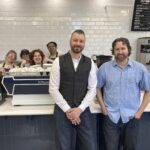
Screenshot 2014-10-30 14.44.05Stainless steel racks of delectable edibles, glass jars brimming with loose tea and whole-bean coffee, eclectic books and soft goods all contained in one little place. A small hand-written sign outside encourages customers to live, love, laugh local. The tidy, yet warm, shop beckons visitors to come in and have a look around.

One Good Woman, a coffee, tea and so-much-more store rests in the commercial shopping center of Camp Hill, though, ever unimposing, it’s tucked neatly in the back off of busy Market Street.

Owner Holly O’Connor always wanted to open a shop and took the plunge 18 years ago. When deciding what type of place to open, she asked herself “What do I like?” So, she set out to build a business focused on good tea and coffee, starting small.

“The first two years was delivery out of the back of my truck to businesses and in neighborhoods,” said O’Connor.

As the business grew and O’Connor was encouraged to open a storefront, she moved into the old Camp Hill borough hall garage and then to the present location at the corner of Market and S. 19th Street.

Today, the smell of coffee permeates the store, and an aisle of coffee greets customers directly inside the door—varieties such as dark Kenya and Ethiopian harrar. For those who prefer a more accentuated taste, there’s snickerdoodle, moon pie and toasted coconut coffee, as well as fair trade options for the socially conscious coffee drinker.

The small batch roasting process from a Baltimore roaster makes One Good Woman coffee special. According to O’Connor, small batch roasting prevents the bitterness that comes with large batch processes. One Good Woman’s coffee is roasted on Monday and arrives at the store on Tuesday. A number of Harrisburg businesses—Yellow Bird Café, Mount Hill Tavern, Harvest in the Broad Street Market and note. Bistro and Wine Bar—serve One Good Woman coffee.

Screenshot 2014-10-30 14.43.55Let’s not forget the tea, which lines the back wall of the store, just past the chalkboard wall scrawled with inspirational daily messages. There are white, green, oolong and black teas from which to choose, plus herbal and flavored teas. The shop doesn’t serve food or beverages, but customers can sample the coffee of the day for a small charge.

While coffee and tea remain the hallmarks of the store, it has grown into an amalgamation of unique items.

“It always has different, obscure stuff,” said Cate Hallman, who travels from Fishing Creek Valley to buy her coffee and tea at One Good Woman.

Some of these rarified items include gourmet food like linguine with squid ink, pumpkin chowder and Thai sweet potato chowder mixes; sauces, including Stonewall Kitchen brand dark chocolate sea salt caramel sauce and white chocolate fig sauce; and jams like peach raspberry jam. Savory spreads, including a roasted onion garlic jam and hot pepper jelly, line the shelves, as well.

Interesting textiles, tablet covers made from recycled fabrics, One Good Woman canvas bags and colorful scarves are scattered about the store.

Need a good book? One Good Woman’s got them too. Customers can consider titles including “In Dog Years I’m Dead,” “Soul Sisters” and “What Would You Do If You Ran the World?”

There’s no worry about finding just the right item. If you’re not sure what to buy, all you need to say is, “I like this, what else will I like?” said Hallman, and the staff will guide you to the perfect fit.

O’Connor credits her customers with the business’s success. She said that the best advice she’s ever received, given to her by her husband Joe, has never failed: “Listen to your customers, they will tell you what to do.”

She said that she continually finds new items for the shop based on customer input. A few years into the business, customers told O’Connor that they wanted gift baskets, and she obliged. With no gift basket-making experience, O’Connor and her mother, now deceased, began creating beautiful baskets filled with delicious products.

Most of all, she wants One Good Woman to be part of and in service to the community.

To that end, she hosts a “Meet Your Maker Series,” in which merchandise producers come to the store to meet the customers, paired with local artists who share their work. The Nov. 1 event, for example, includes a Stonewall Kitchen jam tasting with artist Karen Larsen from Crows Foot Farm Designs.

One Good Woman is a great place to shop, but it’s seemingly also a great place to work. O’Connor has high praise for her employees as customer service purveyors and as a part of the One Good Woman team. They feel the same about her. When asked what makes One Good Woman so special, Laurie, an eight-year employee who runs the warehouse, said the answer is “kind, wonderful people.”

“It’s a friendly place to work,” she added.

Brenda, a part-time employee, said she both works and shops at One Good Woman, adding that that’s where she did most of her Christmas shopping last year.

O’Connor said that patrons often compare the place to shops in Maine, which is a compliment for someone who enjoys spending time in that northern state.

Those who delight in the aroma of coffee, are looking to relax with premium coffee or tea, or find themselves wanting to brighten someone’s day with a distinct gift, might want to pay a visit.

“I try to offer really wonderful products at a great price point so that everyone can shop here,” said O’Connor.

One Good Woman is located at 1845 Market St., Camp Hill. Hours are Tuesday, Wednesday and Friday, 10 a.m. to 5 p.m.; Thursday, 10 a.m. to 6 p.m.; and Saturday, 9 a.m. to 3 p.m.; closed Sunday and Monday. For more information, please visit www.onegoodwoman.com or the shop’s Facebook page.

Continue Reading

Coffee, Tea & History: For four decades, Kauffman’s has blended fine beverages, friendships.

Screenshot 2014-07-30 21.23.36A simple wooden sign hangs outside the unassuming door. Upon walking inside, I hear the chime of a hospitable bell and view a scene from years past. Glass jars with gold lettering line the shelves, chalkboards listing the available goods hang on the walls, and an ancient, silent cash register sits on the counter.

Kauffman’s, Coffee, Tea and Spice has resided in downtown Lemoyne for 36 years. Owner Betty Dorsey recounts that she and friend Barb Shultz bought the business, originally located in Harrisburg’s Shipoke neighborhood, 41 years ago.

“Why don’t we just shut up and buy it,” was Dorsey’s response to their indecision about purchasing the closing business.

They moved it to Lemoyne because they couldn’t afford to purchase the Shipoke building and because Lemoyne had greater customer traffic. Dorsey’s partner sold her part of the business to return to school five years into their venture. Dorsey’s husband, deceased for three years, served as the president of the Local Council of Churches, so she ran the business mostly by herself with the help of their children.

While Kauffman’s is an old-fashioned shop, there’s nothing old about Betty Dorsey. This forward-thinking pastor’s wife started a small business at a time when only about 15 percent of women entered the workforce.

She said that Kauffman’s is different than most teashops because it doesn’t just serve tea. It also sells a variety of products, including pastries prepared by Dorsey’s friend.

Kauffman’s dusty blackboards reveal the treasures within. Its loose teas, 35 types, include the exotic Russian gold, peony white and jasmine teas, as well as the more traditional Ceylon, Earl Grey and English breakfast. Tea lovers can also enjoy teas flavored with black currant, apple, apricot or Kauffman’s blend mint tea.

When speaking of tea, she explains that there is “tea the plant and tea the drink.”

“Tea the drink is not always tea the plant,” she said, referring to the fact that tea, in the broad sense, is a beverage created when leaves, berries or roots are steeped in hot water. Tea, in the strict sense, is a beverage made with the tea plant, Camellia sinensis.

Coffee rounds out the beverage menu with 25 varieties, including Sumatran, French roast, Guatemalan and Kona. All coffee is whole bean and ground on the premises for customers to take home or French-pressed to enjoy in the shop. Dorsey’s extensive travels in Europe have influenced her ideas about coffee, and she wrinkles her nose at any mention of a coffee-brewing method other than French press—it just doesn’t taste good, she believes.

Kauffman’s doesn’t restrict itself to selling beverages; it also deals in spices. Spices make up about a quarter of its business. Common kitchen spices—basil, oregano and thyme—line the shelves, which also include the less common saffron, whole nutmeg seeds and the mysterious tellicherry, a type of black pepper.

The place is full of breakables, but, in the corner on a simple wooden chair, are two handmade cloth dolls for children to play with when they come in. Dorsey wants people to feel comfortable bringing their children into the shop.

“It’s a special little coffeehouse,” said Fred, a regular at Kauffman’s.

He likes that it’s quiet with no cell phones or blenders making what he unapologetically calls “non-coffee” drinks. According to Fred, drinking tea or coffee at Kauffman’s, with the classical music in the background, feels like sitting in a living room.

“It’s like a bed and breakfast of coffee and tea,” he said.

What’s also special about Kauffman’s is that it sells a unique blend of Sumatran, house blend, Italian and Tanzanian coffee, which is sold under an acronym that most people would find vulgar. At Kauffman’s, though, Folgers is the only swear word.

When asked if she ever thought about updating the place, Dorsey replied “no way.” The early-1900s cash register only rings up to $6.95, but Dorsey has never considered changing a thing. She weighs her goods on a vintage scale, writes up sales on slips of paper and uses a calculator to tally up the cost. With a confident smile, she said that Kauffman’s style has gotten her where she wants to be.

About the only modern items at Kauffman’s are the various brewing devices available for purchase. The shop sells French presses and specialized tea brewers that go beyond the typical loose tea infuser.

Justin Walters, owner of JW Music just over the bridge and down the street from Kauffman’s, said that his parents went to Kauffman’s regularly and that his dad refused to buy coffee anywhere else. So, when his parents could no longer travel, Walters would make a special trip to Kauffman’s to purchase coffee for his dad—Colombian supreme.

Like most people who know the store, Walters’ face lights up when he talks about it, and a broad smile comes across his face. “It brings back memories,” he said.

Leaving Kauffman’s Coffee, Tea and Spices feels like leaving an old friend, even if you’ve just met. The aged wooden floor creaks as I walk to the door, the bell peals a goodbye, and Dorsey and friend wave a friendly farewell. Stepping out into the noisy street with a small brown bag full of delicious possibilities, I look forward to my next visit.

Kauffman’s Coffee, Tea and Spice is located at 222 S. 3rd St., Lemoyne. Call 717-763-0829 or visit the Facebook page.

Continue Reading

Confessions of a Barista: What’s life like for the person making your pour-over?

Screenshot 2013-10-30 20.47.02Little Amps Coffee Roasters is humming smoothly as I push open the door. Two men are bent over a single laptop, each cradling a cup of French press. Another customer is digging through the collection of for-sale vinyls and occasionally sipping a cold jar—the shop’s famed shot of espresso poured over ice and shaken vigorously with brown sugar until frothy.

A brightly colored mural of a Mediterranean villa graces one exposed brick wall, and light from the wide windows pours over the polished tables and wooden floorboards at the Olde Uptown location on Green Street. The high, tinny grind of the espresso machine rises above the murmur of voices, and, from behind the bar, barista Allie Schuh waves at me and says, “I’ll be with you in just a second.”

A connoisseur of cozy spaces, I am familiar with this lifestyle, but Allie has promised to show me the side of the coffee trend that I don’t know about—that of the world behind the bar.

According to author Merry “Corky” White, American coffee culture has experienced three major waves: one post-World War II with the introduction of instant coffee, another with the rise of Starbucks and its emphasis on coffee origin and brewing technique and the third with the “refinement of coffee culture” that emphasizes detail and ceremony. With such a refinement, coffee has emerged into the American conscience as a beverage that is both private and public, cult and caffeine. But that is only the story from the front side of the bar.

Allie detaches herself from the espresso machine long enough to give me a hug. “Can I get you something to drink?” she asks, handing me a cup of today’s roast: a sweet, fruity Honduras E.V. Perez with flavors that remind me of blueberry and peach.

Allie’s smile is contagious, as is her expertise. Her personal interest in coffee began as a passion for meeting people in intimate spaces. It transformed into a profession when she graduated from college and found that many traditional businesses are currently unable to invest in young people, but coffee shops are.

She has been a barista for nearly two years, beginning in a small coffeehouse in San Francisco and then working at Midtown Scholar Bookstore when she moved to Harrisburg. She joined Little Amps in 2012. “A good barista is worth his weight in gold,” Allie says. “The profession of coffee is filling a niche for young people.”

Allie smiles at a client over my shoulder, and I’m reminded she’s still on the clock. “For you, Nevin?” she asks and drifts away.

I trail behind her and enter the space behind the bar, a chest-high hallway narrower than a church aisle. Tucked out of the sight of clients are plastic bins of freshly roasted coffee lined in neat rows, brown paper bags, an array of spices for specialty drinks, a digital scale and glassware. Mason jars are being chilled in the fridge for the cold jars. A red step stool is just behind the counter so that one can stand at the proper height to execute a pour-over—a style of coffee made from pouring a thin stream of water in a circular motion over a filter of precisely measured grounds. Everything is so organized that I’m afraid to touch anything.

Allie offers to show me how to pull an espresso, and I eagerly step forward. The act of standing before a massive machine and coaxing out a tiny cup of black liquid has always seemed so magical that I can’t decide if it will be harder or easier than it looks.

It’s both. Allie’s lesson comes with a list of warnings: tamp too hard and you’ll break the grounds, making it more difficult for water to seep through. Pull a shot too short, and it will be bland. Pull a shot too long, and it will be bitter, like over-steeped tea. Allie rinses the heavy port-a-filter with hot water and holds it out to me. “Ready?” she asks.

She shows me once, and then I try to imitate: grinding the espresso into the port-a-filter while rotating it to get an even fill; leveling the grounds with my finger and tapping the filter once to settle them. I gently nestle the tamp into the grounds to evenly distribute its weight; then I press down with my best guess of what 30 pounds of pressure should feel like. Finally, we lock the filter into the espresso machine.

“Go ahead and pull the lever,” Allie says, and I yank down with the same amount of upper body strength that I’d use for an exercise at the gym. The lever reluctantly gives way, and, for nearly half a minute, it releases as espresso pours in delicately colored streams into a waiting cup below: a dark body, a light crema.

I’m staring at the cup reverently when a wave of customers appears before us, and Allie sets my espresso aside. By the time I finish fudging my way through a French press, it’s been a few minutes, and Allie informs me that my espresso is too old to give a clear indication of my failure or my success.

*

Outside of Harrisburg, in Linglestown, the lunch rush is just beginning, and the line for coffee is nearly out the door at St. Thomas Roasters. Barista Andrea Musselman is standing at the front counter with her curly auburn hair held back with a bandanna and her fingers poised over the register keys as she takes a customer’s order.

Beside her, owner Geof Smith is singing “one is the loneliest number” and greeting every customer by name. Laughter mingles with the sound of grinding espresso. Past the serve counter is St. Thomas’ Diedrich roaster, surrounded by canvas bags of coffee and white buckets of freshly roasted beans. Nearly 20 loose-leaf teas and 20 in-house roasted coffees are available for bulk purchase, and the aroma of the coffee lingers everywhere: in the coffeehouse’s dark green walls, the well-loved sofa next to the back entrance and local artwork that adds to the room’s intimacy.

By the time the crowd dies down, Andrea has already served me two house blend espressos: one straight and another poured over ice then strained back out so that I can taste the difference that the temperature makes. She is knowledgeable and moves fast—stepping purposefully to keep up with the speed of the orders.

Her life’s first coffee was a Sheetz cappuccino that her father allowed her to sip. “It was the most delicious thing I’ve ever tasted,” she says. “I drank it all, but I don’t think I was supposed to.” After college, she took a job at Panera Bread that helped her realize that her interest did not just lie in drinking coffee but also in preparing it.

From her standpoint, the modern hype over coffee is not just a fad—it’s valid.

“There are 130 flavor components in coffee,” Andrea explains. “So much of a flavor depends on the complexity of the soil the coffee was grown in, how the coffee was processed, if there was a bug on a bean that fermented or how the coffee has been roasted. The product itself is really exciting and always changing.”

She is drying glasses as she speaks and deftly moves to stir flavor syrups into buckets of fresh beans: hazelnut, vanilla, cinnamon sticky bun. Behind her, Geof has begun the day’s roast, and the bitter aroma breaks into the air with the popping sound of cooling coffee.

Being a barista seems to be equal parts science, art, people and sheer physical labor, but at least, according to Andrea, all the days are different. “It’s paninis today,” she notes, then she laughs. “I sometimes try to predict a busy day. If it’s sunny out, you’d think everyone would be out getting coffee, but that sometimes means everyone’s doing something else.”

Andrea records the date of flavored beans on a clipboard in neat little figures then turns back to me. “Have you ever made a latte?”

I want to impress Andrea with my espresso skills, but this machine is different, and I do not know which buttons to push. Instead, she grinds an espresso and tamps it with a crisp tamp, tap, tamp, tap—and pulls the espresso into a cream-colored mug with green stripes. “To steam milk,” she says, handing a cupful of 2 percent to me, “you have to hold the cup a bit to the side with the steam wand inside, like this, so the milk will swirl.”

With the sound of a long, tight slurp, my milk spins in a vortex and rapidly jumps to 160 degrees: too high. “Now drop the cup down to get some foam,” Andrea instructs. I follow, but I drop too far, and the milk coughs out. I quickly take it off the heat.

To make latte art, Andrea tells me to pour the steamed milk slowly into the espresso, beginning high above the cup then dropping closer while swinging the stream gently from side to side. This technique results in a mug that looks like it’s been topped with a white, coffee-rimmed blob.

I’m staring at it, thinking mud puddle, when Andrea’s co-worker Jessica Janze walks by and cheerfully congratulates me on making a sun.

I’m further behind on my coffee career than I thought.

*

For both Allie and Andrea, both sides of the bar—that of the barista and that of the customer—have their merits.

“The best part of [my job] is really getting to talk about coffee and connect with people,” Andrea says. “When someone comes back in and says, ‘the coffee you recommended was perfect,’ that’s really satisfying.”

Allie would agree. “As a barista, you really get to know the customers you serve. Even though you’re interacting with people just minutes every day, there’s still time to invest in relationships.”

But the other side of the bar is equally satisfying. “In a coffee shop, you get to know your community, meet your significant other here, make friendships,” Allie says. “I’m a barista, and I still enjoy going to a coffee shop after work. This is where it all happens.”

She chuckles. “And on that side of the bar, my feet don’t hurt as much.”


Little Amps Coffee Roasters
1836 Green St., Harrisburg
717-695-4882
133 State Street, Harrisburg
717-635-9870
littleampscoffee.com
 
St. Thomas Roasters
5951 Linglestown Rd., Linglestown
717-526-4171
stthomasroaster.com

Continue Reading

From Rocker to Roaster: Little Amps set to crank up the coffee quality to 11.

So what happens when you reach 30 or so and put your guitar-thrashing, garage punk/acoustic freak folk youth behind you?

Well, different indie psychedelic jam guitarists make different choices, but, for Aaron Carlson, the path soon became clear–coffee roasting.

On Oct. 1, Carlson opens Little Amps Coffee Roasters, a roastery and café in a newly restored building at the corner of Green and Muench streets in Harrisburg. There, he will roast beans on site and brew coffee the old-fashioned way–with a hand pump espresso machine, French presses and slow pours into individual filter cups.

“I will continue the process that started when the coffee was planted,” Carlson said. “I’m very process- and detail- oriented. When you line up everything right–the time, the temperature, all the details–you really have a great cup of coffee.”

Carlson’s shop marks the end of a long journey that began in Dauphin Borough, where he grew up, and wound its way through Washington, D.C., and California. Along the way, he fronted two well-received rock bands before settling into the more adult business of coffee.

“I developed a love of coffee when I was a musician,” he said. “We’d roll into a town and end up at a coffee shop before a show. We would always ask where the best places to go were.”

He later learned the trade at a San Francisco roastery called Ritual Coffee Roasters, which let him watch and listen in exchange for work. Two years ago, he returned to Harrisburg, settling in Bellevue Park, and decided to give this coffee roasting thing a try.

His Little Amps Coffee (the name is a nod to his rock guitarist past) quickly gained an audience from local coffee buffs, and, for the past year, he’s operated a roastery out of borrowed space at Hi Voltage Productions, located in a converted power substation on Maclay Street.

Carlson wasn’t even considering a shop when approached by WCI Partners, which was seeking an operator for a café they planned to open after fully restoring a rundown corner store they had acquired in the heart of Olde Uptown.

After meeting Carlson and hearing his thoughts on community, coffee and creating a great neighborhood space, Little Amps emerged as the perfect fit, said WCI President David Butcher.

“We think this is going to be a great match for this community,” said Butcher. “I know that the residents are very excited that Little Amps is opening here.”

Carlson had hoped, one day, to open his own place–it just came a little earlier than he had thought. And, even though his life already was hectic (he and wife Kara just had a baby boy), he jumped at the opportunity.

In the final days before his shop’s debut, he was making sure all the last details were in place. The space is beautiful, with a poured concrete bar, lots of exposed brick and Carlson’s coffee roaster (in which he will actually roast coffee) as a centerpiece.

Not that he will completely leave behind his rock’n roll past. He plans to have a select group of albums for sale (vinyl only!) and expose patrons to his tastes in music. He might even bring in some of his old band buddies to play a live gig.

“The atmosphere will be wonderful, but the most important thing is the coffee,” he said. “I try to roast perfectly, so that I respect all the stages that have already taken place in the process. I want to get the right roast for the right bean so that it tastes like its origins.”

Little Amps Coffee Roasters, 1836 Green St., Harrisburg. Open Monday to Saturday, 7 a.m. to 2 p.m. Contact: [email protected], www.littleampscoffee.com.

Continue Reading