Harrisburg Begins Planning Process
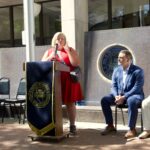
Harrisburg last month kicked off an 18-month effort to draft a new comprehensive plan by holding the first of 20 planned public meetings.
The updating of the city’s comprehensive plan and the development of a housing strategy are two initiatives included in the city’s Harrisburg Strong recovery plan. The comprehensive plan will address many elements that have far-reaching effects on Harrisburg’s future, such as land use, housing, infrastructure and community facilities, said Mayor Linda Thompson.
The city has hired a planning and community development firm, Mullin & Lonergan Associates, to assist with the preparation and adoption of the comprehensive plan, while the economic development element of the plan will be conducted with support from the Harrisburg Regional Chamber of Commerce & CREDC.
Earlier this year, the city began preparations for the planning effort by establishing a steering committee that will guide the comprehensive plan. To date, the committee has met twice with Mullin & Lonergan staff to help develop a scope of work for the comprehensive plan.
The launch of the process to develop a new comprehensive plan was not without controversy.
At the first public meeting, former mayoral candidate Nevin Mindlin asserted that City Council, not the administration, was required by statute to initiate changes to the comprehensive plan.
City Council President Wanda Williams later said that she agreed with Mindlin’s view and would take steps to secure the council’s involvement. Ultimately, City Council will have to approve changes to the comprehensive plan.
In addition, as of press time, City Controller Dan Miller had not yet signed off on the contract with Mullin & Lonergan.
The administration expects more than 20 public meetings to be held during the comprehensive plan process.
City Nearly Out of Money Again
Harrisburg will run out of money by year-end unless the city quickly completes key elements of its financial recovery plan.
City Council attorney Neil Grover last month warned council members that they must quickly pass legislation that will lead to the sale of the city’s incinerator and the long-term lease of its parking assets.
The Harrisburg Strong recovery plan is expected to refill the city’s nearly empty coffers so it can meet payroll and pay its vendors.
However, first, the council must finish approving enabling legislation. Afterwards, the parking and incinerator deals must close and the related bonds must be marketed and sold, a lengthy process that could bleed into next year.
Harrisburg has nearly run out of money every year for the past three years. In the end, it has been able to continue to operate, but only because it stopped payment on its general obligation bonds and cobbled together several last-minute fixes.
Development Projects Given Go-Ahead
Numerous projects in Harrisburg are slated to get off the ground after the City Council gave them the green light last month.
The council unanimously approved the following land development plans:
- A major expansion of the Pennsylvania Housing Finance Agency (PHFA) building at 211 N. Front St. onto two adjacent lots. The $11.5 million project includes the construction of an eight-story addition, the renovation of the historic Hickok Mansion at 201 N. Front St. and the demolition of a mid-century addition to the mansion.
- An update to the building plan for the Susquehanna Art Museum in Midtown to include the creation of a sculpture garden at 1415 N. 3rd St. Work already has begun on the $6.2 million project at the site of the former Keystone/Fulton bank building at N. 3rd and Calder streets. With the approval, SAM will raze the existing dilapidated building at 1415 N. 3rd and use the parcel for a construction staging area before turning it into a sculpture garden upon completion of the new museum, which itself includes the old bank building and a 25,280-square-foot addition.
- A new building expected to house an Italian-style restaurant and wine bar at the corner of State and N. 2nd streets, developed by WCI Partners. Under the current plan, the restaurant would feature a single story with a mezzanine for about 60 diners, focused on gourmet pizza.
- The conversion of vacant office space into 14 one-bedroom apartments at 128-130 Locust St., developed by WCI Partners. The adjacent buildings, about two centuries old, were originally designed as houses before being turned into office space many years ago.
New Businesses on Cameron Street
Cameron Street continues its slow evolution into a nightlife district with the recent approval of liquor licenses for two new businesses.
Last month, the Harrisburg City Council approved the transfer of a liquor license for the Blue Front Lounge, which plans to move from Steelton to 819 S. Cameron St. in December or January.
Owner Richard Hefelfinger said he will transform the first floor of the 8,000-square-foot, circa-1940 brick building into a blues club with a full restaurant. The second floor will feature a pub-type atmosphere with an area devoted to darts and dart tournaments, he said.
Hefelfinger said he decided to move because the building is vastly larger than the snug spot on Front Street where Blue Front Lounge has been located for three years. The new location also has ample parking and is not in a residential area.
Over the years, the property has had a variety of uses. It once belonged to Bishop McDevitt High School and long housed American Quick Print. It sold in March for $240,000 to local developer and businessman Phil Dobson, who said he is a partner in the business.
Just down the road, Dobson also bought the site of the former Harrisburg River Rescue and plans to transform it into an entertainment and events space called the Main Stage Events Center.
Dobson said he expects to attract major acts to a new performing arts theater in the 23,000-square-foot building at 1119 S. Cameron St., which sold in May for $385,000. The space will be able to hold 1,200 to 1,500 people and should open by mid-2014, he said.
Dobson, an owner of Savannah’s on Hanna, said he is optimistic about the Cameron Street corridor because it’s just off Route 83 and has ample parking, both necessary for attracting people from greater Harrisburg and beyond.
“If I want to be a regional destination, I have to be in a location that is easily accessible,” he said. “Here, you are literally a block from the highway.”
He added that he hoped his new ventures would encourage people to come to Harrisburg not just to listen to music or compete in a dart tournament, but to eat, visit and stay.
City Council approved the transfer of a liquor license into Harrisburg for the proposed entertainment venue in September.
City Applies for Funds
Roads, bikes and firefighters would benefit from several funding applications authorized last month by the Harrisburg City Council.
The council directed the administration to apply for:
- A $1.6 million federal grant that would fund the hiring of 10 new full-time firefighters over the next two years. The Staffing for Adequate Fire and Emergency Response (SAFER) program is designed to help localities fortify the ranks of their trained firefighters.
- A $350,000 low-interest loan from the Dauphin County Infrastructure Bank for various paving projects in Bellevue Park, on S. 17th Street in south Harrisburg and on Hale Avenue near the city line.
- A $3,200 matching grant to participate in the Regional Bicycle Connections program with several other municipalities in Dauphin and Lebanon counties. The goal of the grant and program is to create safe, connected bicycle routes to promote cycling.
Bill Seeks Full Funding
Harrisburg’s state lawmakers introduced a bill last month that would guarantee the city “full funding” for the emergency services it provides to the state Capitol complex.
Sen. Rob Teplitz and Rep. Patty Kim said they would seek to commit the state to an annual appropriation of at least $5 million, which they said is the cost to Harrisburg of protecting the complex’s 40 buildings and thousands of workers from fire and other emergencies. In subsequent years, the amount would be indexed to the inflation rate.
This state funding also is built into the Harrisburg Strong financial recovery plan for the city.
Court Rejects Miller Objections
A Commonwealth Court judge last month rejected numerous objections to the Harrisburg Strong financial recovery plan filed by City Controller Dan Miller.
In her opinion, Judge Bonnie Brigance Leadbetter said that Miller filed his objections too late and that, in any case, he lacked standing to make the objections. She also said that it’s vital that the plan’s implementation not be delayed.
Harrisburg receiver William Lynch requested that Miller’s objections be stricken. Mayor Linda Thompson, Dauphin County and several creditors backed Lynch in his response.
In his filing with the Commonwealth Court, Miller objected to the recovery plan because, he said, it relies on numerous assumptions, is incomplete and unduly burdens city taxpayers.
Miller is the Republican candidate for mayor in this month’s general election.
Fees Hiked for Burglar Alarms, Fire Services
If your burglar alarm goes off by accident, you will face a steep fee hike for the emergency response.
Harrisburg City Council last month increased the charge for a second false alarm from $10 to $50. A third false alarm also will cost $50, up from $25. Fourth and fifth false alarms will cost $100 each with charges of $150 for each subsequent false alarm.
Council also imposed new or higher fees for a variety of services provided by the city’s Fire Bureau. For instance, the city now will charge a new $100 fee for a one-hour bonfire or $175 for a two-hour bonfire.
False fire alarms fees have increased from $50 to $150 for the third and fourth false alarm and from $100 to $250 for the fifth to seventh false alarms. Other fees remain the same.
Councilwoman Eugenia Smith said she would make sure that all fees related to public safety services would be posted at the city’s website, www.harrisburgpa.gov.
Philbin Gets Official Nod
Robert Philbin will have a city job into early next year, as the Harrisburg City Council last month confirmed his appointment as chief operating officer through Feb. 1.
In June, Mayor Linda Thompson appointed Philbin to the post following the sudden resignation of the city’s first COO, Ricardo Mendez-Saldivia. Philbin had been acting COO since June.
Philbin, who previously served as Thompson’s spokesman, said he will return to his position as marketing and communications officer with Capital Area Transit following his stint with the city. Thompson’s term as mayor ends in January.
Parking Changes for Reily Street
Harrisburg has changed the parking rules for a section of Midtown to accommodate two new restaurants.
The City Council last month voted to restrict parking to two hours during weekdays on both sides of Reily Street between N. 5th and N. 6th streets and on both sides of N. 6th Street between Boyd and Reily streets.
Council members took the action so that patrons of two restaurants located within The 1500 Condominium could park more easily. Council President Wanda Williams said that state workers often have parked on those blocks all day long, preventing others from using the street spaces.
The new rules should help facilitate parking for diners at both Café 1500, which reopened recently under a new operator, and Crawdaddy’s, which moved last month into the building, relocating from two blocks away.
Changing Hands: September Property Sales in Harrisburg
Bellevue Rd., 2028: N. Emerick to K. Feucht, $48,000
Benton St., 520: J. Phillips to L. Holmes, $69,900
Boas St., 438: T. & E. Buda to R. Kane, $160,000
Conoy St., 110: S. & M. Boyle to M. & S. McLees, $145,000
Croyden Rd., 2986: D. Folk to PA Deals LLC, $42,000
Delaware St., 267: B. & A. Jennings to J. Renue, $128,000
Derry St., 1266: C. Lanza to D. Shah, $34,000
Derry St., 1950: Mussani & Co. to Next Generation Trust Services, $50,000
Edward Rd., 203: D. Morand to M. Gabler, $78,900
Fillmore St., 616: PA Deals LLC to Bholay Nath Properties LLC, $73,000
Green St., 2033: N. Patrick to A. Holland, $45,000
Green St., 3240: E. Mentzer to J. Mueller, $109,900
Holly St., 1944: M. Hampton to J. & B. Readinger, $43,000
Kensington St., 2320: J. Kramer to M. & J. Cramer, $68,900
Kensington St., 2436: T. & A. Teter to L. Kim, $63,000
Logan St., 2421: K. & G. Corker to K. Macrate, $60,000
Market St., 829, 1001: Patriot News Co. to Equity Trust Co., $500,000
Market St., 2105: M. Mettenet Trust to J. Lohlun & E. Ruggieri, $103,000
N. 2nd St., 3214: P. Harper to A. Parks & I. Silva, $149,900
N. 2nd St., 3224: M. Harrison to K. Petrich, $85,000
N. 3rd St., 2120: Fannie Mae to K. Fillingame, $60,000
N. 4th St., 2711: P. & M. Foltz to B. & M. Hayes, $93,500
N. 4th St., 3009: Bank of New York Trust Co. to P. & C. Ambrose, $52,000
N. 16th St., 1301: E. & P. Cumberbatch to Y. Morel-Pena, $36,000
N. 17th St., 99: T. Pham to J. Glick, $47,700
N. Front St., 1419: River Front Development Group LLC to M. Kurowski, $189,000
N. Front St., 1525, Unit 514: K. Alvanitakis to A. Firoozmand, $98,500
Pennwood Rd., 3205: R. & R. Yost to C. Lebo, $99,000
Rumson Dr., 261: Fannie Mae to C. & A. Davis, $38,101
Rumson Dr., 2991: B. Minter et al to Trusted Source Capital LLC, $31,000
S. 18th St., 1235: M. Phuong to M. Quinn, $73,900
Vernon St., 1537: T&R Property LLC to VanDougbar Ventures LLC, $31,250
Vernon St., 1539: T&R Property LLC to VanDougbar Ventures LLC, $32,500
Woodbine St., 220: T&R Property LLC to VanDougbar Ventures LLC, $33,750
Source: Dauphin County, for property sales of greater than $30,000. Data is assumed to be accurate.