





Photos byDah Loh.Photos courtesy of Dickinson College.
A swarm of bees usually creates an equal and opposite reaction—a swarm of people running in an opposite direction.
In Camp Hill Borough, though, residents are embracing their bees. In 2022, they received the borough’s blessing to increase habitats for their pollinating neighbors.
It’s a vital mission. Pesticide and herbicide use, human development and climate change all contribute to the loss of native pollinators, which, in turn, affects area wildlife and ecosystems.
In Camp Hill, a committee worked with Borough Manager Sara Gibson and the staff of Bee City USA, a national organization, to develop an application to earn “Bee City USA” status.
In Camp Hill, a Bee City USA committee oversees pollinator conservation and offers a minimum of one pollinator or habitat project each year. Members work to modify the community’s integrated pest management plan. They put signage around the community, create a web presence, report annually on their activities and accomplishments, and schedule regular public meetings.
Camp Hill is one of just six Pennsylvania communities to have earned this designation (nationally, Bee City USA has 228 affiliates). Its college program, Bee Campus USA, has seven campus affiliates in Pennsylvania, including at Dickinson College in Carlisle.
Phyllis Stiles, who founded Bee City, initially focused on honeybees after learning of colony collapse disorder but expanded it after realizing she was missing the big picture—that many native bees are more at risk of extinction than honeybees. This program is not about putting in hives; it’s about native plants and landscapes for native bees to nest in.
“If we can fill a niche and support these pollinators, in turn, insect life in general will help support everything further up the food chain, and then we’ve started to rebuild our wildlife and our habitat for wildlife,” said Adele Philippides, one of Camp Hill’s Bee City USA committee members.
Camp Hill’s programs include collaborating with a Girl Scout on her bronze project to create a pollinator garden, organizing a Camp Hill Bee City Garden Tour set for June 1 and planning a plant swap in the fall.
Bee Campus
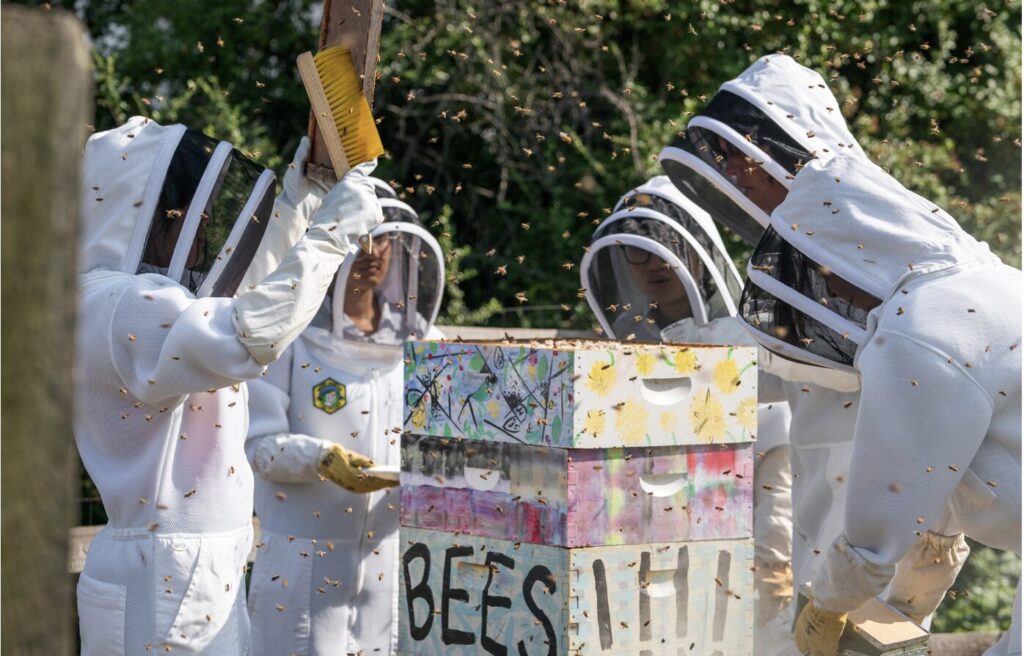
At Dickinson College, a campus community called The Hive helps members learn about sustainability through direct experience, which includes a beekeeping program, honey harvesting, native pollinators and gardens, and value-added products like soaps and lip balms made with herbs from the gardens and the byproducts of bees.
Lindsey Lyons, the director of sustainability learning at Dickinson, notes that The Hive is just one part of the college’s commitment to sustainability, which also includes projects around biking, waste minimization, a free store, data analysis, communications and peer education.
“I think it’s been wonderful,” Lyons said. “I’ve made tons of connections with people in Carlisle through these programs that target native pollinators and beekeeping. With our pollinator gardens, community volunteers are physically coming to us. They’re on campus and in the classroom. It gives them a sense of good work.”
A student intern creates Dickinson’s annual report required by Bee Campus USA, which includes evidence that the campus is enhancing pollinator habitats, educational components and signage. The student who compiled the data for the 2024 report, Ming Robinson, grew up in Manhattan, where gardening opportunities were not as abundant. She has become so enamored of her work in the gardens and The Hive that she has been training to become a master gardener herself.
“The first time I ever mowed the lawn was for the bees,” said Robinson, an environmental science major, who added that she started to learn about gardening from the master gardeners who come to campus. “These people are so nice. They really just care to provide an educational opportunity for students, staff, educators and community.”
Diversity & Abundance
Benefits to a community of gaining Bee City USA status include access to consultants within the national organization who will guide them on “Integrated Pest Management Plan” guidelines and support, including a toolkit for volunteers and city staff. It also offers “the chance to celebrate and brag about the good work they’re doing,” said Laura Rost, the national coordinator for Bee City USA.
While a true measure of the success of pollinator programs is not easily measurable—say like species that can be tagged—Rost said that “if you plant pollinator habitats, they will come.”
“We see anecdotal evidence that people are seeing more species diversity and more abundance when they install pollinator habitats and reduce pesticide,” she said.
Owned by the Xerces Society, Bee City partners with universities and other nonprofits to share data to use for effective conservation work, Rost said. Xerces cites 1.7 million people reached through conservation outreach since 2019 and 1.76 million people engaged in pollinator conservation as a result of the Bee City and Campus programs.
Back in Camp Hill, the borough also recently received a “Bird Town Pennsylvania” designation in a similar effort to create a more sustainable environment for our avian friends. So now, it’s embraced both the birds and the bees.
The Camp Hill Bee City USA Garden Tour will be held on June 1 from 1 to 4 p.m. For more information on the program and events, visit www.camphillborough and search for “Bee City.”
For more information on Dickinson College’s program, “The Hive,” visit www.dickinson.edu/thehive.
To learn about the Bee City USA programs, visit www.beecityusa.org.
If you like what we do, please support our work. Become a Friend of TheBurg!