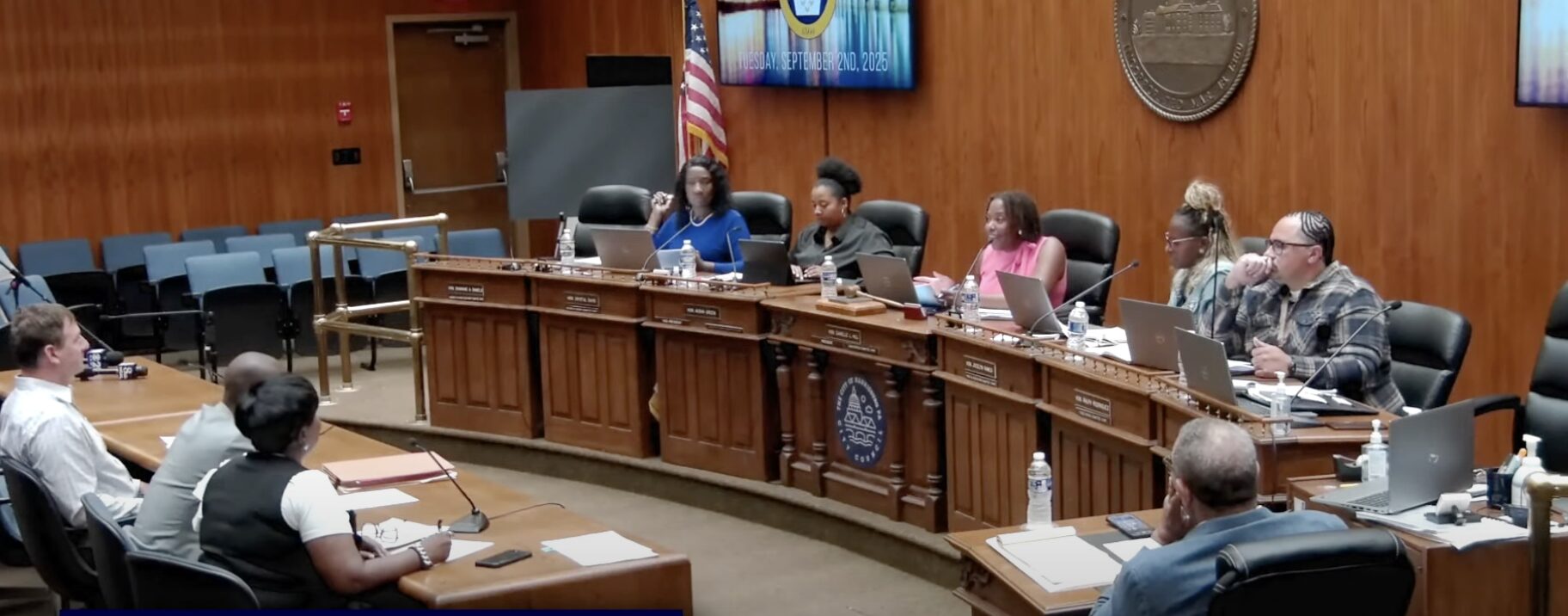
Commissioner Tom Carter and Deputy Chief Kenny Young presented proposed curfew amendments at a City Council meeting. Screenshot from meeting livestream.
Harrisburg police on Tuesday proposed changes to the city’s curfew to deter youth from getting into trouble, but council members weren’t on board.
At a City Council meeting, police bureau officials shared a proposal to make curfew hours longer and fines heftier in an attempt to curb recent incidents, specifically downtown. Council was largely dissatisfied with the plan.
Harrisburg currently has an ordinance that outlines curfew hours for minors in the city, as well as the penalties for breaking curfew. However, at Tuesday’s meeting, police and council officials recognized that curfew hasn’t historically been enforced, due to shortages and officers and resources.
But police Commissioner Tom Carter said that within the past year, the issue of youth causing disturbances and engaging in illegal behavior downtown, around 2nd Street’s restaurant row, has increased. To address that problem, the city has proposed updating and cracking down more on curfew rules.
The proposed amendments would change curfew hours from 10 p.m. to 6 a.m. on Sunday to Thursday, during the school year, to 9 p.m. to 6 a.m. The current hours of 12 to 6 a.m. on Fridays and Saturdays would change to 11 p.m. to 6 a.m. Additionally, the 11 p.m. to 6 a.m. curfew would be in place every day during the summer.
Fine guidelines would also change, changing the current $200 to $500 range, based on the number of offenses, to a $300 to $1,000 range.
The ordinance would, however, introduce a new option for community service as a penalty, which wasn’t in the legislation before.
The changes to times and fines already went into effect downtown when Carter issued a temporary order that took effect Aug. 22. The proposal before council would solidify those updates and extend them to all of Harrisburg.
According to Carter, the measures have already helped lower problems downtown.
“It seemed to have worked since this has gone in,” he said. “We’ve seen less issues with juveniles downtown.”
Council members said that they understood the situation and the need to address it, but were not in favor of more penalties for youth.
Council member Lamont Jones questioned how officers would identify people who are under 18 and expressed concern about increasing negative interactions between officers and youth.
“How is this going to be implemented?” he said. “We want to minimize as much contact with our young people as we can without them being a nuisance or causing any problems in our community.”
Carter clarified that police wouldn’t be driving around looking for young people, but would more likely be interacting with youth if a call came into the police, at which time they may ask their age. Deputy Director Kenny Young added that, in many situations, no citation is even issued because of the time and resources it would take, and officers simply send the kid home.
“We’re trying to get them back home without going through that process,” he said. “If we have no choice then we’re trying to find out other avenues. The citation is absolutely the last thing that, I can guarantee you, that they’re doing.”
Several council members took issue with the increase in fines, stating that it could place a financial burden on parents
“Hopefully it’s meant to be a deterrent, but I’m sure you guys know that our residents—a $100 fine would hurt some of these people,” Jones said. “I would rather see more restorative than punitive.”
Ultimately, Carter said that the ordinance is just a guideline and the amount that someone is fined is up to the magisterial district judges.
“The codified ordinance is just an ordinance; the district justices don’t have to follow this. But we have to put something in place to maintain some sort of law and order with what our young people are doing,” Carter said. “We’re not out there trying to hurt juveniles or juveniles’ parents. We just want compliance and we’re just looking out for the safety of our youth.”
Council member Ralph Rodriguez brought up the fact that the current curfew ordinance isn’t strongly enforced as it is, and questioned why the city needs to update it.
“What would be the difference between enforcing the curfew we already have now instead of raising the penalty? Why couldn’t we just really go hard and enforce it as it is now?” he said.
Deputy Solicitor Tyrsa Cameron explained the amendments as a way to further discourage crime, without giving youth more serious charges. A curfew citation would be a summary offense.
“I think the intention of the amendment was to give the police another tool in their toolbox to handle [the issue],” she said. “I mean, people forget that these teens very easily at their age could get a disorderly conduct criminal charge, so I think the curfew aspect was a way to try to go away from criminalization, give the parents some input and say, because, what is your mom going to say if she gets a fine?” she said.
Rodriguez pushed back.
“Something has to be done, right? I just don’t know if this is quite it, when we already have something on the books that we can’t quite fully enforce to begin with,” he said.
Council member Jocelyn Rawls said that she would rather see thought and resources go to more programming for young people to address root causes of behavioral issues.
“I just don’t think it’s going to work. It hasn’t,” she said. “I think making this amendment isn’t going to make a difference because there’s a bigger issue. We need to redirect our resources in different ways for our youth, we need to give them more opportunities. There are so many more things we could do. And this is just not the answer.”
Carter said that he was open to discussing with council other options to address the issue, if they were not satisfied with the curfew amendments.
Jones moved to keep the bill in committee, meaning it is not scheduled to be voted on at this time.
If you like what we do, please support our work. Become a Friend of TheBurg!