School Board can’t un-do action on superintendent contract, solicitor says.

A recent attempt by the Harrisburg school board to reverse action on the superintendent’s contract does not stand under state law, district officials announced today.

Following a judgement from its solicitor, the board must now continue its search for a new superintendent, board president Judd Pittman said this morning.

Sitting superintendent Sybil Knight-Burney may participate in that search process if she wishes to keep her job. Her contract with the district expires on June 30.

Pittman welcomed the solicitor’s decision, saying it offered clarity for a board that has been tensely divided over Knight-Burney’s tenure.

“We need to have a clean break so we can start our search,” Pittman said in an interview last week.

The board voted in March to open a search for a new superintendent, but then rescinded that vote in a surprise action earlier this month.

Board Solicitor Samuel Cooper determined that the attempt to rescind the March vote conflicted with Pennsylvania School Code, which requires boards to take action on superintendent contracts at least 90 days before they expire. Before that deadline, the board must either notify the sitting superintendent that her contract will be renewed for a period of 3-5 years, or that other candidates will be considered for her job.

If the board fails to act before the deadline passes, the superintendent’s contract is automatically renewed for a one-year period.

Some board directors – including Tyrell Spradley, who motioned to rescind the March vote – believed that nullifying the board’s action from March would result in a one-year contract extension for Knight-Burney.

But Cooper’s reading of school code determined that the some of the options before the board were mutually exclusive. When the board chose to act before the 90-day notification deadline, it eliminated the possibility of a one-year contract extension.

However, the decision to launch a superintendent search does not prevent the board from offering Knight-Burney another three to five-year contract. They may do so if she participates in the search process and emerges as the best candidate, or if they decide to abandon the search all together in favor of retaining her for another term.

An expert on school code questioned the board’s rescission vote in an interview last week, offering an interpretation of school code that was consistent with Cooper’s ruling.

“An attempt to rescind that after the deadline has passed is of questionable validity,” said Stuard Knade, chief legal counsel at the Pennsylvania School Board Association. “You can’t un-ring that bell.”

Continue Reading

Full-day kindergarten on the chopping block, tax hikes loom, as Harrisburg District struggles to balance its books.

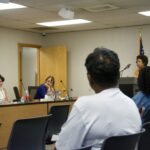
School Board members at tonight’s budget meeting.

Faced with a structural deficit that threatens to eat its savings by 2020, the Harrisburg School District has proposed cutting back its kindergarten program to half-days indefinitely starting next year.

That’s even if the board authorizes maximum tax hikes over the same time period.

Almost 50 people heard budget projections at a public meeting tonight, where tempers ran high among board members, administrators and Harrisburg residents. Many residents demanded to know why the district’s finances had deteriorated so rapidly, given that administrators had been able to add to the fund balance as recently as 2016, when it reached almost $30 million.

Interim CFO Jim Snell explained that the district’s financial recovery plan had merely deferred difficult decision-making since it was implemented in 2013. The program is set to expire in June, the same month that the school board is required to adopt a final budget for the 2018-19 school year.

Snell explained that the district is facing healthcare and pension costs that are “beyond what they ever imagined.” He cited charter school enrollments and a stagnant real estate tax base as revenue limitations.

The district has not levied a tax hike since 2012, but, this year, administrators are proposing an increase of 1.0008 mills, or 3.6 percent of its current 27.8 millage rate – the maximum rate allowed under the Act 1 Index.

With a median home value of $42,800, the tax hike will cost the average city homeowner an additional $43 a year, said district business manager Bilal Hasan.

Budget projections call for an annual 3.6-percent tax hike every year through 2021.

Even with the additional tax revenue, the district will not be able to pay its employee salaries and benefits without cutting some of its programs.

Since it gutted its staff and academic offerings under its financial recovery plan, the district has very few non-mandatory offerings left to eliminate, Snell said. But Pennsylvania does not require schools to offer full-day kindergarten, making it one of the few areas where the district can cut back.

Reducing kindergarten to half-days would net the district $1.2 million in annual savings and eliminate 14 teaching positions, Hasan said.

Hasan said that no other combination of cost-cutting measures would generate the same amount of savings. Eliminating the entire athletic program would only save $700,000, and Snell said that cutting all other extra-curricular programs would not make up the difference.

Many residents pleaded with the school board and administration to preserve full-day kindergarten.

“The only way we can increase our tax base is by offering the services you want to cut,” said Kia Hansard, a district resident and parent. “How will we get people to move into the city, buy homes and stay if we cut kindergarten?”

Jodi Barksdale, president of the Harrisburg Education Association, said that reducing early learning opportunities put students at a disadvantage for the rest of their educational careers.

“Kindergarten through fourth grade is the foundation of education,” Barksdale said. “If we do not invest all of our efforts into the foundation of our children, we are going to crumble and fall.”

Board members said they would do what they could to keep the kindergarten program intact, but the funding gap before them is significant. Board President Judd Pittman said that district would approach private sources of wealth, such as the Foundation for Enhancing Communities, to appeal for assistance.

Even when combined with maximum tax hikes for the next five years, the proposed cuts are not enough to prevent the district from depleting its fund balance by 2020.

The fund balance stood at $21 million going into the 2017-18 school year. But the district’s expenditures have consistently outpaced its revenues, requiring a yearly drawdown of the general fund to bridge the gap.

Budget discussions will continue at the board’s monthly budget and finance meetings at 5:30 pm on Monday, May 7 and Monday, May 14. The board meets in full on May 21, one month before a final budget is due.


Continue Reading

To Zero: “Vision Zero” aims for no auto-related deaths in Harrisburg.

A past accident at Front and Forster streets in Harrisburg.

Car crashes are falling across Pennsylvania, but they’re on a dramatic rise in Harrisburg.

Vehicle-related fatalities have quadrupled in the city in the last four years, according to PennDOT data, rising from two deaths in 2013 to eight deaths in 2017.

City officials say enough is enough. Harrisburg is adopting a new vehicle safety policy, “Vision Zero,” which aims to eliminate vehicle-related deaths within the next decade, city Engineer Wayne Martin said today.

The city is also undertaking a rapid-response study to improve transportation safety on State Street, the site of five pedestrian deaths in the past 17 months.

Martin couldn’t say what’s caused the rash of pedestrian deaths in Harrisburg, but he hopes the Vision Zero plan will help the city find an answer. He cited reporting from PennLive and TheBurg as an impetus for the city’s new scrutiny on its vehicle safety policies.

“We really have to figure out what’s going on,” Martin said. “The stats are really bad for Harrisburg.”

The Vision Zero policy, which has been adopted by such cities as Bethlehem and Philadelphia, represents a data-driven approach to curtailing vehicle accidents and improving pedestrian and cyclist safety. Harrisburg’s plan will consist of a public outreach and data-gathering period to determine hot spots for crashes and potential danger zones.

Martin said that the city has isolated patches of data from traffic studies. This more ambitious data-gathering project will help the city compile a comprehensive profile of its roadways and traffic patterns, he said.

Project leaders will combine data from official sources, such as hospitals and PennDOT, with input from residents. Martin said that the city needs citizens to report areas with reckless driving to help identify potential danger zones.

“Near-misses and reckless driving are things that don’t show up in police reports,” Martin said. “Lots of municipalities have outreach efforts where residents can record risky behavior.”

The data collected over the next four months will lead to official recommendations and, eventually, to changes in city infrastructure and policy, Martin said. He expects public outreach to take place at every step of the way.

“Nothing will be implemented without community input,” said city Communications Director Joyce Davis.” “There will be outreach and meetings, lots of opportunities for people to dialogue and discuss this.”

Those changes could include adjustments to the size of traffic lanes or the addition of bike lanes or transit lanes on busy thoroughfares.

Martin couldn’t comment on potential changes to police enforcement under the Vision Zero plan. He noted that the Police Bureau is perennially short-staffed and that the city could qualify for grants to fund additional police presence on dangerous roadways.

City officials are finalizing a $335,000 contract with McNees Wallace & Nurick to implement the Vision Zero plan and undertake the State Street study. The budget includes a $94,000 public outreach component that will be conducted by Eluminat, a Washington, D.C.-based firm.

The funds for the project will come from the city’s general fund, Martin said.

Continue Reading

2018 Midstate Table

2018 Midstate Table

Continue Reading

In the Year 2050, 2050: Predictions, progress and unintended consequences.

Illustration by Rich Hauck.

From her perch at Zeroday Brewing Co., a friend recently texted me with a question about Harrisburg’s parking system.

A fellow barstool-sitter wanted to know how long Harrisburg’s lease ran with Standard Parking. So, naturally, she texted me.

“Is it 75 years?” she wrote.

“No,” I responded back. “Forty years. Thirty-six more to go.”

Afterwards, I began to think about the passage of time, how I may or may not be walking the Earth by the time the agreement expires (conclusion: probably not). Then I pondered Harrisburg itself, how it might be different by then.

Predicting the future may be a fool’s game, but this fool is game, if only because I’m fascinated by the changes in this city, current and planned. In addition, I believe that Harrisburg has entered a new phase in its story, the fourth in my estimation (the prior ones being pre-industrial, industrial and post-industrial).

I’m not certain exactly what we’ll call this new era, but I expect it will be driven by Harrisburg’s strong advantages (old, dense housing stock, walkability, beautiful setting, superb location), along with and facilitated by, a heavy dose of technology.


Parking will fade as an issue (in a way).

There’s a huge problem with a 40-year deal, and that problem is, whether or not you even realize it, you’re making a bet on the future. You’re gambling that the conditions on the ground at the time of the agreement will remain substantially unchanged throughout it. But will they?

My guess is that, with the parking deal, they will change. In fact, just four years in, we’re already seeing possible problems that were not evident in 2014.

The agreement rested on the reasonable assumption that demand for parking would remain the same or even increase over time. But that’s probably wrong.

No, I haven’t turned into a Harrisburg hater, one of the legions of trolls who seem to delight in (and exaggerate) every problem the city has. In fact, over the long turn, I’m bullish on both business in and visitors to the downtown.

However, I’m not bullish on the use of private automobiles.

I live downtown, so walk almost everywhere anyway. But, when I meet up with a friend who lives Uptown or outside the city—even as near as Midtown—they take Uber downtown, whereas, until recently, they all were driving and paying for parking. If, five or 10 years down the road, driverless cars become common, this trend will only accelerate.

So, my prediction—more people downtown, but fewer cars. This will be great for downtown businesses, but potentially disastrous for the parking deal.


Harrisburg’s population will increase substantially

Do I hear 5,000, 10,000, 20,000 more people?

In recent years, Harrisburg’s population has stabilized, which may be the first step in reversing decades of decline. This isn’t wishful thinking, but the result of simply seeing what’s happening around me.

Ten years ago, the city’s streets seemed empty, the sidewalks even more so, and downtown and Midtown were thick with once-grand buildings that had fallen to ruin. Change has come in a short timeframe. Many blighted buildings have been put back into productive use, and street life is returning.

The future seems even more promising. Over the just the past few months, Harrisburg University announced a mixed-used high rise, the new federal courthouse received funding and the first new house was sold at MulDer Square, to name just a few projects. There are now ambitious proposals for Paxton Creek, the train station area, Market Square and 2nd Street, which could revitalize entire swaths of the city.

Despite this progress, much of Harrisburg remains in poor shape, with empty lots, underused buildings and not enough people.

The upside here is that there’s great opportunity for infill and expansion. Harrisburg easily can accommodate tens of thousands more people, as long as the demand exists for that housing.

To accomplish this, though, the city will need to reach some type of psychic comfort with development and growth. Outsiders and investment should be welcomed, not treated with disdain.


The city/suburb, east shore/west shore split will ease.

Years ago, when I lived in Washington, D.C., the Potomac River divided that city and its suburbs much like the Susquehanna River does here today. Suburbanites claimed they were afraid to come into D.C. less they be mugged or worse, and early Internet bulletin boards were full of the same racist nonsense and fearmongering that you often see today in the PennLive comment section.

In Washington, much of that has faded. Today, there is far more fluid movement between city and suburb, with the entire area more comfortable in identifying itself as a unified region. Finally, the “National Capital Area” has, indeed, become exactly that.

But what about Pennsylvania’s capital region? As Harrisburg continues to redevelop, I believe that greater unity will be found here, too. The city once again will be regarded as the center of an integrated urban area, not as the hole in the doughnut.


Harrisburg has a destiny to fulfill. Someday, it will take its place as a gem of a small city perfectly situated on a grand river. It will just take some time, patience, capital and the good will, mutual support and understanding of well-intentioned people.

Lawrance Binda is editor-in-chief of TheBurg.

Continue Reading

No Small Plans: Club XL supersizes Harrisburg nightlife.

The people mingled and gathered, the lights flashed on, the band took the stage.

It was go time at Club XL.

Harrisburg’s newest entertainment venue opened last month to a crowded house, which is saying something given the sheer size of the place.

Let’s just say that, at Club XL, nothing is small.

Big space, big patio, big stage, big bars, huge screens.

That’s the grand vision of owner Phil Dobson, who opened the 18,500-square-foot club and music venue in an old, 1940s-era warehouse near S. Cameron and Hanna streets in Harrisburg.

“Everything is big, hence the XL,” Dobson said.

The club is the latest piece of Dobson’s redevelopment puzzle for this once-industrial and later forsaken area. Across one street, he opened Savannah’s on Hanna in 2009 and, across another street, River City Blues Club and Dart Room in 2014.

Dobson has owned the Club XL building for about eight years, buying it without a solid plan, but with the thought that he wanted to control the small, several-block area just off I-83, gradually transforming it into a nightlife destination.

Now those plans are firm, and they are of the extra-large variety.

Walking in, a reception area leads to an enormous dance floor with one of the largest stages in Harrisburg, the ceiling outfitted with an industrial lighting system.

“I went all out with the lighting and the sound to give a true nightclub experience,” he said, adding that he’s gone as far as to install Co2 cannons. “When you’re here, it’s all sensory appeal. This brings it to a higher level.”

A 24-tap bar winds around the entire back and leads to a long room on the side, which features a concession area for food orders, with tables. Six giant screens grace the walls, capped off by a 200-inch behemoth. Upstairs, there’s a VIP area, with bottle service available, and, outside, a large bar and patio built around a 200-year-old sycamore tree.

Dobson said that he was inspired by Las Vegas clubs and wanted to bring that type of big-city nightlife to Harrisburg. To that end, he features big dance parties on Friday nights, but it won’t all be DJs.

Dobson also is booking live music for touring bands that need a mid-sized venue that can hold about 1,200 people. The alt-rock lineup of Puddle of Mudd, Saving Abel and Tantric came to town for the debut concert last month. Local bands also will be featured, and Smooth Like Clyde and Honeypump played for Club XL’s soft opening the night before.

This month, the venue will feature performances by Tyler Bryant & the Shakedown, among other bands. It also will host several tribute bands, including In Gratitude (Earth, Wind & Fire), Back in Black (AC/DC) and Bark at the Moon (Ozzy Osbourne).

Club XL also will host sports, comedy and other events that can use a large open space, a stage, lights, giant screens and other amenities, Dobson said.

“When people come here, I want them to be wowed,” he said. “I want to give them so many options that it’ll be an experience.”

Club XL is located at 801 S. 10th St., Harrisburg. For more information, call 717-409-8975, email [email protected] or visit www.xlhbg.com.

Continue Reading

The New Urban Guardians: How ordinary people played a role in the great crime decline.

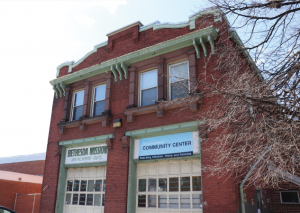
The Bethesda Mission Youth center has provided after school tutoring and other enrichment activities for children and teens since 1990. They’ll soon expand to another building to double their 75-student enrollment capacity.

On Dec. 28, 1990, in the final days of one of the most violent years in the 20th century, the Harrisburg Patriot-News ran an editorial mourning the American city. “Urban life in America is in the throes of a social meltdown,” it read. “The symptoms of decay are everywhere. Violence has become an epidemic, and many major cities will set record rates of homicides this year.”

The image of an urban dystopia proliferated in the 1980s and 1990s, as American cities—abandoned by manufacturers, forgotten by policymakers and besieged by poverty—battled unprecedented levels of violent crime.

At the turn of the 21st century, though, almost as quickly as crime rose, it began to fall. Violent crime has plummeted in almost every American city since 1990, with some cities, including Harrisburg, cutting their violent crime rates almost in half. Harrisburg recorded a violent crime rate of 2,191 incidences per 100,000 people in 1990; in 2014, it had fallen to 1,113. With the exception of homicides, almost every category of violent crime—robbery, burglary, assault, property crimes and motor vehicle thefts—has fallen by a similar magnitude.

But why? Mayors, police chiefs and other students of crime data can say with certainty that cities have gotten safer since the great crime wave of the 1980s and 1990s. How it happened is a subject of more intense debate. Increased policing, prosecution and incarceration have contributed at least partially to the decline in crime. Researchers have pointed to other, non-intuitive societal shifts that could have curbed violent behavior, including increased access to abortion and decreased exposure to lead, and changes in the economy.

Patrick Sharkey, a sociologist and crime researcher at New York University, acknowledges these influences but also offers a more encouraging, hopeful thesis for why urban spaces have gotten safer. As the criminal justice system expanded and became more punitive, Sharkey says, another force began to coalesce in America’s parks, streets and neighborhood centers. The people responsible weren’t police officers or prosecutors, but ordinary residents.

In his latest book, “Uneasy Peace,” Sharkey calls these people the “new urban guardians.” He says that local nonprofit groups successfully fought crime by building playgrounds, opening youth centers, organizing neighborhood watch groups and picking up trash. As they slowly reclaimed their neighborhoods, working long hours with little to no pay or recognition, these citizens made a crucial, but often overlooked, contribution to safety in American cities.

“The changes that took place weren’t just about the expansion of the prison system and the increasing aggressiveness of police,” Sharkey said during a recent conversation at Midtown Scholar Bookstore, where reporters interviewed him about his research. “It was also a mobilization among the residents and organizations in the communities hit hardest by violence. That has been completely left out of discussions about why violence fell, but I think it’s a crucial part that deserves much greater credit.”

Sharkey explained that, since the 1990s, the nonprofit sector exploded as residents in neighborhoods mobilized against violence. New groups focusing on youth mentorship and neighborhood enrichment proliferated. This trend was partly a direct response to rising crime rates, but was also enabled by a separate expansion in private, philanthropic wealth, possibly due to strong gains in the national economy in the 1980s.

With the help of a research assistant, Sharkey tried to quantify the effects of neighborhood nonprofits on crime reduction. Drawing on data from the National Center for Charitable Statistics, the pair determined that, in a given city with 100,000 people, every new organization formed to confront violence or build stronger neighborhoods led to about a 1-percent drop in violent crime.

“These organizations were designed to take back city streets, not through law enforcement but by building stronger communities, and they were extremely effective,” Sharkey said.

Someone to Trust
As Emily Badger writes in the New York Times, Sharkey’s findings validate what community leaders across the country know to be true about the relationship between neighborhood development and violent crime. While many of the active nonprofit organizations in Harrisburg aren’t explicitly involved in violence prevention, their leaders recognize that, by providing essential services to their community—including mentorship, education and beautification—they’ve become participants in the fight against crime.

“Nurturing relationships and building community is an absolute prerequisite to keep violence from occurring,” said Scott Dunwoody, executive director of Bethesda Mission. “We’re reaching out into the community one man, woman and child at a time.”

Founded in 1914 as a men’s ministry and homeless shelter, Bethesda Mission began to expand its programs in Harrisburg at the same time as crime rates climbed. In 1983, it opened a women and children’s shelter on S. 18th Street; in 1990, it started a youth center in an old fire station on Herr Street. Whereas its shelters offer residential programs, Bethesda Mission’s youth center bleeds into the community surrounding it. Today, more than 75 kids from the 1st through 12th grades attend programs there after school, on weekends and throughout the summer. Volunteers help students with homework, teach cooking classes and supervise sessions in the gym or computer lab. These services are so in demand that Bethesda Mission has made plans to expand its youth center into an adjacent building next year, which will allow it to double its programming capacity.

Both Dunwoody and Serina Brown, director of the Youth Center, say they’re in the business of building relationships and strengthening families, not policing the behavior of kids and their parents. But Brown said she wasn’t surprised to hear about the causal relationship between community nonprofits and violent crime rates. While tutoring sessions and leadership classes may not look like violence prevention techniques, they do offer kids attractive alternatives to criminal activity.

“When you’re with someone through the good and the bad in life, it would make sense that it would prevent crimes because you have someone to trust,” Brown said. “Imagine if every family in the city had that.”

When asked how the center measures its efficacy, Dunwoody cites a fact about graduation rates. Over the course of five years, 86 percent of the students who participated in Bethesda Mission’s youth programs graduated from high school—much higher than the city’s district-wide rate of 55 percent. He also points to the North Allison Hill neighborhood where the center is located. Quiet, leafy and well maintained, North Allison Hill has less visible blight and fewer incidences of violent crime than the South Allison Hill neighborhood close by.

“We don’t want to brag and say we’re the reason why this neighborhood is stable, but we are a big part of it,” Dunwoody said. “Centers like this can have an immense role in giving life to a community. It’s the heartbeat.”

Common Sense

Some neighborhoods have anchoring institutions and physical spaces like the Bethesda Mission Youth Center where residents can meet and build relationships. Others have anchoring organizations for citizens to address their shared challenges. These groups, many of which rely on volunteers, are responsible for countless cosmetic and institutional enhancements across Harrisburg.

In 2008, residents in Camp Curtin formed Camp Curtin Neighbors United to address problems of blight and trash, crime and economic development in their Uptown neighborhood. The all-volunteer organization held beautification days, mapped blighted buildings and drafted a strategic plan to outline short-term and long-term neighborhood objectives. They opened a tool co-op on the grounds of Wesley Union AME Zion Church and later started a grant-funded pre-school in the church’s basement. It currently employs two teachers who care for 15 children five days a week.

Jean Cutler, a founding member and former president of CCNU, said that the neighborhood organization has become an organized, effective forum for citizens to voice their needs and find recourse. By investing in education and beautifying the neighborhood through tree plantings and trash cleanups, Cutler and the other members of CCNU hope that Camp Curtin will shed its reputation as one of Harrisburg’s most distressed, crime-ridden neighborhoods.

“Making the environment around you better is a huge part of trying to stop the crime,” Cutler said. “People will be more respectful of the neighborhood, and we will have lower tolerance for outliers. I’m not a criminologist, but most of this is common sense.”

According to Sharkey, that’s sound logic. He explained that having more eyes and ears in public spaces reduces the opportunities for criminal activity and signals to would-be criminals that a neighborhood isn’t theirs for the taking. Essentially, residents must respond to crime the same way they might regard at an unsightly building project or waste site: by saying, “Not in my back yard.”

“Violence doesn’t come out of nowhere; it comes when a place is abandoned,” Sharkey said. “It comes when a place empties out, when there are not strong institutions, when the community isn’t organized, and it’s left on its own.”

Just ask Jeannine and Jeremy Domenico, who literally have eyes on the street from their residence in South Allison Hill. The Domenicos moved into their rowhome on South Summit Street, a narrow one-way that connects the busy thoroughfares of Derry and Mulberry streets, just before Christmas 2013. When they first bought their home, Jeremy (who goes by Jay) wouldn’t let the couple sit in the living room that looks out onto the street. They watched TV and took visitors in another room on the first floor, which was set back from the main entranceway, closer to the backyard. That way, Jay said, any stray bullets would travel farther to hit them.

“There were gunshots every night,” he said. “Our main concern was drive-bys, and we figured, if we were in the back room, there would be four walls for bullets to go through.”

The Domenicos may not have landed in a neighborhood of choice in 2013, but the neighborhood was theirs—and they wanted people to know they were there to stay. By their account, they spent the better part of the next year trying to build a community. They hosted their first block party, which is now an annual event. They led trash cleanups and gained local fame for the elaborate decorations they put on their doors for every holiday – as well as for the four security cameras that keep watch over the front of the street and the alley behind their home.

Over time, they say, the space around them transformed. They no longer had to lead trash pickups—neighbors were doing it themselves. Gunshots sounded less frequently, and drug dealing no longer took place on their street. Cars still speed down the street the wrong way, but the activity that drove them inside their homes has dramatically fallen.

“It’s easy to go inside and shut your door when you see bad behavior,” Jay said. “It seems like, if you live in a bad area, you get terrorized into staying in your house. But, when we’re outside working, we messed up people’s game plans.”

Repaying a Debt

The idea that social cohesion can inoculate neighborhoods against crime isn’t lost on law enforcement officials.

Capt. Gabriel Olivera, chief information officer for the Harrisburg Police Bureau, said that line of thinking is “absolutely” consistent with trends he’s seen in the city over the past two decades. He pointed to Harrisburg’s Midtown neighborhood as one example. In the 1990s and early 2000s, he said, the intersection of Green and Muench streets was known among police officers as “Green and Murder.” Over time, as residents bought homes, beautified streets and formed a neighborhood watch association, the police bureau received fewer calls to the area.

The progress that’s been made against urban crime has relied, in part, on vast amounts of unpaid labor by volunteer residents. If crime across the country is going to continue its downward trajectory, Sharkey said, the people who fight it at every level ought to be compensated.

“The people who volunteer time to make communities safe are doing work on behalf of their city,” Sharkey said. “When they’re given respect and that role is valued, it makes a huge difference.”

Mayor Eric Papenfuse said that he finds that argument compelling, and paying the work of community organizers is something that the city can consider in the future.

“It’s an intriguing concept, and one that warrants thoughtful consideration,” he said. “There are some serious questions surrounding implementation, but I’m willing to explore them and possibly put forth some funding in next year’s budget.”

But not all of Harrisburg’s urban guardians agree that they should be paid for their work.

Claude Phipps, a community organizer who lives in Bellevue Park, has seen local institutions wax and wane in Harrisburg his whole life. Growing up at 6th and Peffer streets, he watched the city reel from the devastation of Hurricane Agnes in 1972 and from financial hardship that followed. He reckons that the city hit “rock bottom” in the early 2000s and made a turn for the better in 2010.

Today, Phipps said he’s happy to volunteer his time as a neighborhood watch coordinator and conflict mediator. He sees it as “repaying a debt” to the long-ago neighbors who guarded over him as a child.

Cutler, the Camp Curtin advocate, said that citizens ought to have “sweat equity” in their neighborhoods.

“When you fund salaries, there’s no money left for projects,” she said. “There needs to be some volunteerism, because, bottom line, you’ll need money to do these projects.”

I posed the question of pay to a coalition of faith-based community leaders, who were meeting in the chilly basement of Derry Street United Methodist Church to plan a summer camp for children. They stressed that the diminishing funds in a crowded nonprofit sector made it hard to ensure programming year to year.

Bill Jamison, a leader of the Allison Hill Ministry, which provides after-school mentoring, outdoor education and field trips for students, said that he earns $17,000 a year while working 60 hours a week. Some years, his program receives more funding; other years, it gets less. He wouldn’t object to more funding for his volunteers, but he also knows his work is too essential to cease over money disputes.

“If we take these services away, that’s where crime comes from,” Jamison said.

But Nashon Walker, CEO of Hoodrise Global, a mentorship program that works in Harrisburg city schools, thinks that community leaders and mentors should demand more pay for their work.

“Inner-city outreach has been underfunded and undervalued,” Walker said. “I don’t have a poverty mentality.”

Walker also pointed to an irony that has led politicians and researchers across the political spectrum to call for criminal justice reform. America’s incarceration spree, effective though it may have been in curbing criminal activity, has borne immense social and economic costs.

“This country pays billions to incarcerate,” Walker said. “Why can’t we pay now to set people free?”

When presenting his research, Sharkey is careful to note that America’s progress against crime is tenuous. Many cities across the country are seeing upticks in violent crime after years of decline. This crossroads, he said, should force American lawmakers to trade in the country’s punitive criminal justice policies for programs that focus on reinvestment and economic development in cities. The good news is that these programs could look a lot like what is already in place in cities like Harrisburg, where neighborhoods self-police by tending to their public spaces, their children and their shared social bonds.

“This is how violence is confronted in a sustainable way without the collateral costs of locking up half the community’s population,” Sharkey said. “It’s an alternative model, and it should be the model.”


Continue Reading

Community Corner: Notable May Events

May Community Corner

Health Forum
May 1: UPMC Pinnacle, Hamilton Health Center and Pennsylvania Psychiatric Institute will conduct a community health needs assessment to identify health issues and concerns of area residents. The community is invited to a forum at Hamilton Health Center, 110 S. 17th St., Harrisburg, 12 to 2:30 p.m. Visit UPMCPinnacle.com for details.

100-Year Celebration
May 3: Brightwood Career Institute, 5650 Derry St., Harrisburg, will host a 100th Anniversary Celebration, 3 to 7 p.m. Guests can enjoy a tailgate-style meal with music, kids’ activities, giveaways and more. The celebration is free and open to the public, but guests are encouraged to call 717-564-4112 to RSVP. Visit brightwoodcareer.edu.

Cinco de Mayo Mixer
May 3: West Shore Chamber of Commerce will hold its 10th annual Cinco de Mayo Regional Mixer at the Volvo CE, 304 Volvo Way, Shippensburg, 4:30 to 7 p.m. Enjoy food, drinks, networking and free admission. Visit wschamber.org.

Book Sale
May 3-5: Friends of Newport Public Library will host a used book sale downstairs at the library, 316 N. 4th St., 10 a.m. to 6 p.m. Friends member preview night is May 2, 6 to 8 p.m. Thousands of used books, CDs, DVDs and more will be for sale, most for $1 or less. Proceeds support the library. Visit pecoinfo.org.

Trail Hall of Famers
May 4: William Kemsley, Jr., the late Elizabeth Levers, the late George Masa and Robert Peoples will be honored at the Appalachian Trail Hall of Fame Banquet at the Allenberry Resort in Boiling Springs. Reception begins at 6 p.m.; dinner will be served at 7 p.m. Visit atmuseum.org.

Spring Festival
May 4-6: The Rites of Spring Festival in Gettysburg will feature 11 bands over three days during the first weekend in May. The festival features progressive acts from around the world. Visit rosfest.com for more.

Run for Pets
May 5: Run for a good cause at the 21st annual 5K Run/Walk for the Animals, with proceeds benefitting homeless pets, at the Humane Society of Harrisburg. Registration begins at 8 a.m., and the event is at 10 a.m. at Wildwood Park, Harrisburg. For more information visit humanesocietyhbg.org.

Spring HBG Flea
May 5: Shop the HBG Flea for local art, vintage treasures and curated curios at Midtown Cinema, 250 Reily St., Harrisburg, 9 a.m. to 3 p.m. Visit hbgflea.com for details. 

Flowers for Mom
May 5: Kids can create a flowering container for mom with Cumberland County Master Gardeners at the Cumberland County Penn State Extension office, 310 Allen Rd., Carlisle, 10 a.m. to 12 p.m. Cost is $10, including a container and plants. Visit extension.psu.edu/cumberland-county.

Derby Day
May 5: Break out the seersuckers and floppy hats for Jump Street’s 17th annual Derby Day, 2:30 to 6:30 p.m. The annual fundraiser will be held this year at a private residence just outside of Harrisburg. For more, visit jumpstreet.org or the Facebook page.

Frog Walk
May 5: Take a walk in the twilight on the boardwalks at Wildwood Park, 100 Wildwood Way, Harrisburg, 7 to 8:30 p.m. Bring a flashlight and dress for the weather. Fee is $5 per person; pre-registration is required. Visit wildwoodlake.org. 

Symphony Gala
May 6: The Central PA Symphony will host its annual fundraising gala at Lebanon Country Club, 3375 Oak St., Lebanon, 6 to 9 p.m. Enjoy a light buffet and dessert bar, followed by live music by Colebrook Road. Visit centralpasymphony.org for details.

Bike Harrisburg
May 6-27: For National Bike Month, Bike Harrisburg will host a series of events, including a Capitol Rally (May 14), Friday Night Social Ride (May 18) and the Seersucker & Lace Ride (May 20). For a complete schedule, visit bikeharrisburg.org.

Health Screenings
May 7: PinnacleHealth will hold free blood pressure screenings at the Harrisburg Mall, 3501 Paxton St., 8:30 to 10:30 a.m. Visit shopharrisburgmall.com for details.

PA Railway Photos
May 8: National Railway Historical Society Harrisburg Chapter will host “Time Line With Tunes: The Illinois Terminal Railroad” and a tribute to the photography of the late Jim Boyd. Business meeting begins at 7 p.m. at Hoss’s Restaurant, 743 Wertzville Rd., Enola, with a meal as early as 5 p.m. Call 717-439-9744 or email [email protected].

Bike to School
May 9: Derry Township’s police department and school district will host National Bike to School Day. Hershey Bears mascot Coco will cheer on children at the Memorial Field parking lot, 8:15 to 8:45 a.m. Recycle Bicycle and InGear Cycling & Fitness will offer bike safety checks. Visit hershey.k12.pa.us for more details.

Happy Hour
May 10: YWCA Harrisburg Junior Board hosts its annual “Spring into Summer” happy hour at Capital Gastropub, 310 N. 2nd St., 5:30 to 8:30 p.m. Tickets are $20 and include a drink voucher and appetizers. Enjoy live music and a silent auction at the event that benefits the YWCA’s Camp Reily, an outdoor summer day camp for kids. Visit ywcahbg.org.

Pilates Day
May 12: Absolute Pilates invites the public to a free community mat class at its Mechanicsburg and Harrisburg locations to celebrate Pilates Day, an annual, international community event to foster the public’s appreciation and awareness of the Pilates Method through a network of grassroots events. Visit absolutepilates.co for locations and times.

Plant & Bake Sale
May 12: The 9th annual Great American Plant and Bake sale will be held, 8 a.m. to 4 p.m., at 3407 N. 2nd St, Harrisburg, to benefit Castaway Critters. Visit The Great American Plant and Bake Sale Facebook page for details.

Hunger Run
May 12: Support the Hummelstown Food Pantry at the 4th Annual 5K Hummelstown Hunger Run, beginning at 10 a.m. in Schaffner Park. Bring a non-perishable food item and be entered to win one of many gift certificates. Visit htownhungerrun.wixsite.com.

Volunteer Work Day
May 12: Head to Wildwood Park, 100 Wildwood Way, Harrisburg, to help with continuing park and habitat enhancement projects, 10 a.m. to 1 p.m. Snacks, tools and work gloves will be provided. To reduce plastic usage, bring along a water bottle. Refreshments will be available. Visit wildwoodlake.org.

Kids Club Event
May 12: Take the family to Harrisburg Mall, 3501 Paxton St., to watch Dauphin County Technical School’s Robotics Team perform a demonstration of robots built by a team of students and to learn how to build robots. Kids Club events are free and are held on the second Saturday of each month, 10:30 a.m. to 12:30 p.m. Visit shopharrisburgmall.com.

Spring Gala
May 12: The Circle School, 727 Wilhelm Rd., Harrisburg, invites the public to its annual Spring Gala, 12 to 4:30 p.m. The free event includes student entertainment, refreshments, a silent auction and basket raffle. Visit CircleSchool.org.

Two Koreas
May 17: Foreign Policy Association of Harrisburg hosts James F. Person, professor of Korean studies at Johns Hopkins University, School of Advanced International Studies, who will speak about North and South Korea and the nuclear arms crisis at the Radisson Hotel Harrisburg, Camp Hill, 7 p.m. A dinner precedes the talk. Visit fpa-harrisburg.org.

3rd in The Burg
May 18: Enjoy the best of Harrisburg during 3rd in the Burg, the monthly arts and culture event at galleries, restaurants and art spaces throughout downtown and Midtown. Check out all the action at thirdintheburg.org.

Golf Charity
May 19: The Caring Cupboard will hold its 12th annual charity golf outing at Deer Valley Golf Course, Hummelstown, for the Palmyra-based food pantry, beginning at 8 a.m. Tickets cost $75 and include breakfast, lunch, drinks, snacks and prizes. Tiered sponsorship opportunities are available for local businesses. Get more details at caringcupboard.org.

Plant Fest
May 19: Join Penn State Extension Cumberland County Master Gardeners at its 14th annual Plant Fest at the Cumberland County Service Center, 310 Allen Rd., Carlisle, 8 a.m. to 1 p.m. Shop for native plants from area growers and plants from Master Gardeners’ gardens. For more information, visit extension.psu.edu.

Library ComiCon
May 19: Joseph T. Simpson Public Library will host its fourth annual ComiCon, with video games, Dungeons & Dragons, live action role play and more, at the First Church of God Community Center, 201 E. Green St., Mechanicsburg, 10 a.m. Prizes are given to winners of Geek Trivia, Cosplay contest and SuperSmash Bros. tournament. Visit cumberlandcountylibraries.org.

Home Tour
May 19: Experience the best of Historic Midtown during HYP’s 20th annual home tour, 12 to 5 p.m. The tour will feature historic homes and lovely gardens in the Harrisburg neighborhood. Tickets are $35 after May 1. Head to WebpageFX, 1705 N. Front St., for the after-party, 4 to 7 p.m. Visit hyp.org for more event details.

Yoga & Spirits
May 20: Join Midstate Distillery, 1817 N. Cameron St., Harrisburg, at 10:30 a.m. for yoga with Sangha Yoga PA, followed by cocktails and snacks. Each ticket includes a guided, one-hour Vinyasa yoga class, complimentary cocktail and light brunch. Tickets are $20 before May 10, $25 after. Visit midstatedistillery.com.

Taste of Jazz
May 20: Enjoy a great mix of world music and cuisine at the 4th Annual Taste of Jazz, which takes place 2 to 5 p.m. at Whitaker Center, 222 Market St., Harrisburg. The multicultural event will feature the jazz ensemble Pieces of a Dream, along with a musical revue by the choral group, CAMA on Broadway, all to benefit the ministries of St. Paul’s Episcopal Church in Harrisburg. For information, call 717-461-2036 and purchase tickets at whitakercenter.org.

Apollo Awards
May 20: Hershey Theatre, 15 E. Caracas Way, recognizes local students and high schools for outstanding achievement in musical and play productions at the Hershey Theatre Apollo Awards, 7 p.m. Monetary awards are given to further students’ education and encourage continued involvement in the performing arts. Visit Hersheyentertainment.com.

Caring Concert
May 20: The Caring Cupboard and Voices of the Valley will host a concert with Palmyra Church of the Brethren, St. Mark Lutheran Church, Palmyra First United Methodist Church and Church of the Holy Spirit choirs at Lebanon Valley College, 7 p.m. A goodwill offering and food drive will benefit The Caring Cupboard. Visit caringcupboard.org.

Business Women’s Forum
May 23: The Harrisburg Regional Chamber & CREDC, the Carlisle Area Chamber of Commerce and West Shore Chamber of Commerce will host the Business Women’s Forum at Messiah College, Mechanicsburg, 8 a.m. to 4 p.m. The conference is designed to create opportunities for women to network and build leadership skills. Visit wschamber.org.

Plant Sale
May 26: Perry County Master Gardeners will host its 10th annual plant sale at the Perry County Extension office, 8 South Carlisle St., New Bloomfield, 9 a.m. to 12 p.m. Shop for a variety of plants, including herbs, vegetables, pollinator-friendly plants and native perennials. Visit extension.psu.edu for details.

Artsfest
May 26-28: Celebrate the 51th annual Artsfest in Riverfront Park. The free event features more than 250 juried artists and crafts people in a variety of mediums. The festival also features live music, Kidsfest and FilmFest. Visit artsfesthbg.com.

Walk of Solidarity
May 28: Domestic Violence Services of Cumberland & Perry Counties (DVSCP) asks men of all ages to join the agency during the Camp Hill 99th Memorial Day Parade for a Walk of Solidarity, offering positive, proactive solutions by engaging men as allies to end violence against women. Visit dvscp.org for details.

Continue Reading

Art & Stroll: At Wildwood Park, the beauty is all natural.

Mash-up might be a newish word, but it’s certainly not a new idea—fusing together two or more unrelated items or concepts, then something inspiring springs from the mix.

“Art in the Wild” is Harrisburg’s mash-up of an art gallery, a student film project, a contest and a hike.

From now through October, you can walk the 3.1-mile trail encircling Wildwood Park’s 229 acres and wetlands to see unique expressions from area outdoor artists. The theme for the sixth annual contest, “Natural Abstraction,” lends itself to creative interpretations through 17 works, all composed of natural, native elements like logs, vines, branches and herbaceous materials.

According to committee Chair Elizabeth Johnson, you will find entries from both talented individuals and groups—first-timers and seasoned outdoor artists.

Veteran contributor Beau MacGinnes designed his sculpture this year with the goal of showing the beauty of the world around us.

“I like to only use things found in nature,” he said. “The past two years that I won first place, I incorporated dead or fallen sticks and branches. In past years, I’ve transplanted moss from other locations to my site.”

For MacGinnes, season changes also hold appeal. In April, the canvass is colorless from winter. Then a little magic happens.

“Spring and summer fill the pieces with lush greens and other colors,” he said. “Each art piece shapes around its background, growing into the environment.”

Brook Lauer, first-place winner in 2013, said that her entry plays upon interactivity with natural surroundings. Her sculpture, “Natural Connections,” is a simulation of heart and brain neurons using vines and sticks united with rainbow-colored yarn, symbolizing biological links.

To further connect the public with her piece, visitors can write a word or phrase of gratitude on a nearby rock and place it in a heart-shaped basket.

“[It shows] the “importance of our human experience and its connection to our natural environments,” she said. “How we need each other to survive.”

Main Driver
“Art in the Wild” also has a community component, with participation by students at the Capital Area School for the Arts. This year, 16 students in the film and video program shot a video, designed for those who cannot walk the trail themselves.

CASA teacher Mick Corman said he enjoys this project for its fast-paced, documentary-style filming. The video features how some pieces in the exhibit were created, along with artist interviews.

“It gives [students] the ability to film artwork outside the usual gallery setting,” he said. “Students have been happy with the resulting video and to work on a great project.”

The exhibit also inspired a Dickinson College “art and sustainability” class, which submitted an entry as a class project.

Well Received
To encourage and reward artists, “Art in the Wild” is a juried exhibit, featuring a prominent outdoor artist as judge. This year, it’s Roy Staab, a Wisconsin-based artist who has mounted sculptures throughout the world, including along the Hudson River, in New York’s Central Park and in Finland.

“It is important that this exhibition is well received in Harrisburg,” Staab said.

In judging the pieces, his criteria are materials and how they are used, how well the exhibit is crafted, siting, originality and creativity, he said. A first-place prize of $600, a second-place prize of $400 and a third-place prize of $200 will be awarded.

An extra layer of community voting offers more chances for honors and prizes. So, when you’re walking around the loop, be sure to cast your ballot for the People’s Choice Awards, which will be announced at the “Celebrate Wildwood” event on Sept. 23. Winners will receive monetary awards and a year’s membership with Friends of Wildwood.

Over the years, “Art in the Wild” has become one of the main drivers for visitors to Wildwood Park. Park, said Manager Chris Rebert. He cited a record attendance in 2017 of more than 100,000 visitors—a 40 percent increase from six years ago.

“I believe ‘Art in the Wild’ pushes people to get out and exercise and see beautiful sculptures while doing so,” MacGinnes said. “I really hope to see more parks adopt similar ideas.”

“Art in the Wild” runs through October at Wildwood Park, Harrisburg. For more information, visit www.wildwoodlake.org.

Continue Reading

Meet the 10th: The midstate’s new congressional district puts Harrisburg in the center of the action.

Due to a recent Pennsylvania Supreme Court ruling, every resident of Burg territory is living in a new congressional district.

The new districts take effect for the 2018 mid-term elections, meaning that most of you will be voting for a new person to represent you in Washington, including in this month’s primary.

The new districts will transform Pennsylvania’s political landscape. Most congressional incumbents running for re-election have seen their districts changed considerably, meaning they have to appeal to new constituents in elections that will likely be more competitive. And if recent voting patterns hold, the Democratic Party should gain at least three seats in the U.S. House of Representatives.

The impact will be particularly strong in the Harrisburg metro area, which is more unified in the newly drawn 10th congressional district. This reasonably compact entity encompasses all of Dauphin County, the eastern half of Cumberland County to Carlisle and a northern chunk of York County that extends just south of the city of York.

“The new map puts Harrisburg at the hub of a metropolitan area, and that makes a lot of sense,” said Democratic congressional candidate George Scott. “It’s a beneficial change for the region as a whole.”

One of his primary opponents agreed.

“I am a fan of the new map because it’s more compact,” said Shavonnia Corbin-Johnson. “The needs of Harrisburg are a lot more similar to the needs of York and Carlisle.”

Entire County
Republican legislators drew Pennsylvania’s current congressional map in 2011, following the 2010 census. They intentionally divided Harrisburg into two districts to dilute its predominantly Democratic voters into two mostly rural, Republican districts.

This “cracking” of an opposition party’s voters is a common practice in gerrymandering, the drawing of district boundaries for partisan advantage. The 2011 map has consistently produced a 13-5 Republican advantage in the House despite Democrats outnumbering Republicans statewide.

On Jan. 22, the Democratic majority in the Pennsylvania Supreme Court ruled that this gerrymandered congressional map violates the state constitution’s clause on free and equal elections. After Republican legislative leaders and Gov. Tom Wolf failed to compromise on a new map, the Supreme Court imposed its own map, with more compact districts and fewer county and municipal splits. This map survived Republican challenges in federal court and the U.S. Supreme Court.

The new congressional map has mostly good news for residents of Harrisburg and the metro area in general. The 2011 map not only split the city into two districts, reducing its political influence, but it split Dauphin County into three districts. With the new map, all of Dauphin County is united, along with the West Shore suburbs in Cumberland County.

“Whoever is elected to Congress in the new 10th District will certainly need to be responsive to the interests of Dauphin County,” said Dauphin County Commissioner Mike Pries, a Republican.

Rogette Harris, chairwoman of the Dauphin County Democrats, agreed.

“I am very happy that Dauphin County is now in just one congressional district,” she said. “During election time, it makes us all much stronger as a voting block, and it makes candidates and elected officials focus on the entire county rather than just a certain segment.”

The boundaries of the previous, Harrisburg-area congressional districts preserved solid Republican majorities. But the newly minted 10th district is more evenly balanced, with Republicans holding a slimmer, 5.5-percent advantage in party registration.

Incumbent Rep. Scott Perry, who previously represented the 4th congressional district (York and Adams counties, the eastern third of Cumberland County and southern Harrisburg), is running unopposed in the May 15 Republican primary. Four Democrats are facing off to oppose Perry in the general election: Scott, Corbin-Johnson, Eric Ding and Alan Howe.

Corbin-Johnson and Scott hail from York County. They were planning to run against Perry in the old 4th district, but the new map forced them to shift their campaigns northward. But these Democrats actually face better odds in the new district, as the old 4th had an 11-point Republican edge.

Scott said that he was slightly disappointed in the new map because he had built strong relationships in areas of the 4th that were not included in the new 10th. But, he admits, the district is better overall for Democrats.

“The composition of the 10th district is significantly more moderate than the 4th district was,” he said. “I would not say the playing field is completely level, but it’s certainly much more level than it was before.”

Corbin-Johnson said that she’s happy to run wherever the congressional lines happen to fall, and she thought that the reasons for the redistricting justified the Supreme Court’s decision.

“The district lines have changed, but my commitment to each and every community has not,” she said. “I haven’t flip-flopped on policy or values with the changing of the lines.”

Own Peril
The new map did cost Pries a chance to serve in Congress.

He was planning to run in the old 15th district, which includes the southeastern portion of Dauphin County and parallels I-78 all the way to New Jersey. This seat was vacated when incumbent Rep. Charlie Dent announced he was retiring.

Because both he and Perry now live in the new 10th district, Pries decided to drop out rather than challenge a Republican incumbent.

“The long period of uncertainty around the maps was definitely a burden for many candidates, incumbents and non-incumbents,” Pries said.

He added that he looks forward to helping send Perry back to Washington for another term.

The 10th district does lean Republican, but Democrats have been energized by the Trump presidency and by recent special elections, such as Rep. Conor Lamb’s congressional victory in western Pennsylvania.

“This is going to be a very competitive race, and I think it’s a race that we, as Democrats, can win,” Scott said.

Corbin-Johnson said that the new, compact district boundaries will make it much easier for people to know who their representative is, which, in turn, will make it easier for people to engage in politics and keep their elected officials accountable for their actions.

“It will make sure that a representative will be more present in the community,” she said.

Amid the Democrats’ renewed optimism, Pries added a word of caution.

“Any candidate who underestimates an opponent in this election cycle would be doing so at their own peril,” he said.

The race is on.

To learn about the congressional candidates’ positions on various issues, visit https://hersheyhit.dudaone.com. The primary is May 15.

Continue Reading