Books & Beaches: It’s summertime and the reading is (mostly) easy.

It’s summer. Your vacation destination is locked-in, dates are set, and the countdown has begun.

If you’re like us, a good book is the cornerstone of a great vacation. Whether you’re lazing by the side of the pool, kicking your feet up under an umbrella on the beach, or staying up late in bed (just one more chapter, you say), no smart phone can replace the erstwhile thrill of a true page-turner. No matter how you vacation, you’re going to need a good book by your side. Since we’re always recommending books over at Midtown Scholar, we thought we’d compile a list of some of the most binge-able page-turners that you’ll want to take on vacation this summer. (And no, we didn’t just select books with beaches on the cover.)

These books are new, and they’re superb.

“Circe” by Madeline Miller

“The archaeological evidence is sketchy, but the first pussy hat was probably knitted by Circe.” So begins the Washington Post’s review of “Circe”—and we don’t have evidence to the contrary. After vaulting to No. 1 on the New York Times bestseller list in just its second week, Madeline Miller’s epic second novel has been lauded as one of the top must-read novels of 2018. Taking Homer’s much-maligned goddess from “The Odyssey” as her focal point, Miller turns a timeless tale on its head to subvert and address male anxiety about female power. Astoundingly relevant, Miller is able to use her extensive knowledge of ancient history as a vehicle to address these contemporary concerns. Addictively page-turning, Miller’s breadth of historical knowledge and powerful storytelling make for a hypnotic journey into the ancient past. Read “Circe,” then circle back to her award-winning debut, “The Song of Achillies.”

“Tangerine” by Christine Mangan

Already optioned for film by George Clooney’s Smokehouse Pictures and set to star Scarlett Johannson, “Tangerine” is one stellar debut by Christine Mangan. Incredibly smart and devilishly twisted, this plot-driven tale of psychological suspense will keep you on the edge of your seat. Not many debut authors can provide the taut, atmospheric story that Mangan delivers in “Tangerine,” confidently guiding the reader through every twist and turn until the very last page. We’ll leave it to Joyce Carol Oates to offer the final blurb for “Tangerine,” as she writes that the novel is “as if Donna Tartt, Gillian Flynn and Patricia Highsmith had collaborated on a screenplay to be filmed by Hitchcock.” Mic, dropped.

“Educated” by Tara Westover

Tara Westover was 17 years old when she first set foot in a classroom. Until that point, she never saw a doctor, a nurse and was so isolated from mainstream society that she never even learned about the Holocaust or the civil rights movement. Born to survivalists in the mountains of Idaho, Westover’s unquenchable desire for knowledge and higher education beyond the confines of her isolated existence propelled her on a journey you’ve likely never seen before. After going on to study at BYU—and eventually earning her Ph.D. from Cambridge University in 2014—Westover’s memoir is an unflinching portrayal of will and determination against the odds. “Educated” is about the struggle for self-invention, grief over severing family ties, and what it truly means to receive an education. Without a doubt, Westover has written this year’s most inspiring and unforgettable memoir.


“From the Corner of the Oval” by Deck Dorey-Stein

Listen up, fans of “Veep” and “West Wing”—Beck Dorey-Stein’s hilariously candid memoir of her time spent as the stenographer at the White House during the Obama years has been on our radar for months. No, this is not your political tell-all or juicy, newsworthy blockbuster (sorry, “Fire and Fury” fans)—it’s a flat-out funny, unfiltered, coming of-age-story set with the unique behind-the-scenes backdrop of the White House and Air Force One. Universal Pictures and Anonymous Content seem to agree, as they’ve just teamed up to adapt the book to the big screen. Oh, and make sure to meet Dorey-Stein this summer on July 21 when she visits Harrisburg to share her story, sign her books and meet readers and fans from across central Pennsylvania. “From the Corner of the Oval” hits the shelves on July 10.


“An American Marriage” by Tayari Jones

This one definitely isn’t in need of the extra praise, but Tayari Jones’s “An American Marriage” deserves all the buzz it’s had. A New York Times bestseller and Oprah 2018 Book Club selection, Jones delivers a masterpiece of storytelling with her novel set in the American South. At the center are newlyweds Celestial and Roy. When Roy is arrested and sentenced to 12 years in prison for a crime he didn’t commit, their lives are turned upside-down. It’s a love story set in the crosshairs of the American dream and the new South—and an intimate and profound portrayal of race and class by a new literary sensation. No arguments with Oprah on this one. Read “An American Marriage” then pick up Jesmyn Ward’s “Sing, Unburied Sing” as a companion novel.

“The Incendiaries” by R.O. Kwon

This one’s not your typical summer breeze of a read, but it will certainly leave an indelible mark on the psyche for days after finishing the final page. Confronting organized religion, cultish groupthink, obsession and violence, R.O. Kwon’s debut novel tackles difficult subject matter with literary poise, psychological depth and startling honesty. At times disturbing—at times un-put-downable—“The Incendiaries” acts as Kafka’s axe for the “frozen sea within us,” aiming not to please the reader, not to hold our hand along the way, but to challenge assumptions, disrupt expectations and disturb the comfortable. Hypnotic and dazzling prose to match this brilliant debut, Kwon has solidified herself as a literary sensation on the rise. Set to hit the shelves on July 31, this one is worth the wait for later this summer.


“Cult X” by Fuminori Nakamura

The magnum opus from Japanese literary sensation Fuminori Nakamura, “Cult X” is more than 500 pages of pure psychological suspense. Drawing inspiration from a 1995 terrorist attack on the Tokyo subway, Fuminori’s novel is a deeply enthralling exploration of what drives people to extremism. Violent and disturbing, yet compassionate and humanistic, Nakamura’s doorstopper of a novel is written with psychological acuity on cults, fringe groups and human behavior in the face of nihilism. Drawing upon such eclectic subjects as neuroscience, astrophysics and quantum physics, “Cult X” is a noirish thriller that twists and turns until the very last page. Think Murakami’s “1Q84”—only darker.


Alex Brubaker is manager of Midtown Scholar Bookstore, 1302 N. 3rd St., Harrisburg. For more information, visit www.midtownscholar.com.


Continue Reading

Houses & Horses: Preserving history in Lower Paxton Township.

The new Lower Paxton Township Historical Commission is on the hunt for horses. Well, not just any horses, but old, handcrafted ones that some township residents may remember fondly.

There was, for instance, the old Inn 22 horse that long graced the grounds of the restaurant located five miles east of Harrisburg on Route 22.

“We’re still looking for that horse,” said Lower Paxton Township Historical Commission Chairman Joe Murphy.

Then there were the carousel horses you once could find on a farm owned by Judy Miller Klinefelter’s family. For years, the Linglestown Fair operated on the land, near what is now the Blue Moose Bar & Grille.

“We held an annual fair here,” said Klinefelter. “State government officials would come out to visit, and we’d have cows, pigs, sheep and other animals, along with cake judging and so forth—sort of like a precursor to our modern-day farm show.”

One of the highlights of the fair was a carousel. According to Klinefelter, when the fair closed down for good, her grandfather received an urgent telephone call from a friend who said, “You’d better get down here, every car that is going through town has one of your horses on it.”

Her grandfather arrived on site to discover one lone horse remaining, and today it’s stabled in Klinefelter’s living room.

“You know there are a lot of things kids don’t want these days, but both my daughters want that horse,” says Klinefelter with a laugh.

As for the remaining horses, she still holds out hope that others might show up someday.
Sharing History

It’s stories like these that bring history to life, Murphy believes.

His wife, Polly, through her work with both the Linglestown and the Lower Paxton 250th anniversary celebrations, learned many more. As the tales unfolded, it became clear that something should be done, and this led to the creation of the Lower Paxton Historical Commission in February.

According to Murphy, the commission’s mission is to identify, preserve, promote and protect the historical heritage of the township. The commission held its first meeting in March and now is conducting monthly history presentations.

“We will also be sharing the history with local students and teachers,” he said.

Preservation serves many purposes, according to the National Trust for Historic Preservation. For instance, old structures exist as a reminder of a city’s culture and complexity. The trust stresses the fact that once an historic structure is torn down, there’s no way to bring it back.

And the Linglestown area is rich with old structures.

For instance, the building that houses St. Thomas Roasters, near Linglestown Square, once operated as a pharmacy and dates back to the 1800s. One of the oldest structures in the area, the Gilchrist House, was built in 1794. The home is located near Arooga’s in Linglestown and is one of the original homes built in Lower Paxton Township.

“We think it’s built around a log cabin and are hoping to get into it with a building inspector,” said Murphy, adding that the home has been vacant for 30 years. “The woman who owns it had no idea until we contacted her.”

And then there’s Thomas Lingle’s house, which still exists on Parkway West, just a few blocks west of Linglestown Square.

David Doyle, who serves as the commission’s vice chair, mentioned long-gone businesses that are fondly remembered and posted by the commission on Facebook. For instance, he said, Moulin Rouge was known for its steaks, Maurice Acri’s served Italian food and Gino’s cooked up locally famous burgers and fried chicken.

When the commission posted a picture of the old Dutch Pantry, which was located on the corner of Allentown Boulevard and Mountain Road, the “likes” skyrocketed, Doyle said. And, of course, the Eagle Hotel, located on Linglestown Square, remains popular to this day.

“As a pre-Civil War structure, it’s one of the oldest taverns in Lower Paxton Township,” Murphy said.

In 1919, the American Legion was formed on the third floor, where they also held auctions for livestock.

“The barn located behind what is now Mud Queen Pottery was where the animals were, and they marched them right over,” Murphy said. “At the time there were two entrances—one for men and one for women.”

Not all preservation projects are focused on structures. Murphy remarked on a 400-year-old tree located off Linglestown Road.

“The John Goodway sycamore is named after the last Indian in the area,” he said. “He’s buried 10 feet north of that tree.”

And speaking of gravesites, Murphy speculated on a tragic loss that may not have occurred had the historical commission existed in the 1950s.

“Around 1956, I-83 was cut onto Route 22,” he said. “This affected approximately 300 graves, most of which were marked and contained many veterans from the French and Indian War up to World War I. They were dumped into one big, mass grave, and they were able to do it because the deceased’s relatives were gone. It was the oldest part of the cemetery. This is what we are going to work on preventing in the future.”


Past Is Future

History, of course, isn’t just physical objects. It also includes memories and stories.

At a recent monthly presentation, the commission shared the story of a B-26 bomber that crashed into Blue Mountain in 1951 due to fog and radio problems. Plans are in the works to honor the crewmen with a memorial service.

“The three crewmen were National Guardsmen from the 202nd Squadron,” Doyle said. “We reached out to the unit to see if they can be of any help with our service.”

Looking ahead, the commission plans to work with Lower Paxton Township to set up markers to designate historical structures. Since the commission operates without taxpayer money, it is gearing up to learn more about grant writing and fundraising to achieve its future goals, including a permanent building to store, display and create an official township historical collection of artifacts and ephemera.

Committee members are optimistic that, as the word spreads, more people will want to learn about the rich history of the township and may consider joining in the important mission of preserving the past for the benefit of the future.


To learn more about the Lower Paxton Township Historical Commission, visit www.lowerpaxton-pa.gov or the Facebook page: Lower Paxton Historical Commission.

Continue Reading

Student Scribes: “Fishy, Fishy in the Brook–Life Lessons from Fishing and Football”

My mother, sister and I have always spent the summer months off the shores of the Assawoman Bay. Her waters flow between Delmarva, Del., and Ocean City, Md. It was here that my maternal grandfather, “Captain Jack,” had become a respectable member of Tuckahoe Acres Campground and the boating community. It was not until recently that I realized the significance of the lessons the captain had subtly been teaching me over the years. One recent event was that, as a kinesiology major, I studied the book “When the Colts Belonged to Baltimore: A Father and a Son, a Team and a Time.” The author, William Gildea, learned life lessons from his father’s love of football, just as I learned life lessons from my grandfather’s love of fishing. The other recent event was a medical emergency that changed the way my grandfather and I spent our time on the water.

Aside from being able to bait a hook, cast a line, drop an anchor, port a ship, and tie a knot, my strong and silent maternal patriarch taught me more about life than I could have ever figured for myself in 21 years. My parents divorced when I was 10 years old. I look at my grandfather as my genuine, paternal figure and credit him as such. By modeling his own strength, my grandfather taught me strength. Fishing was therapeutic during those summer months; the ease I felt on the waters persisted through the seasons so long as my grandfather was around. Through fishing, the captain and I formed an infrangible bond. If my life was the sea, he was port, and with every swell and crest, he taught me strength, patience and how to adapt to unforeseen circumstances.

As soon as we dropped anchor, the captain would recite the nursey rhyme, “Fishy, fishy, in the brook, come and take a bite of my hook,” and, with this, he taught me patience. As a child, it is difficult to understand that fishing is a timely process. Despite my frustration, my grandfather would say, “Now Katie, you can’t catch fish if your line isn’t in the water.” Not knowing then how invaluable such an “ism” would be, I would roll my eyes and retreat to the stern. Being much older now, I realize such a phrase is transferable beyond the waters. To draw a parallel, I would not be able to maintain my GPA if my priorities were not aligned, or my time not invested in my studies. I would not be able to maintain my hard-pressed lifestyle if I were unable to manage my time appropriately or protect my mental wellness.

I learned that, on some days, the fish would bite. William Gildea learned that eventually the Colts would win. But on bad days, when the clock ran out and the ocean failed to deliver, the captain and Gildea’s father alike were there to talk on the ride home. One of my favorite parts of the book is Gildea stating plainly, “It was okay. We could talk.” In undesirable circumstances I, like Gildea, could talk to a father figure.

He taught me to adapt to new circumstances. When I was upset, he would rub my shoulder and say, “Now, don’t get excited.” He was port. Whenever he would drive us to Tuckahoe, he would never take the same route twice. He claimed that driving the same route twice is 1) “bad for the brain” and 2) not adaptive to adjusting to unforeseen circumstances should you need to. Along a similar line is another one of his mantras, “Always be aware of your surroundings.” As I move to a new city, new town every three months, it is extremely important to be aware of my surroundings and to be able to adjust accordingly. Should things go awry, or should I find the adjustment difficult, I remember to “never get excited.”

In Gildea’s book, the Colts played a supporting role in his relationship with his father, and fishing has played a supporting role in my relationship with my grandfather. For it is through sport and activity that father and son, grandfather and granddaughter, captain and first mate, are able to bond over the trials and tribulations, the wins and losses, and the swells and crests.

From time to time, we reminisce on old photographs of the captain stationed in Hawaii or of my grandmother just after she graduated from nursing school. Being the strong and silent type, he would never discuss his past, but, by looking at these photographs, I feel like I know everything I could ever need to about him. William Gildea did this too, as he paged through a Colt player’s photo album.

I knew those years would be important; I just did not know or understand why. In the wake of my own agenda, 2017 was the first in 21 years I had been unable to visit my grandparents in Delaware during the summer months. This was also the summer the captain and my little sister were in a medically related car accident. They are OK, but the captain is no longer allowed to operate his boat due to medical conditions.

To give back to him all he has given to me and to further our relationship through fishing, I tested for my Delaware boater’s license. Last month, my grandfather and I once again sailed the waters of the Assawoman Bay, but this time, I was the captain.

Kaitlin Paich is a senior kinesiology major at Penn State Harrisburg.


Continue Reading

All Afloat: Relax away the stress, the strain at Dissolve.

Kelly Martin was diagnosed with rheumatoid arthritis more than 25 years ago.

So, when the 53-year-old Middletown woman heard about floatation therapy from a co-worker—and found a discount for Camp Hill’s Dissolve Float Spa on Groupon—she decided she had nothing to lose.

“I immediately fell in love,” Martin said. “Floating in the water takes the pressure off your joints, the warmth of the room surrounds you, and it’s stress relief—that’s the trigger for arthritis.”

She’s been going to Dissolve, located on Market Street, twice monthly for the past 18 months to help manage her symptoms.

So what exactly is floatation therapy? Dissolve owner Michael Heiter said that the concept is pretty simple.

“You basically step into a pod, lay back and float,” he said.

But the operation behind the float is much more complex.

The facility has several private float rooms, each containing a pod filled with 200 gallons of water, measuring 10 inches deep, plus a key ingredient—the equivalent of 900 pounds of Epsom salts or magnesium sulfate. The salinity of the water provides a gravity-free float in body-temperature water that lasts about an hour.

Heiter, 47, of Carlisle, said that he was working in a stressful job as a medical device representative, helping to run equipment for surgeries, when he tried floating for the first time at a facility in Bloomsburg.

“It was an amazing experience, probably the most peaceful moments I’d had in my life,” he said.

As a result, he and his wife Tracy decided to bring floatation therapy to central Pennsylvania. The couple spent about eight months searching for the ideal property before discovering Camp Hill’s former Masonic Lodge.

“It’s built extremely well, with almost no windows, made of concrete and steel,” he said. “It needed to be well insulated for quiet.”

Through adaptive reuse, the 1936 structure was transformed into Dissolve Float Spa and opened in May 2016, the first spa of its kind in the area. Dissolve now schedules 400 to 500 floats monthly.

“People say it’s life-changing,” Heiter said. “It’s like a reset or reboot, mentally, physically and spiritually.”

Clients use floating to relieve symptoms of chronic pain, back pain, fibromyalgia, PTSD, Lyme disease, arthritis and other medical ailments, he said. But visitors don’t need a medical reason to come—many people just want to unplug and de-stress.

“A lot of people today struggle with being able to relax,” Heiter said.

Dissolve’s pods are equipped with tranquil music, which helps clients drift into a nap-like zone. Or visitors may choose to turn the music off and relax in quiet stillness.

Pods, often described as large and egg-shaped, feature lids that may be lowered during use. The pods are white and equipped with low lights, which helps prevent a feeling of claustrophobia if the lids are down.

A voice recording signifies when it’s time for visitors to exit the pod, rinse the salinity off in a shower—located within the same room—and get dressed. Clients may choose to wear a swimsuit, or not, while floating.

Massage is also offered at the spa.

Massage therapist Jennifer Hara said her services, including Bowen therapy bodywork, complement flotation therapy.

“Massage and bodywork prepare you for the deeper relaxation (of floating),” she said.

Hara herself has tried floating. She says it’s an “incredible” experience thanks to sensory deprivation—the removal of stimuli.

Cindy Reitz, 61, of Carlisle, was diagnosed with fibromyalgia more than 20 years ago. She also has orthopedic issues that have led to three back surgeries.

“I hurt all the time,” she said.

Last summer, her husband suggested she try floating, and she took to it instantly.

“Nothing else manages the pain (like floating),” she said, adding that her husband remarks that she looks visibly different afterwards.

Reitz now visits Dissolve three times a week.

”One of the things I love about it is, after I get out, I don’t feel heavy or tired,” she said. “I’m energized and moving with more fluidity.”

She said that she tells everyone she knows about floating and the “fabulous, professional” staff at Dissolve.

“I’m so grateful to them and this facility,” she said.

It’s a sentiment that Martin echoes.

“Floating has definitely added to my quality of life and gives me an option other than traditional medicine,” she said. “Besides escaping to the beach, it is my favorite place to get away.”


Dissolve Float Spa is located at 2211 Market St., Camp Hill. For more information, visit
www.dissolvefloat.com or call 717-730-0600. If you have any questions regarding your medical condition and whether floating is right for you, please consult with your doctor.

Continue Reading

Pumped Up: Local firm Andculture purchases, plans to renovate, relocate to Old Waterworks.

The Old Waterworks complex on Front Street.

The King Mansion, the Moffitt Mansion, the “Mary K” mansions.

In recent years, these iconic Front Street buildings have been purchased, restored and reoccupied.

You can now add to that list a singular Harrisburg property—the historic Old Waterworks building.

Today, the owners of Harrisburg-based Andculture closed on the purchase of the sprawling, 22,000-square-foot building, one of only two structures in Harrisburg within Riverfront Park, directly fronting the Susquehanna River.

After a full building renovation, the design and engineering company plans to relocate its 55-person staff from its long-time downtown home at N. 2nd and Locust streets.

“We are very excited about this,” said David Hickethier, co-owner of Andculture. “This has been a long time in the works.”

The building has been on and off the market for several years. However, the sales process was accelerated once the prior owner, Mann Realty Associates, filed for Chapter 7 bankruptcy in January. According to Dauphin County, Hickethier and his partners bought the property from Mann Realty for $1.25 million.

A view from inside the Old Waterworks, as the Pride of the Susquehanna riverboat churns past.

The Waterworks is one of the oldest extant buildings in Harrisburg, actually comprised of four connected structures.

The original stone portion dates to 1841, built to pump water to the city’s first reservoir, which was located near the state Capitol. The pumping station was substantially enlarged in 1901, with much of the buff-colored brick structure dating to that period. In recent decades, the building fell victim both to the Tropical Storm Agnes flood of 1972, which ended its life as a pumping station, and to a devastating fire five years later.

In the 1980s, the city restored the building, turning it mostly into office space. Mann Realty acquired the property from Harrisburg in 2002 for $350,000, according to the Dauphin County property database.

Hickethier expects Andculture, a company he co-owns with partners Josh Benton and Evan Keller, to occupy the majority of the building for its main offices and for its business accelerator, Catamaran.

The company may lease out some of the remaining space, especially to complementary businesses, and would like to reserve a portion for public use, possibly for meetings and receptions, Hickethier said.

An interior view of some of the hardware inside the Old Waterworks.

Since the major city renovation 30 years ago, the building has suffered a few floods and has not undergone a major update. So, Hickethier and his partners plan to mount a complete restoration. The work includes removing drop ceilings, restoring floors, opening up spaces and making substantial repairs.

“The building has the structure and the bones: stone, steel, brick,” he said. “So, I knew we could work with it.”

Right now, they’re shooting for a year-end completion date, with the understanding that renovations could extend into 2019.

“It’s a very unique building,” Hickethier said. “There are only two on that side of Front Street, right on the river.”

The Old Waterworks is located at 614 N. Front St., Harrisburg. For more information about Andculture, visit www.andculture.com.

Continue Reading

Capital Area Head Start limits Harrisburg enrollment as it looks for new classroom space in the city.

Capital Area Head Start provides free pre-k and daycare to hundreds of children from low-income households in Harrisburg. (Photo courtesy of CAHS.)

Capital Area Head Start is in the market for more real estate – and the sooner it finds it, the better.

The organization that provides free pre-K and daycare to almost 700 Harrisburg children will lose some of its current classroom space starting this summer, executive director Jo Pepper said on Wednesday.

The displacement has already forced CAHS to reduce its enrollment slots in Harrisburg for the 2018-19 school year. It still needs to find classroom space for 68 students before programs start on Aug. 20.

“I’m looking for what I’m calling a Band-Aid approach for next year,” Pepper said. “We need to find something now.”

Pepper was told earlier this year that the Harrisburg and Central Dauphin school districts would need to reclaim nine of the classrooms that CAHS currently uses for its programs.

She said that rising enrollments in both districts, due in part to students who migrated to the area from Puerto Rico after Hurricane Maria, have increased demand for their facilities.

CAHS will continue to occupy 20 classrooms in four Harrisburg school district buildings next year, Pepper said. But finding appropriate facility space is a perennial challenge in their high-need areas, such as Allison Hill and South Harrisburg.

The ongoing hunt for facilities has forced the program to move enrollment slots out of the city and into the surrounding suburbs. Harrisburg’s current 666 enrollment spots will decline to 486 for the 2018-19 program year, according to data from CAHS.

Pepper estimated that CAHS has considered more than 100 potential locations in the city since the need for new classrooms arose. The specifications are limiting – classrooms must be on the first floor with an in-room sink, bathrooms, windows and access to outdoor play space. Any facility must be able to accommodate at least two 800-square-foot classrooms.

It’s unlikely that CAHS will find a move-in ready facility by its August deadline, Pepper said. But the need for limited renovations wouldn’t deter them from a spot in a good location.

CAHS currently runs classrooms in churches and community centers. It also uses space at Harrisburg Area Community College’s main campus at Wildwood.

Most landlords charge CAHS a nominal rent or give them the facilities for free, Pepper said. The organization does have a limited budget to pay rent in a new facility, but Pepper declined to specify a rate.

CAHS has already found one new location in Paxtonia that can accommodate 64 children. But Pepper noted that it is not in walking distance for children in Harrisburg’s high-need areas, and CAHS does not provide busing.

TheBurg reported in October that CAHS would occupy classrooms in Hamilton Health Center when it completed a planned expansion this year. The expansion would have enabled the program to redistribute 80 enrollment slots to its Allison Hill program for the 2018-19 school year.

But Pepper said on Wednesday that moving into Hamilton Health was no longer possible.

Hamilton Health officials could not be immediately reached for comment.

CAHS currently provides pre-K programs in seven school districts in Dauphin, Perry and Cumberland counties, Pepper said.

The 17104 zip code, which encompasses Allison Hill and South Harrisburg, has the highest need – and the longest waiting list — of any area served by Capital Area Head Start.

Have a lead on open facility space in Harrisburg? Contact Jo Pepper at [email protected].

Continue Reading

Harrisburg sets second networking, certification event for minority, disadvantaged businesses

The federal courthouse is one of the main projects coming to Harrisburg that will need workers.

Harrisburg will host its second Minority, Women, Disadvantaged Business (MWDB) Enterprise event on Friday, a networking opportunity for local companies and a way to provide resources for small businesses.

The city is holding the event along with Capital Region Water and the Keystone Contractors Association.

“We want our small businesses, particularly women, disadvantaged and minority businesses in Harrisburg to partake in the [event],” said Mayor Eric Papenfuse.

Attending vendors will include PennDOT, the state Department of General Services, Mascaro Construction and the Community First Fund, as well as local banks and certification agencies.

Highlights will include the PA Department of Transportation, which will present a panel discussion on certifications, and Community First Fund, which will hold a panel on obtaining and using credit and will discuss its new fund for businesses.

Marc Kurowski, board chairman for Capital Region Water, said his company will undertake $40 million in capital improvement projects in 2018 alone.

“[This organization] has been fully committed to providing opportunities to local minority, women and disadvantaged business enterprises in all of our local projects,” he said. “There is a lot of work that is coming out of CRW, as well as the city going forward, [with] opportunities for MWDB participation.”

Jon O’Brien, executive director of the Keystone Contractors Association, said that a strong connection between contractors, subcontractors and the market lead to a stronger city.

“It’s always good if you have firms that come in like Mascaro Construction—they’re coming to build a $200 million courthouse,” he said. “Firms like that, they want to come here, they want to work with local firms. They don’t want to rely on out-of-town firms or out-of-town workforce.”

Harrisburg currently has a long line of projects coming up, such as the building of the Harrisburg University office tower, the new state Archives and the federal courthouse.

“We’re in a situation where, over the next couple of years in Harrisburg, there are going to be so many opportunities for jobs, and we don’t want anyone to miss out,” Papenfuse said.

He added that, over the past four to five years, Harrisburg has stabilized after being on the brink of bankruptcy and is ready to welcome new business ventures and city projects.

“We’re ready for the next phase, and the next phase is empowering the community to take part and participate in the growth and economic development of the city,” he said. “We’re there for all small businesses.”

The MWDB Enterprise networking and certification event will be held this Friday, June 1, at the National Civil War Museum in Reservoir Park, 9 a.m. to 3 p.m. This event is free and open to the public, but registration is available at capitalregionwater.com.

Continue Reading

Going Up: HBG school board passes preliminary budget with maximum tax hike, staff cuts.

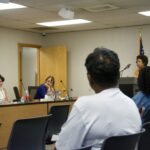
The Harrisburg school board at tonight’s meeting.

Harrisburg homeowners likely will pay higher school taxes this year, thanks to a preliminary budget approved by the Harrisburg school board tonight.

Board directors voted 7-2 to levy a 3.6 percent tax increase, the district’s first since 2012.

Combined with the elimination of 50½ teaching, administrative and support positions, the additional tax revenue will reduce the district’s $9 million deficit to $4.7 million for the 2018-19 school year, Business Administrator Bilal Hasan said.

At tonight’s special board meeting, no members of the public protested the proposed tax hikes. But almost a dozen said that preserving the ranks of teachers, principals and support staff should be the district’s first priority.

Kayla Mini, a music teacher at Foose Elementary School, said that cutting teachers and support staff would exacerbate the district’s poor teacher retention rate.

“Thirty students in a classroom is not kind to me, my colleagues or administrators or to kids,” Mini said. “Why do we have such a high turnover? I guarantee it is because of unkind working conditions.”

District residents offered ideas for cost-cutting measures. Jayne Buchwach proposed a 5-percent pay cut for central administration staff, and Kia Hansard pointed to administrative positions that could be eliminated to increase efficiency.

Jody Barksdale, president of the Harrisburg Education Association, said the district should bid out current services to ensure it is getting the lowest rates on procurement.

The budget that the board approved tonight will eliminate 24 instructional staff, 14.5 administrators (including four school vice principals) and 11 sanitation workers, counselors and security personnel represented by the AFSCME union.

It will also set the district’s tax rate at 28.8 mills, an increase of 1.0008 mills from this year. With Harrisburg’s median home value of $42,800, the tax hike will cost the average city homeowner an additional $43 a year.

Long-term budget projections presented in April call for tax hikes of the same magnitude every year through 2021.

The board has until June 30 to submit a final budget to the state. Until then, the district’s business office will search for more cost-cutting measures, Hasan said.

When pressed by board President Judd Pittman, Hasan said that the business office could consider some of the proposals made by district residents.

However, Hasan said that it would be up to different bargaining units to volunteer to take pay cuts. He also emphasized that all positions in the district’s central administration office were the first to be considered for elimination.

Even so, the board could add one more administrative position before the budget is finalized. It voted 7-2 tonight to approve a resolution for the creation of a new assistant superintendent position.

That position is not currently included in the 2018-19 budget, Hasan said, but will be added following the board’s affirmative vote.

Board directors Carrie Fowler and Tyrell Spradley voted against the assistant superintendent motion. Fowler also dissented in the 7-2 budget vote, joined by board director Percel Eiland.

Continue Reading

Who Was Chosen? Harrisburg proposes recipients for federal housing funds.

Members of Harrisburg City Council listen as a resident speaks at tonight’s meeting.

The annual process of disbursing federal housing funds began tonight, as Harrisburg City Council introduced an ordinance that would provide money to nearly a dozen nonprofit groups.

Mayor Eric Papenfuse said that the city used the same process in selecting award recipients as last year, using a point-based merit system to judge applications.

“It’s a number of small grants,” Papenfuse said. “It’s not as much as anyone wanted.”

In all, the city will distribute $2.04 million in Community Development Block Grant (CDBG) money, a program of the federal Department of Housing and Urban Development. This amount includes almost $1.9 million from the 2018 allocation, plus a small supplemental amount tied to unallocated funds from a prior year.

Like last year, the greatest single amount of money, $593,423, will go to repay federal loans the city backed during the Reed administration for several development projects, including the disastrous Capitol View Commerce Center project, which went bankrupt before being completed years later by a new owner.

“If we didn’t have an exorbitant debt service, we’d have a lot more money for housing,” Papenfuse said.

Most of the nonprofits proposed to receive funds have gotten some money from previous CDBG allocations. The proposed recipients include:

  • TriCounty HDC: $250,000
  • Habitat for Humanity: $100,000
  • A Miracle 4 Sure: $50,000
  • TLC Work Based Training: $45,000
  • Christian Recovery Aftercare Ministries (C.R.A.M.): $40,000
  • Latino Hispanic Community Center: $25,000
  • Heinz-Menaker Senior Center: $25,000
  • Fair Housing Council: $25,000
  • PPL/IN HOUSE: $20,000
  • Shades of Greatness: $15,000
  • Neighborhood Dispute Settlement: $5,000

Like last year, Tina Nixon, an executive with UPMC Pinnacle, scored the applications, Papenfuse said. While most nonprofits that applied received some funding, several did not make the cut, he said.

In addition, the city is proposing to allocate $321,642 for its housing rehabilitation programs and another $408,765 to CDBG administration.

At tonight’s meeting, Les Ford, executive director of Heinz-Menaker, addressed council to emphasize the importance of the Midtown Harrisburg facility.

“The Heinz-Menaker Senior Center is the most active senior center in Dauphin County, bar none,” he said. “We’re just lucky enough to have that in the city of Harrisburg.”

Last year, the administration did not recommend that Heinz-Menaker receive CDBG funds, saying its application did not make the cut. In the end, council reversed that decision and approved $25,000 for the center.

Council is slated to discuss CDBG funding at its next work session, scheduled for June 5. In recent years, it has made some adjustments to the administration’s proposal.

Continue Reading

Bears to Caps: Hershey fans will see familiar faces during Stanley Cup final.

The Stanley Cup finals are underway this week—16 teams entered and two are left. The Washington Capitals are facing off against the Vegas Golden Knights.

One of the teams has a special connection to the central Pennsylvania region. If you have ever been to a Hershey Bears game, you might see some familiar faces on the ice for the Capitals during the final series. Since the 2005-06 season, the AHL’s Hershey Bears has been the primary development club for the NHL’s Washington Capitals.

Hershey has developed players like Braden Holtby, Philipp Grubauer, Dmitry Orlov, Nathan Walker and Chandler Stephenson, all former Bears players. These former Bears will play a key role in this series, in an attempt to secure Washington’s first Stanley Cup.

Hershey has been ingrained in hockey history and is the longest continuously operating member club still playing in its original city. The history of Hershey hockey goes way back to 1931 with amateur matches between college teams. Milton S. Hershey saw the popularity of these games, which encouraged him to bring a professional hockey team permanently to Hershey. Gordie Howe, known as “Mr. Hockey” and 1972 Hockey Hall of Fame inductee, even once remarked that, “Everybody who is anybody in hockey has played in Hershey.” It was a high compliment from the hockey icon.

This year’s Stanley Cup match up will be compelling as both teams have great storylines.

The Caps are known as a hard-luck squad that, while typically one of the best teams in the league, can’t close the deal once they hit the playoffs. Meanwhile, the Golden Knights are a first-year expansion team out of Sin City. Made up of leftover players from the other 30 squads, the team is making history for having the best first-year ever for any professional expansion team.

The Caps’ captain, Alex Ovechkin, is electric and the best goal scorer of his time. He is facing Marc-Andre Fleury in net, who is looking to continue his great playoff run. Fleury is a veteran to postseason hockey, winning the Stanley Cup three times with the Pittsburgh Penguins.

Someone is going to win their first Stanley Cup. Will it be the Washington Capitals or the newcomers, Vegas Golden Knights?

If you have not been watching the Stanley Cup playoffs so far, it is time now to tune in for some of the best competition of the 2017-18 sports season. Hockey not your thing? Vegas does not disappoint during the pregame show, starting every home game with a cosplaying Knight dueling a mascot from the other team, faux-stabbing that mascot, then “vanquishing” him and lifting him up into the rafters. Let’s hope these two teams take it to game seven, which means we won’t have our Stanley Cup champ until June 13.

The Stanley Cup finals began Monday night, with the Vegas Golden Knights taking a 1-0 series lead with an exciting, high-scoring 6-4 victory. The series continues on Wednesday at 8 p.m.


Continue Reading