March home sales, prices stable in Harrisburg area

A home for sale in Harrisburg

Harrisburg area home sales remained stable last month, with sales units and prices mostly unchanged from the prior March.

For March 2020, 551 residential units sold in Dauphin, Cumberland and Perry counties, compared to 558 units in March 2019, according to the Greater Harrisburg Association of Realtors (GHAR). The median price increased to $180,000 from $175,000 over the same period.

In Dauphin County, 278 homes sold at a median price of $169,000 compared to 276 homes at a median price of $162,000 in the year-ago period, said GHAR. In Cumberland County, 242 houses sold compared to 255 the previous March, while the median price rose slightly to $205,000 versus $202,000, according to GHAR.

Perry County had 31 homes sales versus 27 a year ago, with a median price of $171,500 compared to $160,000 in March 2019, GHAR said.

Continue Reading

PA health secretary warns against complacency as new COVID-19 cases, deaths fall from last week

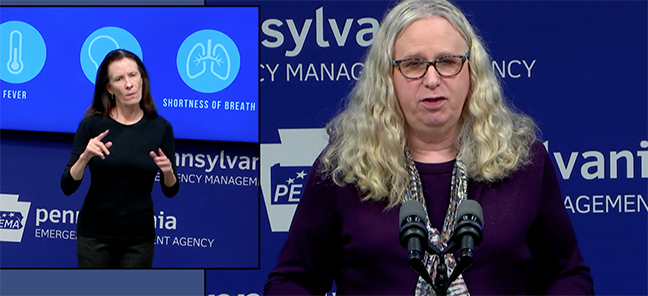
PA Department of Health Secretary Rachel Levine (right)

COVID-19 cases in PA now exceed 24,000, though new cases and deaths from the disease continued to be fewer than last week.

The state Department of Health today said that 1,366 new positive cases were reported for the 24-hour period ending at midnight. That’s down significantly from last week, when nearly 2,000 new cases were reported for several consecutive days.

Yesterday, the department reported 1,178 new positive cases.

In all, the state has confirmed 24,199 positive cases in PA since the pandemic hit in early March.

Tomorrow may better indicate whether the lower case and fatality data represent a trend, as Secretary of Health Rachel Levine has said previously that some daily counts on weekends may be lower due to less frequency of reporting to the department.

The department also reported 17 additional fatalities from COVID-19, meaning that 524 people in PA have died from the disease.

Locally, Lebanon County now has two fatalities, one more than yesterday. Deaths in other midstate counties were unchanged: 24 in Lancaster County, four in Dauphin County, three in Cumberland and York counties and one each in Perry and Adams counties.

“COVID-19 cases and deaths continue to rise in Pennsylvania, and even though the daily increases are not exponential, now is not the time to become complacent,” Levine said, in a statement.

The virus has spread to all of Pennsylvania’s 67 counties.

Locally, Dauphin County now has 240 confirmed cases, 11 more than yesterday. Cumberland County has 122 cases, 12 more than yesterday. Lancaster County has 828 cases, York County has 331 cases, Lebanon County has 284 cases, Adams County has 56 cases and Perry County has 17 cases.

Philadelphia County continues to have the most confirmed cases with 6,810 cases, followed by Montgomery County with 2,285 cases. The two counties also have reported the most deaths from the disease: 127 and 65, respectively.

Statewide, 129,792 coronavirus tests have been performed, with 105,593 people testing negative, according to the state health department. Yesterday, the state reported that 124,890 people had been tested for the virus.

Of the patients who have tested positive to date, the age breakdown is as follows, according to the health department:

  • Less than 1 percent are aged 0-4
  • Nearly 1 percent are aged 5-12
  • 1 percent are aged 13-18
  • 6 percent are aged 19-24
  • Nearly 41 percent are aged 25-49
  • Nearly 29 percent are aged 50-64
  • Nearly 21 percent are aged 65 or older.

Most of the patients hospitalized are 65 or older, as are most of the reported deaths, according to the state. There have been no pediatric deaths to date.

“We must continue to stay home to protect ourselves, our families, our community,” Levine said. “If you must go out, please make as few trips as possible and wear a mask to protect not only yourself, but other people as well. We need all Pennsylvanians to continue to heed these efforts to protect our vulnerable Pennsylvanians, our health care workers and frontline responders.”

Levine continued to emphasize that Pennsylvanians should do the following:

  • Wash your hands with soap and water for at least 20 seconds or use hand sanitizer if soap and water are not available.
  • Cover any coughs or sneezes with your elbow, not your hands.
  • Clean surfaces frequently.
  • Stay home to avoid spreading COVID-19, especially if you are unwell. 

For more information, visit the PA Department of Health’s COVID-19 website.

Continue Reading

Latest data shows sharp drop in newly diagnosed COVID-19 cases in PA

An image from the PA Department of Health’s lab in Exton.

New COVID-19 cases in PA showed a significant drop today, as the state reported the lowest new-case count in more than a week.

The state Department of Health today said that 1,178 new positive cases were detected since yesterday, bringing the total number of positive cases in PA to 22,833.

Sunday’s new case data is significantly lower than in recent days, including 1,989 on Thursday and 1,751 on Friday. In fact, it’s the lowest count since April 1, when 962 new positive cases were reported.

The state also reported fewer fatalities, with 13 new deaths since yesterday, compared to 78 fatalities both Friday and Saturday.

Secretary of Health Rachel Levine has said previously that some daily data, especially on weekends, may vary due to the frequency of reporting to the department. Because today is a holiday, she did not answer questions on the latest update.

Locally, Lancaster County now has 24 COVID-19-related fatalities, one more than yesterday, and Dauphin County now has four deaths, also one more than yesterday. Deaths in other midstate counties were unchanged: three in Cumberland and York counties and one each in Perry, Lebanon and Adams counties.

The virus has spread to all of Pennsylvania’s 67 counties.

Locally, Dauphin County now has 229 confirmed cases, 16 more than yesterday. Cumberland County has 110 cases, Lancaster County has 772 cases, York County has 307 cases, Lebanon County has 270 cases, Adams County has 48 cases and Perry County has 16 cases.

Philadelphia County continues to have the most confirmed cases with 6,352 cases, followed by Montgomery County with 2,164 cases. The two counties also have reported the most deaths from the disease: 128 and 63, respectively.

Statewide, 124,890 coronavirus tests have been performed, with 102,057 people testing negative, according to the state health department. Yesterday, the state reported that 120,153 people had been tested for the virus.

Of the patients who have tested positive to date, the age breakdown is as follows, according to the health department:

  • Less than 1 percent are aged 0-4
  • 1 percent are aged 5-12
  • 2 percent are aged 13-18
  • Nearly 9 percent are aged 19-24
  • Nearly 49 percent are aged 25-49
  • 29 percent are aged 50-64
  • 22 percent are aged 65 or older.

Most of the patients hospitalized are 65 or older, as are most of the reported deaths, according to the state. There have been no pediatric deaths to date.

“If you must go out, please limit it to as few trips as possible and wear a mask to protect not only yourself, but other people as well,” Levine said, in a statement. “We need all Pennsylvanians to heed these efforts to protect our vulnerable Pennsylvanians, and also our healthcare workers and frontline responders.”

Levine continued to emphasize that Pennsylvanians should do the following:

  • Wash your hands with soap and water for at least 20 seconds or use hand sanitizer if soap and water are not available.
  • Cover any coughs or sneezes with your elbow, not your hands.
  • Clean surfaces frequently.
  • Stay home to avoid spreading COVID-19, especially if you are unwell.

 For more information, visit the PA Department of Health’s COVID-19 website.

Continue Reading

COVID-19 cases exceed 20,000 in PA; fewer new cases for second day

The state’s shaded map of positive COVID-19 cases for Saturday.

More than 20,000 Pennsylvanians have now tested positive for COVID-19, though the new-case count was down for a second straight day.

The state Department of Health today reported 1,676 new cases as of midnight. Since the pandemic began in early March, a total of 21,655 residents have been diagnosed with the illness.

Today’s new-case figure is lower than the count both yesterday and Thursday.

The commonwealth, though, reported that another 78 more people have died from the disease, bringing the statewide total to 494 fatalities. Yesterday, the state also reported 78 fatalities.

Locally, Lancaster County now has 23 COVID-19-related fatalities, two more than yesterday, and both Dauphin and Cumberland counties have now reported three deaths, one more than yesterday in both counties. Deaths in other midstate counties were unchanged: three in York County and one each in Perry, Lebanon and Adams counties.

“Now more than ever, as we continue to see COVID-19 cases and deaths rise in Pennsylvania, we need Pennsylvanians to take action,” Secretary of Health Dr. Rachel Levine said. “Those actions should be to stay calm, stay home and stay safe.”

The virus has spread to all of Pennsylvania’s 67 counties.

Locally, Dauphin County now has 213 confirmed cases, 14 more than yesterday. Cumberland County has 105 cases, Lancaster County has 698 cases, York County has 293 cases, Lebanon County has 232 cases, Adams County has 44 cases and Perry County has 16 cases.

Philadelphia County continues to have the most confirmed cases with 6,022 cases, followed by Montgomery County with 2,053 cases. The two counties also have reported the most deaths from the disease: 130 and 60, respectively.

Statewide, 120,153 coronavirus tests have been performed, with 98,498 people testing negative, according to the state health department. Yesterday, the state reported that 105,602 people had been tested for the virus.

Of the patients who have tested positive to date, the age breakdown is as follows, according to the health department:

  • Less than 1 percent are aged 0-4
  • Nearly 1 percent are aged 5-12
  • 1 percent are aged 13-18
  • Nearly 7 percent are aged 19-24
  • Nearly 41 percent are aged 25-49
  • 29 percent are aged 50-64
  • 21 percent are aged 65 or older.

Most of the patients hospitalized are 65 or older, as are most of the reported deaths, according to the state. There have been no pediatric deaths to date.

“If you must go out, please limit it to as few trips as possible and wear a mask to protect not only yourself, but other people as well,” Levine said. “We need all Pennsylvanians to heed these efforts to protect our vulnerable Pennsylvanians, and also our healthcare workers and frontline responders.”

Levine continued to emphasize that Pennsylvanians should do the following:

  • Wash your hands with soap and water for at least 20 seconds or use hand sanitizer if soap and water are not available.
  • Cover any coughs or sneezes with your elbow, not your hands.
  • Clean surfaces frequently.
  • Stay home to avoid spreading COVID-19, especially if you are unwell.

For more information, visit the PA Department of Health’s COVID-19 website.

Continue Reading

The Week that Was: News and features around Harrisburg

Gamut’s theater in downtown Harrisburg

Life has become all-COVID, all the time, which is reflected in our news coverage, as well. This past week, we addressed the issue in several different ways, including breaking news, features and even in our monthly podcast. If you missed any of our stories, we have them all listed and linked below.

COVID-19 pandemic dominated the news once again, with the state’s grim press briefings a daily event. Click here to read the latest update from the Department of Health.

David Black, CEO of the Harrisburg Regional Chamber & CREDC, describes his organization’s role during this unprecedented economic crisis and offers tips for small businesses. Read what he has to say, in a story that complements the monthly Burg Podcast.

Gamut Theatre scrubbed the remainder of its 2019-20 season, which includes the popular annual “Shakespeare in the Park.” As our online news story states, the theater will remain closed for public performances through at least Sept. 1.

Harrisburg businesses and schools were among the topics discussed during another of Mayor Papenfuse’s “Community Conversations” on Facebook Live. The pandemic has affected both greatly, and our online story focuses on what is being done to address these enormous challenges.

Harrisburg housing is a tough issue that seems almost impossible to resolve. But why is that? In his monthly column, our editor explores why the city can’t seem to address its housing shortage, whether affordable or market-priced.

PA schools will remain closed for the remainder of the academic year, the state announced this past week. This applies to schools of every stripe, which now need to find ways to educate students outside of the physical classroom. Our online news story has the announcement.

Religious communities have been forced to quickly adapt to societal isolation, made especially difficult during April’s numerous sacred celebrations. Our online feature describes how several local congregations are trying to adjust.

Sara Bozich spent another week at home, like most everyone else. Nonetheless, she’s plugging away at her weekly blog, which has suggestions for virtual activities and ways to support local businesses.

TheBurg Podcast, April edition, dropped this past week, featuring segments on how the pandemic is affecting local businesses and the arts community. Host Karen Hendricks also features a story on hiking locally and our editor’s “Most Harrisburg Thing.” Give it a listen!

UPMC Pinnacle offered advice on how to stay safe during that inevitable trip to the grocery store or while getting takeout. Read their recommendations in an online column.

Do you receive TheBurg Daily, our daily digest of news and events delivered right to your email inbox? If not, subscribe here!

Continue Reading

Harrisburg city, community leaders discuss businesses, schools during Facebook Live event

Harrisburg Mayor Eric Papenfuse, in a screen shot from Friday’s Facebook Live event

Harrisburg’s mayor held another in a series of Facebook Live events on Friday and, on tap, three topics of great community concern–local businesses, the school district and supporting medical personnel.

Much of Mayor Eric Papenfuse’s “Community Conversation” revolved around a new grant program, the result of a partnership between the city and Impact Harrisburg, a nonprofit for local economic development.

The Neighborhood Business Stabilization Fund will help mitigate damage caused to small businesses by the COVID-19 crisis, explained Nona Watson, director of economic development in the city.

“This project is intended to fill the gap in the offerings of financial assistance to small businesses,” added Sheila Dow Ford, executive director of Impact Harrisburg.

The $1 million fund will provide grants of up to $10,000 for accepted businesses on a first-come, first-served basis.

“This is a Harrisburg-centric grant we are talking about,” Dow Ford said. “It is a way to quickly provide resources to all businesses.”

In addition, Chris Celmer, acting superintendent of the Harrisburg school district, discussed resources the district is providing in light of Gov. Tom Wolf’s closure of all Pa. schools for the remainder of the academic year.

Celmer said that laptops are being distributed to students in grades nine through 12, and the district is working on applying for grants in order to extend the distribution to other grades, as well.

In addition to a partnership with WITF to broadcast educational material for students on television, the district will use the city’s channel WHBG20 to put out individual lessons. Celmer explained that Harrisburg teachers have been recording lessons to broadcast.

“We are really trying to tackle this situation in a number of different ways to ensure that 100 percent of our students will have some access to academic enrichment during this very unprecedented time,” he said.

Lastly, Christian Caicedo, UPMC Dauphin Region president, discussed a new initiative to support medical personnel in Harrisburg.

Caicedo encouraged the community to use the hashtag #HELPTHEHELPERS to show support for health care workers, as well as grocery clerks, garbage collectors and everyone performing essential tasks.

Window signs and social media frames with the hashtag can be downloaded at UPMCPinnacle.com/HELPTHEHELPERS.

Additional updates:

  • 150 free Wi-Fi hotspots can be found around the city; a map can be found here.
  • Families with school-aged children can apply for 60 days of free Wi-Fi here.
  • The Community Policing Division’s Family Food Box program will operate on Thursdays from 4 to 6 p.m. only.
  • The Harrisburg School District’s breakfast and lunch program will operate on Tuesday from 11 a.m. to 12:30 p.m. only. Meals for five days can be picked up.
  • The Harrisburg YMCA on Front Street is opening its showers to homeless individuals on April 13, 15 and 17 from 9:30 a.m. to noon.

Each week’s Community Conversation can be found on YouTube. They are held each Friday at noon through Facebook Live. For more information, visit the City of Harrisburg, Impact Harrisburg and the Harrisburg School District’s websites.

Continue Reading

Total COVID-19 cases approach 20,000 in PA; new cases fewer than yesterday


Nearly 20,000 Pennsylvanians have now tested positive for COVID-19, as the state reported 1,751 new positive cases today.

The state Department of Health said 19,979 residents have been diagnosed with the illness since the outbreak began in early March.

Today’s new-case figure is notably lower than yesterday’s 1,989 new cases.

The commonwealth, though, reported that 78 more people have died from the disease, bringing the statewide total to 416 fatalities.

Locally, Lancaster County now has 21 COVID-19-related fatalities, four more than yesterday, and Lebanon and Adams counties reported their first fatalities. Deaths in other midstate counties were unchanged: three in York County, two in Cumberland and Dauphin counties and one in Perry County.

“Now more than ever, as we continue to see COVID-19 cases and deaths rise in Pennsylvania, we need Pennsylvanians to take action,” Secretary of Health Dr. Rachel Levine said. “Those actions should be to stay calm, stay home and stay safe.”

The virus now has spread to all of Pennsylvania’s 67 counties.

Locally, Dauphin County now has 199 confirmed cases, 19 more than yesterday. Cumberland County has 96 cases, Lancaster County has 648 cases, York County has 283 cases, Lebanon County has 218 cases, Adams County has 43 cases and Perry County has 16 cases.

Philadelphia County continues to have the most confirmed cases in the state with 5,521 cases, followed by Montgomery County with 1,889 cases. The two counties also have reported the most deaths from the disease: 110 and 50, respectively.

Statewide, 113,019 coronavirus tests have been performed, with 93,040 people testing negative, according to the state health department. Yesterday, the state reported that 105,602 people had been tested for the virus.

Of the patients who have tested positive to date, the age breakdown is as follows, according to the health department:

  • Less than 1 percent are aged 0-4
  • Nearly 1 percent are aged 5-12
  • 1 percent are aged 13-18
  • Nearly 7 percent are aged 19-24
  • 41 percent are aged 25-49
  • 29 percent are aged 50-64
  • Nearly 21 percent are aged 65 or older.

Most of the patients hospitalized are 65 or older, as are most of the reported deaths, according to the state. There have been no pediatric deaths to date.

“If you must go out, please limit it to as few trips as possible and wear a mask to protect not only yourself, but other people as well,” Levine said. “We need all Pennsylvanians to heed these efforts to protect our vulnerable Pennsylvanians, and also our healthcare workers and frontline responders.”

Levine continued to emphasize that Pennsylvanians should do the following:

  • Wash your hands with soap and water for at least 20 seconds or use hand sanitizer if soap and water are not available.
  • Cover any coughs or sneezes with your elbow, not your hands.
  • Clean surfaces frequently.
  • Stay home to avoid spreading COVID-19, especially if you are unwell. 

For more information, visit the PA Department of Health’s COVID-19 website.

Continue Reading

Small businesses taking biggest hit in economic crisis, says Harrisburg Chamber CEO

Small businesses are suffering the hardest economic hits, at least immediately, as a result of the coronavirus pandemic.

That’s according to David Black (pictured), president and CEO of the Harrisburg Regional Chamber and Capital Region Economic Development Corporation (CREDC), encompassing Dauphin, Cumberland and Perry counties.

“Small businesses typically have the least amount of bandwidth,” Black said on the April edition of TheBurg Podcast, released today. “If you’re a restaurant, you can’t work from home—there are some real challenges with the small businesses. Larger businesses are operating and have people working from home.”

Chamber membership is comprised of about 1,000 member businesses and nonprofits representing a workforce of 120,000.

Right now, Black said the chamber and CREDC’s 15 employees are focused on connecting area businesses with information such as the $350 billion, federally funded Paycheck Protection Program.

Last week, the organizations worked around the clock to help process Harrisburg-area businesses’ applications for the state’s COVID-19 Working Capital Assistance Program, which Black calls a “gallant effort of $60 million cobbled together from within the state budget.”

Applications to that program exceeded state funding within the first few hours.

Black said members are craving two things during this time of social distancing: information and interaction. That’s why both organizations continue to hold board meetings as scheduled—via phone—and some social events, via Zoom videoconferencing.

As the pandemic and its economic effects continue to unfold, Black remained optimistic for the Harrisburg region’s long-term economic health.

“Historically, central PA has always been a strong region,” Black said. “The big question is, ‘How long does it take to get back?’”

To hear more of Dave Black’s interview and insights, listen to TheBurg Podcast, released today.

For more information on COVID-19 programs and resources such as loans, see the Harrisburg Regional Chamber and Capital Region Economic Development Corporation’s website at https://www.harrisburgregionalchamber.org/.

Continue Reading

TheBurg Podcast: April 2020, The Hard Times Edition

Meet some of the Harrisburg area’s most fascinating people, and hear their own authentic stories, straight from every month’s issue—with a different twist—on TheBurg Podcast. Because there’s always “more to the story.” Hosted by Karen Hendricks. TheBurg is a monthly community magazine based in Harrisburg, Pa.; Lawrance Binda, co-publisher/editor.

Life as we know it is changed. The COVID-19 pandemic is the first national and international crisis most of us have ever experienced. Stay-at-home life has become a mixture of both terrible news and grim statistics, intertwined with beautiful news of selfless medical professionals and community helpers.

With that in mind, this month’s podcast reflects news from a variety of those perspectives.

We’ll have an update on Central Pennsylvania’s small businesses and how they’re weathering this storm, featuring David Black, President and CEO, Harrisburg Regional Chamber and Capital Region Economic Development Corporation.

We’ll also talk with a Harrisburg area musician, Xander Moppin of Yam Yam, about how the pandemic is affecting the arts.

And enjoying a breath of fresh air, outdoors, has never sounded so good. We’ll explore hiking with reporter Maddie Conley. “Trailing Along,” in the April issue of TheBurg, explains how the organization Hike It Baby is introducing the next generation to nature.

Plus Lawrance Binda, editor of TheBurg, will share TMHT, “the most Harrisburg thing,” amid the pandemic.

Interested in sponsoring TheBurg Podcast? Contact Lauren at [email protected].

Karen Hendricks is a lifelong journalist; visit her website here.

Continue Reading

Staying Safe: UPMC Pinnacle doctor offers tips when venturing out for food

Pizza awaits pickup at Knead in Harrisburg

With COVID-19 diagnoses on the rise, it’s more important than ever to follow stay-at-home orders and practice social distancing. Minimizing contact with others is the best way to reduce the spread of the virus. The fewer people who get sick, the fewer who will need to be hospitalized.

But what about when you do need to go out? Experts agree that stocking up for no more than two weeks’ needs is best for the good of everyone in our communities. Here are some tips to help avoid contracting viruses and staying healthy on your next trip to the grocery store or a restaurant for takeout. 


Before going out

If at all possible, designate one person at a time to do the errands. If you do bring your family, there should be someone old enough to supervise them in the car so they are safe while you are in the shop. Taking the family out for browsing during stay-at-home orders puts everyone at greater risk. 

  • Put on a mask. Disease experts are now saying we should wear a mask whenever we go out in public – to protect yourself and to protect others. Under the new recommendation, healthy individuals are advised to wear mouth and nose face coverings. These can include homemade masks, scarves or bandanas. Medical quality masks are not necessary and should be saved for medical professionals.
  • Make a list of where you need to go and consolidate your needs into one trip with multiple stops. Put grocery shopping as the last destination so food stays cold. If you are getting takeout, plan to swing by on your way home so the food maintains the appropriate temperature.
  • Make a list of what you will need at the grocery store. Start by taking inventory of what’s already in your pantry, and then plan around these items to create meals.
  • Plan your shopping trip during the bookends of store hours: early and late in the day tend to be less crowded at more stores.
  • Be prepared with hand sanitizer or hand sanitizing wipes.
  • Don’t take your reusable shopping bags.


At the grocery store 

You may have seen videos with people cleaning groceries with near-surgical precision. While studies have shown that coronavirus can live on different surfaces for varying numbers of days, remember that those were laboratory experiments. The actual conditions in which the virus would have to live in the real world are very different.

There is currently no evidence that suggests that the virus has been or can be transmitted from groceries. The probability of this is extremely low, but there are some things you can do to promote safety at the grocery store: 

  • Don’t go shopping if you’re sick or if you think you might be sick.
  • To limit exposure, consider curbside pickup or a grocery delivery service.
  • Don’t panic buy. Stick to your list.
  • Use disinfecting wipes on cart handles and other high-touch surfaces, like door handles. If you have hand sanitizer, that also works, but if you have neither, no need to panic.
  • Whether you have disinfected or not – don’t touch your face.
  • Physically distance yourself from others as much as you can in the store.
  • Don’t browse. Get in, get out, and go home.
  • Avoid touching products and returning them to the shelf. Only touch what you plan to purchase.
  • Avoid exchanging cash and pay with a credit card instead.
  • Clean your hands with hand sanitizer or wipes after you have loaded the groceries in your car.


Picking up takeout 

There is currently no evidence that COVID-19 can be transmitted through food or food packaging, according to the CDC and the FDA. While the virus may last on packaging for a few days, the general consensus is that the concentration of virus particles would be low and very unlikely to cause infection. 

Instead, consider using caution to avoid transmitting the coronavirus from employee or delivery person to customer, or vice versa, through coughing, vaporized air particles or other direct contact. Many food delivery services are moving to contactless drop-offs or encouraging customers to take advantage of drop-off instructions to minimize the chance of spreading the virus. If you do stop for takeout: 

  • Pay with a credit card and not cash.
  • Maintain social distancing with other patrons.
  • Clean your hands with hand sanitizer or wipes after you have brought your takeout to your car.


When you get home

Groceries 

  • Wash your hands for at least 20 seconds, and avoid touching your face after bringing your food or grocery delivery inside.
  • Wash your hands again after putting groceries away.
  • Rinse your produce with water before you consume it to help remove dirt and pesticides. Experts have always recommended this, but the general consensus is not to use soap, as that could cause stomach upset.


Takeout
 

While there are currently no guidelines for takeout, these practices may make you feel reassured and support overall good hygiene:

  • Remove food from takeout containers and toss takeout containers and disposable cutlery that came in the bag.
  • Wash your hands for at least 20 seconds before and after eating.
  • Recycle the bags that the food comes in, and disinfect your tables and counters before and after you eat.

No matter where you go and what you bring home, get in the habit of washing your hands frequently throughout the day. Always wash your hands when you come in from outside and before and after eating. Try not to touch your eyes, nose or mouth. Hand-washing and avoiding touching your face are the two of the best ways to prevent illness.


James Raczek, MD, FAAFP, is the chief medical officer at UPMC Pinnacle.

To learn more about COVID-19 and stay up to date with UPMC Pinnacle, please visit UPMCPinnacle.com/COVID19.

Continue Reading