New COVID-19 cases continue a gradual decline in Pennsylvania

An image from the PA Department of Health lab in Exton

Newly diagnosed COVID-19 cases dipped again in PA, as the state reported one of the lowest daily case totals in six weeks.

The state Department of Health reported 623 new COVID-19 cases in Pennsylvania for the period ending at midnight. This marks a week with new case numbers below 1,000, the first time that has happened since March.

With the additional cases, 62,234 Pennsylvanians have now been diagnosed with the coronavirus.

New cases in PA peaked in early April at nearly 2,000 cases, but have shown a gradual, relatively steady decline since, despite greater levels of testing for the virus over that time period.

Case numbers on weekends have tended to be lower due to less reporting to the health department, according to Secretary Rachel Levine.

Of the new cases today, 190 are in residents of nursing and personal care homes.

Locally, total diagnosed cases are as follows:

  • Adams County: 189 cases (yesterday, 185)
  • Cumberland County: 522 cases (yesterday, 515)
  • Dauphin County: 963 cases (yesterday, 938)
  • Franklin County: 621 cases (yesterday, 601)
  • Lancaster County: 2,508 cases (yesterday, 2,470)
  • Lebanon County: 874 cases (yesterday, 873)
  • Perry County: 40 cases (yesterday, 40)
  • York County: 851 cases (yesterday, 835)

Overall, 18.7 percent of PA residents tested have shown to be positive for the virus.

The health department also reported another 15 fatalities, meaning that 4,418 Pennsylvanians have died from the disease over the past two months.

The majority of new fatalities—14—were residents of nursing or personal care homes.

Around central PA, the COVID-19 fatality data now stands as follows:

  • Adams County: 6 deaths (yesterday, 6)
  • Cumberland County: 48 deaths (yesterday, 48)
  • Dauphin County: 39 deaths (yesterday, 39)
  • Franklin County: 13 deaths (yesterday, 13)
  • Lancaster County: 187 deaths (yesterday, 186)
  • Lebanon County: 19 deaths (yesterday, 19)
  • Perry County: 1 death (yesterday, 1)
  • York County: 16 deaths (yesterday, 16)

Statewide, Philadelphia County continues to have the most confirmed cases with 16,140 cases, followed by Montgomery County with 5,872 cases. The two counties also have reported the most deaths statewide from the disease: 1,022 and 620, respectively.

“As counties move from red to yellow, we need all Pennsylvanians to continue to follow the social distancing and mitigation efforts in place,” Levine said.

So far, the state has moved 37 counties in the southwest portion of the state into the yew phase. On Friday, 13 more counties, including Cumberland, York, Perry and Adams counties, will enter the yellow phase.

Nursing homes and personal care facilities have been particularly hard hit by the virus. Out of total deaths, 3,057, or 69.2 percent, have occurred in residents from nursing or personal care facilities, according to the health department.

In nursing and personal care homes, there are 13,447 resident cases of COVID-19, and 2,091 cases among employees, for a total of 15,447 at 558 distinct facilities in 45 counties, according to the health department.

In addition, 4,451 of total cases in PA are in health care workers.

Statewide, 332,904 coronavirus tests have been performed, with 270,670 people testing negative, according to the state health department. Yesterday, the state reported that 327,836 people had been tested for the virus.

Of the patients who have tested positive to date, the age breakdown is as follows, according to the health department:

  • Nearly 1 percent are aged 0-4
  • Nearly 1 percent are aged 5-12
  • Nearly 2 percent are aged 13-18
  • Nearly 6 percent are aged 19-24
  • Nearly 37 percent are aged 25-49
  • Nearly 26 percent are aged 50-64
  • Nearly 29 percent are aged 65 or older.

Most of the patients hospitalized are 65 or older, as are most of the reported deaths, according to the state.

Levine continued to emphasize that Pennsylvanians should do the following:

  • Wash your hands with soap and water for at least 20 seconds or use hand sanitizer if soap and water are not available.
  • Cover any coughs or sneezes with your elbow, not your hands.
  • Clean surfaces frequently.
  • Stay home to avoid spreading COVID-19, especially if you are unwell.

“We must continue to protect our most vulnerable Pennsylvanians, which includes our seniors, those with underlying health issues, our healthcare workers and our first responders,” Levine said. “I am proud of the work that Pennsylvanians have done so far, but we cannot stop now, we must continue to take the necessary steps to protect ourselves from COVID-19.” 

For more information, visit the PA Department of Health’s COVID-19 website.

Continue Reading

Bob’s Art Blog: Art Gone Wild

Part I: Folklore and Fact: Fairies, “Friends” and a Farrago (What put the “wild” in Wildwood)

Legend has it that magical creatures, sprites and fairies reside amongst the lichens and moss found in Wildwood Park. Will-o’ the wisps light up the nights on the lake, and whispers from wee folk are heard on the walking trails if you listen closely.

The lore surrounding the environ speaks to this haven for nature and its otherworldly inhabitants. The 229 acres comprising the space within the park’s parameters have been designated as a natural habitat now approaching 120 years in operation. The superstition, “knock on wood,” has its origins in the days of yore when the Celts roamed Europe. People would run into the woods to share secrets then literally knock on the trees, so the spirits abiding within would not hear what was divulged.

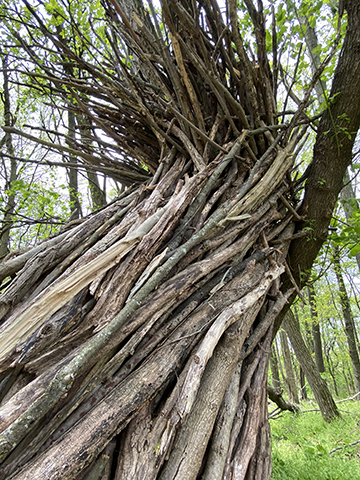
“The Last Wave” by Beau and Jana MacGinnes at “Art in the Wild”

In late afternoon, Wildwood Park becomes a photo from an album of bygone years—blue sky, calm water, a lone heron on the lake and twee chipmunks frolicking among the ground cover. It wasn’t always that way. Wildwood Park’s history has had its share of ups and downs over its six score years.

It was originally called Wetzel’s Swamp. In 1901, Wildwood Lake was established by Harrisburg as part of a national movement called “City Beautiful,” incorporating elements of interest well advanced for the day. It housed a zoo that counted “lions and tigers and bears” oh my…(just kidding) among its constituency. Seriously, the zoo was home to a whimsical farrago of animals that included elk, buffalo, a black bear and a barrel full of monkeys, 24, in fact, exotic and enchanting. The zoo was a popular feature from the 1920s through the 1940s. The menagerie included a mountain lion, muskrat, raccoon, mink and white-tailed deer among the attractions. Where the deer and antelope played was situated on the acreage today that is the HACC campus. Riding stables, boating concessions and a ball field all provided entertainment and recreational opportunities. Combine the legend and lore, and therein lies the foundation for “Wildwood.”

The park fell to disrepair and ended up becoming a dumping site by the 1960s. Also, later in that decade, the Audubon Society, through a study, determined Wildwood to be ideal for a nature center with programming as a natural extension. The Dauphin County commissioners purchased the land we recognize today as Wildwood Park for the magnanimous sum of $1 in 1976 with the blessing of Harrisburg City Council and a land transfer. The nonprofit “Friends of Wildwood” was established in 1987 and, in 1989, the American lotus, native to Wildwood, was placed on the endangered plant species list. In 1992, philanthropist and one of Wildwood’s greatest “friends,” Benjamin Olewine, established a trust and, in 1999, the $4-million-plus Olewine Nature Center opened. To this day, it stands as a cherished treasure. The center anchors the park as the repository for education, enlightenment and entertainment of the outdoor variety.

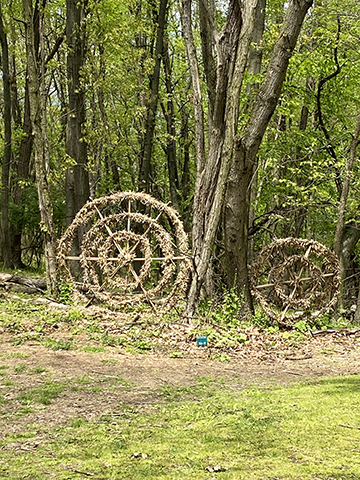
“Kindred Spirits” by Eve Gurbacki

This nod to Wildwood’s storied past acknowledges Wildwood’s friends and Dauphin County Parks and Recreation’s role, as well as Harold Plasterer, the original zookeeper, historians Floyd Demmy and Ernest Morrison and the generosity of Benjamin Olewine. So, in the spirit of knocking wood, I have left that bit of history out of the bag. There you have, in part, some of the backstory—what put the ”wild” in Wildwood.

Speaking of history, the 2020 edition of “Art in The Wild,” an annual event now in its eighth year, owes its success to the visionaries steering its committee.

Elizabeth Johnson’s humble demeanor and gentle spirit belies the embodiment of a passionate advocate for the environment, particularly that of Wildwood Park. She is assisted in her mission by longstanding committee members Marcy Brenner and Jim Caufield, equally invested in the gift “Art in the Wild” brings to the residents of Dauphin County. As in most endeavors, it takes a village, and, in this case, perhaps a forest, which includes committee members Donna Curancy-Seltzer, Patricia Garcia, Moe Hickey, Carol Lopus, Michelle McKeown, Mara Shall and Olivia Susskind, who all do their part to make this annual event a success. Park Manager Chris Rebert nurtured the first seven years with a passion and love before handing the torch to Richelle Corty, the park’s environmental educator. Sending emails and making personal calls to all the entrants, she ensured participation and kept everyone up to date on all the changes as they occurred.


Part II: “Art in the Wild” Installations 2020

Nature and art are irrepressible forces as are the artists creating. As the seasons evolve, so does the landscape. You can almost hear the gentle hum that stops for a brief reverie, then begins anew.

“Art in the Wild,” like any other art event, relies on the artists to deliver the goods. What started out as the largest field of participants (20), dwindled to a smaller group (due to the pandemic) of committed environmental artists.

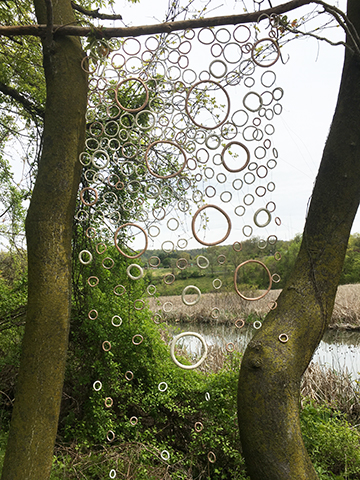
“Rings of Reflection” by Suzanne Pagel

Past winners truly stepped up to the challenge solely for arts sake. Two teams, Eve Gurbacki and Adrianne Zimmerman along with Beau and Jana MacGinnes, won back-to-back, first-place awards and have been at the vanguard since AITW’s inception.

Advancing this year’s theme of harmony, Gurbacki spread the visual field with crop circle totems to Mother Earth in her installation entitled “Kindred Spirits.” The MacGinnes team pushed an apocalyptic vision to new heights in “The Last Wave,” with a tsunami of a wave reaching towards the heavens, so powerful in its scope that it leaps the path to the other side. In fact, both use wide angles in promoting visual acuity as 20-20 comes into focus.

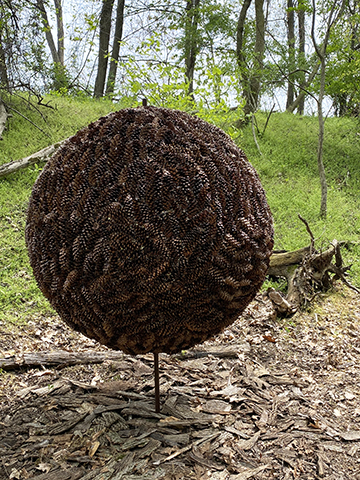
New to the mix, Suzanne Pagel created a triptych of transformation incorporating hanging ceramic disks using filament that gives the sense of being trapped in a spider web, capturing the very essence of art’s fragility in her piece, “Rings of Reflection.” “Ecospheric Tones,” created by Jill Lippert, is, on the surface, a sphere replete with pinecones camouflaging the wind chimes within.

“Ecospheric Tones” by Jill Lippert

In fairness to the other entrants, no more spoilers will be revealed as viewers need to experience the installations by walking the 3.1-mile trail. They say competition is good for the soul, and everyone likes to be recognized, but the core group of AITW winners over the past few years share a mutual admiration and appreciation for each others’ work. It embodies a sense of camaraderie more than competition. Perhaps a landscape leitmotif will run through the installations, offering individual takes on the chosen theme, “Woodland Harmony.” Jim Caufield, at last year’s awards ceremony, spoke to the level of involvement, citing the number of installations to date, which now tops 100 with this year’s offering. Mick Corman, film/video teacher at Capital Area School for the Arts, graciously videotaped the installations, as the students who previously did so were unable to this year.

By all accounts, there have been more visitors to the park since the pandemic began in March, which has resulted in greater public interest and awareness than ever before. Up close and personal is still the best way to view AITW while practicing social distancing. “Art in the Wild” has become an annual rite of spring, like the geese migrating back north, the sight of the first robin and the buds blooming on the trees. This time around promises art in nature from seasoned veterans and first-time entrants presenting a varied collection of installations for the public’s consideration, rendered refreshingly radiant. It speaks to this dedicated group. They have created monuments to nature out of fertile imaginations, from conceptualized theme to articulated achievement.

What could very well be the only new art event in the area for spring opens to the public on May 16 and runs through September’s end.

Continue Reading

New COVID-19 cases remain just below 1,000 in PA

An image from the state Department of Health lab in Exton, Pa.

New COVID-19 cases today again were just below 1,000 in PA, as the state health department reported 989 newly confirmed cases.

This marks six days in a row with new case numbers below 1,000, the first time that has happened in about six weeks.

With the additional cases, 61,611 Pennsylvanians have now been diagnosed with the coronavirus.

New cases in PA peaked in early April at nearly 2,000 cases, but have shown a gradual, relatively steady decline since, despite increasingly greater levels of testing for the virus over that time period.

Of the new cases today, 320 are in residents of nursing and personal care homes.

Locally, total diagnosed cases are as follows:

  • Adams County: 185 cases (yesterday, 183)
  • Cumberland County: 515 cases (yesterday, 492)
  • Dauphin County: 938 cases (yesterday, 912)
  • Franklin County: 601 cases (yesterday, 580)
  • Lancaster County: 2,470 cases (yesterday, 2,428)
  • Lebanon County: 873 cases (yesterday, 863)
  • Perry County: 40 cases (yesterday, 36)
  • York County: 835 cases (yesterday, 828)

Overall, 18.8 percent of PA residents tested have shown to be positive for the virus.

The health department also reported another 61 fatalities, meaning that 4,403 Pennsylvanians have died from the disease over the past two months.

The majority of new fatalities—52—were residents of nursing or personal care homes.

Around central PA, the COVID-19 fatality data now stands as follows:

  • Adams County: 6 deaths (yesterday, 6)
  • Cumberland County: 48 deaths (yesterday, 41)
  • Dauphin County: 39 deaths (yesterday, 41)
  • Franklin County: 13 deaths (yesterday, 17)
  • Lancaster County: 186 deaths (yesterday, 186)
  • Lebanon County: 19 deaths (yesterday, 19)
  • Perry County: 1 death (yesterday, 1)
  • York County: 15 deaths (yesterday, 16)

Statewide, Philadelphia County continues to have the most confirmed cases with 16,032 cases, followed by Montgomery County with 5,797 cases. The two counties also have reported the most deaths statewide from the disease: 1,021 and 614, respectively.

“As counties move from red to yellow, we need all Pennsylvanians to continue to follow the social distancing and mitigation efforts in place,” said health Secretary Rachel Levine.

So far, the state has moved 37 counties in the southwest portion of the state into the yew phase. On Friday, 12 more counties, including Cumberland, York, Perry and Adams counties, will enter the yellow phase.

Nursing homes and personal care facilities have been particularly hard hit by the virus. Out of total deaths, 3,043, or 69.1 percent, have occurred in residents from nursing or personal care facilities, according to the health department.

In nursing and personal care homes, there are 13,257 resident cases of COVID-19, and 2,075 cases among employees, for a total of 15,332 at 556 distinct facilities in 44 counties, according to the health department.

In addition, 4,432 of total cases in PA are in health care workers.

Statewide, 327,836 coronavirus tests have been performed, with 266,225 people testing negative, according to the state health department. Yesterday, the state reported that 319,832 people had been tested for the virus.

Of the patients who have tested positive to date, the age breakdown is as follows, according to the health department:

  • Nearly 1 percent are aged 0-4
  • Nearly 1 percent are aged 5-12
  • Nearly 2 percent are aged 13-18
  • Nearly 6 percent are aged 19-24
  • Nearly 37 percent are aged 25-49
  • Nearly 26 percent are aged 50-64
  • Nearly 29 percent are aged 65 or older.

Most of the patients hospitalized are 65 or older, as are most of the reported deaths, according to the state.

Levine continued to emphasize that Pennsylvanians should do the following:

  • Wash your hands with soap and water for at least 20 seconds or use hand sanitizer if soap and water are not available.
  • Cover any coughs or sneezes with your elbow, not your hands.
  • Clean surfaces frequently.
  • Stay home to avoid spreading COVID-19, especially if you are unwell. 

“We must continue to protect our most vulnerable Pennsylvanians, which includes our seniors, those with underlying health issues, our healthcare workers and our first responders,” Levine said. “I am proud of the work that Pennsylvanians have done so far, but we cannot stop now, we must continue to take the necessary steps to protect ourselves from COVID-19.” 

For more information, visit the PA Department of Health’s COVID-19 website.
Continue Reading

The Week that Was: News and features around Harrisburg

One of the more colorful outfits at Friday’s ReOpen PA rally

The pandemic news had some new twists and turns this week, in addition to the same old, plodding story. As usual, we covered it all as it unfolded. If you missed any of our coverage, we have it all listed and linked below.

Allison Hill is slated for a major redevelopment project, as Harrisburg City Council this past week approved a building plan for a centrally located area around N. 15th Street. The developer hopes to break ground later this year. Click here for the details.

April home sales held their own in the Harrisburg area, despite the pandemic. Sales were down a bit, but prices actually rose during the month. Find out the details in our monthly update.

COVID-19 cases continue to drop, ever so slowly, around the commonwealth, though the fatality count has risen sharply. We covered the state’s daily briefings, including the latest story here.

Cumberland, Adams, York and Perry counties will move into the “yellow” category next week, Gov. Wolf said. This leaves the Harrisburg area split, with about half the area still under the most restrictive red phase. Get the details in our online news story.

Gov. Tom Wolf came out swinging this past week, warning counties that they risk losing aid if they unilaterally relax business and stay-at-home restrictions. He didn’t mince words, much like the strong language of several critical county commissioners. Find out what happened from our online story.

Grieving and funerals have changed greatly due to the coronavirus pandemic. Our online feature story explains how people are adapting in a time of social distancing and limits on public gatherings.

Harrisburg-based small businesses received some rare good news this week, as they learned they would receive $5,000 checks under a joint program by Impact Harrisburg and the city. We had the story details, including interviews with a few recipients.

Harrisburg school district has a large, unexpected budget deficit due to lower tax revenue and lower-than-expected aid, in light of the pandemic. However, they still don’t expect to raise taxes. Our online story explains why.

ReOpen PA held another protest of Gov. Tom Wolf’s “stay at home” and business closure orders. The crowd was smaller than last month’s, but remained passionate, with lots of colorful posters, flags and pro-Trump paraphernalia. Our online feature story captures the action.

ReOpen PA is back, exercising their Constitutional right of assembly. That’s perfectly fine, says our editor, as long as they also exercise respect for the capital city and its people. His editorial created a lively online conversation after its publication.

Sara Bozich is still staring at her computer screen, that is, when she’s not staring out the window. But, lucky for us, she’s found some terrific online activities and takeout options, which she shares in her weekly blog post.

St. Stephen’s Episcopal School had to cancel its annual “Race for Education,” but that didn’t stop the fundraiser from moving forward. Like many other things in our lives, the race went online. Find out how you can contribute in our online feature story.

Do you receive TheBurg Daily, our daily digest of news events delivered directly to your email inbox? If not, subscribe here!

Have you yet become a “Friend of TheBurg?” Find out about our new membership program, which has some great benefits, by clicking here.

Continue Reading

Cumberland, Perry, York counties to enter “yellow” phase next week, says governor

PA Gov. Tom Wolf (right) today said that several central PA counties will enter the yellow phase next week.

Much of the Harrisburg area—but not Harrisburg itself—soon will move into the “yellow” phase, meaning that the state will lift some coronavirus-related restrictions.

On Friday, Gov. Tom Wolf said that 12 more counties will move to the less-restrictive yellow category on May 22.

Locally, they are Cumberland, York, Perry and Adams counties. In addition, several counties from outside the area will go to the yellow phase at that time: Beaver, Carbon, Columbia, Juniata, Mifflin, Susquehanna, Wayne and Wyoming.

“To Pennsylvanians in one of the 49 counties in the yellow phase, I cannot emphasize enough that you should continue to implement social distancing,” Wolf said, adding that people should continue to keep six feet away from others, wear a mask in public, telework and vigilantly wash their hands. “This virus has not been eradicated from these counties, and we are continuing to closely monitor new case counts.”

On Friday, 13 counties in the southwest portion of the state moved from red to yellow, joining 24 others in the northwest and north-central parts of the state.

Eighteen counties, including Dauphin, Lebanon and Lancaster counties, will remain in the “red” zone, which has the most restrictive “stay at home” and business closure mandates.

Wolf declined to say when these counties might move into the yellow category. Last week, he extended his “stay at home” order for all red-zone counties until June 4.

In response, Dauphin County’s two Republican commissioners, Jeff Haste and Mike Pries, issued a statement decrying Wolf’s decision to keep the county in the red zone.

“The governor’s decision today to keep Dauphin, Lebanon and Lancaster counties shut down while neighboring counties begin to reopen is nothing more than political payback,” said Haste, who chairs the board of commissioners. “Rather than listen to the people of Pennsylvania, he pits groups of people against each other and puts out misleading data to back up his cause. We’ve heard from hundreds of residents and business owners that the time to reopen is now.”

Haste cited data saying that Dauphin and Cumberland counties have shown similar infection rates, but that Dauphin County appears to have more cases because it has performed many more COVID-19 tests.

“Based on these figures, Dauphin County has performed 2½ times as many tests as Cumberland County and, it seems, is being punished for it,” said Haste.

As of Friday, the state reported 912 positive cases in Dauphin County and 492 in Cumberland County. Both counties have had the same number of deaths from the illness–41.

Pries cited other data showing that the pandemic has not overwhelmed the county’s health care system, citing low usage of ventilators. Of the county’s 140 ventilators, only three currently are being used for COVID-19 patients, and 84 remain fully available, he said.

“Looking at these numbers, it’s obvious that our healthcare system is not overwhelmed,” said Pries. “Why keep local businesses closed while thousands of people a day pack into the big-box stores? We have flattened the curve and want to reopen our county in a gradual and safe way that balances public health with the economy.”

Haste said that county District Attorney Fran Chardo and Sheriff Nick Chimienti will not enforce orders to keep non-essential businesses closed. Lebanon County also has said it will not enforce those orders.

For his part, Wolf said that he bases his decisions on where counties stand on the advice of scientific and medical professionals.

“It’s easy to look outside and see a beautiful spring day, and think, ‘Hey, there’s no danger,’” he said. “But the danger is real, and we need to take that seriously.”


Continue Reading

ReOpen PA rally smaller, still passionate, the second time around

A sign at today’s ReOpen PA rally

A smaller, yet still passionate, crowd gathered on Friday in front of the PA Capitol building, as ReOpen PA held a second rally in a month protesting the state’s coronavirus-related restrictions.

Like during the first rally, many protestors carried homemade signs or scrawled messages on their vehicles that said things like “Stop Virulent Government” and “Jesus Is My Vaccine”—and there was no shortage of “Trump 2020” signs or people selling them.

But, despite a full, professionally organized publicity blitz, the crowd was about half the size of the first rally in April, which attracted upwards of 1,000 people. The parade of honking vehicles circling the Capitol Complex also seemed to have lost much of its punch.

The smaller gathering didn’t stop Jeff Sternly from declaring the protest a “major success in sending a message to the governor.” Sternly ventured down from Lackawanna County and said he also had attended the April rally.

“See all this people here?” he said, gesturing to the crowd. “They want their freedom back.”

ReOpen PA alleges that Gov. Tom Wolf, through his response to the COVID-19 pandemic, “has unconstitutionally denied citizens their basic rights” and “threatened the livelihood of all Pennsylvanians.”

In March, Wolf issued a “stay-at-home” order and required that all “non life sustaining businesses” close their physical locations to fight spread of the virus. Since then, his administration developed a three-color system for gradually reopening.

Today, 13 counties in the southwest portion of the state switched from “red” to “yellow,” thereby loosening some of those restrictions. Last week, 24 counties also changed to the yellow category.

The Harrisburg area remains in the most restrictive “red” zone, though Wolf has said that he would announce today that more counties soon will enter the yellow phase.

Today’s rally lacked the hours-long cavalcade of honking vehicles through downtown and Midtown residential neighborhoods, which marked the first event. On Friday morning, the city placed barricades cordoning off most of the Capitol district’s residential areas and limiting access between downtown and Midtown.

Many vendors sold pro-Trump merchandise at the rally.

It did feature a number of speakers who oppose Wolf’s measures, including Republican state legislators Sen. Doug Mastriano (R-33) and Rep. Russ Diamond (R-102).

Diamond, for one, led the crowd in a chant decrying Wolf’s actions, repeatedly saying they were a “complete and utter failure.”

“Putting 2 million people out of work and not making the unemployment system [work], so they can handle it, that’s a complete and utter failure,” he said.

Like Sternly, Diana Jackson of Berks County said that this was her second “ReOpen PA” rally and that she was prepared to return to Harrisburg if necessary.

“We need to go back to work,” she said. “That’s the bottom line.”

Continue Reading

COVID-19 cases top 60,000 in PA, as day-to-day trendline continues to flatten

An image from the PA Department of Health lab in Exton

Pennsylvania today exceeded 60,000 total COVID-19 infections, though the number of new daily cases continued to be below 1,000.

The state Department of Health today reported 986 newly diagnosed cases as of midnight.

New cases in PA peaked in early April at nearly 2,000 cases, but have shown a gradual, relatively steady decline since. The state has reported fewer than 1,000 new cases all week.

Of the new cases today, 260 are in residents of nursing and personal care homes.

With the additional cases, 60,622 Pennsylvanians have now been diagnosed with the coronavirus.

Locally, total diagnosed cases are as follows:

  • Adams County: 183 cases (yesterday, 174)
  • Cumberland County: 492 cases (yesterday, 477)
  • Dauphin County: 912 cases (yesterday, 895)
  • Franklin County: 580 cases (yesterday, 563)
  • Lancaster County: 2,428 cases (yesterday, 2,364)
  • Lebanon County: 863 cases (yesterday, 856)
  • Perry County: 36 cases (yesterday, 36)
  • York County: 828 cases (yesterday, 817)

Overall, 18.9 percent of PA residents tested have shown to be positive for the virus.

The health department also reported 124 fatalities, meaning that 4,342 Pennsylvanians have died from the disease over the past two months.

The majority of new fatalities—95—were residents of nursing or personal care homes.

According to the department, 35 of the deaths occurred within “the last few days,” while 89 resulted from “the reconciliation of data over the past several weeks.” The department often has had to update fatality counts due to inconsistent reporting to the state and data conflicts.

Around central PA, the COVID-19 fatality data now stands as follows:

  • Adams County: 6 deaths (yesterday, 5)
  • Cumberland County: 41 deaths (yesterday, 37)
  • Dauphin County: 41 deaths (yesterday, 40)
  • Franklin County: 17 deaths (yesterday, 15)
  • Lancaster County: 186 deaths (yesterday, 183)
  • Lebanon County: 19 deaths (yesterday, 19)
  • Perry County: 1 death (yesterday, 1)
  • York County: 16 deaths (yesterday, 15)

Statewide, Philadelphia County continues to have the most confirmed cases with 15,835 cases, followed by Montgomery County with 5,697 cases. The two counties also have reported the most deaths statewide from the disease: 1,004 and 608, respectively.

“As counties move from red to yellow, we need all Pennsylvanians to continue to follow the social distancing and mitigation efforts in place,” heath Secretary Rachel Levine said.

Today, the state moved 13 counties in the southwest portion of the state into the less-restrictive yellow phase, joining 24 counties in the northwest and north-central parts of PA that moved to yellow last week.

Nursing homes and personal care facilities have been particularly hard hit by the virus. Out of total deaths, 2,991, or 68.9 percent, have occurred in residents from nursing or personal care facilities, according to the health department.

In nursing and personal care homes, there are 12,937 resident cases of COVID-19, and 2,039 cases among employees, for a total of 14,976 at 550 distinct facilities in 44 counties, according to the health department.

In addition, 4,349 of total cases in PA are in health care workers.

Statewide, 319,832 coronavirus tests have been performed, with 259,210 people testing negative, according to the state health department. Yesterday, the state reported that 311,195 people had been tested for the virus.

Of the patients who have tested positive to date, the age breakdown is as follows, according to the health department:

  • Nearly 1 percent are aged 0-4
  • Nearly 1 percent are aged 5-12
  • Nearly 2 percent are aged 13-18
  • Nearly 6 percent are aged 19-24
  • Nearly 37 percent are aged 25-49
  • Nearly 26 percent are aged 50-64
  • 28 percent are aged 65 or older.

Most of the patients hospitalized are 65 or older, as are most of the reported deaths, according to the state.

Levine continued to emphasize that Pennsylvanians should do the following:

  • Wash your hands with soap and water for at least 20 seconds or use hand sanitizer if soap and water are not available.
  • Cover any coughs or sneezes with your elbow, not your hands.
  • Clean surfaces frequently.
  • Stay home to avoid spreading COVID-19, especially if you are unwell. 

“We must continue to protect our most vulnerable Pennsylvanians, which includes our seniors, those with underlying health issues, our healthcare workers and our first responders,” Levine said. “I am proud of the work that Pennsylvanians have done so far, but we cannot stop now, we must continue to take the necessary steps to protect ourselves from COVID-19.”

For more information, visit the PA Department of Health’s COVID-19 website.

Continue Reading

Harrisburg will mount barricades, limit neighborhood access for Friday’s “ReOpen PA” rally

A map of Friday’s street barricades and the suggested protest route

Harrisburg plans to limit vehicular traffic tomorrow in and around the city’s Capitol district to prevent a planned protest from spilling into the residential neighborhoods.

The city will set up barricades at numerous intersections (see map with blue “x’s”) so that only local traffic will be able to enter the Capitol neighborhood and to limit the flow of traffic between the Capitol and Midtown neighborhoods.

“We respect the right of the protesters to make their voices heard,” said Mayor Eric Papenfuse. “We ask them in turn to respect the rights of our residents to be safe in their homes and not have to put up with excessive disruptions to their daily routines.”

ReOpen PA, a group that opposes the business restrictions and stay-at-home orders put in place by the Wolf administration because of the COVID-19 pandemic, plans to rally at the Capitol steps on Friday starting at noon.

Barricades allowing “local traffic only” will be placed at the following intersections, as well as other locations as needed, for the duration of the scheduled protests, according to the city:

  • 2nd and North
  • 2nd and Briggs
  • Forster and Susquehanna
  • Forster and Green
  • 3rd and North
  • Forster and Penn

Harrisburg will also temporarily close the intersections at 2nd and Forster streets and 3rd and Forster streets, and encourage protesters to follow the demarcated route of 2nd-to-Forster-to-3rd and the Capitol steps.

During the first ReOpen PA protest, on April 20, many downtown and Midtown residents were upset and complained to the city after protesters drove through their neighborhoods for hours, blaring horns, shouting from vehicles and gridlocking traffic.

According to the city, the barricades are intended to prevent a recurrence, “in an effort to protect the city’s residential neighborhoods from the impact of excessive traffic and noise.”

Continue Reading

At St. Stephen’s, the run may be off, but the “Race for Education” continues

An image from last year’s Race for Education. This year, the race is going virtual.

These days, everything seems to be virtual, and it’s no different for running races.

Many annual races, which usually double as fundraisers, are going online, including the annual Race for Education, sponsored by St. Stephen’s Episcopal School in Harrisburg. Due to the COVID-19 crisis, Friday’s event will look a little different.

While the city is used to cheering on St. Stephen’s students and faculty running through Riverfront Park, they will have to do so this year through their screens. Only a small group of faculty will run a course around the school. Students and other staff can join the race from their own homes by running around their neighborhoods, yards or living rooms.

“The Race for Education is one of the happiest days at our school,” said Head of School Ellen Hartman. “It’s a celebration.”

The theme this year is “A Day at the Races.” Each faculty member running will wear a different color to represent every grade.

Typically, students are joined by local sports teams’ mascots and neighbors, which dole out high-fives and applause. The school recognizes that it won’t be the same event as usual, but wanted to keep it for morale.

“In 22 years, they’ve never not had it,” said Bernadette Kaiser, the event chair. “That’s made it such a huge part of who we are.”

St. Stephen’s values equitable education for students with a wide range of socioeconomic backgrounds. Because it is a small private school that gives large amounts of financial aid to students, the race is crucial in raising funds to offset their tuition cost. Each year, students send letters to friends and family in hopes of getting sponsors for the race.

Hartman explained how, each year, their goal is to raise $16,000. This year, she expects funds to be much lower.

“I’m scared,” she said. “Along with small businesses not being able to survive, I’m worried about small private schools.”

Kaiser hopes the school will be able to hold additional fundraisers in the fall to make up for less money coming from the race.

While funds may decrease this year, Kaiser actually thinks the number of spectators may increase. Having the Race for Education streaming on Facebook Live will make watching it more accessible for sponsors who live out of state or couldn’t come before, she explained. If all goes well, St. Stephen’s may consider live streaming the race in the future, as well.

Students, faculty and the community can’t be physically together this year, but they can still be there for each other.

“This is the one thing that really brings everyone together every year,” Kaiser said.

 To sponsor a St. Stephen’s student or donate to the Race for Education, visit https://www.sseschool.org/race-for-education.

Continue Reading

PA again ups COVID-19 fatalities; new case data remains stable

PA Health Secretary Rachel Levine (right) at a recent press briefing

The commonwealth again increased the statewide fatality count from COVID-19, while newly diagnosed cases continued below 1,000.

The state Department of Health reported 275 more fatalities, meaning that 4,218 Pennsylvanians have died from the disease over the past two months.

The majority of new fatalities—191—were residents of nursing or personal care homes.

According to the department, 44 of the deaths occurred in the 24 hours ending at midnight, while 231 resulted from “the reconciliation of data over the past several weeks.” The department often has had to update fatality counts due to inconsistent reporting to the state and data conflicts.

Around central PA, the COVID-19 fatality data now stands as follows:

  • Adams County: 5 deaths (yesterday, 5)
  • Cumberland County: 37 deaths (yesterday, 35)
  • Dauphin County: 40 deaths (yesterday, 39)
  • Franklin County: 15 deaths (yesterday, 13)
  • Lancaster County: 183 deaths (yesterday, 172)
  • Lebanon County: 19 deaths (yesterday, 19)
  • Perry County: 1 death (yesterday, 1)
  • York County: 15 deaths (yesterday, 14)

The department today also reported that 938 new cases of COVID-19 had been diagnosed as of midnight.

New cases in PA peaked in early April at nearly 2,000 cases, but have shown a gradual, relatively steady decline since. The state reported 707 new cases yesterday and 837 on Tuesday.

Of the new cases today, 269 are in residents of nursing and personal care homes.

With the additional cases, 59,636 Pennsylvanians have now been diagnosed with the coronavirus.

Locally, total diagnosed cases are as follows:

  • Adams County: 174 cases (yesterday, 169)
  • Cumberland County: 477 cases (yesterday, 463)
  • Dauphin County: 895 cases (yesterday, 871)
  • Franklin County: 563 cases (yesterday, 545)
  • Lancaster County: 2,364 cases (yesterday, 2,325)
  • Lebanon County: 856 cases (yesterday, 849)
  • Perry County: 36 cases (yesterday, 35)
  • York County: 817 cases (yesterday, 803)

Overall, 19.1 percent of PA residents tested have shown to be positive for the virus.

Statewide, Philadelphia County continues to have the most confirmed cases with 15,624 cases, followed by Montgomery County with 5,583 cases. The two counties also have reported the most deaths statewide from the disease: 1,000 and 587, respectively.

“As counties move from red to yellow, we need all Pennsylvanians to continue to follow the social distancing and mitigation efforts in place,” health department Secretary Rachel Levine said.

On Friday, the state plans to move 13 counties in the southwest portion of the state into the yellow phase, joining 24 counties in the northwest and north-central parts of PA that moved to yellow last week.

Nursing homes and personal care facilities have been particularly hard hit by the virus. Out of total deaths, 2,896, or 68.6 percent, have occurred in residents from nursing or personal care facilities, according to the health department.

In nursing and personal care homes, there are 12,677 resident cases of COVID-19, and 1,922 cases among employees, for a total of 14,599 at 549 distinct facilities in 44 counties, according to the health department.

In addition, 4,217 of total cases in PA are in health care workers.

Statewide, 311,195 coronavirus tests have been performed, with 251,559 people testing negative, according to the state health department. Yesterday, the state reported that 302,869 people had been tested for the virus.

Of the patients who have tested positive to date, the age breakdown is as follows, according to the health department:

  • Nearly 1 percent are aged 0-4
  • Nearly 1 percent are aged 5-12
  • Nearly 2 percent are aged 13-18
  • Nearly 6 percent are aged 19-24
  • Nearly 37 percent are aged 25-49
  • Nearly 26 percent are aged 50-64
  • 28 percent are aged 65 or older.

Most of the patients hospitalized are 65 or older, as are most of the reported deaths, according to the state.

Levine continued to emphasize that Pennsylvanians should do the following:

  • Wash your hands with soap and water for at least 20 seconds or use hand sanitizer if soap and water are not available.
  • Cover any coughs or sneezes with your elbow, not your hands.
  • Clean surfaces frequently.
  • Stay home to avoid spreading COVID-19, especially if you are unwell.

 “We must continue to protect our most vulnerable Pennsylvanians, which includes our seniors, those with underlying health issues, our healthcare workers and our first responders,” Levine said. “I am proud of the work that Pennsylvanians have done so far, but we cannot stop now, we must continue to take the necessary steps to protect ourselves from COVID-19.”

For more information, visit the PA Department of Health’s COVID-19 website.

Continue Reading