Love on a Bun: At Queen’s, the barbecue is tender. So are the people.

Anya & Titus Queen

“Hey!” “Are you OK?”

Titus Queen looks out of the plate-glass window of his super-snug restaurant and spies one of the 3rd Street regulars passing on by. Something didn’t look quite right to him.

He darts outside. The man said he was fine, but Titus wanted to be sure. He comes back and turns the lock on the door.

“It’s all right,” he says to Anya, his wife and business partner.

As I sat for an hour with the owners of Queen’s BBQ and Southern Cuisine, I was reminded of my own Italian household when I was growing up—you just never know who’s going to show up.

A cousin drops by. A close friend comes in, hands Anya a gift, then helps out taking orders. People tap on the window and wave.

And then there are the customers, who, for now, in these pandemic times, are relegated to calling ahead and picking up their heaps of pulled pork, brisket, collards and mac and cheese curbside.

“We definitely miss not being able to interact with people like we want,” Anya said. “That’s been the most difficult thing.”

But, in truth, there have been many difficult things in the short history of Queen’s.

Landlord issues delayed the opening for over a year, relegating the couple to working at the now-closed Subway franchise a few doors down until that was cleared up. Then COVID hit, forcing them to shut down quickly in March, just a month after officially opening.

They cautiously opened back up in April and have been gradually adding days and hours since. But you still can’t just walk in. There’s simply no room in the tiny waiting area for anyone to socially distance.

“We’re not going to open up our lobby until they figure out COVID because we don’t want to put anybody at risk,” Anya said.

Another big challenge is what’s across the street—or what isn’t.

Queen’s sits within a block or two of where thousands of state workers should be every day—the Capitol Complex, the PA Liquor Control Board, the State Museum, etc. Those buildings remain largely empty.

Titus and Anya are very open about their uphill battle, but believe that their tasty southern fare and the support of the community will see them through. They point to their strong marks on several food rating sites and their network of friends, family and just hungry fans.

“The community has been very supportive,” Anya said.

One of those customers is Harrisburg’s chief executive.

Mayor Eric Papenfuse has become a regular, especially of the pulled pork sandwich (“every bite melts in your mouth”), which he orders with coleslaw, and a side of macaroni and cheese (“creamy and satisfying”).

“Queen’s BBQ is an exceptional addition to the culinary scene in Harrisburg,” Papenfuse said. “I’m proud to support this small business and recommend it to everyone.”

Ivan Black, owner of Next Step Performance, a gym located at the 1500 Condominium, is another big fan. He said that he orders at least weekly, recently phoning in for a rack of ribs and a side of collard greens. For Black, patronizing Queen’s is “killing two birds with one stone”—you get great food and great people.

“They’re fantastic,” he said. “They do such a great job with their food, but you also get to support a business that you’d like to see make it when this whole (pandemic) thing is over.”

And that’s exactly where Titus and Anya Queen are focused, as well. They’re offering the best food and service they can in the hope that, one day, COVID will be history, and they can welcome people back inside to their counter.

Anya only hopes that happens before their new granddaughter gets too big because, if you ask, she’ll smile broadly and excitedly flip through the pictures on her phone to show you.

“Isn’t she the cutest?” Anya said. “She’s always smiling.”

She said that she learned about the intersection of food, family and caring for others from her grandmother, who lived on Allison Hill and insisted on feeding the entire neighborhood.

“She always had food on the stove,” she said. “She always fed people whenever they were hungry.”

For a moment, the couple is able to cast their worries aside and think about a more prosperous future for themselves, their family and their community.

“We try to always be thankful for everything we have,” Titus said. “That’s our slogan.”

Queen’s BBQ & Southern Cuisine is located at 912 N. 3rd St., Harrisburg. For more information, visit www.queensbbqandsoutherncuisine.com or their Facebook page or call 717-526-9998.


Continue Reading

Different Lives, Different Narratives: Messiah College Professor Drew Hart on the divisions between Black, white America

Drew Hart

“There is more support than any time in our history, in this moment,” said Dr. Drew Hart, author, professor, activist and Harrisburg resident about the current attention on racist policies in this country.

He hopes that this interest and activism are not superficial.

“There is the potential that something really meaningful could flourish from this,” he said.

How do we move from this cursory concern to profound change?

Not in the way one might think, according to Hart. We must start at the root and unlearn and relearn much of the knowledge we have acquired, not just about Black history, but about American history or “real American history.” In his book, “Trouble I’ve Seen: Changing the Way the Church Views Racism,” Hart give readers an opportunity for this relearning.

He described historical practices like red-lining, an intentional federal government system of color-coding neighborhoods to keep minorities and immigrants out of predominantly white neighborhoods, and the withholding of GI Bill benefits like low-interest loans and mortgages from Black veterans.

There are two different narratives in America, Hart explained. Black stories include oppression, brutal policing and the constant scrutiny of whites. White stories are centered around American pride, opportunity and wealth achieved by hard work. By challenging the white narrative, white Americans challenge their identity.

“If you are in a social bubble, when your narrative always gets told, then you take that for granted,” he said. “That becomes the instinctive way that you interpret everything that happens around you.”

In other words, people begin to think that their perspective is the only perspective, and they spend little time listening to other people’s experiences.

“Even though they [whites] may not have any lived experience in these [Black] communities, they don’t have the meaningful, substantive relationships from a variety of people in those communities to receive these stories, and yet they have an immediate response” to events in the Black community, he said.

His book described this as “going with your gut,” a practice that white Americans need to set aside in order to understand the struggles of the Black community.

To sustainably turn this present progress into change, people need to invest time into their neighborhoods, find ways to participate in community good, hold police accountable, and “link arms with those who are oppressed,” said Hart.

For those who doubt the racism and oppression against Blacks and respond that “All Lives Matter” to the cries of injustice, “You are not listening to what Black people have been saying,” Hart said.

This response to Black Lives Matter is also a result of not recognizing racism, he said. People hearken back to crosses burned on yards, segregated lunch counters and whites-only water fountains to define racism. However, according to Hart, racism is a chameleon, adapting to the current situation just as it has done throughout American history.

After slavery was abolished, Jim Crow laws took effect. These laws, which lasted into the late 1960s, allowed for segregation, decided where Blacks could work and travel, and disallowed voting rights. The “war on drugs” followed, which incarcerated Blacks at a higher rate than whites and provided for much tougher jail sentences for the use of crack cocaine, used more by Blacks, versus the use of powdered cocaine, used more by whites.

These racist policies are fueled by the idea of white supremacy—not the “skinhead” white supremacy many people are familiar with, but the accepted, often unconsciously held idea that whites are superior to Blacks. Hart’s book points out that white people need to begin to examine their assessment of Blacks and other minorities.

Society labels white teenagers who use drugs as “experimenting,” as a normal part of growing up. However, it labels Black teens who engage in drug use as “thugs” and a threat to society.

In fact, Hart has experienced that a Black man’s mere presence often labels him a “thug.” The book dives into these experiences and the fact that they happened in an unlikely place—a Christian college.

That Christians foment racial division may seem unconscionable, but Christianity has not only participated in but has perpetuated and justified racial oppression and remained silent in its midst. Within the pages of “Trouble I’ve Seen,” Hart calls out the church and urges it go beyond its complacency.

Christianity has racial work to do, as does Harrisburg, according to Hart. Substantial conversations regarding race need to be had and neighborhoods like Uptown and Allison Hill need more investment.

“[There are] no simple answers, but until we talk about the root problems, we won’t get to anything meaningful,” he said.

This weighty work is what birthed Hart’s next book, “Who Will be a Witness: Igniting Activism for God’s Justice, Love and Deliverance,” due out in September. During his countrywide speaking engagements, people often ask what’s next or how to we “do” racial justice.

“I realized they need a little more help thinking through this,” he said.

Even with the focus on racial matters right now, those working on the long, uphill cause of justice know this is an ultramarathon not a sprint. When asked if he has hope for the future, Hart measured his words. He said he’s not hopeful in the optimistic sense but in another way.

“I’m hopeful in the sense that we can be the hope,” he said. “I’m more interested in the practice of hope, of exercising hope, of living hope for others.” 

For more information on Dr. Drew Hart, his activism and books, visit www.drewgihart.com.


Continue Reading

Breaking Walls, Building Lives: At Nativity School, Lavelle Muhammad educates, prepares boys for life

Lavelle Muhammad in front of the new Nativity School of Harrisburg.


Most cultures believe that parents must always put their children first. But, unfortunately, that doesn’t always happen.

At 14 and 15 years old, Lavelle Muhammad was sitting in rehab centers in the Lancaster area with his mother, helping her work through her issues. That pain has never left him and is what propelled him on his life’s path.

More than 30 years later, Muhammad is trying to find solutions for young boys, some in similar situations, now as principal and executive director of Nativity School of Harrisburg, a middle school for disadvantaged inner-city boys. Sometimes, however, life continues to intrude on the safe space that he and the school are trying to create. In just one week last September, two shootings outside Nativity’s home at the Camp Curtin YMCA in Harrisburg disrupted school.

The day after the second shooting, the community turned out to support the anxious students with state representatives, city councilors, county commissioners, police officers, firefighters and neighbors, who showed up to walk them safely into school. But getting back to normal required their 6-foot-3 gentle giant of a principal to emit calm and allay fears.

“I think he’s so good with them,” Nativity board Secretary Sheri Phillips said. “One, I think because of his—he has such a good presence because of his size. And, two, because his voice is just so calm. He doesn’t get overly excited. He has a very calming presence for the boys. They have a lot of respect for him.”

His students echo those feelings, adding other words to the list like “curious” and “corny.”

“Lavelle Muhammad made me want to be at school because he brings good vibes into our school,” said Jahfi Logan, now a rising 10th-grader at Trinity High School in Camp Hill.

Even more, Logan liked that Muhammad is relatable and “laughs at his own jokes.”

As his teenaged experience of being a parent to his parent illustrates, Muhammad didn’t always find it so it easy to laugh at himself.

“I was so angry, so similar to these boys [at Nativity] because I didn’t understand why I was angry, but I was angry by the condition and the life circumstances given to me,” he said.

He was able to channel his anger and pain through his athletic talents. In high school, his coaches and a special teacher, who saw the pain through Muhammad’s popular sports star bravado, gave him hope. That teacher, “who, with all due respect, was a nerd,” didn’t judge. Instead, he offered solutions as “he talked to me differently than anyone had ever talked to me,” helping Muhammad make it through high school and onto the football field at Millersville University.

After college, he felt a bit lost, but that lack of direction proved fortuitous, leading him to Harrisburg for a new start. He had a job working with juvenile delinquents and fell in love with the community, even as he grew frustrated over the senseless killings and misguided youth.

“I just wanted to be an agent of change, so I got with some like-minded men who were concerned citizens, and we would just mentor the youth, work with them, walk around the streets, communicate with people, let them know there’s an opportunity out there beyond what they were given now,” he said.

Since that time, he’s continued to reach out within the community to find others who would help him work to secure the streets. It’s there that he’s found potential Nativity students.

He said that young boys running the streets at night, some shirtless, would see him and his friends walking the streets, dressed in suits, and would be amazed at this sight. They became almost like well-intentioned Pied Pipers as the boys, intrigued, would follow along beside them, asking questions, staying safe. Some did end up attending Nativity School after Muhammad sought out their parents and explained the school and its mission.

Life or Death

Founded in 2001, Nativity School of Harrisburg is part of a larger network of Catholic-based Miguel Nativity schools around the country that were founded to offer hope and to break the cycle of poverty in inner cities.

Nativity School of Harrisburg, although faith-based, is non-denominational. Students are taught facts about many religions, the history of the Bible and passages from the Bible. The goal: to give boys from hardship something to believe in.

As a father figure to many of the boys who come from fatherless homes, Muhammad stresses the need to give them a loving and nurturing relationship.

“I’ve always looked at it like ‘never forget that they’re children, but treat them as adults with a lot of respect,’” he said. “I like to have fun with them … but at the same time, I’m stern with them.”

When he first arrived as principal at Nativity, Muhammad was looking for boys to attend the school.

“We had one, a fifth-grader sitting in his living room when a bullet shot through his window and hit him in his mouth. The next day DJ [Demond Bates, Nativity dean] and I found him,” said Muhammad, who has, for the past 12 years, also worked as a relief houseparent with his wife at Milton Hershey. “He was too young to enroll, but we stayed with him, communicated, and in sixth grade, put him in the school. Now, he’s soon to graduate from Milton Hershey School.”

The streets still call out to Muhammad. He galvanizes other men to canvas the areas like 16th and Market streets where they see all kinds of activity.

“We give them a smile, give them some encouragement,” he said, of the men on the streets. “That breaks those walls—those tough guy walls. You’re not worried about their humanity because once you tap into their divinity, you break those walls.”

He’s breaking down similar walls at Nativity, finding boys who want to be educated, getting boys who are scarred by life to trust and believe and adding educational programs.

To’Ron James, a Nativity graduate and recent graduate of Trinity High School who will attend Bloomsburg University this fall, confirms that Muhammad instilled trust in him.

“He did have a powerful message for us—it’s either life or death,” James said. “You’re either going to do the right things or you’re going to do the bad things. That still hits me to this day.”

At the same time, Muhammad is working to build new programs based off his ideas about humanity and finding solutions to problems. He hopes to start a conflict resolution center in Harrisburg, separate from his work at Nativity. He is talking with local community groups and leaders who are seeking the same thing—“to make our community a safer place to live”—to start such a center.

“My desire is to open a conflict resolution center that community members can come to—a place to resolve conflict and learn conflict resolution skills,” he said. “The goal is obviously to help to lower the killings and the shootings in our community and teach our children how to use their verbal skills to de-escalate. It’s a way to prevent physical altercations—let’s come talk and resolve this without the bloodshed.”

A New Space

Nativity School of Harrisburg, long located in the Camp Curtin YMCA, hasn’t had the space to help as many students as the school’s leaders would like, but the purchase of a building at 2101 N. 5th St. this spring changes everything.

While the school gets more than 40 applicants a year, it has only been able to accept 15 boys. With the new building, which also houses Zion Assembly church and Tri-County OIC, Nativity leaders hope the school will be able to continue to grow and serve as many as 200 students over time. They also hope to add a fifth-grade class.

Nativity’s board had been looking at properties for years. They wanted a building with a gymnasium and classrooms. It was a complicated search that continues to involve big fundraising campaigns. But when the Zion Assembly congregation, which was too small for its big space, decided it wanted to support the Nativity mission by selling to the school, the dream finally became a reality.

The location helps Nativity achieve another dream, too—to continue to work together with the Camp Curtin Y, along with Homeland, to help to improve and make a difference in that neighborhood and in the city as a whole.

Why just boys? Nativity started with just a student or two who had come from juvenile detention. Over the years, the focus changed from rehabilitation to education and the need to build strong families.

“A lot of the households don’t have father figures, and it affects them in school and in their lives,” said board Secretary Sheri Phillips of Nativity’s mission. “Nativity gave them a place they could go and learn and feel a family atmosphere.”

For now, Nativity hopes to expand the number of boys it can serve and to continue to celebrate the successes of its graduates. More and more of the boys are graduating from high school then continuing their education at colleges and trade schools. Many of them return, wanting to give back to the school that helped them break the cycle of poverty.

To learn more about the Nativity School or to donate to their building campaign, visit www.nativityschoolofharrisburg.org.


Continue Reading

Vacation, Staycation: Pandemic travel trends include outdoor recreation close to home

Norris Flowers was 12 years old when he launched his life-long career in the tourism industry.

Fifty-five years later, he’s seen a lot—but never anything like the pandemic crisis of 2020.

“We couldn’t have picked a worse time for this to happen, coming out of winder doldrums when businesses are down and looking forward to the busy summertime,” said Flowers, president and CEO of Destination Gettysburg. “For this to hit in March when we’re starting to crank up, and it’s instantly all shut off? I’m running out of adjectives, but it’s devastating.”

The pandemic was indeed a rude awakening, after a surprisingly promising start to 2020.

“January and February are traditionally slow months, but this year we set records in hotel demand in Adams County—a combined 15% increase over 2019,” Flowers said. “So, the projections for 2020 were supposed to set all kinds of records, moving the bar up in revenues.”

Instead, revenues fell faster than a lead balloon.

In April, hotel revenues totaled $960,000, dropping 78% from last year’s nearly $4.4 million. Destination Gettysburg, like most area tourism bureaus, derives nearly all of its funding from a percentage of hotel taxes.

“We’ve seen a 90% drop in revenue based on hotel taxes,” Flowers said. “On March 16, we had 15 full-time positions. We’ve been hit so hard financially… we’re a full-time staff of seven, period.”

Tourism is tied to the Adams County economy—it has an economic impact of $735 million.

Despite the bleak situation, Flowers points to several encouraging signs. Camping and other outdoorsy activities are all on the rise.

But the biggest travel trend for 2020? Traditional summer vacation plans are morphing into staycations and daytrips.

“The national research is saying that,” Flowers said. “And we saw that early on—even in the red phase, people were out walking the battlefield, and 90% were from the region.”

Researchers say those able to afford vacations will likely be driving, not flying, staying closer to home, and probably returning to a destination that’s familiar rather than exploring a new location. That’s great news for a destination like Gettysburg, where more than half of all visitors in a typical year are returnees.

“The travel industry as a whole will recover faster than other industries, and Adams County will bounce back faster than others,” Flowers said.

That’s due in great part to the draw of the Gettysburg National Military Park. The National Park Service reopened its visitor center in late June.

“Outdoor assets are an advantage, because they make social distancing very easy,” said Aaron Jumper of the Cumberland Valley Visitors Bureau.

Cumberland County has always hung its hat on outdoor recreation—fly fishing, hiking—including a portion of the Appalachian Trail, plus three state parks.

“Staycations are what we’re pushing for this summer,” Jumper said. “They’re opportunities for people who haven’t explored their backyards.”

His organization is launching “My Cumberland Valley Summer,” a marketing pivot that features bucket list experiences in Cumberland County’s smaller towns.

While hotel occupancy is down more than 50% from last year, Cumberland County Visitors Bureau hasn’t lost any of its 13-member staff. That’s largely because it’s combined with the county’s economic development agency.

“One of the benefits we have, with our economic development arm—we can see some of the business needs and then act on those needs through grant funding and other programs being announced in the coming weeks,” Jumper said.

Forecasts predict it’ll take 18 to 24 months for the tourism industry to return to its pre-COVID-19 levels.

“This pandemic is nine times worse than the impact our industry felt from 9/11. It’s going to take us to 2022 to get back to 2019 numbers,” said Mary Smith, president and CEO of Visit Hershey & Harrisburg (VHH).

In Dauphin County, the $2.5 billion tourism industry accounts for 20,000 jobs. Hersheypark is a primary driver.

“There’s no question, Hersheypark not being open for the first part of the year impacted hotel numbers, our restaurants and other attractions,” Smith said.

About 30% of Dauphin County’s 8,900 hotel rooms at 88 properties were occupied in May. Similar to Destination Gettysburg, VHH’s annual operating budget of nearly $4 million is primarily funded through hotel taxes; half the staff is furloughed.

VHH recently launched an initiative called the Safe Together Pledge.

“It’s a tool for businesses to be able to communicate to the public [via posters] that they’re following the recommended health guidelines set forth by the state and CDC,” Smith said. “Research shows more than 75% of people will research a destination to see what guidelines and protocols are in place.”

Smith has been in constant contact with Dauphin County’s specific industry sectors throughout the pandemic.

“One of our hardest hit industries in addition to hotels, are restaurants,” Smith said. “Many have gotten creative by expanding outdoor dining, and I applaud the city of Harrisburg and the Downtown Improvement District who partnered to make outdoor dining a success.”

VHH typically attracts visitors from New York, New Jersey, Philadelphia and Washington, D.C., but, this year, they’re marketing primarily to Pennsylvanians.

“Based on the national research, people are still hopeful they’ll be doing at least one to two road trips before the end of the year,” Smith said. “One of the things that’s a positive for not only Dauphin County but the entire state of Pennsylvania, is that we’re a driving destination with many outdoor activities and attractions—that’s a good thing for us.”

For more information, see destinationgettysburg.com, visitcumberlandvalley.com and visithersheyharrisburg.org.


Continue Reading

All Together Now: Music teacher Rich Askey has offered a steady hand leading educators in Harrisburg, in Pennsylvania

Rich Askey

Rich Askey is “very talented at lifting up other voices,” said one colleague.

Fitting for someone who segued a lifetime in music—teaching in the Harrisburg school district and performing for Theatre Harrisburg—into a second career as president of the Pennsylvania State Education Association (PSEA) and a seat on the Pennsylvania Commission on LGBTQ Affairs.

In a sense, Askey is still directing choirs, conducting disparate voices to sing for a quality education and a safer space for every student in every Pennsylvania public school.

Handled It

Born in Harrisburg and raised in Camp Hill, Askey chose Camp Hill High School over Catholic school on the strength of its music program. It was his first sign that “public education was a really good thing.”

Growing up gay, Askey was teased and physically assaulted. There were days he didn’t want to go to school. In high school, he found his safe space in the classroom of Mrs. Thurston, where bullying was unacceptable, and he felt free to cultivate his talents.

“Everybody has that one teacher, and Mrs. Thurston was that one teacher for me,” he said. “She saw I had talent. She saw the good in me.”

Later on, in his second college teaching practicum, Askey was “the Camp Hill kid all of a sudden at Trenton Junior High #4.” A veteran teacher calmed his nerves by advising, “Just be who you are, and let them know that you like them, and everything will be fine.”

“And it was,” he said. “It was. That sealed the deal for me.”

Askey launched his Harrisburg teaching career in the school district’s notorious former intermediate school on Wayne Avenue, originally built in a failed experiment in open classrooms.

“If you could survive there, you could survive anywhere,” said Deb Wire, a mentor of Askey’s who, in retirement, organizes the governor’s STEM Competition.

As a Harrisburg music teacher, Askey worked with arts groups and funders to bring in high-level, diverse performing artists for concerts and workshops.

“I always felt like the kids didn’t get to get out of the neighborhood,” Askey said. “They hardly got down to see the river. Let’s teach them there are things possible to achieve, and someone who looks like me is doing this.”

So, Askey survived—and thrived. He also stepped up to be building representative for the Harrisburg Education Association, the union local.

“You can’t fool a kid,” said Wire. “They saw how Rich moved about his school. Teachers would come to the door crying. They saw Rich for who he was—working his classroom, dealing with teachers, dealing with the principal. It was a lot for him, and he handled it beautifully.”

Askey served as HEA president when former Mayor Steve Reed controlled the schools through the Empowerment Act. Wire saw someone who listened to all sides and rejected the “us against them” mentality of teachers versus administration.

“Rich came to realize that wasn’t going to solve any problems,” said Wire.

 Grew Me

After serving on the National Education Association board and as treasurer of PSEA’s southern region, Askey ran for statewide treasurer and won, “and that’s where life turned a little topsy-turvy for me,” he said.

Near the end of his second year as treasurer, the PSEA president left to fill a state cabinet post. That bumped Askey to vice president. Soon after, in November 2018, beloved PSEA President Dolores McCracken died after a short battle with cancer. Mourning the loss of his friend, Askey became president “before I should have even finished being treasurer.”

He was bolstered by the appointed vice president, Korri Brown. Every morning, she would ask, “What can I do for you today, Mr. President?” Their elevations gave PSEA its most diverse leadership ever—a gay man and a woman of color in top leadership.

The morning in May 2019 when Brown faced official election to her post, she suffered a brain aneurysm and died. While he grieved personally, Askey had to unify an organization plunged into mourning again.

“It truly grew me as a leader, because I knew then I had to step back and put the needs of other people frontline, 24/7,” he said.

The measure of a person is found in “the way they stand up to lead a challenge and make difficult decisions in the midst of those challenges,” said PSEA Executive Director Jim Vaughan.

“He has risen to an untold number of challenges,” he said. “I feel privileged to work with him and know that he has the ability to deal with any number of crises in a calm manner.”

 Bright Energy

In March, on Friday the 13th, when Gov. Tom Wolf closed schools—ostensibly for two weeks—Askey and Vaughan were in PSEA headquarters on 3rd Street. In a few chaotic hours, they helped draft the emergency legislation ensuring that all school employees, including support staff, would be paid and giving school districts the flexibility to continue functioning.

Askey’s meticulous preparation positioned him for such moments, Vaughan said.

“Very few people can walk in a room and make things look effortless,” he said. “It’s the work that goes into it that people don’t see that makes him look like he can speak off the cuff.”

Both Vaughan and Wire noted Askey’s reliance on procedures and documentation to assure fairness amid contention.

“Union leaders can be Jimmy Hoffa or they can be someone like Rich,” said Wire, recalling Askey’s Harrisburg days. “The bottom line was, people trusted him. Even when people weren’t happy with some of his responses, he was truthful.”

That preparation soon showed again.

Even before the racial justice protests of 2020, Askey had created the PSEA Educational Justice Committee, and PSEA trained members in implementing racial and social justice. Priorities in the union’s 2020 legislative agenda include attracting more teachers of color.

“All the research shows the ability to connect with a teacher and see some of themselves in that person make a huge difference in the education of a child,” Askey said.

Equality, Askey noted, isn’t the same as equity. He cited a favorite poster of kids looking over a fence at a baseball game. With equality, all are standing on the same platform, but the short ones can’t see. With equity, the stools account for their different heights, and everyone has a view.

“There is more bipartisan buy-in to these conversations than I’ve ever seen,” he said. “I have hope because at least there are more conversations about it. There’s more on the table than there’s ever been before.”

 Safe Spaces

Askey and Ed Dishong had been partners for about 20 years when the U.S. Supreme Court legalized gay marriage in 2015.

“We were watching the news,” Askey recalled. “So romantic. I looked over and said, ‘So, are we going to get married?’ Six weeks later, we went down to Rehoboth and got married.”

With an invitation to join the Pennsylvania Commission on LGBTQ Affairs, Askey expanded his circle of advocacy to include “my community.”

“That’s one of the reasons I feel like I have one of the best jobs in the world, because it led me to this opportunity,” he said.

Serving on the commission’s education committee, Askey helps craft model inclusion and gender equity language for school boards. He is also bridging back to PSEA, with a well-received workshop on gender identity and creating safe classroom spaces.

Amid the committee’s weighty discussions, Askey stressed the importance of training and resources that empower school staff to implement policy on the ground, said committee Co-chair Jere Mahaffey.

It was Mahaffey who cited Askey’s talent at “lifting up other voices” to ensure diversity in all conversations. And, he adds, Askey is fun to work with.

“Rich understands just how important and nuanced and complex these things are, but he always brings a sense of optimism. He always brings a sense of bright energy, and that’s really important to sustaining the work that we’re doing.”

Can Pennsylvania achieve equity? Here’s that Askey optimism, buoyed by this year’s surge of activism.

“I believe that society is going to lead the way, and we’re going to make the changes in public education that have to be made,” he said. “It’s hard work. It’s going to be a lot of work and a lot of self-examination and admitting what’s not right, but we have an opportunity that we’ve never had before.”


Continue Reading

Past Perfect: Almost lost, two historic properties are back in use, receive preservation honors

Elementary Coffee Co.

Andrea Grove, owner of Elementary Coffee Co., said her favorite part of her shop’s newly refurbished home is the angled door.

Set 500 feet from the state Capitol, it makes a statement, she said, offering an opening to the dark-suited professionals of state government, the art-lovers of Midtown, the dog-walkers and joggers of the riverfront, and everyone else who passes by.

Her leased space dominates the combined building at 254 to 256 North St. that is one of two winners of the 2020 Preservation Award from the Historic Harrisburg Association.

The strategic location clearly unites not only an eclectic collection of people, but eras.  Freshly roasted coffee is served in a Civil War-era rowhome, now transformed into a sleek, chic new venue.

“This is part of the re-urbanization of America,” said Matt Krupp, a North Street neighbor whose company acquired and redeveloped the property, which includes two upstairs apartments. “Residents like the walkability of the downtown, which is a wave we were happy to ride.”

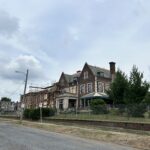
This year’s other Preservation Award recipient is the “Fox on Washington,” at the corner of S. 2nd and Washington streets. Built in 1906, this gem of brick and sandstone lies between UPMC Pinnacle, which once owned the property, and the now-shuttered Paxton Fire Station.

Originally home to the Fox Hotel and, starting in the 1930s, Santanna’s Seafood House, the three-floor structure was meticulously restored and redeveloped by Harristown Enterprises. It now houses two stylish two-bedroom apartments, and six one-bedroom units.

The handiwork of Trinity Construction Group of Steelton and Camp Hill-based architect By Design Consultants, all residences have granite countertops, wood vinyl plank living room floors, metal console washstands, tiled showers with glass enclosures, stainless steel appliances and full-sized washers and dryers.

The exterior has both original and harvested sandstone, said Brad Jones, Harristown’s president and CEO. Renovators replaced masonry, restored a sagging turret and installed architectural-series windows.

Jones said that his favorite part of the 114-year-old boutique building is the façade, offering an attractive entry both to Shipoke and downtown Harrisburg.

“They don’t build buildings like this anymore,” he said. “We’re really proud of it.”

Fox on Washington

Complete Block

Like the Fox on Washington, Elementary Coffee’s new location was once home to a restaurant, the popular Coventry eatery. Built in the late 1860s, the structure was one of the oldest remaining homes in the Capitol area neighborhood.

Krupp, working with Alli Lin, LLC, acquired the property in late 2017 from the Harrisburg Redevelopment Authority and began renovation in early 2018. Work ended in the fall of 2019.

Krupp said the south- and east-facing façade is original brick. They removed the rear of the building and installed permeable pavers to allow environmentally conscious natural drainage, providing seven parking spaces and egress.

They also removed the third-floor dormer attic, which was unusable space, and transformed it into dramatic, 19-foot-high cathedral ceiling space. The second floor holds two 800-square-foot, one-bedroom, one-bathroom apartments.

New sidewalks and trees were added in the front, along with custom-made curved windows on the front and side.

Krupp said the once-dilapidated building is a key piece of the puzzle in the “complete block” concept. Already, North Street boasts a coffee shop, upscale restaurants, a diner, eye doctor, hair salon, mechanic and gym.

“There’s been so much investment in this block in the past two years,” Krupp said.

The Impact

According to HHA’s David Morrison, the HHA Preservation Committee selected the award winners, with final approval from the board of directors. The committee examined the quality and extent of restoration, the impact on the surrounding neighborhood, and the degree to which demolition or loss was prevented or history was preserved.

The old Coventry building “adds greatly to the vibrancy of a property so close to the Capitol Complex,” Morrison said.  “They literally saved a building that would have not survived without this restoration.”

Morrison lauded the old Coventry’s “historic exterior and dramatic interior.” He ticks off the many other buildings along that leafy stretch of North Street from memory, including the state headquarters of Preservation Pennsylvania, and at Green and North streets, a building with a “very rare” cast-iron façade, typical of the 1870s and 1880s.

“That’s what makes that neighborhood very special,” he said.

Coventry was a holdback in a row of rejuvenation, he said, but is now another gem.

He added that the Fox on Washington “is the gateway to center city Harrisburg.”

“That’s one of the first things you see,” he said. “If that were to be demolished, it could have led to the entire block being demolished. The whole character of the experience of arriving in Harrisburg would have changed dramatically.”

And that’s just the exterior.

“They did a magnificent job of taking a building that was under-utilized for a number of years and finding a way to make every square foot functional and usable,” Morrison said.

Renters will enjoy living at the edge of Shipoke, he predicted, just a block away from the stately John Harris Mansion.

“It’s a very desirable neighborhood,” Morrison said. “And the historic setting is kept intact.”

Washington Street is populated with beautiful historic rowhomes, with brick sidewalks and mature trees.

“It would have been a shame to be replaced with a modern building or parking garage,” he said. “It’s the impact that we are looking for.”

Historic Harrisburg Association’s annual Preservation Celebration and Toast will be held on Sept. 20. For more information, visit www.historicharrisburg.org, contact HHA at [email protected] or 717-233-4646.

Continue Reading

Flay It Again, Sam: Rosemary finds inspiration for a fresh, summery meal

Those of you who read this monthly column know that I love cookbooks.

From the first Betty Crocker cookbook given to me by my mother many years ago to the treasured “Patsy’s Italian Family Cookbook” purchased at the actual Patsy’s restaurant in New York, I often read them as if they were novels. I want to learn more and more about different foods and how to prepare them.

I like watching the Food Channel too, and an old favorite of mine is Bobby Flay’s “Boy Meets Grill.” Bobby has a list of cooking credentials a mile long and is the owner of such acclaimed restaurants as the Mesa Grill in Las Vegas, Bar American at Mohegan Sun, Gato in New York City and multiple locations of Bobby’s Burger Palace. His cooking usually leans toward southwestern but, in his newest cookbook, “Bobby at Home,” he describes his love for Italian cooking, too. He says that his childhood in Manhattan, shared with many Italian friends, has resulted in an ability to make an unrivaled marinara sauce.

I have enjoyed reading “Bobby at Home” not just for the recipes, but for his anecdotes about his summer cooking adventures with family and friends. As a lowly cook in central Pennsylvania, I too have always believed that cooking means sharing and making memories with those you love. (Just minus the house in the Hamptons.)

With August, the end of summer is approaching. For me, the seasonal fresh produce has always been an Italian cook’s dream: the best tomatoes, thick-skinned red bell peppers that are perfect for roasting, and, perhaps my favorite of all, eggplants. Bobby offers a wonderful eggplant recipe that can serve as a vegetarian entrée or as an addition to a larger antipasto table. His suggestion to use baby eggplants is a good one, as they are much sweeter and tenderer than their larger counterparts. With the addition of creamy, fresh ricotta cheese, ripe red tomatoes and fresh basil, it is Sicily on a plate.

Grilled Baby Eggplants with Fresh Ricotta and Farm Stand Tomatoes

Ingredients

  • 3 large, ripe beefsteak tomatoes, halved, seeded and diced
  • 1 garlic clove, smashed
  • 12 fresh basil leaves, thinly sliced
  • ¼ cup chopped flat-leaf parsley leaves
  • Kosher salt and freshly ground pepper
  • 1 cup fresh whole milk ricotta cheese
  • 1 teaspoon finely grated lemon zest
  • 4 baby eggplants, halved
  • ¼ cup canola or olive oil

Recipe

  • Combine the tomatoes, garlic, basil and parsley in a large bowl and season with salt and pepper. Let the mixture sit at room temperature while you prepare the eggplant for up to 2 hours. (I like to drain off any excess liquid that accumulates.)
  • Combine the ricotta and lemon zest in a small bowl and season with salt and pepper. Cover and refrigerate while you prepare the eggplant.
  • Heat your grill to high, or you can use an indoor grill pan, if you prefer.
  • Brush the eggplant halves on both sides with the oil and season with salt and pepper. Grill the eggplant, cut the sides down, until golden brown (about 4 minutes). (I usually turn my grill down to medium for most things to avoid burning.) Flip the eggplant halves and grill the bottoms until they are golden brown too (about 3 minutes more). Test gently with a small fork to make sure the eggplant is tender.
  • Transfer the eggplant to a platter, cut side up, and top each half with a “dollop” of ricotta. Spoon some of the tomato mixture over each mound of ricotta. (The plate looks lovely with some extra basil leaves scattered around for garnish.)

Try the eggplant with some nice, crusty Italian bread and a crisp cool white wine (maybe a Verdiccio or a soave). Along with a little fresh fruit, this is a simple, but perfect dinner on a warm summer evening.

I’m going to stick with Bobby for a while, I think. Next on my cooking list is his “End of Summer Tomato Soup,” “Swordfish with Plum Sauce” and “Green Chili Cheeseburgers.”  And I am definitely thinking about leaving my favorite gin and tonics temporarily behind for Bobby’s “Mesa Margaritas.” On the rocks and no salt!

Enjoy the last full month of summer, everyone.


Continue Reading

Agriculture Restructure: Farmers shift gears amid the pandemic

Lucas Brownback is sitting on a cash crop.

“We’ve been preparing and hoping for a year like this—we just wish it wasn’t under these circumstances,” said Brownback, a second-generation farmer who co-owns and operates Perry County’s 300-acre Spiral Path Farm with his brother, Will.

For the past 10 years, shares of Spiral Path’s certified organic CSA program have remained steady at around 1,200 members. But in 2020, more than 400 new members joined.

“The pandemic happened at the midway point of our seeding,” Brownback said. “So, once we started to see the huge surge, we upped our plans and fields.”

Over the course of the season, the farm grows about 50 types of vegetables, plus a few varieties of fruit. Produce is harvested and distributed weekly at 35 different locations throughout five counties—Cumberland, Dauphin, Lebanon, Perry and York.

“Customers were first and foremost excited to lock in their produce share because of the food shortage they were seeing at grocery stores,” Brownback said. “And people are very grateful for our contactless pickup.”

The honor system is in place at Spiral Path’s pickup sites. The day we talked, CSA boxes were being packed with zucchini, lettuce, beets, parsley, kale, cucumbers and garlic scapes.

But that’s only half the story. While half of the farm’s produce supplies CSA members, the other half stocks Wegmans grocery stores along the east coast. That market is reliable and steady.

Brownback said most local farmers are seeing a huge demand for the fruits of their labor. Many consumers prefer buying fruits and veggies directly from growers amid the pandemic.

Spiral Path, unlike some CSAs, accepts new members throughout the growing season, so consumers can sign up at any time. Boxes of produce are distributed weekly through Christmas.

Cash Cow, Canceled

Alec Dewey, like many of us, saw his world change in the blink of an eye when the pandemic hit.

“It feels like forever ago,” said Dewey, president of Harrisburg Dairies. “In early March, our volume was at an all-time high. We had put in a new production line, taken on new business, and we were on a growth path to have a record year.”

More than half of Harrisburg Dairies’ business is tied to the food service and distribution industry, including schools, colleges and restaurants, nearly all of which were closing due to COVID-19.

“Our volume dropped off by 40% in March and sent things in a troubling direction,” Dewey said. “But cows don’t know anything about a virus, so, at the same time, the milk was still coming in.”

With some of his markets drying up, Dewey found himself “in a big-time surplus.”

Typically, 200,000 gallons of milk flow into the Herr Street facility from 30 farms across five counties weekly. Harrisburg Dairies processes, packages and distributes the calcium-laden beverage across nine states—some of which is further distributed by partners to additional east coast states.

“We were one of the processors that had to dump [thousands of gallons of] milk—once in April and once more in June,” Dewey said. “It was heartbreaking because we have close relationships with every farm going back generations. Their fathers worked with my father, or their grandfathers worked with my grandfather.”

Dewey’s great grandfather founded Harrisburg Dairies in 1931. The business will celebrate its 90th anniversary in March 2021.

“The natural reaction from people, when they hear about dumping milk is, ‘Why don’t you just give it away?’ But it’s not as easy as it sounds,” Dewey said. “The milk has to be picked up, processed, bottled, then to give it away—there are pricing laws… It’s not legal to give away milk. It’s an unfair competitive situation for grocery stores and other dairies.”

So, when people started reaching out to him, offering to buy milk, and asking if he would facilitate the delivery, he said yes. Under the federal CARES Act, charitable groups can organize milk giveaways and be reimbursed.

To date, Harrisburg Dairies has supplied milk to several dozen community giveaways, at least two per week, through churches and other organizations.

“Sometimes, a truck full of milk is gone within the hour, with people lined up down the street,” Dewey said.

Several state and federal programs are designed to give farmers a helping hand.

Part of Pennsylvania’s share of the federal CARES Act funding, $15 million worth, is supporting direct relief payments to dairy farmers. An additional $5 million is reimbursing dairy farmers who donate excess products to the state’s charitable food system, officially called the Pennsylvania Agricultural Surplus System (PASS). Dairy farms that discard milk will each receive at least $1,500 in what’s being called the “Dairy Indemnity Program.”

“We anticipate—of 5,700 dairy farms—4,500 applications,” said Shannon Powers, press secretary for the state Department of Agriculture. “We’ve received more than 200 so far, mostly by mail. Because our offices are closed, someone has to physically go to the building to pick up the mail to process the applications.”

Over the past three years, Pennsylvania’s milk production has steadily increased to 10.2 million pounds annually. Nationally, only one state has more dairy farms—Wisconsin.

Powers said that dairy farmers have a deep-rooted work ethic and empathy for others, which makes milk dumping all the more painful.

“Aside from the financial pain, it’s hard to see what you’ve produced go to waste,” said Powers. “And, as part of Pennsylvania’s farming culture, there’s a tremendous desire to help neighbors when you can.”

For more information, visit spiralpathfarm.com. Visit Harrisburg Dairies’ Facebook page for information on milk giveaways.


Continue Reading

Best in Glass: Brooks Hemauer has made the leap from award-winning amateur to professional brewer

In an article titled, “The Winner Effect,” author Eugene Sheely explained that, when people compete and win a contest, large amounts of dopamine and testosterone are released into the brain.

“Over time, changes to their brain structure and chemical makeup occur, making them more confident, smarter and able to take on larger challenges over time,” he wrote.

Brooks Hemauer may not have realized this when he won first place two years in a row at the Iron Brewer contest in Lancaster, but one thing he can attest to is that the recognition buoyed his spirits and inspired him to “up his beer game.”

Hemauer’s foray into the brewing business began with an IPA kit and an end product that he enjoyed.

“I continued to brew, and soon it became a passion of mine,” said the Dillsburg resident, whose next step was to join the Sons of Alchemy, a local home brewing club that has spawned many beer careers. Homebrew festivals followed, as did the compliments. According to Hemauer, the question asked most often was, “Where can I buy your beer?”

This prompted him to consider the prospect of selling his suds and pursuing his passion. Soon, he was bidding goodbye to his job in the automotive business and embracing the position of brewer.

“The game plan was to have our production facility at our detached garage in Dillsburg,” said Hemauer, who soon hit roadblocks at the local government level. “We needed a special exemption to brew beer as a rural occupation in the rural agricultural zone where we live.”

Determined, he returned to the drawing board, and the second time ended up being the charm. This time, he brought in studies to bolster his argument.

“We had to verify that we weren’t depleting the aquifer for other homes in the area,” he said.

By September 2019, Hemauer was licensed and began selling beer to bars and restaurants. It wasn’t long before his thoughts turned to the benefits of brick and mortar. This led him to open a taproom at the Wesley Drive Plaza in Mechanicsburg near the Peppermill restaurant.

New Digs

The new Hemauer Brewing Co. taproom spans about 1,400 square feet and seats about 49 people.

Brooks’ wife Shannon has joined him in serving the public and running the business. The couple would like to report smooth sailing since the inception, but COVID-19 has put a crimp in the best-laid plans.

“We were three days away from receiving our liquor license when they halted field inspections,” said Hemauer, who then contacted the beer trade group, the Brewers of Pennsylvania. “They have an attorney on retainer, and we were put in touch with him, and he was able to expedite things.”

The couple opened to the public on May 1, offering a wide variety on tap.

“We have sours and barrel-aged beers, with a rotating selection that varies weekly,” said Hemauer.

Available on most days is their flagship Helles lager. Out of all the selections, the Lucky Lobsta is the most popular.

“It’s a New England-style IPA,” said Hemauer, adding that its popularity can be attributed to the “haze craze.”

Untappd, a beer-focused social media app, describes the Lucky Lobsta as “a beer with a soft, silky mouthfeel that is purposely hazy from the use of oats.”

Another popular selection, according to Hemauer, is “Wild Ways,” a wild yeast fermented saison created with a yeast that was captured at the garage where he brews in Dillsburg.

“I am the keeper of that yeast, and no one has it,” Hemauer said.

The Hemauers also offer seltzer with a rotating selection of pineapple, black cherry, passion fruit and mango.

As for food, they keep it simple, with items like pretzel braids, chips and salsa, a three-cheese grilled cheese and a spicy Italian panini, to name a few.

“People expect to be able to order food when they visit a taproom,” Hemauer said.

Kelly Coons of Dillsburg said that she began to frequent the establishment after becoming acquainted with the Hemauer brand at the PA Flavor festival during Harrisburg Beer Week.

“We sampled an amazing beer and began asking them where we could find more of their brews,” Coons said. “After learning that they were in Dillsburg, we kept a close eye on them.”

Coons said that she visited the day after they opened the taproom to grab some of their 32-ounce crowlers.

“I love their brews, their creative names, and their knowledge and recommend stopping in for a flight,” she said.

Carlisle resident Marsha Cleff said that she enjoys visiting with the couple now that the taproom is open for dine-in.

“With so many new breweries on the scene, a brewery needs a niche, and theirs is easy to see,” she said. “The logo is an ‘H,’ which I am convinced stands for home!”

Hemauer said that there’s a reason there are no televisions in their taproom.

“We want neighbors to meet neighbors, and we enjoy all the conversations,” he said.

As for COVID-19, the Hemauers are determined to ride the storm out.

“We [breweries] are not all going to make it, but my wife and I are trying to position ourselves for it, and it’s gratifying to be your own boss,” he said. “That way, the fires I put out are all my own.”

Hemauer Brewing Co. taproom is located at 1010 Wesley Dr., Mechanicsburg. For more information, visit their website at www.hemauerbrewingco.com.


Continue Reading

Educated Guess: As back-to-school plans take shape, educators try to plot their way through the pandemic

When Gov. Tom Wolf ordered schools closed in March, nobody was ready. No educator had planned for something like this. Most didn’t have the online resources readily available to teach remotely.

However, some schools switched gears faster than others.

“We gave the students a three-day vacation and, by Thursday, we were up and running,” said Phil Puleo, superintendent of the Christian School Association of Greater Harrisburg. “It was a Herculean effort by the teachers and parents.”

After weeks of online schooling, students, parents and educators could finally let out a collective deep breath. They had made it to summer.

It’s August now, but things remain unsettled. The pandemic is still with us, so people are back to holding their breath, wondering what the year is going to look like.

Some schools are returning to in-person classrooms, while others are sticking to online or testing a hybrid of the two. Many have pushed the fall start date back, and most have back-up plan upon back-up plan ready. All are trying to put their best foot forward in a future full of unknowns.

“We are really concerned about our kids’ health,” Puleo said. “But we also are really concerned about their education.”

Class In-Session

The Christian School Association of Greater Harrisburg (CSAGH), which includes Harrisburg Christian School and West Shore Christian Academy, plans to bring its students back to its brick-and-mortar buildings in the fall.

“We think we can do this in a reasonable and responsible way,” Puleo said.

The two schools will open on time, on Aug. 18, with daily temperature checks, spaced-out desks, scheduled hand-washing times and regular cleaning.

Puleo explained that the learning environment will be flexible. “Window into the Classroom” is what CSAGH is calling its online instruction program. Students not ready to come back to school for health reasons, among others, can live-stream classes online.

“We are really trying to make sure everyone is comfortable going forward and that the education and community they are used to continues uninterrupted, whether they need to be on or off campus,” Puleo said.

Harrisburg Academy, a private school in Wormleysburg, is taking a similar approach with in-person education and a virtual option. They too will require daily temperature checks, regular sanitation and social distancing. In addition, mask wearing by students will be mandatory.

“We adopted the stiffest rules we could, and I believe we have a safe environment,” Head of School Adrian Allan said.

To Allan, school is more than academics. It includes social and physical elements, among others. That’s why it was so important for him to bring students back.

“I look at this in terms of what’s best for the whole child,” he said. “If you’re going to be a flagship premier school, you’re going to have to go further than other schools.”

But some schools are increasingly finding that not all families are comfortable going back.

While most schools are caught in the changing winds of the pandemic, cyber schools have remained firmly planted, already with a leg up on the situation. They may even be benefitting from the crisis.

“As school districts unveil plans for fall, we expect to see an uptick in enrollment,” said Tim Eller, senior vice president of outreach and government relations at Commonwealth Charter Academy.

Already fully online, the public cyber charter school was largely unscathed by the coronavirus crisis, aside from moving their graduation ceremonies online. Everything else continued without a hitch, Eller said.

For this reason, he believes that cyber-school is the most stable option for students during the pandemic.

“Since everything is done virtually, there will be no disruption to CCA students,” Eller said.

At the Pennsylvania Cyber Charter School, virtual education continued just like at CCA’s, but, for CEO Brian Hayden, things were hardly normal.

“While our students didn’t change the place they went to school, their family life changed significantly,” Hayden said.

He acknowledged that, for many students, internet access created an issue with multiple family members at home needing access at the same time. In addition, much of the PA Cyber staff consists of parents with young children whose daycares were closed. It was a challenge just to make sure they were able to teach, Hayden said.

“From the teaching perspective, we learned what worked and didn’t work,” he said.

Moving forward, PA Cyber is already seeing higher enrollment inquiries than last year. Whereas these inquires don’t typically come in until late July, the school was witnessing an uptick as early as June.

“I think cyber-school is a great option for those who choose it,” Hayden said.

Getting Creative

Capital Area School for the Arts (CASA) has been working on their classroom expansion project to add more room for STEAM and other courses on the third floor of Strawberry Square.

The plan is for the project to be completed by the start of the new school year. This is perfect timing, as it will give students more space to spread out when they return, said Tim Wendling, CEO and principal of CASA.

“Even though there’s so much going on, we are really excited to have our brand new space,” he said.

The public charter school plans to conduct a hybrid model of learning that incorporates rotating days of in-person and virtual classes starting Aug. 31. They have alternate plans prepared in case they decide to move to all in-person or go fully online.

“As we plan, we are being realistic,” Wendling said. “Our main goals are to provide the best instruction and make sure all are safe. With this, everything is unknown, so we are trying not to worry.”

The Harrisburg School District has been trying to do the same. But many of its families are hesitant about sending their students back.

Chief Academic Officer Susan Sneath said that many parents reached out to the district, saying they didn’t want to send their kids back to a brick-and-mortar school.

In response to that, the district created their Harrisburg Virtual Learning Academy (HVLA), which will provide district students with a free cyber option for learning.

“I wouldn’t be in public education if I didn’t think brick-and-mortar was the very best way to educate kids,” Sneath said. “However, my hope and dream for HVLA is that parents in Harrisburg feel that their school district is supporting what they want.”

HVLA is for district students K-12. They will be able to participate in district sports, clubs and events and will graduate as a Harrisburg Cougar.

As far as the district’s plans go for its traditional students, they weren’t finalized as of this writing. An update made in July by Superintendent Chris Celmer suggests there may be a mixture of online and in-person learning. Desks will be spaced six feet apart and, in compliance with the order made by PA Secretary of Health Rachel Levine, masks will be worn inside the buildings. The school is also considering a new bell schedule to reduce the flow of traffic, according to a statement made by Celmer.

The district’s start date has been pushed back to Aug. 31.

Plans for the upcoming school year are fluid and changing, along with the times. Every school, every district and every family is doing its best to balance education and safety. It really is a learning curve.

“It’s going to take a lot for us to get used to,” Puleo said. “It’s scary, it’s unknown, but as a caring community, we are providing for the academic, social and health safety of our students.”

The Christian School Association of Greater Harrisburg is located at 2000 Blue Mountain Parkway, Harrisburg. For more information, visit www.csagh.org.  

The Harrisburg Academy is located at 10 Erford Rd., Wormleysburg. For more information, visit https://www.harrisburgacademy.org/.

The Commonwealth Charter Academy Harrisburg Campus is located at 1 Innovation Way, Harrisburg. To learn more, visit www.ccaeducate.me.

The Pennsylvania Cyber Charter school office is located at 652 Midland Avenue, Midland. For more information, visit www.pacyber.org.

The Capital Area School for the Arts Charter School is located at 150 Strawberry Square, Harrisburg. To learn more, visit www.casa-arts.org.

The Harrisburg School District office is located at 1601 State St., Harrisburg. For more information, visit www.hbgsd.k12.pa.us.  


Continue Reading