




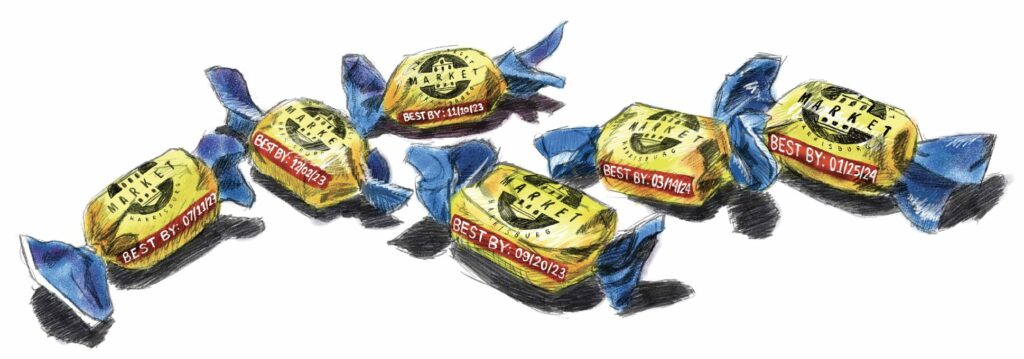
Illustration by Rich Hauck.
I thought hard about whether I should write another column about the Broad Street Market.
After all, my last piece was just two months ago, and I’ve served up several others over the past year.
However, this month marks a year since the devastating early-morning fire that ripped through the historic brick market building, closing the 150-year-old structure and displacing about two-dozen vendors and thousands of customers.
If you’ll bear with me, I believe that I have one more column in me as we mark this sorrowful anniversary. So, where have we been?
The morning following the fire, Gov. Josh Shapiro, along with other officials, gathered in front of the market and made a big show of promising to marshal government resources to quickly restore and rebuild the market.
“This market matters; it’s mattered for more than a century,” Shapiro said before a circle of TV cameras. “You’re going to see government at all levels now work together. We are all now going to come together and do what’s necessary to support the rebuild.”
We wanted to believe him. We wanted to believe that he’d pull a Harrisburg version of the I-95 bridge overpass, which was fixed in 12 days, to great acclaim.
But it wasn’t to be. As I write this, work hasn’t even begun on the restoration, the building sitting as a sad, burned-out ruin for a year and counting.
And when the city said that the temporary market would be open in weeks, by Labor Day, we wanted to believe that, too.
But that also wasn’t to be. As it turned out, the city had the wrong summer holiday in mind, as the temporary market finally opened 10½ months after the fire, the following Memorial Day weekend.
Both major parts of the project languished. Displaced vendors lost hope and left. The public fumed.
I realize that hindsight is 20/20, and, if I had been in charge, maybe I wouldn’t have done any better. But, given a year’s worth of hard lessons, we should be able to soberly assess the situation. Perhaps it’ll prove valuable for the next major city disaster, which, God willing, won’t happen in my lifetime.
Owner/Advocate
Major projects need an empowered, organized individual who can make things happen. That person needs to be responsible for shepherding the complex undertaking from day one, as a primary part of their job. They also must have the ear of decision-makers, be able to cut through the red tape, herd the cats and crack the heads. They must understand all the moving parts and play the role of passionate, tenacious advocate. The Broad Street Market didn’t have such a person, despite yeoman’s work by some city staff whose plates were already full. Despite Shapiro’s pledge, the project often was treated in the same slow, business-as-usual way of plodding, distracted government, instead of as the profound emergency it was and still is.
Unified Effort
Since I’ve been in Harrisburg, one thing’s been constant—the unending feud between the administration and City Council. It’s the same story, year in and year out, no matter the mayor, no matter the council. You’d think that an unmitigated disaster like the market fire would bring our elected officials together for a common cause—and you’d be wrong. Official Harrisburg never united behind this effort, which became an increasing problem as all parts of government needed to communicate and cooperate. For its part, council seemed mostly to want to ignore the whole thing, even after the market sank into insolvency and had to pass around the hat, relying on private donations to pay its bills. Then, when forced to act, council immediately reverted to its default divisiveness.
Board Quality
Many nonprofits creep along with substandard boards of directors: political hacks, résumé builders, no shows. Over the years, the Broad Street Market board has had all of these, along with some quality members. The board, though, was caught flat-footed when disaster struck. What’s that old saying—this isn’t what we signed up for? Several members left, as did the market’s over-his-head director. Fortunately, a few capable, concerned residents stepped up, repopulating the board, thinking creatively and making key decisions to keep the market functioning.
I’ve given a lot of thought to what’s transpired over the past year. One through-line, I believe, is that many Harrisburg officials didn’t—and maybe still don’t—understand and appreciate the market’s importance to the community.
Sure, the market is a major source of fresh food, one of the few in the city, which, alone, should have focused minds (and didn’t). But it’s so much more.
The Broad Street Market is a wonderful, wacky, loud place where people of all races, classes and cultures mix, mingle, shop and dine. Walking in, you may see people talking, laughing, fighting, flirting, sleeping, eating, playing, plotting.
It’s where a biker sits next to a businessman, where kids chat with retirees, where folks from every neighborhood wait together for a sandwich, where the Amish brush up against the barflies.
Harrisburg tends to be a transient place, one without a deep sense of shared roots or fate. But, if there’s a center of city life here, it is, without question, the Broad Street Market.
Lawrance Binda is publisher/editor of TheBurg.
If you like what we do, please support our work. Become a Friend of TheBurg!