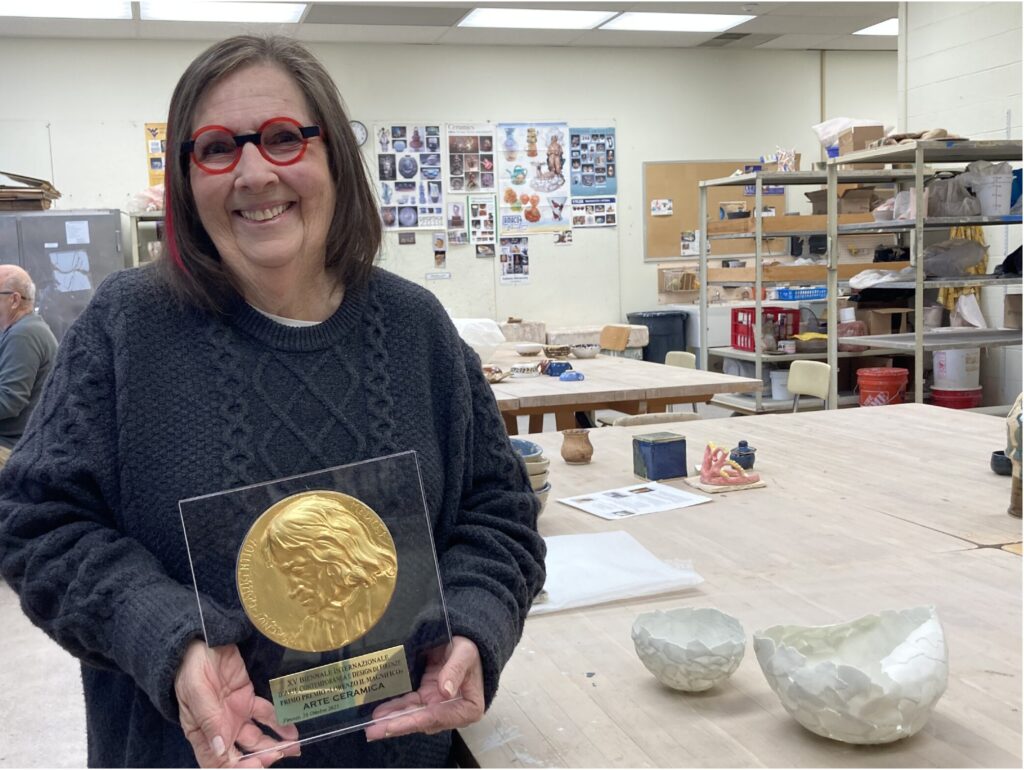
Stephanie Wallendjack holds her first-place award in “Ceramic Art” from the 2025 Florence Biennale in Italy.
Stephanie Wallendjack’s ceramic art is not meant to be perfect.
It is not what she’s going for.
“I kind of like the failures—I embrace them,” the 75-year-old said from a clay-stained table in Room 126A at HACC’s Rose Lehrman Arts Center.
In 2017, the South Hanover Township resident found herself at a ceramics class at HACC post-retirement. After a lifetime working in science, she began exploring art through the community college’s 65+ program, which allows seniors to take most credit courses for free.
She took art history, metalsmithing, glassblowing—but with pottery, she found herself hooked. She is now one of 12 participants in a workforce development program that allows seniors to use studio space at the college.
“I found a really good incubator for this creative voice I didn’t know I had,” she said.
Eight years later, she was in Italy winning first place in “Ceramic Art” at one of the world’s most prestigious art exhibitions, the 2025 Florence Biennale in Italy.
“Totally unexpected, but also very validating,” Wallendjack said of the experience. “It’s amazing that you can still open new doors and have new discoveries at any stage in your life.”
The discoveries are what she enjoys about pottery.
Once a nurse in a cardiology unit and later a researcher who reviewed clinical drug trials, Wallendjack is a self-professed “science geek,” who loves intellectual puzzles and details.
She seems more interested in the process of creation than her works’ ultimate forms.
If her pottery sculptures crack or flake, it does not rattle her. She thinks of it all as part of the journey.
“Like this piece,” she said, gesturing to one of her works. “You can tell this collapsed, but I love that.”
She then pointed to a big plaster mold on her desk, where one of her newest clay creations laid drying. Her medium of choice, a mix of paper clay and porcelain, draped over a large balloon that she poked a hole in and drained slowly of air.
“When I started playing with clay, I promised myself to not construct anything functional,” she said.
She pulled the balloon away, leaving a shell-shaped fixture behind. Scaly, small pieces of layered clay that, when dry, would allow varying levels of light to pass through.
Wallendjack takes inspiration from repetitive, chaotic patterns found in nature. An entomology lover, she pointed out its resemblance to a mud wasp nest—although, she said, it isn’t meant to look like anything.
“I just want to do a dance with the clay,” Wallendjack said.
She determined it wasn’t dry enough to remove from its mold.
“The clay is pretty wet,” she said, looking a few tables over to studio neighbor and fellow pottery artist John Guarnera for advice. Guarnera has been working with ceramics since he was in high school.
Together, they stuffed crumbled newspaper into the vessel and moved it to a high shelf where it could continue drying. Guarnera added a “Do Not Touch” sign to be safe.
He spoke highly of Wallendjack’s work, impressed by her new accolade.
“Here’s someone who has come in with no clay experience, who goes down a rabbit hole with fiber clay, a unique area in which some others dabble, but she is fully invested in,” Guarnera said.
Assistant professor of art Kourtney Stone, who teaches ceramics, explained what makes the material special: it is porcelain clay mixed with paper fibers.
“The paper fibers help make the porcelain behave in very specific ways,” Stone said.
Among these—it can be rolled out thinly, which fits with Wallendjack’s artistic style, and it can be reattached easily, using a little water, if a piece breaks off. The clay also lends itself to fast work, as it dries quickly and resists cracking.
“It meshes with the way her brain works,” Stone said.
The former scientist in Wallendjack can be seen in her approach to art—especially since the process is not always smooth sailing.
“I approach things and they go awry because I didn’t know the rules and I learn from that,” she explained.
She told of one failed experiment: a ball made of “very delicate ribbons of orange, brown and yellow.”
“The whole thing collapsed in on itself,” Wallendjack said.
But she liked the way the mess looked.
“We fired it. It’s one of my favorite forms,” she mused. “I’ve been trying to create ‘controlled collapse’ based on that failure.”
She said that she also learned through trial and error that she hated working with color. The artist now works exclusively in black and white, with an occasional splash of cobalt.
Following her blue ribbon in Italy, she said she is looking for galleries to display her work and wants to start working on an even larger scale.
“It was very humbling being around so many people, most of whom have spent their lives perfecting their craft and finding their voice,” she said. “It gave me confidence to continue to explore these forms and push them even further.”
For more information on Stephanie Wallendjack, visit www.stephaniewallendjack.com.
If you like what we do, please support our work. Become a Friend of TheBurg!