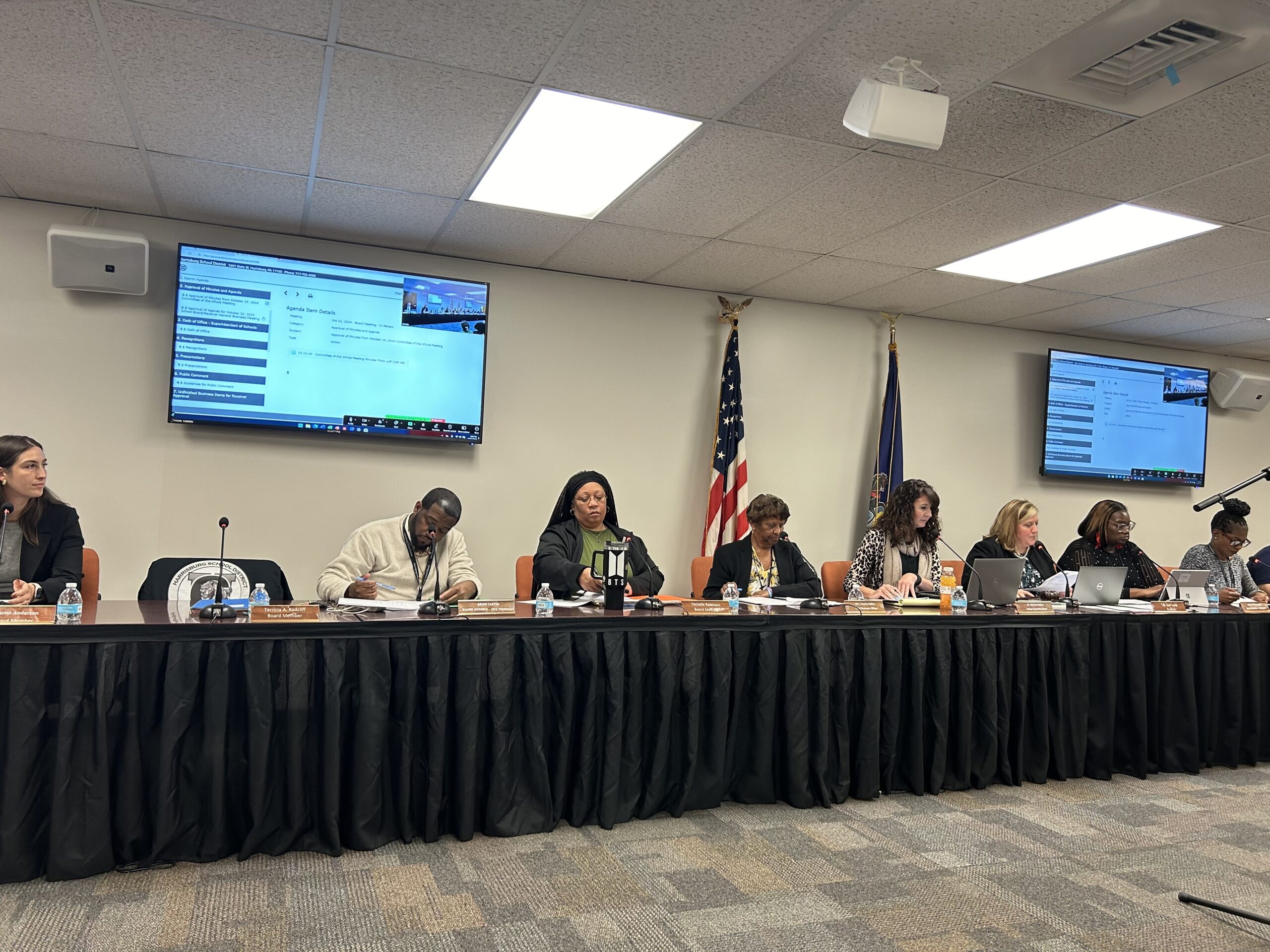
A previous school board meeting
Harrisburg property owners may see a tax increase in the coming year, as the school district seeks to make up for lost funds.
Harrisburg School District officials proposed a 2025-26 budget on Tuesday, while weighing a property tax raise that, they say, is needed to balance a budget impacted by the post-COVID-funding fiscal cliff.
Chief Financial Officer Dr. Marcia Stokes presented a proposed $211.8 million budget, a $5 million decrease from the 2024-25 budget, along with a 2% property tax hike.
The proposal would raise the tax mill rate from 30.78 to 31.4 mills, the first in a series of incremental tax raises that Stokes said the district should make over the coming years.
Even though the tax would increase, Stokes said that homeowners who qualify for the state’s Homestead Exemption would likely see a decrease on their bill, due to increased relief funds and fewer program participants.
Stokes explained that a tax increase is needed to combat less projected local revenue, due to a drop in taxable properties in the city, as well as less projected federal revenue, due to the end of Elementary and Secondary School Emergency Relief (ESSER) funds that brought the district millions of dollars in the years following the pandemic.
School board directors questioned what would happen if they decided not to raise taxes at all. Stokes said that the district would likely have to make budget cuts and that the school district would face challenges in the long run, as it needs to begin raising taxes to maintain a healthy, balanced budget.
“From my professional standpoint, small incremental increases are the way to go, because they are predictable for our homeowners. They are something that’s slowly building the revenue stream that we have to maintain,” Stokes said.
However, district receiver Dr. Lori Suski wasn’t in complete agreement with Stokes about the tax hike—she believes they may need to raise taxes at an even higher percentage.
Most concerning for Suski, the district has petitioned the state to end its court-appointed receivership, an oversight program for distressed districts. The district has been under the state’s watch and control for almost six years. In June, a Dauphin County Court of Common Pleas judge is slated to decide whether or not Harrisburg is ready to exit and regain local control or remain in the program for another three years.
As part of a potential exit, Harrisburg would be required to follow its Amended Recovery Plan, which details goals and objectives to help the district become financially and educationally stable. Part of that plan includes a need to raise revenue through local sources.
According to an outside financial advisory firm, Public Financial Management (PFM), the district needs to raise its property taxes by 4.81% this year to satisfy the Amended Recovery Plan and to balance the budget. PFM put this recommendation, along with recommended future year tax hikes, in a presentation to the Pennsylvania Department of Education (PDE) about the district’s potential receivership exit.
Suski said that she is worried that, if the district doesn’t follow that guidance, they could be placed back under state control.
“We need to look at the long-term goal, and the long-term goal is we’ve worked very hard to exit,” she said.
Currently, Suski said that she expects the court to make a decision on a possible exit from receivership on June 17. The district is slated to adopt its budget on June 24. So, if the district is granted an exit, the board needs to decide if it strictly will follow the Amended Recovery Plan or not. If not, Suski said that she believes the state could seek to put Harrisburg back into receivership, as it is required to monitor the district for five years after an exit.
“It’s like rolling the dice. You don’t know what you’re going to get,” Suski said. “I can’t imagine that they would throw you back in, but I don’t know.”
She also pointed out that the difference in the impact on the average taxpayer, if the board approved the 4% hike over the 2%, would be less than $100.
“I would hate to see all the work that has gone on in this district over the last few years to be down the tubes for just over $80,” she said. “I’m not trying to diminish the impact on the taxpayer. But we also need to remember that local control means local effort, local investment in our school district.”
Under receivership, the receiver has the sole authority and vote on every matter except for taxes. The Harrisburg School Board’s only power is to levy taxes. So, whether or not the district remains in receivership, the board will make the decision on taxes.
Stokes’ proposed 2% raise makes some assumptions on state revenue that she believes the district will receive, she said. She explained her lower tax increase proposal as counting on those funding sources to balance the budget—an assumption that PFM did not make in its assessment, and that Suski said could be risky.
Most years, the district is left to finalize its budget before the commonwealth adopts its budget, which frequently happens late. That leaves Stokes and the administration to make educated guesses on how much state funding it can expect to include in its budget.
This year, Stokes believes that Harrisburg will get extra money through Gov. Josh Shapiro’s proposed significant increase in funds to the Ready to Learn Block Grant. In her calculations, Stokes estimated that the district would get $3.7 million, half of what Shapiro proposed for them in his budget, to be conservative. She also made the estimation that the district would receive the full amount of other state funding that it typically receives annually.
“This is our estimate based on the information we have here today,” Stokes said. “I would expect changes to happen because hopefully we’ll know what our federal revenues are. Hopefully, we’ll have a better idea of what’s going on down the street from the negotiation standpoint to say, ‘how much of our subsidy can we really rely on?'”
However, Suski expressed that even that estimate might not be conservative enough and cautioned the board on not following PFM’s advice for the higher tax raise, afraid that if they don’t, they may not satisfy the recovery plan.
Suski noted that no district in the state has successfully left receivership yet, and so what happens after an exit, including whether or not the district could be forced to re-enter, remains murky.
During public comment, the City of Harrisburg’s Interim Director of Building and Housing Development Gloria Martin Roberts shared concern over Suski’s tax hike proposal, saying that she believes it would negatively impact the city’s low-income residents.
“$100 may seem insignificant, but it’s significant to a whole lot of us,” she said.
The decision on whether or not to raise taxes, and by how much, will likely impact the $211.8 million budget. The budget’s most significant expenditures include salaries and benefits, instructional costs, debt payments and millions of dollars in payments to charter schools.
The proposed budget will be made available for public review before a final vote in June.
For more information, visit the Harrisburg School District’s website.
If you like what we do, please support our work. Become a Friend of TheBurg!