Photo courtesy of Phil Thomas
John Pufnak got a call from city police. He was fire marshal for Harrisburg State Hospital, so somebody wanted him to know that a patient was directing traffic at the busy intersection of Cameron and Maclay streets.
“The cop said he was doing a darn good job,” Pufnak remembers.
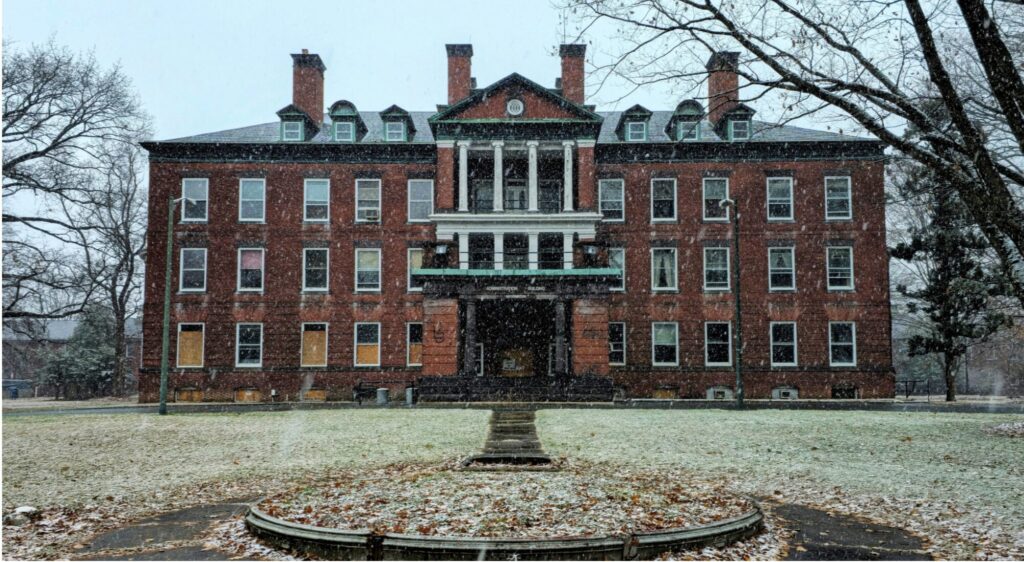
Harrisburg State Hospital hasn’t housed a patient since 2006, but those who tell the story of the historic, 300-acre campus always come back to the people.
By 2029, 400 or 500 people will return to the campus—state employees resettled in shiny new laboratories where they will conduct public health and food safety testing, plant disease diagnostics, air- and water-quality tests, and criminal justice investigations.
The Pennsylvania Department of General Services plans to restore four historic State Hospital buildings and demolish the rest to make way for two gleaming labs. The site’s friends acquiesce to progress while mourning the loss and sharing tales of love, pain and unauthorized use of fire extinguishers.
Family
The staff tagged Pufnak with the affectionate nickname “Fire Marshal Bill,” from Jim Carrey’s “In Living Color” character.
“It was a family,” said Pufnak, of Lower Paxton Township, now retired. “No matter what department you were in, it was that close. It wasn’t like working for a company. You worked with everybody.”
Naturally, there were days when people acted up. Pufnak got the call when a patient turned a water-pressure fire extinguisher on the nurses’ station, giving everyone there a heavy-duty super-soaking.
“They weren’t happy, but all I could do was replace the fire extinguisher,” Pufnak said with a laugh.
Today, Pufnak leads a group of former employees that convenes to share memories. He has toured the closed buildings, lamenting their deterioration caused by time and vandals.
“If our nurses could see this, they would cry,” he said. “These were more than their patients. They were their kids. Most of them said, ‘These are our kids.’ That’s how close these people were.”
A Site Transformed
The state needed a modern, adaptable replacement for its scattered laboratories used by the departments of Health, Agriculture, Environmental Protection and Conservation and Natural Resources, said DGS spokesperson Eric Veronikis. Pennsylvania State Police forensics, serving federal, state, and local law enforcement statewide, also needed a centralized crime lab.
Among the state-owned sites explored, the Harrisburg State Hospital grounds offered a chance to “repurpose a commonwealth-owned property.” By consolidating research capabilities, the project eliminates the costs of five different acquisition and construction processes, which allows the state to invest more in construction of a higher-quality building, Veronikis said.
Construction on the $325 million, 300,000-square-foot joint laboratory is slated to begin in early 2026. Phase 2, including the PSP lab and historic restorations, begins later in 2026, and all phases conclude around 2029.
DGS will demolish 35 hospital buildings, but remnants will linger in preservation of the Administration Building, Chapel, Dixmont Cottage and Dix Museum. All will be repurposed for administrative, training and meeting spaces for the joint-laboratory agencies.
Modern Use
The Pennsylvania State Lunatic Hospital was founded in 1851, in an age of reform, when “personal problems became social problems,” and states devoted institutions to the specific needs of people who were mentally ill, deaf and blind, or “feebleminded,” said retired Millersville University history professor Dennis Downey.
The Pennsylvania state legislature founded its Harrisburg hospital on the “compassionate care” principles advocated by reformer Dorothea Dix. She left her imprint on Harrisburg State Hospital through therapeutic pursuits for patients. Bowling alley. Reading rooms. The wondrous image-projection lamps known as “magic lanterns.”
But in time, ideas of incarceration as a waystation toward rehabilitation evolved into “more coercive warehousing of people,” Downey said. Harrisburg State Hospital kept growing, but overcrowding was always a problem, and deinstitutionalization became one of the solutions.
And then, he said, the question became, “What do you do with these large institutions once you close them?”
In the case of Harrisburg State Hospital, DGS “sought and received input from officials, organizations and other stakeholders with a demonstrated historic preservation interest in the former Harrisburg State Hospital site,” Veronikis said. The buildings saved from demolition were selected for their historical significance, existing condition and suitability for rehabilitation into modern use.
I asked Downey: Is something lost to history when only a partial site is preserved?
“That’s a subject for broad community discussion,” he said. “Not any one person or one entity has an answer. How can it be meaningfully used to not only preserve history and the memory of the people but also meet current needs?”
The Grounds
As Historic Harrisburg Association Board President Jeb Stuart once noted, the Harrisburg State Hospital campus “retains its original topography and park-like setting, a place of profound beauty . . . (that) reinforces the hospital’s historic significance as a place meant to uplift the spirits of those who lived and worked there.”
The redesigned complex will “embrace the landscape,” with a new, natural green area of native trees and meadow plantings to complement the arboretum and grounds, said Veronikis.
Pufnak so rarely used his state vehicle assigned for getting around campus that he got a “use it or lose it” lecture from the garage supervisor. But Pufnak preferred strolling the grounds. It was where patients held picnics, the Patton arboretum blossomed every spring, and the portion of the Capital Area Greenbelt crossing Asylum Run hearkened back to the early 20th-century City Beautiful movement plan for a parkway ringing the city.
The Greenbelt and arboretum will remain open and accessible “throughout the project,” Veronikis said. At completion, additional walking paths will be accessible from the Greenbelt. The ballfield visible from Cameron Street and open to local leagues, currently including cricket, softball and volleyball, will also remain available and “as it is for the foreseeable future,” he said.
City on the Hill
Urban explorer Phil Thomas sees the story of Harrisburg State Hospital in the details. Nicer trim in the men’s wards than the supposedly identical women’s wards. Therapeutic heat lamps left in a dark corner. Tile-walled rooms for water therapy. Isolation rooms for agitated patients. Storage cabinets still marked, “Leather restraints.” Books and VHS tapes in the rooms.
Thomas, of Hanover, is an amateur photographer who has been drawn to HSH since it closed for residents. On his own time, and his own dime, he documented the site’s architecture, history and deterioration for his “City on the Hill” website and Facebook page (hsh.thomas-industriesinc.com).
Although every project, alteration and closing came down to money, Thomas believes, “for the most part, the people wanted to do good. They wanted to help. Harrisburg was a home for the employees and the patients. I’ve heard from former employees who said HSH stands for ‘home sweet home.’”
Thomas worried that further neglect could have caused the loss of structures to fire—as seen just this past December—or collapse. He credits DGS for going “above and beyond” to preserve four landmark buildings when leveling the whole site would have been cheaper and easier.
“Those are staying, and they’re staying mostly original, which is great and will definitely lend itself better to history and people becoming interested in the place than if it was just a plaque in the yard,” he said.
Facing History
Why preserve the history of American institutionalization?
“History is something that happens to people,” said Downey, quoting Arnold Toynbee and C. Vann Woodward. “We have to remember that history is not some dead carcass of facts. It’s something that happens to people.”
To understand where we are today, we have to understand where we came from, he added.
“It’s not just memories but having tangible reminders,” he said. “These sites can serve a public good in reminding us that many of the challenges and problems that we face today have a deep, rich and complex history behind them. A key is to reuse at least some portion of the sites, not only as a memorial but as a way to instruct the public and also lawmakers who won’t know anything about this.”
Veronikis notes that stakeholder suggestions for memorializing the site’s history “have been incorporated into the project design as much as possible,” including plans for an educational memorial marker and incorporating salvaged architectural features into the landscaping.
Thomas pictures a sculpture made from the convalescent building’s copper cupola. His friend Pufnak is glad that the site’s key buildings will remain in state hands and restored for use. He has asked the architects to incorporate their designs with artifacts from the original buildings.
And, Pufnak says, he has a salvaged memento of his own. It’s a water-pressure fire extinguisher, just like the one that a patient turned on the nurses one soggy day.
If you like what we do, please support our work. Become a Friend of TheBurg!