Tag Archives: Harrisburg incinerator

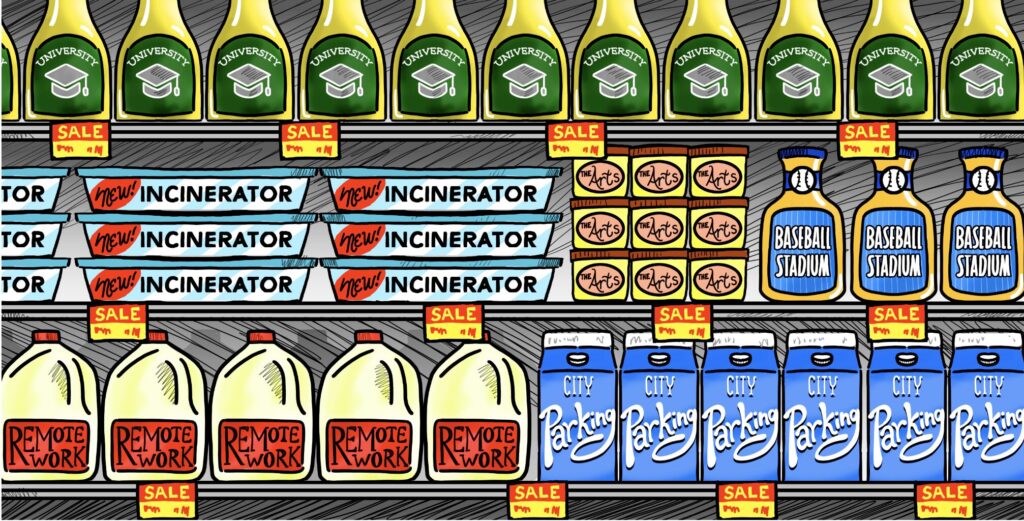
Loss Leaders: A brief history of bad decision-making in Harrisburg

Illustration by Rich Hauck

“What brought you to this lowly state?”

Over the recent holiday season, I watched “A Christmas Story” for the umpteenth time as, maybe, you did too. If so, you may recognize that quote, muttered by the “old man” during the scene in which Ralphie imagines himself poisoned and blinded by Lifebuoy soap.

Hearing that quote, I thought of—wait for it—Harrisburg. Ridiculous, right?

Except that Harrisburg does find itself in a lowly state, and, from online comments, it seems that lots of folks, maybe newer to the city, don’t understand how we got here. How has downtown, specifically, become riddled with closed businesses and empty storefronts? I thought a quick review was in order.

Gather ‘round, boys and girls, and let me tell you about the 1990s.

Britney Spears was cranking out pop hits, “Y2K” was about to destroy the planet, and, in Harrisburg, “mayor for life” Steve Reed was spending money (as my mother would say) like a drunken sailor.

Reed was ambitious, wanting things for Harrisburg found in many other cities: a university, an arts center, museums, a sports hall of fame, a baseball stadium. And he wasn’t about to let the annoying fact that Harrisburg couldn’t afford any of these things get in his way.

At around the same time, the city’s cursed incinerator kept polluting and failing—and polluting and failing. Something needed to be done about that.

So, Reed and his yes-men stumbled upon an “ingenious” solution they thought could kill two birds with one stone. They heard about an experimental technology that, they hoped, would burn trash cleanly, expand capacity and generate electricity. If it worked, the city would dispose of its garbage, get the EPA off its back, and, to boot, pocket some cash, a constant Reed obsession as he pursued his many grandiose, incredibly expensive schemes.

Only it didn’t work—and bad money followed more bad money trying to bang the darn contraption into shape. In a few years, Harrisburg found itself nearly half-a-billion dollars in debt and on the brink of bankruptcy.

In fact, in late 2011, City Council tried to declare municipal bankruptcy but was blocked from doing so by the state legislature, which mandated a receiver instead. A couple years later, the receiver drafted a financial recovery plan that sold off the incinerator and leased the city’s most valuable asset—its parking system—back to the commonwealth for 40 years to pay off Harrisburg’s massive debt.

And that’s how the city lost control of its parking.

So, if you have complaints about the insane rate of street parking, or the insane rate of garage parking, or the insane rate of parking tickets, don’t bother trekking to city hall. They can’t help you. Stroll over to 3rd and State streets, ascend the grand stone staircase and rap on the Capitol’s front door. Those are the guys who control the city’s downtown parking.

Now, to summarize: What brought Harrisburg to this lowly state?

At its core—bad leadership, at the both the state and local levels.

For years, Reed ran amok with the city’s finances and the state, which is supposed to supervise municipal spending, looked the other way. Then, once it all hit the fan, the state prevented the city from declaring bankruptcy and forced it into receivership.

As part of the financial workout, the state took over the city’s parking system, issuing bonds to pay off the city’s creditors. It then hired a parking manager, whose wacko response to weak demand was to keep jacking up rates. Downtown Harrisburg now is one of the most expensive places on earth to park a car, and people have responded by not visiting and not using the system.

But the parking nightmare didn’t end there either.

After the pandemic, the state allowed most of its workforce, most of the time, to work remotely. State employees usually didn’t need to pay for parking, but others did: lobbyists, lawyers, contractors, consultants, caterers, constituents, businesspeople, visitors—each day, tons of people met with and supported the 25,000 or so folks who worked at the Capitol complex. So, in that way, the state sabotaged its own parking regime.

These visitors also supported downtown businesses.  They robustly patronized cafés, lunch spots, hotels and restaurants, often not shy about flexing their expense accounts. For Harrisburg’s small downtown, these customers made a huge difference—today, they’re mostly gone.

Meanwhile, back at city hall, leadership is also wanting. We have virtual gridlock because City Council and the mayor are locked in a bizarre, deeply personal cold war. Instead of joining forces and marshalling resources to help solve the city’s problems and revitalize downtown, they’ve essentially stopped communicating, aside from the occasional dig or media taunt.

At long last, the people of Harrisburg need—and deserve—quality leadership from all its elected officials. In recent Harrisburg history, this leadership has been, at turns, irresponsible, negligent, arrogant and profligate, and it’s a major reason why the city, today, finds itself in “this lowly state.”

Lawrance Binda is publisher and editor of TheBurg.

If you like what we do, please support our work. Become a Friend of TheBurg!


Continue Reading

Virtual Burn: LCSWMA offers online tour of Harrisburg waste facility

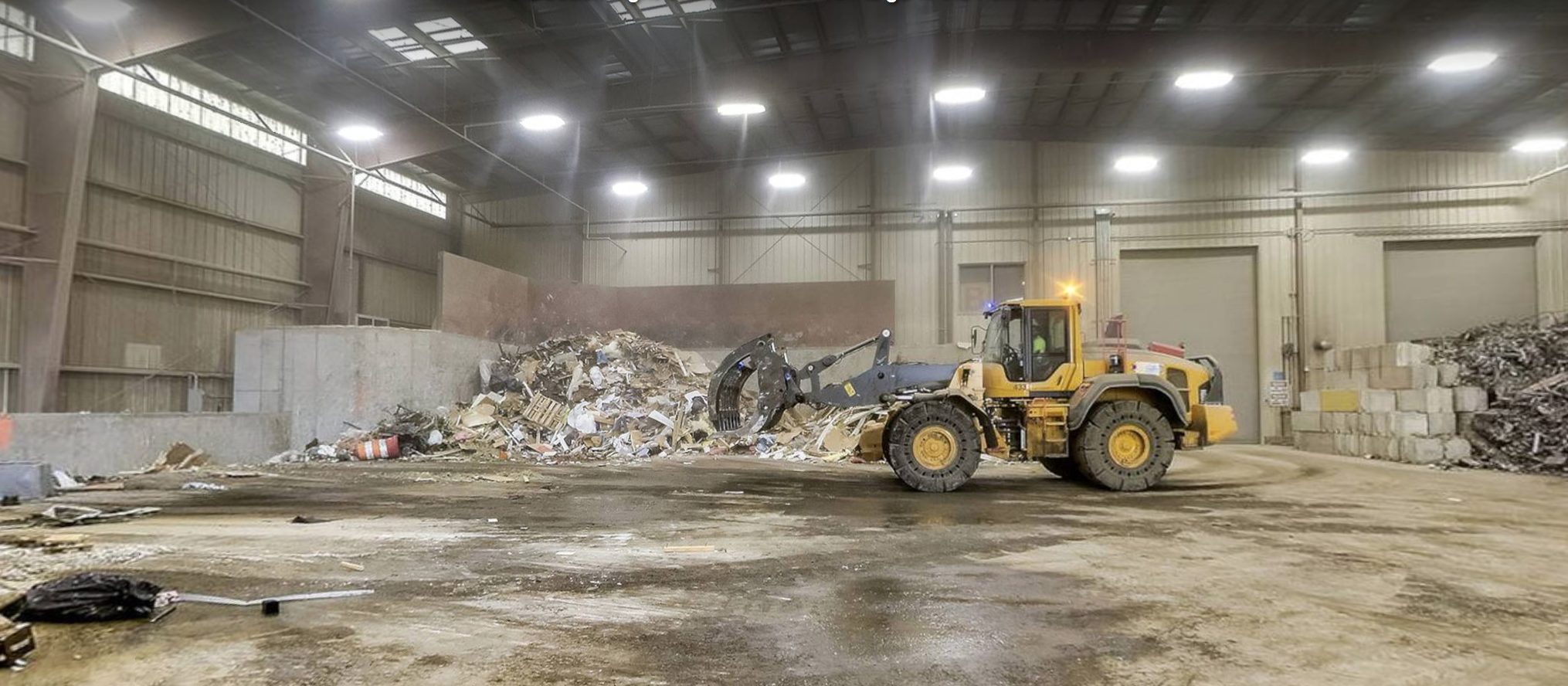
Screenshot from the Susquehanna Resource Management Facility virtual tour.

There’s a new way for Harrisburg residents to see and learn about where their trash goes when it leaves their homes.

The Lancaster County Solid Waste Management Authority (LCSWMA) has recently launched a virtual tour of the Susquehanna Resource Management Facility, formerly known as the Harrisburg incinerator.

“We have found that the best way for people to truly understand what we do as an organization is to take people through to tour it,” said Katie Sandoe, head of communications and public affairs at LCSWMA.

Through the online resource, people can explore a 360-degree view of various parts of the center, including the scalehouse, tipping floor and turbine generator. Additional videos, pictures and a virtual tour guide explain the process of turning waste into electricity.

Sandoe said that LCSWMA takes various groups through tours of the facility regularly, but started to rethink how they could do that during the pandemic.

“We reimagined how we can bring the immersive experience of touring the facility to people where they’re at,” she said. “It’s become a great way for us to amplify our outreach.”

LCSWMA has virtual tours for two of its other facilities, the Transfer Station Complex in Lancaster and Lancaster Waste-to-Energy Facility. They are currently working on creating one for their final location, the Frey Farm Landfill in Lancaster.

Whereas LCSWMA can typically only conduct around 2,000 tours across its facilities in a good year, Sandoe said, over 10,000 people have already completed the virtual tours.

Sandoe hopes that the virtual tours will increase accessibility for people who may not have been able to tour the site in person due to physical challenges or disabilities.

She also sees them as a tool for educators to use in the classroom, especially as part of a STEM curriculum.

Otherwise, it’s a great resource for community members who are simply interested in what the complex does. Many people have heard of the incinerator, but don’t really know what happens at the complex, Sandoe said.

“Typically it’s curiosity that leads people to us,” she said. “People are just interested in how something is made.”

To virtually tour LCSWMA’s Susquehanna Resource Management Facility, visit their website.  

If you like what we do, please support our work. Become a Friend of TheBurg!

Continue Reading

HBG FAQ: Welcome to Harrisburg. Now read this.

Illustration by Rich Hauck.

Recently, I got an early tour of Harrisburg’s newest boutique apartment building.

At the Bogg on Cranberry, the units are fresh and beautiful, but, sure, I understand the kneejerk response among locals when you mention the location—the heart of downtown’s entertainment district.

Who would want to live there, with a birds-eye view of whatever’s going down along 2nd Street late on a Saturday night?

It turns out—a lot of people.

When I was there, the place was buzzing with construction, swarms of workers measuring, hammering and sawing throughout the building’s 11,000 square feet of space. The 12 units had already been leased, well before the building was done. The first tenants were just weeks away from moving in, so the rush was on.

But who were these people and where were they coming from?

“From outside Harrisburg mostly,” said tour guide Brad Jones, CEO of Harristown Development, which owns the Bogg. “They’re newcomers.”

And, after this apartment building was done, Harristown had two more in the pipeline, larger projects on Pine Street, which will add another 69 units to the neighborhood.

That’s great, I thought—new blood, new spending money, a few extra bucks in the city’s pockets. But then I had another reaction, one that can best be described as, “Uh-oh.”

It was a selfish thought, but one born of experience. More new people meant more questions—or, actually, the same questions asked over and over and over again: What is this? Why is this? How do I?

Indeed, Harrisburg is a quirky place with numerous rules and customs you likely have never encountered coming from, say, D.C. or Pittsburgh or another similarly civilized city.

So, as a public service, I thought I’d dedicate this column to answering some of the questions that I’m most frequently asked. And welcome, newcomers, to the often endearing, sometimes perplexing little city that is now your home.

Why is the city called Harrisburg?
The Harris family, natch. You can visit where they lived, then, risking your life, cross the street and see where they’re dead. If you’re new to town, a visit to the Harris Mansion is a must.

Why is such a tiny city the capital of such a large state?
Geography, politics, free land. But buck up. I’ve been to Jefferson City, Mo.

Is Harvey Taylor more than a bridge?
Back in the 1940s and ‘50s, Harvey Taylor was a powerful state lawmaker and powerbroker. But, today, yes, he’s basically a bridge.

So, what, um, happened to Harrisburg?
Depression, deindustrialization, suburbanization, flood, flood, flood. Every city has an off century now and again. So, yes, Harrisburg remains a work in progress. But, trust me, it’s a zillion times better than a decade or two ago.


Who’s this Steve Reed guy I keep hearing about?
Steve Reed was Harrisburg’s mayor for 28 years and, to mangle a phrase from Homer J. Simpson, he was either the cause of—or the solution to—all of Harrisburg’s problems.

I hear that Harrisburg went through some kind of financial crisis. How’d that happen?
Do you know that old cliché about your eyes being bigger than your belly? It’s like that, but, instead of food, the city ate an incinerator, a bunch of museums, parking garages, a university, a baseball stadium and a hundred other things. Essentially, one little city ordered everything on the menu then couldn’t pay its bill.

Is Harrisburg now out of the woods financially?
Maybe.

Why is there a Civil War museum in Harrisburg?
The phony answer is because the war almost reached the city. The real answer is because Steve Reed wanted one here. Just be glad that you’re not asking, “Why is there a Wild West museum in Harrisburg?”

OMG, I heard a gun battle at 7 o’clock this morning!
Those are just duck hunters, because that’s allowed in the middle of a densely populated city, for some reason. Unless it was a gun battle. But it probably was duck hunters.

OMG, I heard explosions at 10 o’clock tonight!
Those were just fireworks. Unless they were explosions. But they probably were just fireworks, to the great distress of every dog in the city.

Speaking of dogs, is it true that Harrisburg is about to get its first public dog park?
It is true, thanks to the good people at Friends of Midtown. For such a small city, Harrisburg is full of wonderful civic and church groups trying to move us in the right direction. Find one that interests you. Become part of the solution.

Will the 3rd Street repaving project ever get done?
That’s what they tell me. Ditto the two-way 2nd Street conversion and the river walk rehab.


Dammit, I’m really mad about schools, parking and street cleaning. I’m gonna give the city a piece of my mind!
You’re not actually mad at the city government, but you are mad at the Harrisburg school district, Park Harrisburg and Capital Region Water, respectively. You’ll need to go complain to them.

I almost got hit crossing Front/Forster/State streets. I’m gonna march right down to city hall . . .
Stop. Also not controlled by the city. They’re state roads. So, you’re gonna have to march right down to PennDOT for satisfaction. And good luck with that. I’ve been trying for years.

What’s the deal with all the bugs?
Yes, the annual outbreak of mayflies is pretty gross, but that’s the small price you pay for living along a wide, gorgeous river.

What’s the deal with all the spiders?
When you have billions of mayflies, you get millions of spiders.

Why does this tiny city have so many fantastic restaurants?
Lawmakers, lawyers and lobbyists like to eat, and we’re the lucky beneficiaries. So, we can all eat and drink ourselves silly thinking about all the land we can’t tax.

What, pray tell, is the Harrisburg beaver?
My new friend, the elusive Harrisburg beaver is a mysterious beast, as deep as the river, as fleet as the freeway and as pleasant as a mid-February day.

Harrisburg’s a weird little place, isn’t it?
Yup. How great is that?

Continue Reading

Waste Not: A Q&A with LCSWMA CEO Jim Warner.

Jim Warner

In 2013, Jim Warner saw a big opportunity—one that required a big risk.

He led his organization, the Lancaster County Solid Waste Management Authority, in making a major acquisition—the financially distressed Harrisburg incinerator. Since then, LCSWMA has invested millions to upgrade the plant and the property, transforming it into the Susquehanna Resource Management Complex, a state-of-the-art waste-to-energy complex.

At year-end, Warner plans to retire as LCSWMA’s long-serving CEO. So, we asked him to reflect on his past and on the career-defining decision to acquire the debt-ridden Harrisburg facility. This interview has been edited for clarity and space.

TheBurg: How did you get into this industry?

Warner: I got out of graduate school in 1984 from Ship [Shippensburg University] with a degree in environmental science. I got a job in Gloucester County (N.J.) as one of the first county recycling coordinators in America.

TheBurg: What year was that?

Warner: That was 1985, when the “garbage crisis” first manifested itself, in New Jersey. So, government responded by saying, “Well, maybe we should recycle part of the waste stream, and we wouldn’t have as big of a problem.” So, counties in the mid-‘80s began hiring . . . professionals to manage and implement recycling programs in a region or a county. Then Lancaster became the first county [in Pennsylvania] to write a comprehensive waste management plan, in 1986.

TheBurg: Where were you from originally?

Warner: I grew up in Lebanon, Pa.

TheBurg: So, you were coming back home?

Warner: Not only that. I went to Millersville for my undergrad and, actually, most of my best friends were from Lancaster. My senior year, I lived in downtown Lancaster. So, yeah, I was coming back. I’ve been here for basically 31 years.
TheBurg: So you became Lancaster County’s recycling coordinator?

Warner: I did. I was like the third or fourth employee in the office. And, during that time, we borrowed a lot of money and built a waste-to-energy plant, built the first double-lined landfill in 1988 and then implemented a recycling program. That year, July 1988, is when Pennsylvania passed their mandatory recycling law under Bob Casey’s administration.

So, I set up the recycling and hired an assistant or two. And my desire was to really get into the business component more. So, then, as we grew, I had a series of promotions and more responsibility until about 1994 or ‘95, when I was sort of the general manager. Then our executive director at the time made a pretty quick exit, and the board of directors decided that I was capable enough to manage the system as it was then, which was not nearly as complicated as it is now. So, as a young 38-year-old, I became executive director and, eventually, my title changed to CEO. The organization went from about $35 [million] to—I wouldn’t doubt if we did $90 million this year and 350,000 tons to 1 million. Some of that was organic, but a lot of it was strategic. Probably the biggest piece ever in that evolution was the acquisition of Harrisburg [incinerator], as far as a big chunk of business.

TheBurg: Let’s talk about Harrisburg then. Take me through the process of how you ended up buying the incinerator here.

Warner: It’s really interesting. As we had a growth spurt from the mid-‘90s to about 2005, we were growing at about 3½ percent per year. So, as we projected that out, it looked like we were going to run out of processing capacity in the Lancaster plant somewhere around 2010.

So, then a couple of things happened. That growth stopped suddenly in about 2007, with the recession. We started evaluating—how would we expand the Lancaster facility?

We started looking at—what would be the cost of doing that expansion? And we had a good model, in that two very similar plants in Florida—one in Hillsborough County and one Lee County—had just gone through that process, where they built a fourth unit. Each one added a 600-ton unit, and their plants went from 1,200 to 1,800 tons per day. And each of the projects cost about $135 million. So, we started modeling about $150 million, figuring we would come a decade after them.

When you do that, there’s sort of a Catch-22. If you put in a 600-ton-per-day unit, that’s 180,000 tons per year of waste going through that unit. The problem is that, when you build a unit, you don’t necessarily have 180,000 tons of waste coming in the day you open it because, if you had, you would have been landfilling all that waste until the day you open the unit. And we never wanted to get into that, where we grew so much but we waited until we could fill the unit with Lancaster County waste. The price to pay would have been too much landfilling of waste. It would have eaten up years of landfill capacity.

So, the other option is, maybe wait until you have 20,000 or 30,000 tons, and then you go and get the other 150,000. And getting the other 150,000 and bringing it in, would have been very difficult to do. And the price we would have gotten for what we call spot trash in the industry wouldn’t have supported the cost of adding a unit like that. We bought some time then because of the Great Recession, and, meanwhile, the timing of Harrisburg’s distress was progressing.

Now, at the time, the [Harrisburg] receiver [William Lynch]—he’s trying to get the highest price possible because there’s $370 million of indebtedness on the plant. [He] wanted an inflated price for the asset, which would be supported by guaranteed waste streams at above-market rates for 20 years, with put-or-pays—guaranteed amount to LCSWMA every year—in exchange for an over-inflated price for the asset. He needed $130 million because they could only value the parking [asset] at $240 million. So, those were the two assets they had: 130 for this, 240 for that.

So, all along, we had asked them—what do you want paid? Because we could make it $100 million, we could make it $80 million, we could make it $130 million. But then here’s what your tipping fees are going to be over 20 years, and the guarantee levels change the valuation. What were they willing to accept as their tipping fee? So, Dauphin County, I think we started at $85, and the city started at $190. But the market is $50, $60. And there was a lot of push/pull there between the city and the county. If you had a blended rate, the city and the county would both be paying $120 or something like that. But that wasn’t going to happen because the county didn’t feel they had as much responsibility for the mess as the city did.

But we tried to stay out of that. We were just coming in and trying to make the asset work for us and, if we could help solve this neighboring problem, that would be good, too.

TheBurg: It seemed to me, at the time, that everything seemed to align together in a serendipitous way.

Warner: If we hadn’t come in, I don’t know how the city would have avoided bankruptcy.

I think the first number we gave them was like $47 million, and people had the impression we were low-balling, but we were giving an at-market price without the guarantees. But, when all of a sudden, they wanted $130 million, then the tipping fees were going to go way up, and the guarantees had to be made on the revenue because we’re paying 20 years forward. We gave them $130 million one Monday morning—Dec. 23, 2013—on the guarantee that they’re going to be paying us some rate times some amount of tons every year for 20 years. And we can never bring that risk to our doorstep, because they got their over-inflated price that morning.

Our risk was that we had to continue to make the asset function for those 20 years. For that, we were relying on our own expertise and know-how of being in the business, and that was a risk we were willing to take on.


TheBurg: So, you bought this thing. What came next?

Warner: I think we’ve put about $22 million in, in the first four years. We added some things that we didn’t think we were going to—we could get by. And there are other things that we didn’t do that don’t need done. This building we’re sitting in, we call it the TMA building, which stands for Transfer, Maintenance and Administration. So, we built this bigger than we had thought. We built 23,000 square feet. We have two transfer bays.

And the reason we made it much more robust than we originally thought was because, the more we thought about it—our arrangement with the city of Harrisburg and Dauphin County is that we’re going to take your waste for the next 20 years. What happens if the main asset doesn’t function? Believe it or not, just in March, we went four days without a unit working because, well, everything seemed to go wrong for four consecutive days. But all the waste came here, the trucks dumped in the transfer building, and we transferred it all to our Lancaster waste facility.

When THA (the Harrisburg Authority) had the plant come down, they would just say, “Take your waste elsewhere. We’re not open.” We, first of all, can’t do that. But, secondly, we don’t want to do that because we want that revenue. With our assets, we can manage it, so that’s why we can do that.

So, this building was $5 million. We just finished a $4 million cooling tower. We thought we could put a Band-Aid on the old tower every five years. But we just decided to abandon the cooling tower. The cooling tower here was built for like a shopping center, not a power plant. So, we put in a real cooling tower. So, now we don’t have to worry about whether, over the next 20 years, it’s going to work. Then we’ve done all this site work. We changed the entrance from Cameron Street to 19th Street. We put in a new scale house. We paved the roads, new fencing, landscaping. All that was a couple million dollars. Then, inside the plant itself, we’ve upgraded, done things to the boilers and the grates, and we’re continuing to do that. So, we’ve invested about $5 million more than we thought we would during the first four years. But now we’ve made the big investments, unless something drastic would go wrong.


TheBurg: What does your future hold?

Warner: Getting back to here [the Harrisburg facility]—I could not be more pleased. This was not easy. This challenged our staff. Our board took a leap of faith with me driving this. I think it’s proved out.

The first four years, I think, will be the hardest. That’s when we had to do the most overhaul, prove ourselves in the community. People drive in here and drive out in 12 minutes. They use to have to wait in line for an hour and a half. So, the customer service has increased. We’ve taken this facility, which was substandard, and we’ve taken it—and I knew we could do this—we’ve put it to our standard, LCSWMA’s standard—and our standards are the best in the industry. So, we had a long way to go there. I think we’ve done well. The mayor, I think, is pretty pleased. I know that Public Works loves the service they get here. We don’t have any griping. When you get no griping, you know you’re doing things right.

With me—our board, my departure has been well planned. For years, I’ve been working with the board with timing. I think the board has made a wise move to promote from within, just like they took a little chance with me. They hired our current chief operating officer, Bob Zorbaugh. It’s his group that runs this and makes it function. We have an extremely strong executive team of six that Bob’s coming out of. He knows the business inside and out. It will take some time for people to get to know Bob, but he’ll do an excellent job. He knows what it is to make facilities function successfully.

To learn more about the Lancaster County Solid Waste Management Authority, visit www.lcswma.org.

Continue Reading

“Worst Municipal Finance Disaster”: Commonwealth files lawsuit against actors in HBG incinerator debacle.

Inside the Harrisburg incinerator, just before its sale in 2013.

The commonwealth of Pennsylvania filed a civil lawsuit on Monday against numerous companies involved in Harrisburg’s disastrous incinerator retrofit, seeking compensation for some of the $360 million in debt that the project piled up.

The lawsuit, filed in Commonwealth Court, names many of the law firms, finance companies and consultants familiar to those who have followed the 25-year saga of the incinerator, which nearly bankrupted Harrisburg and led the commonwealth to impose a receiver to help set the city’s finances straight.

“It is time to hold those responsible for the failed incinerator debt scheme accountable and recoup the taxpayer dollars wasted by their negligence and deception,” said Gov. Tom Wolf, in a statement. “This project, started in 2003, represents the worst of how lobbyists and special interests bilk taxpayers for their own gain. My administration is standing up to these interests on behalf of the taxpayers, and we will continue to fight to stop anyone that uses deception or fraud to take advantage of taxpayers.”

The incinerator dates from the late 1960s. However, much of the facility’s crippling debt began to accumulate with its 1993 “sale” from the city to the city’s own utility authority, the Harrisburg Authority. The state’s lawsuit mostly concerns itself with the period starting in 2003, when under the administration of former Mayor Steve Reed, the authority made the disastrous decision to “retrofit,” or upgrade, the facility using largely untested technology from Minnesota-based Barlow Projects. (Click here for a detailed history of the Harrisburg incinerator.)

In its lawsuit, the commonwealth calls the Harrisburg incinerator debacle, “. . . the worst municipal finance disaster in the history of the commonwealth of Pennsylvania.”

The respondents named in the suit include RBC Capital Markets Corp.; Obermayer, Rebmann, Maxwell & Hippel LLP; Buchanan Ingersoll & Rooney PC; Eckert, Seamans, Cherin & Mellot LLC; Public Financial Management, Inc.; Buchart Horn Inc.; and Foreman and Caraciolo PC.

The lawsuit charges that members of these firms formed a “working group” that allegedly did not act in the best interests of the city. Among the allegations, the lawsuit states that:

  • “The Working Group’s dual representation of the [Harrisburg] Authority and the city created destructive conflicts of interest.”
  • “In their efforts to close the debt transaction and collect their compensation, the Working Group’s members provided the city with false and misleading information, concealed material facts and aided others in breaching their duties to taxpaying citizens. Consequently, the city signed onto imprudent and illegal debt guarantees that rendered it insolvent.”

Because of this insolvency, former Gov. Tom Corbett declared a fiscal state of emergency and placed the city into receivership.

The lawsuit also alleges that:

  • The working group convinced Harrisburg City Council to guarantee $130 million in debt that the city could not afford.
  • The working group’s disclosures understated the financial burden of the reconstruction project and its financing.
  • The working group did not disclose to council or to residents the “unreasonable assumptions” supporting its financial analysis.
  • The engineering consultant failed to identify “key defects” in the original incinerator retrofit design by Barlow Projects.
  • The working group “falsely” advised the city that the incinerator debt complied with laws meant to prevent excessive municipal debt.
  • The working group told the city to classify debt as self-liquidating (able to pay for itself out of revenue), “even as the incinerator is about to shut down.”
  • The working group advised the city to classify new incinerator debt as self-liquidating “based on unreasonable assumptions and despite contrary evidence.”
  • The working group submitted “incomplete and inaccurate information” to obtain state approval of city debt guarantees.
  • The working group “violated” laws requiring contractors to post financial security.

In the end, the lawsuit charges that the working group was responsible for adding some $60 million to the incinerator’s debt.

“The professionals involved in these transactions reaped rewards at the taxpayers’ expense,” the lawsuit alleges.

The lawsuit further makes charges against some of the respondents, including allegations of fraud, negligent misrepresentation, breach of fiduciary duty, aiding and abetting breach of fiduciary duty, legal malpractice, aiding and abetting fraud, professional malpractice and unjust enrichment.

In its suit, the state is requesting both actual and punitive damages, as well as a jury trial.

“The action taken today by Governor Wolf is welcome news for the city of Harrisburg,” said Harrisburg Mayor Eric Papenfuse in a statement. “I’m thrilled the governor is taking the necessary step to hold accountable those responsible for the failed incinerator debt scheme. Our residents also are pleased the commonwealth is continuing to fight to secure revenues for the city.”

In 2013, the Lancaster County Solid Waste Management Authority agreed to purchase the Harrisburg incinerator, relieving about half of the outstanding debt on the facility. Tax increases and the long-term lease of the city parking system covered much of the rest of the debt.

The state exited its receivership in early 2014, though the city remains in the state’s Act 47 program for financially distressed municipalities.

In 2015, the commonwealth filed almost 500 criminal counts against Reed, many in relation to incinerator financings. However, many of the counts were eventually dismissed because a judge ruled that the statute of limitations had expired. Last year, Reed pleaded guilty to 20 theft-related counts arising from city-owned museum artifacts that were found in his possession, and he was given probation.

“I thank Gov. Wolf for his willingness to take tackle the tough issues and take on special interests to do what’s right for Harrisburg residents and Pennsylvania taxpayers,” Papenfuse said.

Continue Reading

TheBurg Podcast, May 5, 2017

Welcome to TheBurg Podcast, a weekly roundup of news in and around Harrisburg.


May 5, 2017: This week, editor-in-chief Lawrance Binda and city reporter Danielle Roth pick apart Tuesday’s mayoral debate and discuss each candidate’s performance. Binda catches listeners up to speed with Friends of Midtown’s City Council forum, which he moderated, and the State’s corruption probe into the Harrisburg Incinerator. Binda and Roth discuss President Donald Trump’s weekend visit to Harrisburg.

Subscribe to TheBurg Podcast on iTunes and Google Play.

Special thanks to Paul Cooley, who wrote our theme music. Check out his podcast, the PRC Show on iTunes.

Find the stories referenced in this week’s podcast, plus candidate Q&As and a list of upcoming debates:

Continue Reading

This Is the End: State closes Harrisburg corruption probe with suggestions, not charges.

Attorney General Josh Shapiro today announced the end of state’s investigation into the Harrisburg incinerator and the actions of former Mayor Steve Reed.

The years-long public corruption probe of former Harrisburg Mayor Steve Reed and his associates ended with a whimper today, as the state released its final report without announcing additional charges.

At a mid-afternoon press conference, Attorney General Josh Shapiro described in damning terms the actions of Reed, whom he described as virtual dictator who drove the city into fiscal ruin.

“A great city—a great city—was badly harmed and continues to be hampered,” he said, adding that much of the blame lies with “a power-hungry mayor willing to ignore the rules to get his way.”

Nonetheless, it was too late for the state to file charges against Reed and his subordinates in relation to the retrofit of the city’s troubled incinerator in south Harrisburg, as the five-year statute of limitations had expired.

“Due to the passage of time, the grand jury could not ultimately recommend charges,” he said.

Almost two years ago, a previous grand jury indicted Reed on nearly 500 corruption-related counts. However, a judge later dismissed most of those counts, saying the state filed them too late, more than five years after Reed left office in January 2010.

This past January, Reed pleaded guilty to lesser charges—20 counts of receiving stolen property after city-owned museum artifacts were found in his home and in a separate storage facility he rented—and was later sentenced to probation.

The 87-page grand jury report offers a history of Harrisburg’s doomed incinerator project, beginning with the city’s sale of the facility to the Harrisburg Authority in 1993 and continuing through the final retrofit financing in December 2007.

In all, the incinerator accounted for $434 million in debt, though only $155.8 million was spent to actually repair and retrofit the facility, Shapiro said. Much of the rest of the money went to pay professionals who issued the debt or to the city and Dauphin County in the form of “guaranty fees.”

Ultimately, the incinerator was sold to the Lancaster County Solid Waste Management Authority to help settle a portion of the accumulated debt.

Shapiro used much of his time outlining the grand jury’s recommendations for reform, such as prolonging the statute of limitations in public corruption cases and giving the attorney general’s office the ability to investigate municipal corruption without a referral from the local district attorney.

Shapiro also said that the commonwealth’s ethics laws should be amended to bar conflicts of interest and the accumulation of power. Reed was able to force through the incinerator retrofit and borrowings, Shapiro said, due to his “grip on power” and control of bodies like the Harrisburg Authority. Meanwhile, the state lacked authority to scrutinize the incinerator project, even while approving bond deals, he said.

“The retrofit of the incinerator was built on a house of cards,” Shapiro said. “Then it all came crashing down.”

Author: Lawrance Binda

Continue Reading

Burning for You: LCSWMA has owned the once-infamous Harrisburg incinerator for almost three years. How’s it going?

Screenshot 2016-09-28 10.54.03

LCSWMA’s James Warner and Kathryn Sandoe.

My trash that morning included food-encrusted paper plates from a family gathering, the never-read insert from a contact lens solution package, and the usual assortment of home-office detritus.

Now, just maybe, it was rolling past me in a white City of Harrisburg garbage truck, practically molecular amid the tons of trash delivered every day to the Susquehanna Resource Management Complex.

You might know this place better as the Harrisburg incinerator. It hasn’t been in the news much lately, and, yes, that’s perfectly fine with owner Lancaster County Solid Waste Management Authority (LCSWMA), whose officials showed me around on a recent, warm day.

Not that things are standing still there. This is a facility in flux, already the recipient of $10.6 million in upgrades and slated for $25 million more by around 2031. LCSWMA sees the plant as part of a broad strategy to make trash disposal and waste-to-energy creation a regional effort.


What They Acquired

The quasi-governmental LCSWMA has photographic proof of the distressed, dilapidated facility it acquired on Dec. 23, 2013. This 59-acre tract between S. 19th and Cameron streets included an auto graveyard, a scrubby entrance guarded by a rusty gate, potholed roads, and lots littered with every form of trash imaginable—corrugated metal, concrete blocks, rotting wooden poles, soda bottles.

LCSWMA’s first task was site cleanup. The 180 tons of scrap collected sold for $42,000. About $1.5 million was pumped into aesthetics—a new entrance and fencing, repaved roads, landscaping. Even today, staffers cruising the site in golf carts stop to pick up every stray piece of trash.

“We care about what our neighbors think,” said CEO James D. Warner.

And, while aesthetics matter, LCSWMA also had to bring operational functionality to a facility that had suffered many botched upgrades, plus years of deferred maintenance. There was the inefficient collection system, forcing haulers to wait hours to tip their loads. Worn-out elements of the burning system weren’t replaced. The water-cooling system, essential to operations and now in the replacement rotation, demands constant repairs.


Improvements

LCSWMA’s investment touched on every square inch of the site.

For instance, the main entrance, moved to 19th Street, now flows directly to a new scale house, with separate inbound and outbound scales.

A new, $5 million transfer building is where recyclable metals, pulled from the waste stream, are collected. It’s also where such small-haul customers as landscapers, contractors and plumbers unload their trash by hand. This step streamlined incoming traffic by keeping the slow unloaders from clogging up the line also occupied by automatically unloading trash trucks.

Overall, the plant received $3.9 million in upgrades, including three new boilers (they’re the equipment that do the actual incinerating), new fans and a $1.5 million emissions monitoring system. The new emissions monitoring system supplanted a creaky old one that symptomized many of the problems LCSWMA inherited.

“If you lose your (emissions) data, you lose your ability to prove your compliance, which means you’re automatically out of compliance,” said Warner.


How It Works

While LCSWMA is the site owner, operator Covanta—on a contract that expires in 2017 and currently negotiating a new agreement with LCSWMA—manages day-to-day functioning.

An average of 152 vehicles enter the site on weekdays. All are weighed coming in, their exit weights compared to determine the weight of the trash left behind. When exiting, municipal garbage trucks don’t have to cross the outbound scale because it’s already known how much these vehicles weigh when empty, another new streamlining procedure.

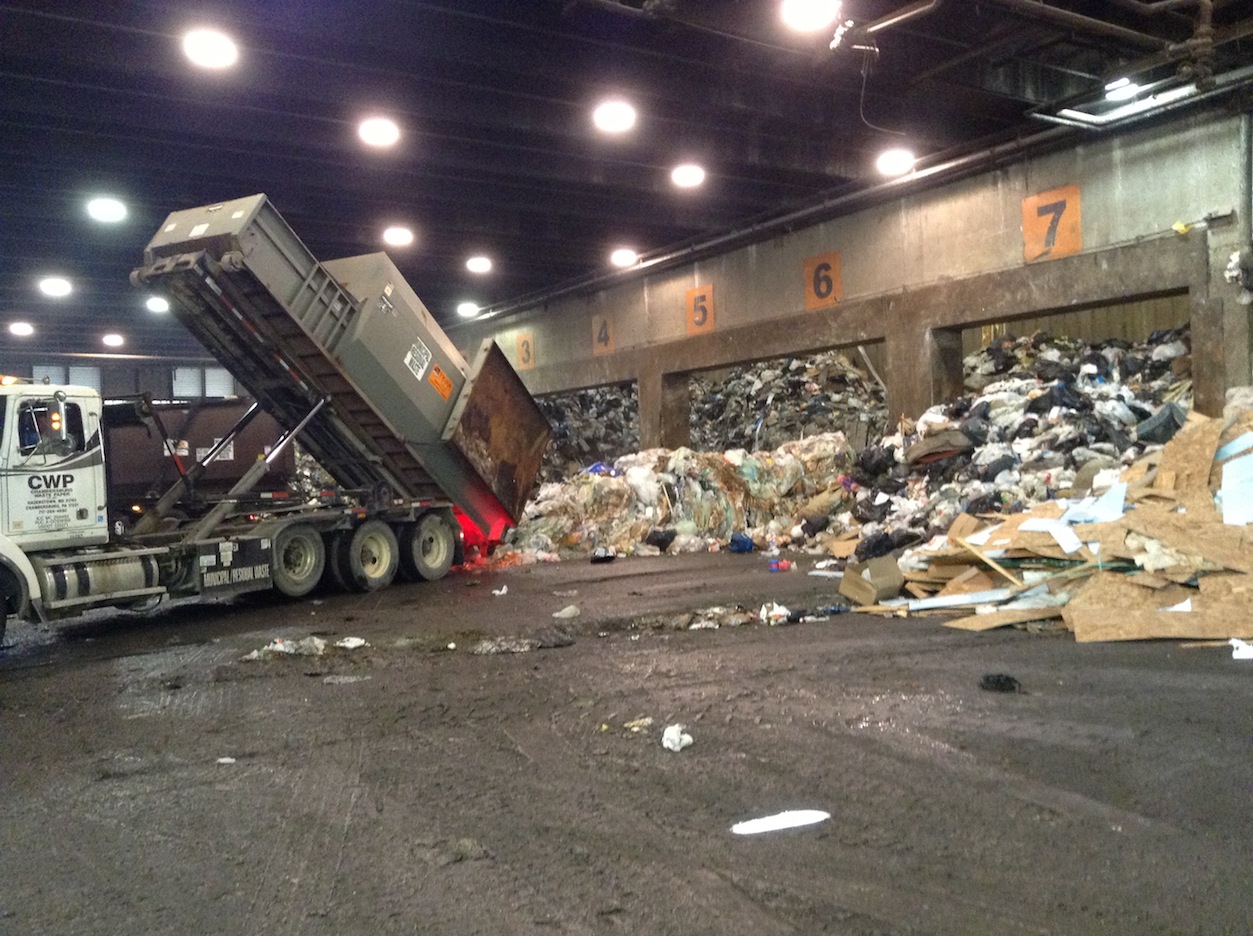
From there, garbage trucks enter the incinerator building and back up into the tipping area, high ceilinged and concrete floored. They disgorge their contents onto the floor while a worker known as the compliance officer operates a wheel loader to push the trash below an open arch.

From behind the arch, giant mechanized claws (TheBurg’s brilliant former staff reporter Paul Barker once called them “teddy pickers”) descend and grab great gobs of garbage. The crane-operated pickers drop the trash into hoppers, which feed chutes where it’s agitated and fed with combustion air for burning. The burners run 24/7, creating ash that moves through a conveyor system designed to corral both the heavy particles and the fly ash that likes to flitter off on its own.

The ash is then collected in trucks and trundled to a collection area just a couple hundred yards away on the site, waiting to be reloaded a fews days later for transport to LCSWMA’s Lancaster-area landfill.


Waste to Energy

Keep in mind that this is a waste-to-energy facility. Your garbage burns in a kind of box with a ceiling made of tubes. The fire heats water in the tubes to create steam, which is further super-heated and pumped through pipes to power turbines. Those turbines create the power that lights up the dark recesses of the Capitol complex. Any excess is sold to the regional power grid.

The Capitol complex arrangement was part of the multifaceted LCSWMA purchase deal that gave new life to a wheezing facility. LCSWMA needed revenue guarantees to justify the above-market purchase price of about $130 million. One part of the guarantee involved selling 110,000 megawatt hours of electricity a year to the state for 20 years, at about 4.3 cents per kilowatt hour.

The other part guarantees that my garbage—and yours, if you live anywhere in Dauphin County—will come to this facility until 2033. The city of Harrisburg is committed to delivering 36,800 tons a year, paying $190 for every ton tipped. Dauphin County’s commitment, at $80 a ton, is measured in revenue—$10.1 million worth of trash every year.

“We paid upfront based on how much trash they were going to generate over a fixed time,” said Warner. “They got all their money upfront in the acquisition price, and that’s why we have the obligation for a certain amount of business.”

City and county are delivering about 200,000 tons of trash a year, he said. If they deliver less, they would still pay up, but neither is falling short. In fact, keeping the facility functioning optimally requires trucking in another 100,000 tons from New Jersey.

“Power plants like to run at capacity,” he said.


The Vision

If the proverbial can kicked down the road can have a resting place, perhaps this was it, amid the old trash-strewn lots and the visible signs of deferred maintenance. Much of LCSWMA’s investment has focused on whittling down the maintenance backlog. Boilers are now much less likely to break down, reaching “record highs” in their availability to process waste, said Warner.

“The asset is doing a wonderful job at doing what it’s supposed to do,” he said.

Shockingly, this is a rather new development.

“When things would break down [before] and the trash would back up, they would just say, ‘Hey, customers, you have to go somewhere else today,’” he said. “That’s a sin of all sins in this business to tell your customers to take their business elsewhere.”

Looking ahead, LCSWMA is instilling a scheduled maintenance discipline, blended with a broader vision of regionalizing the waste-to-energy scene. Though it’s a facility on the upswing, it remains hampered by the burn system installed by a company named Barlow before it went bankrupt. The system is so nonstandard that, according to Warner, it’s the only one in use today. It produces heat value—the amount of energy recovered from each ton burned—of only 80 percent, considered below industry standard.

Changing that burn system isn’t financially feasible, but LCSWMA’s plant upgrades and regular maintenance are meant to squeeze out a few more BTUs per ton. They include a scheduled turbine cleanup next year and replacing the facility’s cooling tower, now an assembly of six huge drums, with a system capable of cooling more water and helping the whole plant run more efficiently.

Another 2017 upgrade will replace the clunky, two-step ash collection and transport system—“the armpit of this facility,” Warner called it—with a process putting ash directly into trucks for hauling to Lancaster.

Waste-to-energy systems such as this plant constitute one of three options for managing our waste stream, he said. We can landfill it, recycle it, or burn it. Waste-to-energy opponents, claiming that municipal waste is non-renewable and derived from finite resources, call for more recycling. In Lancaster County, LCSWMA is both the recycling and waste disposal authority, and while it “works hard to increase recycling rates, there’s always enough waste to process,” he said.

“We process that post-recycling waste, we make renewable energy, and we take that ash and use it in lieu of dirt at our landfill to cover waste that couldn’t be processed,” he said.

Without burning, LCSWMA’s Lancaster landfill, established in 1989, would have been full in about 11 years, instead of the 30 now projected.

“Because we burn the trash and reduce the waste, we got 20 more years out of our landfill, and we generated millions and millions of kilowatt hours of renewable electricity,” said Warner.


A Neighbor

Acquiring the Harrisburg facility brought a regionalized face to the Lancaster-based LCSWMA, whose facilities include a waste-to-energy facility in Bainbridge, Conoy Township. It also added operational redundancies that expand waste-handling options. When there’s a problem or scheduled outage at one LCSWMA plant, waste can be transferred to another. In the next two decades, as the Lancaster facility reaches capacity, Harrisburg will be able to handle the overflow, Warner said.

“We felt that by regionalizing and acquiring this asset, we could bring our expertise here to serve the city and the county, but we also saw that there was processing capacity—that, after it serves the local community, it can combust for energy more waste than they produce,” he said. “As we continue to grow in Lancaster, where our plant is relatively full, we have the ability in the future to ship waste from Lancaster and process it here because we can’t process it at our plant.”

Transporting trash wouldn’t negate the green advantages of waste-to-energy.

“Route 283 gives us that ability to get here by truck in 50 minutes,” Warner said. “It’s not transportation-sensitive because we can access it in a short distance and a short amount of time.”

As part of its mission and outreach, LCSWMA has committed to community service that supports the goal of greening the area. It’s the lead sponsor for the nearby Capital Area Greenbelt Association’s “Tour de Belt” fundraiser. The company waives tipping fees for Tri County Community Action’s annual “Great Harrisburg Litter CleanUp.” It’s also working with the Susquehanna Area Mountain Bike Association on trails.

It’s about asking, “How are we a neighbor to the city of Harrisburg?” Warner said.

“We are much more than a waste agency,” he said. “We think as a public authority whose main responsibility is to manage the trash. However, we need to connect in our community.”

To learn more about the Lancaster County Solid Waste Management Authority, visit www.lcswma.org.

Author: M. Diane McCormick

Continue Reading

In Trash Bill Suit, City Sees Source of Sanitation Woes

A trash hauler on the tipping floor of the Harrisburg incinerator. (File photo.)

A trash hauler tips waste at the Harrisburg incinerator. (File photo.)

When a south Harrisburg apartment complex filed a lawsuit against the city last week, it hoped to challenge what it called an “unconscionable” new city bill for trash pickup, one it says would more than triple what it pays a private hauler to provide the same services.

But the city says the suit, filed by Harrisburg Park Apartments, an affordable-housing complex in the 1400-block of S. 15th St., instead demonstrates one of the reasons officials are overhauling sanitation in the first place: private haulers are dodging city dumping rules.

An invoice attached to the complaint, from the complex’s private hauler Republic Services, strongly suggests the company is evading the $190-per-ton charge to dump trash at the city incinerator, Mayor Eric Papenfuse told reporters Tuesday.

“If you look closely at the lawsuit, they put forth a bunch of assertions and facts which would tend to support our contention,” Papenfuse said. “It’s direct proof of the fact…that they’re not paying the city rate. They’re paying the county rate.”

The Harrisburg incinerator charges vastly different rates for municipal waste based on where it originates—$190 per ton to dump waste from Harrisburg, as opposed to $80 per ton for waste originating anywhere else in Dauphin County.

The incinerator does not specifically monitor where the trash is from, depending instead on an honor system in which haulers themselves declare the point of origin.

“We rely upon the haulers to be honest and forthright,” said Katie Sandoe, a spokesperson for the Lancaster County Solid Waste Management Authority, which bought the incinerator in 2013. Sandoe said the authority also reviews historical totals for disparities, which it has not detected.

Robert Hasemeier, a consulting engineer who worked on a recent audit of city sanitation services, estimated there were 6,000 to 8,000 tons of city trash that were declared each year as having originated elsewhere.

Presented with these numbers, Sandoe said the authority has “not seen the type of disparity that’s being described,” though she did say she was referring to recent disparities, rather than the historic shortfalls the city claims it has been facing.

According to the suit, Republic Services charges the apartment complex $2,200 per month to pick up trash twice per week from its five, six-cubic-yard dumpsters.

The weight of the trash would vary considerably depending on what sort of materials are in it and how full the dumpsters are, and without a breakdown of tonnage in the invoice, it’s uncertain how many tons Republic is transporting to the incinerator from the complex each month.

But assuming the dumpsters are only half full, and using an industry estimate of 200 pounds per cubic yard of household trash, the monthly total would be around 12 tons of garbage.

The cost of dumping that amount of garbage alone, and excluding personnel and other costs, would be $2,304 if the company were properly declaring its origin.

A customer service representative at Republic Services referred questions to Andy Warntz, an area sales manager, who could not be reached Tuesday.

Harrisburg Park says its complaint was prompted by a February letter notifying local businesses that the city would be taking over all waste collection and recycling within its boundaries this year.

The letter noted that several properties previously relied on private haulers for such services, but that the city was compelled to reclaim those accounts to meet “trash volume requirements” agreed to in the course of the incinerator sale.

The city must deliver 35,000 tons to the incinerator each year or else pay to cover the shortfall, providing extra incentive to recover lost city accounts, especially if the audit has correctly estimated the amount of trash being improperly declared.

“We are confident the city’s waste disposal and collection services will meet or exceed the services provided by private haulers and potentially save your business money,” said the letter, which was signed by the mayor and public works director.

According to the lawsuit, however, a new bill based on existing city rates would more than triple Harrisburg Park’s current trash costs, bringing them from Republic’s $2,200 per month to nearly $7,500.

The strongly-worded complaint blasts the city’s takeover, calling its rates “facially unconscionable,” “unreasonable and absurd” and “usury.”

It claims the city takeover, if not prevented by the court, would either force the owner to charge higher rent from tenants or go bankrupt and close the property, thereby reducing the stock of affordable housing available to low-income families.

Jordan Cunningham, a partner at the law firm Cunningham, Chernicoff and Warshawsky, which is representing Harrisburg Park in the complaint, could not be reached Tuesday. Ralph Salvia, another attorney at the firm, declined to comment, saying only that the complaint had to be re-filed to remedy a procedural error.

Papenfuse, for his part, said he has arranged to meet with Harrisburg Park’s attorneys to explain the city’s position. In the meantime, he offered his own opinion of the lawsuit, which he says is not the first one that has been threatened over the sanitation takeover.

“There is no merit to their case at all,” he said.

Continue Reading

The Risk of Winning: Harrisburg, place your bets.

Screenshot 2015-04-29 00.32.24My mother once told me about her first gambling experience.

She was 21, newly married, and she and my father spent an afternoon at a racetrack in New York.

An elderly, grizzled denizen of the track sat next to them and noticed my mother’s increasing frustration as she lost race after race.

“It’s good that you lost,” he told her after the day’s program was over. “This way, you won’t come back.”

The old guy was onto something. He understood the allure of gambling, even if he couldn’t resist it himself. Once in, it’s hard to get out, as the gambler keeps trying to relive the thrill of the big win, hoping it will happen again.

When I look back at the history of Harrisburg, I see bets all over the place. The Reed administration was a 28-year, high-stakes game, one that followed the pattern my mother was warned about.

Former Mayor Steve Reed had some significant early victories, betting big and coming up with a winning hand on things like attracting a minor league baseball team to Harrisburg and deciding where to locate a new downtown hotel.

In those early days, he seemed to win even when he lost. Reed never got his hydroelectric dam across the Susquehanna built, but invested the project’s $391 million at a higher interest rate than was paid out to municipal bond-holders, earning enough money to build a baseball stadium and make other improvements to City Island.

Over time, though, the odds turned against him, as they do every gambler. By the 1990s, his overspending and refusal to raise taxes began to catch up, requiring constant scrambles and financial gimmickry to fill budget holes. His $6 million revolving loan fund never bore much fruit, with many businesses refusing to pay back their loans. And his big economic development initiative, building, in his words, “five nationally scaled museums,” thus turning Harrisburg into a museum mecca, largely flopped at a very high cost.

Reed’s biggest mistake, however, was a classic gambler’s error—chasing your losses. Faced with a broken-down incinerator, Reed kept doubling down on a bad hand, taking greater and greater risks to make back the money he already had sunk into it. He couldn’t bring himself to abandon the project and eat the losses when they reached $50 million, $75 million, $100 million. Finally, hundreds of millions in the hole, he was removed from the table by the city’s voters.

But why am I revisiting the Reed years?

In March, now-Mayor Eric Papenfuse made a wager of his own. He placed a bet that some tweaks to Harrisburg’s hated parking system would deliver more people to downtown businesses, some of which say they’ve suffered after the cost of on-street parking doubled last year and paid parking was extended to Saturdays.

In a deal with Park Harrisburg, “happy hour” rates were cut by $1 an hour and, through the Pango mobile app, parkers can get four free hours on Saturdays. To pay for this, Harrisburg staked up to $285,000 in unspent hotel tax funds set aside for marketing, money that will be used to cover any losses that Park Harrisburg might incur because of the lower rates.

Papenfuse believes that the cost to the city will be “much, much less” than the amount committed, perhaps nothing. In a best-case scenario, lower rates will lead to more customers and greater revenues for Park Harrisburg, which might lower parking fees permanently.

In general, I don’t believe in taking undue risks with taxpayer money. However, I think that Papenfuse’s bet is a good one, as it has limited downside and potentially significant upside. In a way, it reminds me of the dam-money arbitrage from Reed’s early years. Both men were faced with what appeared to be intractable problems—the decrepit, embarrassing state of City Island for Reed and onerous parking fees for Papenfuse. Both then employed highly creative solutions that also made financial sense.

Now, Eric Papenfuse is no Steve Reed. While quite confident, he lacks Reed’s dismissive arrogance and take-no-prisoners approach to governing. While a risk-taker, his risks, so far, have been calculated and limited. He shows far more respect for the public dollar and seems less likely to become addicted to the allure of creative financing. I also don’t think Papenfuse will serve in office for nearly three decades, which compounded the severity of the errors that Reed made.

Nonetheless, it’s worth remembering that there’s danger in a winning bet. The peril is over-confidence, in believing in your own infallibility, of thinking that great victory requires great gamble, of wishing to relive the rush of the big score.

So, we’ll see what happens with Papenfuse’s roll of the dice. For the sake of Harrisburg, I hope it pays off and, by this time next year, we’ll have lower parking rates, more customers downtown and $285,000 still sitting in the bank. Unlike my mother’s acquaintance from the racetrack, I can’t silently root for failure, even if, as the old man knew, when it comes to gambling, we often win most when we walk away dejected the first time out.

Lawrance Binda is editor-in-chief of TheBurg.

Continue Reading